

Phase 1: 공감 (Story-Driven Opening)
안녕하세요! 매일한글 에디터입니다.
Have you ever watched monumental Korean films like 1987: When the Day Comes or A Taxi Driver, only to find your heart swelling with raw emotion as ordinary taxi drivers, college students, and shopkeepers locked arms in the streets? Many advanced learners tell me: “I want to discuss modern Korean history beyond the miracle on the Han River, but whenever conversations turn to political movements and democratic resilience, my Korean suddenly reverts to stiff, robotic textbook lines!”
It is completely understandable. Discussing how South Korea broke through authoritarian regimes and achieved dynamic democratization through peaceful solidarity requires high-level discursive finesse. You are navigating intense historical weight, collective grief (한, Han), and immense social pride (흥, Heung). Based on real-world discussion workshops conducted with C1-level scholars and expats in Seoul, this guide will equip you with sophisticated, culturally nuanced language to articulate how civic resilience shaped the vibrant Korea you love today.
Phase 2: 핵심 표현 3선 심층 분석
1. 연대의 힘을 보여주다 (Yeondae-ui himeul boyeojuda)
- Pronunciation: [Yeon-dae-ui hi-meul bo-yeo-ju-da] (Think of ‘yeon’ like the year ‘yearn’ without the r, ‘dae’ like ‘day’, and ‘him’ like the English pronoun ‘him’ pronounced with punchy breath)
- Meaning: Literally “To show the power of solidarity.” Figuratively, it refers to citizens putting aside individual differences to unite for the greater good of justice and human rights.
- K-Culture Moment: Frequently heard in documentaries and historical dramas when citizens pass out warm rice balls (주먹밥, Jumeokbap) and blood donations during the 1980 Gwangju Uprising.
- Editor’s Insight: This phrase carries profound moral gravitas. It isn’t just about teamwork (팀워크); it invokes the collective conscience of ordinary people standing against institutional injustice.
- Situation Spectrum: Casual 🚫 | Semi-formal ⚠️ | Formal ✅
- 🤔 Think About It: Does your native language distinguish between corporate “collaboration” and grassroots “civic solidarity”? How does this choice of words elevate the moral standing of ordinary citizens?
2. 역사의 굴곡을 넘어서다 (Yeoksa-ui gulgogeul neomeoseoda)
- Pronunciation: [Yeok-sa-ui gul-go-geul neo-meo-seo-da] (Pronounce ‘gul’ like ‘ghoul’ and ‘gok’ like a clipped ‘gawk’)
- Meaning: Literally “To overcome the bends and curves of history.” Nuance: Navigating and triumphing over tumultuous periods of dictatorship, poverty, and rapid social change.
- K-Culture Moment: Used by cultural commentators reviewing films like Ode to My Father (국제시장) or 12.12: The Day (서울의 봄) when discussing the dramatic trials of the 20th century.
- Editor’s Insight: The word ‘굴곡’ (gulgok) visually paints an agonizing, winding road. Using this verb highlights endurance and resilience rather than passive suffering.
- Situation Spectrum: Casual 🚫 | Semi-formal ✅ | Formal ✅
- 🤔 Think About It: Why does Korean culture depict historical progression not as a straight upward line, but as a winding, uphill journey overcome by collective will?
3. 성숙한 시민의식을 발휘하다 (Seongsukhan simin-uisigeul balhwihada)
- Pronunciation: [Seong-su-khan si-min-ui-si-geul bal-hwi-ha-da] (Say ‘seong-suk’ crisp and dry, followed by ‘bal-hwi’ like ‘bal-whee’)
- Meaning: Literally “To display mature civic consciousness.” Nuance: Demonstrating peaceful, lawful, and organized public action, such as cleaning up streets after massive million-person candlelight rallies.
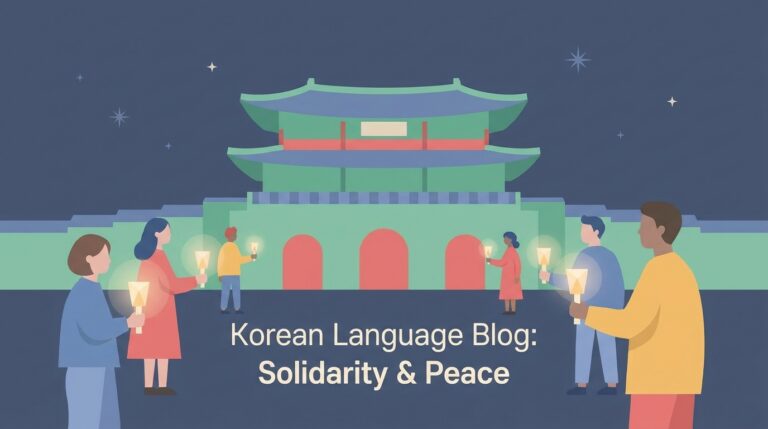
- K-Culture Moment: Anchors during the peaceful Gwanghwamun candlelight vigils reporting on citizens picking up trash and guiding families safely.
- Editor’s Insight: This phrase is the ultimate badge of pride for modern Koreans. It contrasts chaotic violence with disciplined, dignified democratic maturity.
- Situation Spectrum: Casual ⚠️ | Semi-formal ✅ | Formal ✅
- 🤔 Think About It: How does your home culture define “civic virtue”? Is it individual voting, or does it include collective public presence?
Phase 3: 교과서 한국어 vs 진짜 한국어
Situation A: Describing street protests
- 📖 교과서 한국어: 시민들이 독재 정권에 저항했습니다. (Simindeuri dokjae jeonggwone jeohanghaesseumnida.) – “Citizens resisted the authoritarian regime.”
- 🗣️ 진짜 한국어: 평범한 시민들이 촛불을 들고 한마음으로 거리로 쏟아져 나왔어요. (Pyeongbeomhan simindeuri chotbureul deulgo hanmaeumeuro georiro ssodajyeo nawasseoyo.) – “Ordinary citizens took to the streets as one, holding candles in hand.”
- 💡 왜 다를까?: Textbook phrasing sounds like an excerpt from a dry political science dissertation. Real Koreans emphasize the sensory imagery—holding candles, moving like a flood tide—and the emotional unity (한마음).
Situation B: Evaluating modern democratic progress
- 📖 교과서 한국어: 한국은 민주화를 달성했습니다. (Hangugeun minjuhwareul dalseonghaesseumnida.) – “Korea achieved democratization.”
- 🗣️ 진짜 한국어: 수많은 희생 끝에 마침내 시민의 힘으로 민주주의를 쟁취해 낸 셈이죠. (Sumanheun huisaeng kkeute machimnae siminui himeuro minjujuuireul jaengchwihae naen semijyo.) – “After countless sacrifices, we essentially won democracy through the power of citizens.”
- 💡 왜 다를까?: The verb ‘쟁취하다’ (jaengchwihada – to seize/win after hard struggle) honors the lives sacrificed along the way, while the polite marker ‘-셈이죠’ frames it as an insightful, reflective conclusion.
Phase 4: K-Culture 딥다이브 & 비언어적 매너
4-1. 눈치(Nunchi) & 제스처: Respectful Engagement with Modern History
When discussing modern historical topics such as the May 18 Gwangju Democratization Movement (5·18 광주민주화운동) or the June Democracy Movement (6월 민주항쟁):
* Vocal Tone & Posture: Lower your vocal pitch slightly and maintain a calm, deliberate cadence. Avoid lighthearted chuckling or dismissive hand gestures.
* Nodding & Pausing: Practice thoughtful listening. In Korean intellectual circles, taking a 2-second pause before responding signals deep respect for the gravity of the subject.
* Avoiding Partisan Trapdoors: Refrain from labeling specific modern political parties immediately. Instead, ground your perspective in the universal resilience of the “citizens” (시민, Simin) and “the public” (국민, Gukmin).
4-2. 문화 코드 분석: The Cinema of Resistance
South Korea’s modern cinema is uniquely obsessed with historical reflection. From A Taxi Driver (2017) to 1987: When the Day Comes (2017) and Seoul Spring (2023), these films are not merely period dramas; they serve as communal rituals of remembrance. Notice how these narratives rarely center on a lone superhero. Instead, ordinary people—a doctor falsifying an autopsy to reveal police brutality, an editor defying censorship guidelines, college students printing leaflets—form a web of resilience. This reflects the foundational Korean sociological idea of 대동세상 (Daedong-sesang): an egalitarian world built on shared solidarity.
Phase 5: 실전 롤플레이 시나리오
Setting: A quiet indie book cafe near Gwanghwamun Square, Seoul. Rain gently taps against the glass.
Characters:
* 민서 (Min-seo): A documentary scriptwriter and thoughtful cultural critic.
* You: A C1 Korean learner engaging in an evening discussion about Korean modern history.
Turn 1
* 민서: 광화문 광장을 걷다 보면, 불과 수십 년 전 이곳에서 민주주의를 외치던 사람들의 목소리가 아직 맴도는 것 같아요. (Gwanghwamun gwangjangeul geotda bomyeon, bulgwa susip nyeon jeon igoseseo minjujuuireul oechideon saramdeurui moksoriga ajik maemdoneun geot gatayo.)
* 🎭 행동 지문: 창밖의 광장을 아련하게 바라보며 따뜻한 찻잔을 두 손으로 감싼다.
* “Whenever I walk through Gwanghwamun Square, it feels like the voices of those who cried out for democracy just decades ago are still echoing here.”
Turn 2
* You: 맞아요. 한국의 현대사는 압축 성장의 눈부신 이면에 수많은 시민들의 뼈아픈 희생이 공존하잖아요. (Majayo. Hangugui hyeondaesaneun apkchuk seongjangui nunbusin imyeone sumanheun simindeurui ppyea-peun huisaengi gongjonhajanayo.)
* 🎭 행동 지문: 차분하게 고개를 끄덕이며 진지한 눈빛으로 공감을 표한다.
* “That’s true. Behind the brilliant compressed growth of modern Korean history lies the coexistence of painful sacrifices by so many citizens.”
Turn 3
* 민서: 정확한 지적이에요. 흔히들 경제 기적만 주목하지만, 사실 권위주의 시대를 버텨낸 건 평범한 사람들의 연대였죠. (Jeonghwakhan jijeogieyo. Heunhideul gyeongje gijeongman jumokhajiman, sasil gwonwijuui sidaereul beotyeonaen geon pyeongbeomhan saramdeurui yeondaeyeotjyo.)
* 🎭 행동 지문: 공감하며 책상 위의 역사 서적을 조심스레 펼친다.
* “Spot-on observation. People often focus only on the economic miracle, but what truly withstood the authoritarian era was ordinary people’s solidarity.”
Turn 4
* You: 평화적인 촛불집회만 보더라도, 성숙한 시민의식을 세계적으로 증명해 보였잖아요. (Pyeonghwajeogin chotbuljiphoeman bodeorado, seongsukhan simin-uisigeul segyejeogeuro jeungmyeonghae boyeotjanayo.)
* 🎭 행동 지문: 손을 모으며 확신에 찬 어조로 이야기한다.
* “Even looking at the peaceful candlelight vigils, Korea proved its mature civic consciousness to the entire world.”
Turn 5
* 민서: 바로 그거예요. 총칼 앞에서도 굴복하지 않고 끝내 민주주의를 일궈낸 회복탄력성이 우리 사회의 진짜 저력인 셈이죠. (Baro geugeoyeyo. Chongkal apeseodo gulbokhaji anko kkeutnae minjujuuireul ilgwonaen hoeboktallyeokseongi uri sahoeui jinjja jeoryeogin semijyo.)
* 🎭 행동 지문: 잔잔한 미소를 지으며 깊은 자부심을 드러낸다.
* “That is it exactly. That resilience—refusing to bow before guns and bayonets and ultimately cultivating democracy—is the true latent strength of our society.”
Turn 6
* You: 역사의 굴곡을 넘어서면서 쌓인 그 저력이 지금의 역동적인 한국 문화를 만든 밑거름이 아닐까요? (Yeoksaui gulgogeul neomeoseomyeonseo ssain geu jeoryeogi jigeumui yeokdongjeogin hanguk munhwareul mandeun mitgeoreumi anilkkayo?)
* 🎭 행동 지문: 호기심과 통찰력을 담아 질문을 던진다.
* “Could that inner resilience, accumulated while surmounting the twists of history, be the fertile soil that shaped today’s dynamic Korean culture?”
Turn 7
* 민서: 와, 그런 시각으로 한국 사회를 바라봐 주시니 대화가 정말 깊어지네요. 감동이에요. (Wa, geureon sigageuro hanguk sahoereul barabwa jusini daehwaga jeongmal gipeojineyo. Gamdongieyo.)
* 🎭 행동 지문: 두 손으로 가볍게 박수를 치며 감탄한다.
* “Wow, viewing Korean society from that angle takes our conversation so deep. I am genuinely moved.”
Turn 8
* You: 저야말로 한국인들의 평화적 연대와 회복력을 보며 늘 깊은 영감을 받습니다. (Jeoyamallo hangukindeurui pyeonghwajeok yeondaewa hoebokryeogeul bomyeo neul gipeun yeonggameul batseumnida.)
* 🎭 행동 지문: 따뜻한 눈맞춤과 함께 찻잔을 들어 예를 표한다.
* “It is I who am always deeply inspired by the Korean people’s peaceful solidarity and resilience.”
🔀 인터랙티브 분기점 (Choose Your Response)
After Min-seo’s remark in Turn 5, how do you steer the conversation?
- Option A: “그래도 경제 발전이 먼저였으니 독재 정권도 어쩔 수 없는 과정 아니었나요?” (Graedo gyeongje baljeoni meonjeoyeosseuni dokjae jeonggwondo eojjeol su eomneun gwajeong anieonnayo? – Still, wasn’t economic growth first, making the dictatorship an unavoidable step?)
- 👉 Feedback: [Risk 🚨] Highly polarizing. While debated among economists, phrasing it dismissively can invalidate the immense human sacrifice and grief of surviving families.
- Option B: “역사의 굴곡을 넘어서면서 쌓인 그 저력이 지금의 역동적인 한국 문화를 만든 밑거름이 아닐까요?” (Yeoksaui gulgogeul neomeoseomyeonseo ssain geu jeoryeogi jigeumui yeokdongjeogin hanguk munhwareul mandeun mitgeoreumi anilkkayo?)
- 👉 Feedback: [Best 🌟] Exceptional C1 delivery! Connects modern history directly to contemporary cultural energy with high-level vocabulary (‘굴곡’, ‘저력’, ‘밑거름’).
- Option C: “한국 사람들 시위 너무 자주 해서 교통 체증만 심해지는 것 같아요.” (Hanguk saramdeul siwi neomu jaju haeseo gyotong chejeungman simhaejineun geot gatayo. – Koreans protest so often, it feels like it just makes traffic jams worse.)
- 👉 Feedback: [Bad ❌] Shows a superficial tourist perspective, completely trivializing a sacred constitutional right born from historic blood and sweat.
Phase 6: 10초 감정 섀도잉 드릴
Read aloud along the pause markers (/) and internalize the emotional milestone:
[🥺 뭉클하고 경건하게 - Deeply touched and reverent]- 수많은 이들의 희생이 / 결코 헛되지 않았음을 / 역사가 증명하고 있어요. / (Sumanheun ideurui huisaengi / gyeolko heotdoeji anatseumeul / yeoksaga jeungmyeonghago isseoyo.)
- “History proves / that the sacrifices of countless souls / were never in vain.”
[🔥 비장하고 단호하게 - Resolute and solemn]- 총칼 앞에서도 굴복하지 않고 / 평화적 연대로 / 민주주의를 쟁취했습니다. / (Chongkal apeseodo gulbokhaji anko / pyeonghwajeok yeondaero / minjujuuireul jaengchwihaesseumnida.)
- “Without surrendering before weapons / through peaceful solidarity / we achieved democracy.”
[✨ 자부심과 벅찬 감정으로 - Bursting with pride and warmth]- 어두운 시대를 밝힌 건 / 광장을 가득 메운 / 평범한 시민들의 촛불이었습니다. / (Eoduun sidaereul balkhin geon / gwangjangeul gadeuk meun / pyeongbeomhan simindeurui chotburieotseumnida.)
- “What illuminated those dark eras / was the candlelight of ordinary citizens / filling the plaza.”
Phase 7: K-Culture 미니 사전 (핵심 키워드 4선)
- 촛불집회 (Chotbul jiphoe)
- Translation: Candlelight Vigil / Rally
- Usage: Beyond simple demonstration, it represents Korea’s signature festival-like, non-violent civic culture where children and grandparents join together peacefully with candles.
- 시민의식 (Simin-uisik)
- Translation: Civic consciousness / Citizenship
- Usage: Praised in social debates when people observe public order, participate in community voting, or self-organize relief efforts during national disasters.
- 격동기 (Gyeokdonggi)
- Translation: Era of turbulence / Tumultuous period
- Usage: Used in literary and historical contexts to describe Korea between the 1960s and 1990s characterized by lightning-fast industrialization alongside democratization.
- 회복탄력성 (Hoebok-tallyeokseong)
- Translation: Resilience
- Usage: Originally a psychological term, now extensively used in socio-political commentary to describe Korea’s ability to bounce back stronger from national crises (IMF crisis, political upheavals).
Phase 8: 여행자를 위한 생존 키트
서바이벌 표현 TOP 3
- 이곳의 역사적 배경을 한국어로 설명해 주실 수 있나요? (Igosui yeoksajeok baegyeongeul hangugeoro seolmyeonghae jusil su innayo?)
- Pro Tip: Use this at historical museums. Docents will be stunned and offer deep, moving explanations!
- 민주화 운동 기념관이 어디에 위치해 있나요? (Minjuhwa undong ginyeomgwani eodie wichihae innayo?)
- Pro Tip: Essential when navigating historic memorial spots around Seodaemun or Namyeong-dong.
- 사진 촬영이 가능한 엄숙한 구역인가요? (Sajin chwallyeongi ganeunghan eomsukhan guyeogingayo?)
- Pro Tip: Always ask this at memorial halls; showing consideration for the space’s sanctity reflects high cultural etiquette.
Editor’s Travel Note
When tracing Seoul’s democratic heritage, start from the National Museum of Korean Contemporary History (대한민국역사박물관) in Gwanghwamun, visit the Seodaemun Prison History Hall, and walk down to the Democracy Movement Memorial Park. Don’t rely on international navigation apps here—install and navigate using the 네이버 지도 앱 다운로드 for real-time walking pathways, curated cultural trails, and seamless subway transfers.
Phase 9: “한 발 더 깊이” (생각 질문)
In Korean culture, the physical space known as the 광장 (Gwangjang, The Plaza) is far more than an architectural urban square. It is the sacred living room of the nation, where private citizens leave their insular spheres to form a single, throbbing public voice. From the 1919 March 1st Movement to the red waves of the 2002 World Cup and the million-candle rallies of recent decades, Koreans resolve existential national crossroads out in the open air. This phenomenon demonstrates that dynamic civic solidarity is the true immune system of Korean democracy.
💬 Your Turn: How does public gathering function in your own culture? Is public protest viewed with suspicion, or celebrated as a healthy display of democratic resilience? Let us know in the comments below!
Phase 10: FAQ & 오해 방지 (FAQ Schema)
Q: Isn’t discussing Korean politics taboo for foreign residents?
A: Partisan politicking (e.g., favoring a specific contemporary candidate) can indeed be touchy. However, reflecting respectfully on the historical triumph of democracy and honoring civic solidarity is deeply respected and welcomed by Koreans across the spectrum.
Q: Why do Koreans refer to citizens as ‘국민’ (Gukmin) sometimes and ‘시민’ (Simin) other times?
A: ‘국민’ (Gukmin) emphasizes membership in the national family/republic as a collective identity, while ‘시민’ (Simin) highlights autonomous, rights-bearing civic individuals participating in democratic governance.
Q: Does the phrase ‘압축 성장’ (Compressed Modernity) carry a positive or negative connotation?
A: It carries both! It acknowledges the awe-inspiring economic leap from postwar ashes, while simultaneously critiquing the social stresses, authoritarian scars, and intense competition born from rushing through centuries of development in decades.
🚨 흔한 실수 (Common Mistakes) 경고판
- Calling all modern rallies “폭동” (Pokdong – Riots): ❌ Highly offensive! Authoritarian states historically labeled democratic protests as riots. Always use 민주화 운동 (Democratization movement) or 평화 시위 (Peaceful protest). ✅
- Confusing ‘연대’ (Solidarity) with ‘연대’ (Yonsei University): In casual speech, Yonsei University is nicknamed 연대 (Yeondae). Context matters: ‘시민 연대’ means civic solidarity, not college campus life!
- Overusing dry honorific textbook particles: Avoid finishing complex thoughts with stiff grammatical endings like “-하였던 것입니다.” Instead, use organic C1 conversational hooks such as “-던 셈이죠” or “-을 발휘한 셈이에요.”
Phase 11: 액션 미션 & 참여 유도
- 🥉 Bronze Mission (Solo Practice): Stand in front of the mirror and recite Shadowing Drill #2 with a resolute, solemn tone until it rolls off your tongue in under 10 seconds.
- 🥈 Silver Mission (Social Sharing): Pick your favorite Korean film set in modern history (1987, A Taxi Driver, or Seoul Spring), write a 2-sentence review in Korean using the expression ‘연대의 힘을 보여주다’, and share it in our comments or on Instagram tagging
@DailyHangul. - 🥇 Gold Mission (Real-world Execution): Visit a memorial hall or discuss with a Korean language exchange partner using the sentence starter: “한국 현대사를 보면 시민들의 회복탄력성이 정말 대단한 것 같아요.”
🎮 K-Culture Mission: Watch the ending credits of the movie 1987: When the Day Comes. Listen closely for the protest chant “호헌철폐 독재타도” and spot how documentaries describe the crowd as ‘시민들의 물결’ (a wave of citizens)!
Phase 12: 인터랙티브 퀴즈 챌린지
1. 상황 판단 (Situational Judgment)
Which response is most appropriate when your Korean professor asks: “한국이 독재를 딛고 민주화를 이룩할 수 있었던 원동력은 무엇일까요?”
* ① “그냥 시간이 지나면서 경제가 좋아져서 자연히 된 것 같아요.”
* ② “국민들이 연대의 힘을 발휘하여 평화적으로 민주주의를 쟁취해 낸 덕분입니다.”
* ③ “시위를 많이 해서 교통이 마비되었기 때문입니다.”
2. 빈칸 채우기 (Fill in the Blank)
- “어려운 위기 속에서도 한국 사회는 특유의 ( )을/를 발휘하여 빠르게 민주주의를 회복했습니다.”
- (힌트: Bounce-back capacity / resilience)
3. True / False 문화 퀴즈
- True or False: In modern Korean society, candlelight vigils (촛불집회) are legally and culturally considered violent riots.
👉 Click here to reveal the answers and explanations!
- 정답: ②
- 해설: Option ② elegantly synthesizes advanced C1 vocabulary (‘연대의 힘’, ‘쟁취하다’) while providing a thoughtful socio-historical perspective.
- 정답: 회복탄력성 (Hoebok-tallyeokseong)
- 해설: ‘회복탄력성’ signifies the dynamic resilience of the community to recover from structural crises.
- 정답: False
- 해설: Candlelight vigils are regarded globally and domestically as the hallmark of peaceful, orderly, and mature civic expression in Korea.
- 해설: Candlelight vigils are regarded globally and domestically as the hallmark of peaceful, orderly, and mature civic expression in Korea.







