

Surviving Solo in Seoul: How to Talk About Bills and Living Costs in Korean
Phase 1: 공감 (Story-Driven Opening)
안녕하세요! I’m your Daily Hangul editor and your personal Korean cultural navigator.
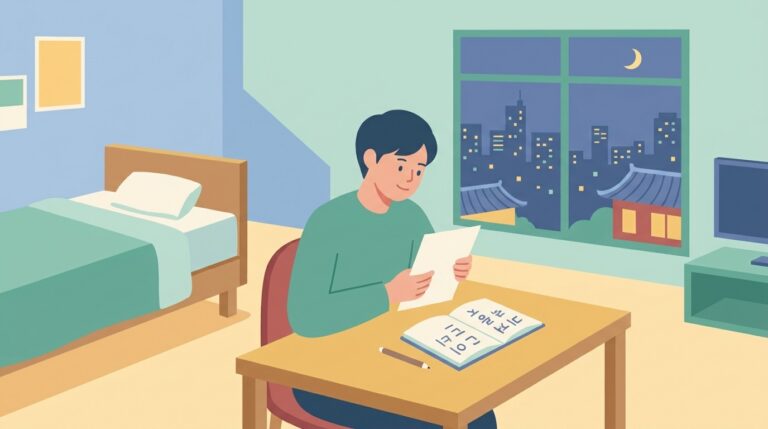
Picture this classic K-drama scene from Because This Is My First Life (이번 생은 처음이라): you finally sign the lease on your very own cozy Seoul studio apartment (원룸, wonrum). The sheer thrill of absolute freedom rushes through your veins! You can slurp midnight convenience store ramen in your oversized pajamas, blast K-pop at 2:00 AM, and decorate your tiny sanctuary with aesthetic mood lamps from Daiso. No nagging parents, no annoying dorm curfews. Just pure, unadulterated independence.
…And then, the 25th of the month rolls around.
Your mailbox is suddenly stuffed with terrifyingly colorful envelopes: monthly rent (월세, wolse), building maintenance fee (관리비, gwallibi), gas and electricity bills (공과금, gonggwageum), topped off with the horrifying realization of how much you spent on late-night Fried Chicken delivery (식비, sikbi). You pull out your phone, stare blankly at your banking app, and realize: adulting in Korea hits your bank balance fast.
Many of our intermediate (B1) learners tell us: “I know how to buy things at the store, but when my Korean coworkers or classmates vent about their rent and living costs, I freeze up. I don’t know the authentic words to express the real struggle of surviving alone!”
Don’t worry. Today, based on feedback from hundreds of expats and solo dwellers (jachwisaeng) in Korea, we are unlocking the exact phrases, cultural nuances, and witty slang you need to talk about the freedom, the loneliness, and the heavy financial weight of solo living like a true Seoulite.
Phase 2: 핵심 표현 3선 심층 분석 (Top 3 Key Expressions)
1. 혼자 감당하기에 부담이 만만치 않아요 (Honja gamdanghagie budami manmanchi anayo)
- Pronunciation: [Hon-ja gam-dang-ha-gi-e bu-dam-i man-man-chi a-na-yo] (Sound tip: “Gamdang” rhymes with “calm dong”, and “manmanchi” sounds like a rhythmic “mon-mon-chee”.)
- Meaning: Literal: “To handle it alone, the burden is not trivial.” | Real Nuance: “Shouldering this completely on my own is really no joke / it’s financially overwhelming.”
- K-Culture Moment: Seen in almost every coming-of-age slice-of-life drama when a young job seeker sits over a cup of instant noodles with their best friend, looking at their utility invoice.
- Editor’s Insight: 만만하다 (manmanhada) means something is “easy to deal with” or a “pushover.” By saying 만만치 않아요 (manmanchi anayo), you soften your complaint while conveying that the financial pressure is serious.
- Situation Spectrum:
- Casual: ✅ (혼자 감당하기에 부담이 만만치 않아)
- Semi-formal (Polite): ✅ (혼자 감당하기에 부담이 만만치 않아요)
- Formal: ✅ (혼자 감당하기에 부담이 만만치 않습니다)
- 🤔 Think About It: In English, we might bluntly say “I’m broke” or “Rent is killing me.” Why do Koreans often use double negatives like “not easy/not trivial” (만만치 않다) to express hardship?
2. 숨만 쉬어도 돈이 나가요 (Summan swieodo doni nagayo)
- Pronunciation: [Soom-man swi-eo-do do-ni na-ga-yo] (Sound tip: “Sum” sounds like “soom” in “zoom”. Imagine letting out a tired breath!)
- Meaning: Literal: “Money leaves even if I only breathe.” | Real Nuance: “Just existing costs money; the fixed expenses never stop.”
- K-Culture Moment: A staple hyperbole heard on YouTube vloggers’ monthly budget reviews (월급 로그) when calculating recurring subscription services, building fees, and basic transportation.
- Editor’s Insight: This is the ultimate relatable complaint among 20s and 30s Koreans living alone. It highlights the invisible fixed costs of modern life where doing absolutely nothing still incurs rent and utility charges.
- Situation Spectrum:
- Casual: ✅ (숨만 쉬어도 돈 나가)
- Semi-formal: ✅ (숨만 쉬어도 돈이 나가요)
- Formal: ⚠️ (Slightly too colloquial for formal corporate reports; use 지출이 계속 발생합니다 instead)
- 🤔 Think About It: Does your native culture have a bodily metaphor for the relentless nature of urban living expenses?
3. 이번 달 통장이 텅장 됐어요 (Ibeon dal tongjangi teongjang dwaesseoyo)
- Pronunciation: [I-beon dal tong-jang-i teong-jang dwae-sseo-yo] (Sound tip: Emphasize the wordplay between round ‘tong’ and hollow ‘teong’!)
- Meaning: Literal: “This month, my bank account (tongjang) became an empty account (teongjang).” | Real Nuance: “My paycheck vanished into thin air the second payday passed.”
- K-Culture Moment: Frequently spotted in webtoons (웹툰) or variety show subtitles when a character checks their mobile banking app after paying rent.
- Editor’s Insight: A brilliant portmanteau of 통장 (tongjang, bankbook) and 텅텅 (teongteong, completely empty/hollow). It turns a painful financial reality into self-deprecating humor.
- Situation Spectrum:
- Casual: ✅ (내 통장 완전 텅장 됨)
- Semi-formal: ✅ (이번 달은 통장이 텅장이 됐어요)
- Formal: 🚫 (Avoid in official banking consultations or business meetings)
- 🤔 Think About It: Why does Korean youth culture invent humorous words for economic hardship? How does humor serve as emotional cushioning?
Phase 3: 교과서 한국어 vs 진짜 한국어 (Textbook vs. Real Korean)
Situation 1: Talking about heavy monthly living expenses
- 📖 교과서 한국어: 생활비 지출이 너무 많습니다. (Saenghwalbi jichuri neomu manseumnida. / Living expenses expenditures are very large.)
- 🗣️ 진짜 한국어: 생활비 때문에 허리가 휘겠어요. (Saenghwalbi ttaemune heoriga hwigesseoyo. / My back is bending because of the living expenses.)
- 💡 왜 다를까? While textbooks teach dry economic nouns (지출, expenditure), native speakers use physical idiomatic metaphors. “허리가 휘다” (the waist/spine bends) vividly depicts being physically crushed under financial burdens.
Situation 2: Talking about soaring grocery prices and food bills
- 📖 교과서 한국어: 식비를 절약하기가 어렵습니다. (Sikbireul jeoryakhagiga eoryeopseumnida. / It is difficult to economize food expenses.)
- 🗣️ 진짜 한국어: 요즘 물가가 미쳐서 배달음식은 꿈도 못 꿔요. (Yojeum mulgaga michyeoseo baedareumsigeun kkumdo mot kwoyo. / Prices are crazy lately, so I can’t even dream of ordering delivery food.)
- 💡 왜 다를까? Koreans love delivery culture (배달 문화), but high delivery fees (배달팁) plus inflation have made daily delivery a luxury. Saying “꿈도 못 꿔요” (I can’t even dream of it) captures today’s B1 conversational realism.
Phase 4: K-Culture 딥다이브 & 비언어적 매너 (Deep Dive & Non-Verbal Manners)
4-1. 눈치 (Nunchi) & Gestures
When discussing financial strain in Korea, body language and humility (겸손) are vital:
* The Empathetic Sigh (한숨): When your friend says “관리비가 너무 많이 나왔어” (My maintenance fee came out so high), do not immediately boast about how cheap your rent is. Instead, tilt your head slightly, release a soft sigh (휴…), and nod sympathetically.
* The Invisible Bill Rub: When Koreans talk about heating bills during the freezing winter (난방비 폭탄 – heating bill bomb), they unconsciously rub their hands together or shiver slightly to emphasize the dread of turning on the boiler.
* Tone Down the Griping with Elders: If speaking with a landlord or a senior coworker (선배), never sound resentful. Use polite deferential endings and framed gratitude: “혼자 사니까 생각보다 신경 쓸 게 참 많네요” (Since I live alone, there are quite a lot more things to take care of than I thought).
4-2. Culture Code: The Rise of the ‘Jachwi’ Era
Single-person households (1인 가구) now account for over 34% of all households in South Korea. The concept of 자취 (Jachwi)—traditionally meaning a student cooking for themselves while studying away from home—has evolved into a definitive lifestyle stage for young adults.
On the hit variety show I Live Alone (나 혼자 산다), you see celebrities enjoying home aesthetics, but the real charm comes when they show budget hacks: freezing bulk green onions, hoarding sauce packets from food deliveries, and hunting for 1+1 deals at convenience stores. Living alone represents the ultimate transition from communal filial piety to modern individualism, but it brings the bittersweet weight of full financial self-reliance.
Phase 5: 실전 롤플레이 시나리오 (Real-Life Roleplay)
- Setting: A small café in Sinchon. You are having an iced Americano with your Korean friend Minsu (민수), who also moved into a solo studio apartment six months ago.
민수 (Minsu):
🎭 (Sipping his coffee with a weary sigh)
너 자취한 지 이제 세 달쯤 됐지? 혼자 사니까 어때? 좋아?
(Neo jachwihan ji ije se daljjeum dwaetji? Honja sanikka eottae? Joa?)
“It’s been about three months since you started living alone, right? How is it? Do you like it?”
You (Learner):
🎭 (Smiling faintly, then shaking head)
자유로운 건 정말 좋은데, 공과금 고지서 받을 때마다 깜짝깜짝 놀라요.
(Jayeoroun geon jeongmal joeunde, gonggwageum gojiseo badeul ttaemada kkamjjak-kkamjjak nollayo.)
“The freedom is great, but every time I get the utility bills, I get startled.”
민수 (Minsu):
🎭 (Slapping his forehead in solidarity)
아, 맞다. 자취 초반에 공과금이 제일 무섭지. 이번 달에 얼마나 나왔는데?
(A, matda. Jachwi chobane gonggwageumi jeil museopji. Ibeon dare eolmana nawanneunde?)
“Ah, right. When you first start living alone, utility bills are the scariest. How much came out this month?”
You (Learner):
🎭 (Showing your phone screen)
월세에 관리비, 가스비까지 합치니까 숨만 쉬어도 돈이 나가는 기분이에요.
(Wolsee gwallibi, gaseubikkaji hapchinikka summan swieodo doni naganeun gibunieyo.)
“Adding rent, maintenance fees, and gas, it feels like money leaves just by breathing.”
민수 (Minsu):
🎭 (Nodding vigorously)
완전 공감! 게다가 혼자 먹는데 식비는 왜 이렇게 많이 드는지 몰라.
(Wanjeon gonggam! Gedaga honja meongneunde sikbineun wae ireoke mani deuneunji molla.)
“Totally relate! Besides, even though I eat alone, I don’t know why grocery costs are so high.”
You (Learner):
🎭 (Laughing wryly)
맞아요. 모든 생활비를 오롯이 혼자 감당해야 해서 부담이 만만치 않아요.
(Majayo. Modeun saenghwalbireul orosi honja gamdanghaeya haeseo budami manmanchi anayo.)
“Exactly. Having to shoulder all the living expenses entirely on my own is no easy burden.”
민수 (Minsu):
🎭 (Tapping your shoulder encouragement)
그래도 한 6개월 지나면 너만의 절약 노하우가 생길 거야. 힘내자!
(Geuraedo han yuk-gaewol jinamyeon neomanui jeoryak nohauga saenggil geoya. Himnaeja!)
“Still, after about six months, you’ll develop your own saving tips. Hang in there!”
You (Learner):
🎭 (Clinking coffee cups)
고마워요. 이번 달엔 진짜 집밥 열심히 해 먹어야겠어요!
(Gomawoyo. Ibeon daren jinjja jipbap yeolsimhi hae meogeoyagesseoyo!)
“Thanks. This month, I really need to diligently cook meals at home!”
🔀 Interactive Choice Point
Minsu asks: “오늘 저녁에 치킨 한 마리 시켜 먹을래? 내가 쏠까?” (Want to order a chicken tonight? Should I treat you?)
- Option A: “아니에요, 민수 씨도 자취생인데 제가 얻어먹을 순 없죠. 각자 집에서 밥 먹고 돈 아껴요!” (Best! Considerate, understands the shared struggle, builds warm camaraderie.)
- Option B: “돈 없으니까 당연히 사주세요. 비싼 걸로요.” (Bad! Demanding a luxury treat just because they offered sounds opportunistic and rude.)
- Option C: “저는 돈이 너무 많아서 치킨 필요 없어요.” (Risk! Sarcasm like this often falls completely flat across cultural lines and sounds arrogant.)
Phase 6: 10초 감정 섀도잉 드릴 (10-Second Emotion Shadowing)
Practice these lines out loud with the exact vocal inflections. Follow the / pause markers!
[😮💨 한숨 쉬며 답답하게 - Exhausted & overwhelmed]
월세 내고 / 관리비 내고 나면 / 숨만 쉬어도 / 돈이 나가요.
(Wolse naego / gwallibi naego namyeon / summan swieodo / doni nagayo.)
“After paying rent / and maintenance fees / just breathing / costs money.”-
[😂 웃픈 목소리로 - Laughing through the pain]
월급날이었는데 / 바로 통장이 / 텅장이 됐어요!
(Wolgeumnarieonneunde / baro tongjangi / teongjangi dwaesseoyo!)
“It was payday / but instantly my bankbook / turned completely empty!” -
[💪 다짐하듯 씩씩하게 - Determined & resilient]
혼자 감당하기 / 만만치 않지만 / 이번 달도 / 잘 버텨볼게요!
(Honja gamdanghagi / manmanchi anchiman / ibeon daldo / jal beotyeobolgeyo!)
“Shouldering it alone / is not easy / but this month too / I will hang in there!”
Phase 7: K-Culture 미니 사전 (Mini-Dictionary)
-
자취생 (Jachwisaeng)
- Definition: A person (student or young worker) living on their own away from their family home.
- Real-world usage: Used when sharing frugal lifestyle hacks, quick single-portion recipes, or commiserating over high utility bills.
- 텅장 (Teongjang)
- Definition: An empty bank account (a blend of 통장 bankbook + 텅텅 empty).
- Real-world usage: The universal reaction among young professionals on social media immediately following payday automatic bill deductions.
- 관리비 (Gwallibi)
- Definition: Building management and maintenance fee.
- Real-world usage: In Korean rental contracts, rent might look cheap, but high gwallibi can double your housing expense. Always ask: “관리비에 뭐가 포함돼요?” (What is included in the maintenance fee?).
- N포세대 (N-po-sedae)
- Definition: The “N-abandoning generation” (young adults giving up dating, marriage, homeownership, and more due to socio-economic pressures).
- Real-world usage: Common in news analyses explaining why solo living often triggers anxiety over long-term financial security.
Phase 8: 여행자 & 체류자를 위한 생존 키트 (Survival Kit)
Survival Expressions TOP 3
- 관리비 포함인가요? (Gwallibi pohamingayo?)
- Meaning: “Is the maintenance fee included?”
- Pro Tip: Essential when renting short-term apartments or looking at listings on property apps. If not included, expect an extra 70,000 to 200,000 KRW bill!
- 공과금은 따로 내야 하나요? (Gonggwageumeun ttaro naeya hanayo?)
- Meaning: “Do I have to pay utility bills separately?”
- Pro Tip: Clarifies whether electricity, water, and city gas are metered individually or billed into the building flat rate.
- 영수증 버려주세요 / 영수증 챙겨주세요 (Yeongsujeung beoryeojuseyo / Yeongsujeung chaenggyeojuseyo)
- Meaning: “Please discard the receipt” / “Please give me the receipt.”
- Pro Tip: If you are managing your monthly budget strictly, keep the paper receipt to scan into household budgeting apps.
Editor’s Travel Note
- Smart Expense Tracking: To avoid end-of-month panic, monitor transactions using the popular Korean financial app 토스 Toss 모바일 앱 다운로드. It links local accounts and gives real-time categorization of utility bills.
- Apartment Hunting Caution: When browsing studio apartments on real estate platforms like 직방 부동산 앱 둘러보기, beware of hidden maintenance fees that inflate the advertised base rent.
Phase 9: “한 발 더 깊이” (Cultural Insight)
Traditional Korean culture was fundamentally anchored in the “우리” (Uri – We/Our) collective mindset. For generations, extended families lived under one roof, sharing kimchi pots, heating stones (ondol), and living expenses. However, rapid urbanization and hyper-competitive modern work environments have accelerated the rise of the “혼족” (Honjok – Solo Tribe).
Living alone offers long-desired personal autonomy, but it severs the traditional financial shock absorber of family collectivism. When young Koreans say “모든 걸 오롯이 혼자 감당해야 해요” (I must shoulder everything purely on my own), that adverb 오롯이 (orosi – entirely, solely) holds deep emotional gravity. It reflects both proud maturity and poignant solitude.
💬 Your Turn: Have you ever experienced living completely on your own? What was the most shocking unexpected bill or expense you had to shoulder? Tell us your story in the comments below!
Phase 10: FAQ & 오해 방지 (FAQ Schema)
Q: What is the difference between 공과금 (gonggwageum) and 관리비 (gwallibi)?
A: 관리비 (gwallibi) refers to the building’s operational maintenance fees (cleaning staircases, elevator electricity, building security, and sometimes water/internet). 공과금 (gonggwageum) refers to utility bills based on personal usage, specifically electricity (전기세) and city gas heating (도시가스 요금).
Q: Can I use the word “텅장” in a job interview or formal business setting?
A: No. 텅장 is trendy slang (신조어). In formal environments, use precise terminology such as 잔고가 부족하다 (balance is insufficient) or 재정적 부담이 크다 (financial burden is heavy).
Q: Why do Koreans ask “자취해요?” so early when getting to know each other?
A: Asking if someone lives alone (자취해요?) or lives with their parents (본가에서 통근해요?) is a standard small-talk topic in Korea. It quickly establishes your daily routine, cooking habits, and shared relatable life experiences without being considered an intrusive personal question.
🚨 Common Mistakes Warning Board
| Incorrect Usage | Why It’s Wrong | Correct Action |
|---|---|---|
| “저는 돈이 죽었어요.” | Literal translation of “My money is dead.” Makes no sense in Korean. | Say: “통장이 텅장 됐어요” or “돈이 다 떨어졌어요.” |
| Confusing 월세 (Rent) with 전세 (Jeonse) | 월세 is monthly rent; 전세 is a lump-sum lease deposit without monthly payments. | Clarify your lease type accurately when discussing housing costs. |
| Pronouncing 감당 as “Kam-tang” | Distorting the flat unaspirated consonants confuses native listeners. | Softly pronounce it as [Gamdang] with an even tone. |
Phase 11: 액션 미션 & 참여 유도 (Action Missions)
- 🥉 Bronze Mission (Solo Practice): Stand in front of your mirror, hold up any piece of paper pretending it is a bill, and recite: “숨만 쉬어도 돈이 나가요!” with deep emotional exhaustion.
- 🥈 Silver Mission (Social Share): Post a photo of your simple home-cooked meal on Instagram or Threads with the Korean caption: “자취생의 식비 절약 집밥 🍚 #자취스타그램 #DailyHangul”.
- 🥇 Gold Mission (Real Life Usage): The next time a Korean friend or language partner complains about high prices, respond with: “요즘 물가 때문에 부담이 만만치 않죠?” (The burden is no joke due to prices lately, right?).
- 🎮 K-Culture Mission: Watch one clip of MBC’s variety show 나 혼자 산다 (I Live Alone) on YouTube and write down how many times you hear words related to food costs (식비) or groceries (장보기)!
Phase 12: 인터랙티브 퀴즈 챌린지 (Interactive Quiz Challenge)
1. Situational Judgment Quiz
Your coworker sighs and says: “이번 달에 난방비가 15만 원이나 나왔어요…” (My heating bill came out to 150,000 won this month…). What is the most culturally empathetic and natural response?
* (A) 축하해요! 따뜻하게 지내셨네요. (Congratulations! You lived warmly.)
* (B) 와, 진짜 난방비 폭탄 맞으셨네요. 혼자 감당하기에 부담이 만만치 않겠어요. (Wow, you really got hit by a heating bill bomb. Shouldering that alone must be no joke.)
* (C) 저는 돈이 많아서 괜찮은데요. (I have lots of money, so I’m fine.)
2. Fill-in-the-Blank Quiz
Complete the sentence using the correct slang for an empty bank account:
* “월급 받자마자 카드값이 빠져나가서 내 통장이 완전히 ( )이 되었어.”
3. True or False Cultural Quiz
* In Korea, “관리비” (maintenance fee) always covers your personal winter gas heating cost. (True / False)
👉 Click here to reveal answers and explanations!
- Answer: (B)
- Explanation: Responding with empathy using “난방비 폭탄” (heating bill bomb) and acknowledging the burden (부담이 만만치 않겠어요) provides warm comfort. Option A sounds dismissive, and Option C is boastful.
- Answer: 텅장 (Teongjang)
- Explanation: The combination of 통장 (bank account) and 텅텅 (completely empty) describes a drained bank account right after bills are deducted.
- Answer: False
- Explanation: In almost all studio apartments (원룸) and officetels, individual gas heating (도시가스) is billed separately as part of utility bills (공과금), not included in the standard building maintenance fee (관리비).







