

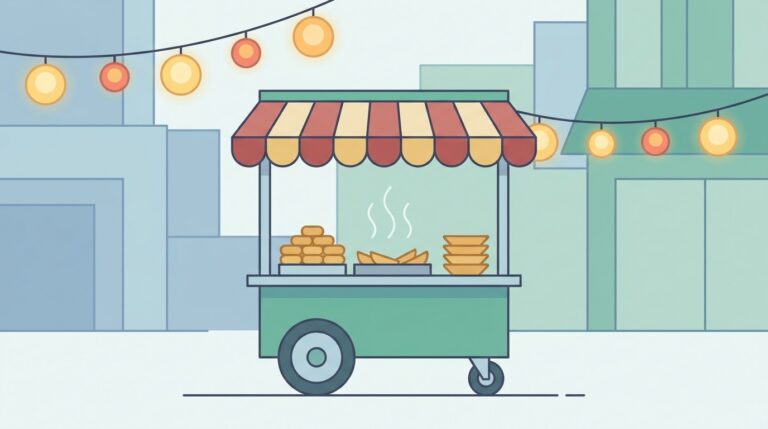
Never Panic at a Korean Street Food Cart: How to Order Fried Snacks Like a Local
Phase 1: Empathy (Welcome to the Street Cart)
안녕하세요! 매일한글 에디터입니다. (Hello! It is your Daily Hangul editor.)
Picture this: It is a brisk Friday evening in Seoul. You are walking past a bustling outdoor food cart (pojangmacha) in Hongdae. The irresistible aroma of sizzling oil fills the air, and golden piles of crispy Twigim (Korean deep-fried snacks) sit right next to a giant, bubbling tray of sweet and spicy Tteokbokki. You are handed a stainless-steel plate and metal tongs. You eagerly pick three delicious items—a crunchy seaweed roll, sweet potato, and plump squid.
Then, sudden stage fright hits. The vendor turns to you with a brisk, welcoming look, and you freeze. How do you say you picked three pieces? Will they reheat it so it is piping hot? Can you ask for that legendary spicy sauce on top without sounding awkward?
If you have ever stood before a Korean snack cart feeling tongue-tied or resorting to frantic pointing, take a deep breath. Based on real classroom feedback from dozens of our absolute beginner (A1) learners, this guide breaks down the exact words, rhythm, and body language you need. By the end of this 5-minute read, you will order your snacks smoothly and eat like a seasoned local!
Phase 2: Key Expressions Breakdown
Here are the three foundational phrases that will instantly turn you from a nervous tourist into a street food pro.
1. 튀김 세 개 골랐어요 (Twigim se gae gollasseoyo)
- Pronunciation: [Twigim se gae gollasseoyo] (Twee-gheem seh geh gol-lah-ssuh-yo — imagine saying “twee” as in tweet, “gheem” like steam with a hard G, and “seh” like the start of set).
- Meaning: Literal: “Fried food three items picked.” / Actual: “I picked three pieces of fried food.”
- K-Culture Moment: Seen in nearly every slice-of-life K-drama (like Weightlifting Fairy Kim Bok-joo), where hungry students step up to a cart and tally their fried bounty before diving in.
- Editor’s Insight: Street cart fried items are kept on display at room temperature. You select what you want onto your plate first, and this sentence acts as your friendly cue to let the vendor know you are ready for the magic.
- Situation Spectrum: Casual: ⚠️ (Only with close friends: 튀김 세 개 골랐어) | Semi-formal: ✅ (튀김 세 개 골랐어요 – perfect for vendors!) | Formal: 🚫 (튀김 세 개 골랐습니다 – too robotic for street food).
- 🤔 Think About It: In Korean, we attach specific counters like 개 (gae – items) to numbers. Why do you think Korean uses specialized counter words instead of simply saying the number alone?
2. 이거 다시 튀겨 주세요 (Igeo dasi twigyeo juseyo)
- Pronunciation: [Igeo dasi twigyeo juseyo] (Ee-guh dah-shee twee-gyuh joo-seh-yo — “Igeo” sounds like “eager” without the final ‘r’).
- Meaning: Literal: “This again fry please.” / Actual: “Please fry these once more for me.”
- K-Culture Moment: Watch any late-night Korean travel vlog: the vendor takes the cold tray and plunges the snacks back into crackling hot oil for 30 seconds until blisteringly crisp.
- Editor’s Insight: Vendors usually do this automatically, but during peak rush hours, saying this politely ensures you never get a lukewarm snack.
- Situation Spectrum: Casual: ⚠️ | Semi-formal: ✅ (Polite and standard) | Formal: 🚫.
- 🤔 Think About It: 주세요 (juseyo) translates to “please give” or “please do for me.” How does placing polite requests at the end of the sentence change the energy of your request?
3. 떡볶이 국물 묻혀 주세요 (Tteokbokki gungmul mutyeo juseyo)
- Pronunciation: [Tteokbokki gungmul mutyeo juseyo] (Ttuk-boh-kkee goong-mool moo-chyuh joo-seh-yo — “Ttuk” sounds like tuck, “goong” rhymes with boing).
- Meaning: Literal: “Tteokbokki broth smear please.” / Actual: “Please coat/dip them in tteokbokki sauce.”
- K-Culture Moment: The iconic street snack hack! Rather than dipping each piece into soy sauce, vendors will ladle rich, crimson tteokbokki sauce straight over your cut-up fried pieces.
- Editor’s Insight: This customization is almost universally complimentary! It is called Beombeok (sauce mix), and asking for it shows you truly understand Korean snack culture.
- Situation Spectrum: Casual: ⚠️ | Semi-formal: ✅ | Formal: 🚫.
- 🤔 Think About It: Food cart owners happily add extra sauce for free without nickel-and-diming customers. What does this generous gesture tell us about Korean hospitality?
Phase 3: Textbook Korean vs. Real Street Korean
Textbooks teach grammar designed for written tests, but real street carts operate on rapid-fire warmth and speed.
Situation 1: Telling the vendor how many pieces you chose
- 📖 교과서 한국어 (Textbook): 튀김 세 개를 선택했습니다. (Twigim se gaereul seontaekhaesseumnida.) — “I have concluded selecting three pieces of fried food.”
- 🗣️ 진짜 한국어 (Real-Life): 세 개 골랐어요! (Se gae gollasseoyo!) — “I picked three!”
- 💡 왜 다를까? (Why the difference?): In busy street carts, long grammatical particles (-를) and formal verbs (선택하다) sound like a corporate boardroom. Short, energetic phrases keep the line moving.
Situation 2: Asking for the bill
- 📖 교과서 한국어 (Textbook): 이제 계산을 진행해 주시겠습니까? (Ije gyesaneul jinhaenghae jusigesseumnikka?) — “Could you proceed with payment calculation now?”
- 🗣️ 진짜 한국어 (Real-Life): 얼마예요? (Eolmayeyo?) — “How much is it?”
- 💡 왜 다를까? (Why the difference?): Real street dining is punchy. A clean 얼마예요? paired with an open palm or your payment card is universally understood and instantly friendly.
Phase 4: K-Culture Deep Dive & Non-Verbal Manners
4-1. 눈치 (Nunchi) & Cart Etiquette
- The Tool Rule: When you approach the fried food mountain, look around for stainless steel tongs (jip-ge) and round plates. Never touch the food items with your hands or toothpicks while picking!
- Handing Over the Tray: Once you place your items on the tray, set it on the raised metal counter directly in front of the fry vat. Do not shove it right into the vendor’s space; place it down gently and make soft eye contact.
- The Head Tilt: When saying 골랐어요 (gollasseoyo), accompany it with a slight 15-degree head bow. This instantly communicates respect and turns a transaction into a warm human encounter.
4-2. The Soul of Bunsik (분식) & Pojangmacha
In South Korea, street food carts are democratic comfort zones. High schoolers studying for college entrance exams rub elbows with office workers in tailored suits. There are no reservations, no tablecloths, and often no chairs. Eating standing up while holding a warm paper cup of steaming fishcake broth (Odeng gungmul) is a cultural equalizer—a shared culinary hug on cold Korean nights.
Phase 5: Real-Life Roleplay Scenario
Setting: A vibrant Bunsik cart outside Sinchon Station at 8:00 PM. Vats of bright red tteokbokki bubble beside a sizzling deep-fry station.
Characters:
* You: A traveler ready for a delicious dinner.
* Imo (이모): The energetic cart owner with an apron and a friendly, boisterous voice.
- Imo: 어서 와요! 뭐 먹을래요? (Eoseo wayo! Mwo meogeullaeyo?)
“Welcome! What would you like to eat?” -
You: [🎭 Gently placing your tray on the counter with tongs in hand]
튀김 세 개 골랐어요. (Twigim se gae gollasseoyo.)
“I picked three pieces of fried food.” -
Imo: [🎭 Glancing at the plate and nodding briskly]
네~ 김말이, 오징어, 만두네! 다시 튀겨 줄게요. (Ne~ gimmari, ojingeo, mandune! Dasi twigyeo julgeyo.)
“Okay! Seaweed roll, squid, and dumpling! I will fry them again for you.” -
You: [🎭 Smiling gratefully]
감사합니다! (Gamsahamnida!)
“Thank you!” -
Imo: [🎭 Snipping the hot fried items into bite-sized pieces with kitchen shears]
떡볶이 국물 묻혀 줄까? (Tteokbokki gungmul mutyeo julkka?)
“Shall I coat them in tteokbokki sauce?” -
You: [🎭 Nodding enthusiastically]
네, 국물 묻혀 주세요! (Ne, gungmul mutyeo juseyo!)
“Yes, please coat them in sauce!” -
Imo: [🎭 Ladling spicy red sauce over the plate and handing it over with two long toothpicks]
여기 있어요. 맛있게 먹어요! (Yeogi isseoyo. Masitge meogeoyo!)
“Here you go. Enjoy your snack!” -
You: [🎭 Bowing slightly as you take the plate]
잘 먹겠습니다! (Jal meokgetseumnida!)
“I will eat well! (Thank you for the food!)”
🔀 Interactive Decision Point
The vendor asks if you want your fried snack coated in spicy sauce (떡볶이 국물 묻혀 줄까?). How do you respond?
* Option A: Silently wave your hand and look away anxiously.
Feedback: [Risk] The vendor might assume you do not want it, or feel confused by your silence. A simple “네” (Yes) or “아니요” (No) keeps the vibe warm!
* Option B: Shout “국물 줘!” (Gungmul jwo!)
Feedback: [Bad] This is blunt, impolite casual speech (Banmal). Talking down to an older vendor can come across as disrespectful.
* Option C: Smile and answer: “네, 묻혀 주세요!” (Ne, mutyeo juseyo!)
Feedback: [Best!] Perfect, natural, polite A1 Korean! You will get warm, saucy perfection served with a proud smile.
Phase 6: 10-Second Emotion Shadowing Drill
Read these aloud, pausing at the slashes (/) and channeling the mood inside the brackets!
[😊 Bright and polite]
저 / 튀김 세 개 / 골랐어요! (Jeo / twigim se gae / gollasseoyo!)
“I / three fried snacks / picked!”-
[🤤 Craving maximum crispiness]
이거 / 다시 / 튀겨 주세요! (Igeo / dasi / twigyeo juseyo!)
“This / once again / please fry!” -
[✨ Delighted and excited]
떡볶이 국물도 / 같이 / 묻혀 주세요! (Tteokbokki gungmuldo / gachi / mutyeo juseyo!)
“Tteokbokki sauce too / together / please coat!”
Phase 7: K-Culture Mini Dictionary
- 튀김 (Twigim): Traditional Korean street fritters battered in a light, ultra-crispy crust. Classics include squid (ojingeo), sweet potato (goguma), and glass noodles wrapped in nori (gimmari).
- 떡튀순 (Tteok-Twi-Sun): A famous portmanteau representing the holy trinity of Korean snack food: Tteokbokki (떡볶이) + Twigim (튀김) + Sundae (순대 – blood sausage).
- 범벅 (Beombeok): A culinary term meaning “completely mixed or smothered.” Asking for Twigim-beombeok means dunking fried snacks entirely into savory tteokbokki sauce.
- 오뎅 국물 (Odeng gungmul): Savory broth made from simmered fish cakes, radish, and kelp. It sits in massive rectangular stainless vats and is free for customers to sip from paper cups while eating.
Phase 8: Survival Kit for Travelers
TOP 3 Emergency Phrases
- 얼마예요? (Eolmayeyo?) — “How much is it?”
Pro Tip: Essential for wrapping up your street feast cleanly. - 포장해 주세요 (Pojanghae juseyo) — “Please pack it to go.”
Pro Tip: Perfect if you want to take your fried snacks back to your hotel room for late-night drama bingeing. - 오뎅 국물 마셔도 돼요? (Odeng gungmul masyeodo dwaeyo?) — “May I drink fishcake broth?”
Pro Tip: While it is almost always free, asking first is considered top-tier polite etiquette!
Editor’s Travel Note
Always keep 5,000 to 10,000 KRW in paper cash when exploring traditional night markets, as some independent vendors prefer cash or instant bank transfers. To locate popular night food clusters in Seoul without getting lost in back alleys, consult our detailed Naver Map street navigation guide.
Phase 9: One Step Deeper (Culture Reflection)
At first glance, a pojangmacha looks like fast food. But look closer at how space functions in Korea. Patrons huddle together under plastic tarps against the winter wind, dipping snacks into communal pots of broth and chatting openly with vendors twice their age. Korean food spaces run on Jeong (정)—an emotional fabric of shared empathy and uncalculated generosity. That free ladle of tteokbokki sauce or ladle of fishcake soup isn’t a retail promotion; it is a warm community embrace.
💬 Your Turn: Which classic Korean fried snack are you most excited to try first—squid (오징어), glass noodle seaweed roll (김말이), or sweet potato (고구마)? Tell us in the comments below!
Phase 10: FAQ & Common Mistakes
Q: Do I pay before or after eating at a street food cart?
A: If you are eating on the spot while standing, you almost always pay after you finish, because you might decide to grab an extra skewer of fishcake or another dumpling halfway through! If you order to-go (포장), pay immediately when ordering.
Q: How do I drink the fishcake broth?
A: Look for paper cups stacked near the broth vat. Grab a clean cup, use the large soup ladle resting in the broth, pour yourself a cup, and sip it while standing. You do not need to ask for a spoon!
Q: Can I dip my fried snacks directly into the shared soy sauce container?
A: No! For hygiene reasons, never double-dip or dip food directly into communal containers. Most stalls provide a small silicone brush to paint the sauce on your food, or individual paper dishes to pour sauce into.
🚨 Common Mistakes Alert
- Mistake: Grabbing fried food from the display using bare hands or wooden toothpicks.
Correct Action: Always use the metal tongs and stainless trays provided at the front of the cart. - Mistake: Using casual speech (Banmal) like “얼마야?” (Eolmaya?) with street vendors.
Correct Action: Even in casual street settings, always use polite endings: “얼마예요?” (Eolmayeyo?). - Mistake: Leaving wooden skewers and crumpled paper cups on the counter ledge.
Correct Action: Dispose of skewers and cups in the blue or black trash bins usually tied to the cart legs beneath the counter.
Phase 11: Action Missions
- 🥉 Bronze Mission (Solo Practice): Stand in front of your mirror and practice saying: “튀김 세 개 골랐어요!” three times with a bright smile.
- 🥈 Silver Mission (Community Sharing): Share a photo of your favorite fried snack or Korean dinner on social media with the sentence: 튀김 세 개 골랐어요! #DailyHangul.
- 🥇 Gold Mission (Real-world Challenge): Next time you visit a Korean restaurant or street cart, order your fried dumplings or snacks entirely in Korean using: “이거 다시 튀겨 주세요!”
- 🎮 K-Culture Mission: Watch an episode of a Korean drama featuring street food (like Itaewon Class or Mystic Pop-up Bar). Spot whether the characters use toothpicks (isssigae) or wooden chopsticks to eat their snacks!
Phase 12: Interactive Quiz Challenge
Test what you learned today before you head out to your next food adventure!
1. Situation Challenge: You selected two pieces of fried squid and one seaweed roll. What is the most natural sentence to say to the cart owner?
* A) 튀김 세 개를 선택 완료했습니다. (Twigim se gaereul seontaek wanryohaesseumnida.)
* B) 튀김 세 개 골랐어요. (Twigim se gae gollasseoyo.)
* C) 튀김 세 개 내놔. (Twigim se gae naenwa.)
👉 Click to see the answer and explanation
Correct Answer: B) 튀김 세 개 골랐어요.
Explanation: Option B is polite, natural, and standard for street vendors. Option A is excessively stiff/formal, while Option C is a rude command in casual speech.
2. Fill-in-the-Blank: Complete the sentence to ask the vendor to coat your snacks in spicy sauce:
* “떡볶이 국물 _______ 주세요.” (Please coat them in tteokbokki sauce.)
👉 Click to see the answer and explanation
Correct Answer: 묻혀 (mutyeo)
Sentence: 떡볶이 국물 묻혀 주세요 (Tteokbokki gungmul mutyeo juseyo).
Explanation: The verb 묻히다 (muthida) means to smear, dip, or coat lightly.
3. True or False: In Korean food carts, fishcake broth (Odeng gungmul) typically costs extra per cup.
* [ ] True
* [ ] False
👉 Click to see the answer and explanation
Correct Answer: False!
Explanation: Fishcake broth is virtually always complimentary for customers eating at the stall. Just grab a paper cup and enjoy!







