

From Empty Wallets to Carving Bones: The Secret Korean Idioms for Money and Everyday Grit
Phase 1: Empathy (Story-Driven Opening)
안녕하세요! (Annyeonghaseyo!) I’m your Daily Hangul editor and cultural companion. Have you ever watched a slice-of-life K-drama like My Mister or Reply 1988 and heard characters sighing deeply over kitchen tables or street carts, talking about money in ways your textbook never explained? You hear words that translate literally to “scraping gourds” or “carving bones,” and suddenly you wonder: Are we talking about dinner, surgery, or family finances?
Many of our intermediate learners hit this exact wall. You know the formal verbs for economizing, like 절약하다 (jeoryakhada – to economize), but real Koreans rarely use such sterile language when venting over a cold soju after overtime. Korea underwent dizzying economic changes over the last half-century—from post-war reconstruction to the 1997 IMF crisis. The grit, sweat, and humor of working-class Koreans (seomin, 서민) were poured straight into daily idioms. When you master these physical, visceral expressions, you stop sounding like an automated financial report and start sounding like an empathetic friend who understands the real hustle of everyday Korean life.
Phase 2: Deep Dive into 3 Core Idioms
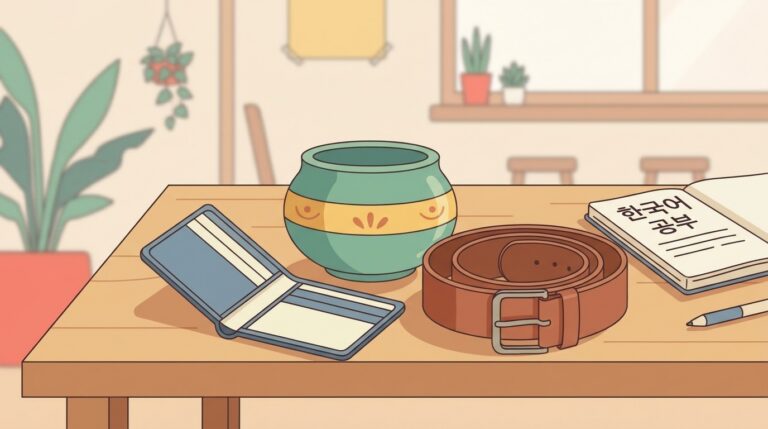
1. 허리띠를 졸라매다 (Heorittireul jollamaeda)
- Pronunciation: [Heo-rit-tti-reul jol-la-mae-da] (Sounds like “huh-reet-tee-reul johl-lah-mae-da”)
- Meaning: Literally “to tighten one’s belt.” In reality, it means to cut down expenses drastically during tough financial times, bracing for austerity with firm willpower.
- K-Culture Moment: You will see this constantly in office dramas when a startup faces budget cuts, or when parents tell their kids that college tuition means the whole family must hold off on dining out.
- Editor’s Insight: It carries an active nuance of collective resilience. You don’t just endure poverty passively; you tighten your grip and make a conscious decision to get through it.
- Situation Spectrum: Casual ✅ | Semi-formal ✅ | Formal ✅ (Editorials and news anchors frequently use this phrase).
- 🤔 Think About It: Does your native culture visualize budget cuts on the physical body, or through cold fiscal metaphors like “tightening purse strings”?
2. 바가지를 긁다 (Bagajireul geukda)
- Pronunciation: [Ba-ga-ji-reul geuk-da] (Imagine “bah-gah-jee-reul geuk-dah”, with ‘geuk’ sounding like a sharp scratch)
- Meaning: Literally “to scratch the dried gourd bowl.” Figuratively, it refers to a spouse (historically a wife) nagging persistently, especially about finances, domestic irresponsibility, or lack of ambition.
- K-Culture Moment: In weekend family dramas, an exhausted husband sneaks into the house late after drinking with coworkers, only to be met by his wife with arms crossed, muttering: “또 술이야?” (Tto suriya? / Drinking again?). He later complains to his friends, “아내가 밤새 바가지를 긁었어.” (Anaega bamsae bagajireul geulgeosseo. / My wife nagged me all night).
- Editor’s Insight: Historically, shamans scratched gourds to drive away demons of illness and poverty. Over time, that grating, persistent scraping sound became the ultimate metaphor for domestic nagging.
- Situation Spectrum: Casual ✅ | Semi-formal ⚠️ (Only among close peers) | Formal 🚫 (Never use with superiors or in formal settings).
- 🤔 Think About It: Why do domestic conflicts about finances often get reduced to acoustic discomfort in folklore?
3. 뼈를 깎다 (Ppyeoreul kkakda)
- Pronunciation: [Ppyeo-reul kkak-da] (Pop that double ‘pp’ like in “supper”, followed by a crisp ‘kkak’)
- Meaning: Literally “to shave or carve one’s own bones.” Nuance: enduring excruciating, agonizing pain and painstaking discipline to achieve a goal or overhaul an organization.
- K-Culture Moment: When K-Pop idols describe their brutal trainee years before debut, or when a company CEO announces restructuring during an economic downturn.
- Editor’s Insight: This is the highest tier of hardship. While
허리띠를 졸라매다is about financial thrift,뼈를 깎는 노력(bone-carving effort) describes the gut-wrenching sacrifice of body and soul. - Situation Spectrum: Casual ⚠️ (Slightly overdramatic unless joking) | Semi-formal ✅ | Formal ✅.
- 🤔 Think About It: How does contrasting “flesh” and “bone” reflect the Confucian value of pushing the physical vessel to its utmost limit?
Phase 3: Textbook Korean vs. Real Korean
Situation 1: Declaring that you need to cut spending this month
- 📖 교과서 한국어: 이번 달에는 개인 지출을 줄여야 합니다. (Ibeon darenaen gaein jichureul juryeoya hamnida.) — I must reduce personal expenditures this month.
- 🗣️ 진짜 한국어: 이번 달은 진짜 허리띠 바짝 졸라매야 돼. (Ibeon dareun jinjja heoritti bajjak jollamaeya dwae.) — I’ve really got to cinch my belt extra tight this month.
- 💡 왜 다를까?: Textbook Korean sounds like an official corporate audit. Native speakers personalize hardship with vivid physical adverbs like
바짝(tightly, intensely).
Situation 2: Explaining a heated discussion at home over household savings
- 📖 교과서 한국어: 아내가 저에게 과소비를 하지 말라고 지속적으로 조언했습니다. (Anaega jeoege gwasobireul haji mallago jisokjeogeuro joeonhaetssumnida.) — My wife continually advised me against excessive spending.
- 🗣️ 진짜 한국어: 카드값 많이 나왔다고 와이프가 바가지를 어찌나 긁던지 혼났네. (Kadeukgap mani nawatdago waipeuga bagajireul eojjina geukdeonji honnatne.) — My wife nagged me to death over the credit card bill, man, I was in so much trouble.
- 💡 왜 다를까?: Real relationships involve friction and humor. Using
바가지를 긁다communicates emotional exhaustion mixed with affectionate resignation.
Phase 4: K-Culture Deep Dive & Non-Verbal Etiquette
4-1. Nunchi & Gestures
When Koreans discuss financial strain or hard work, the body language tells half the story:
* The Belt Pinch: When saying “허리띠를 졸라매다”, lightly pinch your waistline or adjust your belt with a dry, self-deprecating smile. It softens the mood while signaling pragmatic determination.
* The Subtle Sigh: Expressing sympathy for someone’s sweat and toil requires an audible soft sigh (휴... / hyu…) followed by a nod. Never boast about your easy life when someone mentions tightening their belt; practice nunchi by matching their subdued energy.
* The Bill Tug-of-War: If you are with colleagues and someone says, “오늘은 내가 쏠게!” (Oneureun naega ssolge! / I’ll treat today!), but you know they are in a tight spot, gently place both hands on their arm or bill tray to protest, saying, “무슨 소리야, 더치페이 하자!” (Museun soriya, deochipei haja! / What are you talking about, let’s split the bill!).
4-2. Cultural Code Analysis: The Spirit of the “IMF Generation”
Why are Korean economic idioms so physical? In 1997, the Asian Financial Crisis struck South Korea overnight. Ordinary citizens gave up their personal wedding rings and gold heirlooms in the nationwide Gold-Collecting Campaign (Geummoagi Undong). This collective memory cemented the idea that economic struggle isn’t solved by clever abstract theory, but through physical perseverance (뼈를 깎다) and shared household sacrifice (허리띠를 졸라매다). Even the younger generation today uses these idioms alongside fresh slang to express solidarity in a fiercely competitive job and housing market.
Phase 5: Real-Life Roleplay Scenario
Setting: A quiet back-alley pub in Euljiro, Seoul, after a grueling Thursday shift.
Characters:
* Min-ho (민호): A 30-something marketing team colleague trying to save for a home deposit.
* You: A perceptive colleague sharing grilled pork belly (samgyeopsal) and a drink.
- Turn 1 (Min-ho): 요즘 물가가 너무 올라서 점심 먹기도 겁난다, 진짜. (Yojeum mulgaga neomu ollaseo jeomsim meokgido geomnanda, jinjja.)
- 🎭 Slumps shoulders while turning over a piece of meat on the grill.
- “Prices have gone up so much lately, it’s honestly scary just getting lunch.”
- Turn 2 (You): 맞아요. 저도 지난달 카드 명세서 보고 깜짝 놀랐어요. (Majayo. Jeodo jinandal kadeu myeongseseo bogo kkamjjak nollasseoyo.)
- 🎭 Nods sympathetically, taking a sip of water.
- “I know. I was shocked when I saw my credit card statement from last month too.”
- Turn 3 (Min-ho): 내 집 마련 하겠다고 전세대출 갚는 중인데, 완전 허리띠를 졸라매야겠어. (Nae jip maryeon hagetdago jeonsedaechul gamneun junginde, wanjeon heorittireul jollamaeyagesseo.)
- 🎭 Gives a bitter laugh and makes a belt-tightening gesture.
- “I’m trying to buy my own place while paying off my lease deposit loan, so I really have to tighten my belt completely.”
- Turn 4 (You): 그래도 혼자 뼈를 깎는 노력 하느라 너무 무리하지는 마요. (Geuraedo honja ppyeoreul kkakneun noryeok haneura neomu murihajineun mayo.)
- 🎭 Places a wrapped lettuce bite (ssam) gently on his plate.
- “Still, don’t push yourself past the breaking point with all this bone-carving effort all by yourself.”
- Turn 5 (Min-ho): 주말에 외식이라도 한번 하자고 하면 아내가 바가지를 얼마나 긁는지 몰라. (Jumare oesigirado hanbeon hajago hamyeon anaega bagajireul eolmana geukneunji molla.)
- 🎭 Chuckles softly, shaking his head with fond exasperation.
- “If I even suggest eating out on the weekend, my wife nags me to pieces.”
- Turn 6 (You): 형수님도 우리 미래 생각해서 알뜰하게 챙기시는 거잖아요. (Hyeongsunimdo uri mirae saenggakhaeseo alteulhage chaenggisineun geojanhayo.)
- 🎭 Smiles warmly to comfort him.
- “She’s just being thrifty because she’s thinking about your shared future, right?”
- Turn 7 (Min-ho): 알지, 고맙긴 하지. 자, 오늘은 내가 힘내라고 샀으니까 맛있게 먹어! (Alji, gomapgin haji. Ja, oneureun naega himnaerago sasseunikka masitge meogeo!)
- 🎭 Reaches for the bill proactively.
- “I know, I’m grateful to her. Anyway, this is on me today so you can cheer up, eat up!”
- Turn 8 (You): 안 돼요! 오늘 허리띠 졸라맨다면서요, 반반 나눠 내요. (An dwaeyo! Oneul heoritti jollamaendamyeonseoyo, banban nanwo naeyo.)
- 🎭 Firmly pulls out your phone to split the bill via payment app.
- “No way! You just said you’re tightening your belt today, let’s split it half and half.”
🔀 Interactive Decision Fork
Min-ho resists your split-bill offer, waving his card. What do you do?
- Option A: Grasp his arm firmly, open your mobile banking app, and say: “다음엔 형이 사요, 오늘은 무조건 더치페이예요!” (Next time is your turn, today is strictly Dutch treat!)
- 👉 Feedback (Best): Perfect balance of jeong (affection) and tact. You honor his financial goal without embarrassing his pride.
- Option B: Shrug and say: “그래요? 그럼 비싼 갈비 2인분 추가할게요!” (Really? Then let’s add two orders of expensive short ribs!)
- 👉 Feedback (Risk): Dangerous unless Min-ho is an exceptionally close childhood friend who appreciates edgy irony. In an office dynamic, this shows a lack of nunchi.
- Option C: Stand frozen and say: “돈도 없으면서 왜 사요?” (Why buy food when you don’t even have money?)
- 👉 Feedback (Bad): Catastrophic. Direct attacks on a Korean person’s financial dignity will instantly ruin the workplace bond.
Phase 6: 10-Second Emotion Shadowing Drill
Practice these lines out loud. Notice how pauses (/) build realistic conversational tension!
[😤 결의에 차서 - Resolute and Determined]- 이번 분기에는 / 적자를 메우기 위해 / 전 직원이 허리띠를 졸라매야 합니다.
- (Ibeon bunggieneun / jeokjareul meugi wihae / jeon jigweoni heorittireul jollamaeya hamnida.)
- “This quarter, / to plug the deficit, / every single employee must tighten their belt.”
[😮💨 씁쓸하고 지친 목소리로 - Weary and Resigned]- 퇴근하고 / 집에 들어가면 / 또 바가지를 긁힐 텐데 / 벌써 겁나네.
- (Ttoegeunhago / jibe deureogamyeon / tto bagajireul geulkhil tende / beolsseo geomnane.)
- “Once I get off work / and step inside the house / I’ll probably get nagged again, / I’m already dreading it.”
[🔥 비장하고 진지하게 - Solemn, High Stakes]- 이건 우리 팀의 / 존폐가 걸린 / 뼈를 깎는 쇄신안입니다.
- (Igeon uri timui / jonpyega geollin / ppyeoreul kkakneun swaesinan-imnida.)
- “This is a bone-carving reform plan / on which the very survival / of our team depends.”
Phase 7: K-Culture Mini Dictionary
- 짠테크 (Jjante-keu)
- Literal / Translation: Salty Investment / Extreme Penny-Pinching.
- Usage: Derived from
짜다(to be salty/stingy) and재테크(financial tech). It describes young Koreans micro-saving through cash-back apps, daily zero-spend challenges, and drinking office instant coffee.
- 영끌 (Yeong-kkeul)
- Literal / Translation: Soul Dragging / Marshalling Every Last Resource.
- Usage: Short for
영혼까지 끌어모으다(gathering even one’s soul). Widely used in the real estate and stock markets when people take on maximum leverage to buy an asset.
- 가성비 (Gaseongbi)
- Literal / Translation: Price-to-Performance Ratio (Value for Money).
- Usage: The undisputed golden standard for Korean dining and shopping. A restaurant isn’t merely good; it must have stellar
가성비to survive.
- 텅장 (Teongjang)
- Literal / Translation: Empty Bank Account.
- Usage: A witty play on words replacing the
통in통장(bankbook) with텅(the sound/concept of emptiness). You utter this the day after payday when auto-debits wipe your balance.
Phase 8: Traveler’s Survival Kit
Top 3 Survival Phrases for Local Markets and Budget Diners
- 조금만 깎아주세요! (Jogeumman kkak-aju-se-yo!)
- Meaning: “Please give me a small discount!”
- Pro Tip: Do not use this in chain stores or department stores! Save it exclusively for traditional open-air markets (like Gwangjang or Namdaemun) when buying multiple physical goods or souvenirs.
- 영수증은 버려주세요. (Yeongsujeungeun beoryeojuseyo.)
- Meaning: “Please throw away the receipt.”
- Pro Tip: Almost all point-of-sale terminals in Korea will ask this. Knowing this phrase saves you from awkward hand-waving at convenience stores.
- 각자 계산할 수 있을까요? (Gakja gyesanhal su isseulkkayo?)
- Meaning: “Could we pay separately?”
- Pro Tip: During busy lunch rushes (11:30 AM – 1:00 PM), small mom-and-pop shops prefer one payment. If you must split, ask politely with this phrase before tapping cards.
Editor’s Travel Note
To eat well while practicing financial wisdom in Korea, keep an eye out for 기사식당 (gisa sikdang – drivers’ diners). Originally built for taxi drivers who require quick, nourishing, and affordable meals, these diners serve legendary bulgogi and pork cutlets with unlimited side dishes. Before navigating the alleys of Euljiro or Mapo, make sure to read our curated guide on Naver Map Navigation Secrets to pinpoint local gems with outstanding 가성비.
Phase 9: “One Step Deeper” (Humanities Essay)
In many Western cultures, personal financial hardship is treated as a private taboo or a clinical transaction between an individual and their bank. In Korea, however, hardship is inherently socialized. The physical violence embedded in idioms like 뼈를 깎다 or 허리띠를 졸라매다 is rarely used to provoke pity; rather, it is shared over shared stews to build camaraderie. By airing out domestic friction via 바가지를 긁다 or laughing about a 텅장, Koreans convert the anxiety of modern survival into a shared communal hug. Hardship acknowledged together is hardship halved.
💬 Your Turn: What is your favorite idiom in your mother tongue for cutting expenses or working brutally hard? Does it relate to food, clothing, or physical pain? Share your thoughts in the comments below!
Phase 10: FAQ & Common Mistakes
Q: Can I use “바가지를 긁다” when my boss at work criticizes my performance?
A: Definitely not! 바가지를 긁다 implies a personal, domestic relationship—almost always between spouses, or occasionally from a nagging parent. If your manager reprimands you, native speakers say 잔소리를 듣다 (to hear nagging) or 꾸지람을 듣다 (to be scolded).
Q: Does “뼈를 깎다” only apply to working overtime or physical labor?
A: No. It is most often used metaphorically for mental stamina, profound ethical self-reflection, or institutional restructuring. For example, politicians or sports coaches will announce “뼈를 깎는 반성” (bone-carving reflection) after a major defeat.
Q: Is “허리띠를 졸라매다” considered rude to say to someone who is actually struggling?
A: It can be insensitive if used as unwanted advice (e.g., telling someone who lost their job to “just tighten your belt”). However, using it to describe yourself or as an expression of joint solidarity (e.g., “우리 다 같이 허리띠 졸라매고 이겨내자!”) is encouraging and deeply respectful.
🚨 Common Mistakes Alert
- Mistake: Saying “제 아내가 저한테 바가지를 썼어요” when trying to say she nagged you.
- Correction:
바가지를 쓰다means to get ripped off / overcharged! To say she nagged you, you must use바가지를 긁다(to scratch the bowl).
- Correction:
- Mistake: Using
뼈를 깎다for casual everyday chores like cleaning your room.- Correction: Reserve
뼈를 깎다for milestone struggles—passing the bar exam, rehabilitating an injury, or training for a national team.
- Correction: Reserve
- Mistake: Literal translation: “제 벨트를 세게 묶었어요”.
- Correction: Use the established cultural collocation
허리띠를 졸라매다. No native speaker uses 벨트를 묶다 to mean living thriftily.
- Correction: Use the established cultural collocation
Phase 11: Action Mission & Engagement
- 🥉 Bronze Level (Solo): Look into your mirror with a determined expression and vocalize the sentence: “이번 달은 허리띠 졸라매야 돼!” three times with crisp diction.
- 🥈 Silver Level (Social): Check your bank balance or receipt today. Post a picture of your humble home-cooked meal on Instagram or Threads with the hashtag
#허리띠졸라매는중(In the middle of tightening my belt). - 🥇 Gold Level (Real-World): The next time you grab street food or dine with a Korean acquaintance, use
가성비가 진짜 좋네요!(The value for money here is truly great!) and observe their enthusiastic reaction. - 🎮 K-Culture Mission: Watch an episode of a workplace K-drama (such as Misaeng). Listen carefully during budget review meetings to see if you can spot the phrase
허리띠를 졸라매다!
Phase 12: Interactive Quiz Challenge
Quiz 1. Situation Judgement
Your close Korean friend sighs and tells you that rent increased and their savings account is dwindling. Which response shows the highest level of natural conversational empathy?
* A) “바가지 긁지 마세요.”
* B) “우리 당분간 허리띠 바짝 졸라매고 같이 힘내자!”
* C) “영수증을 버려드릴까요?”
👉 Click to reveal Answer & Explanation
Correct Answer: B
Explanation: Option B correctly uses 허리띠 바짝 졸라매다 to show collective empathy and camaraderie. Option A misuses the domestic nagging idiom, and Option C is an irrelevant transactional question from cash registers.
Quiz 2. Fill-in-the-Blank
Complete the dramatic declaration of a person preparing for a life-altering exam:
* “합격을 위해 나는 지난 1년간 (________) 노력을 다했다.”
* (Hint: Involves the intense metaphor of shaping physical bone).
👉 Click to reveal Answer & Explanation
Correct Answer: 뼈를 깎는 (Ppyeoreul kkakneun)
Explanation: The modifier form 뼈를 깎는 노력 means “bone-carving, excruciatingly dedicated effort.”
Quiz 3. True or False Cultural Check
- Statement: The expression
바가지를 긁다can be used to describe an elementary school teacher scolding a whole classroom of students.
👉 Click to reveal Answer & Explanation
Correct Answer: False
Explanation: 바가지를 긁다 is restricted to domestic, intimate relations—primarily a wife nagging a husband regarding financial or marital negligence. A teacher scolding students is simply 혼내다 or 야단치다.







