

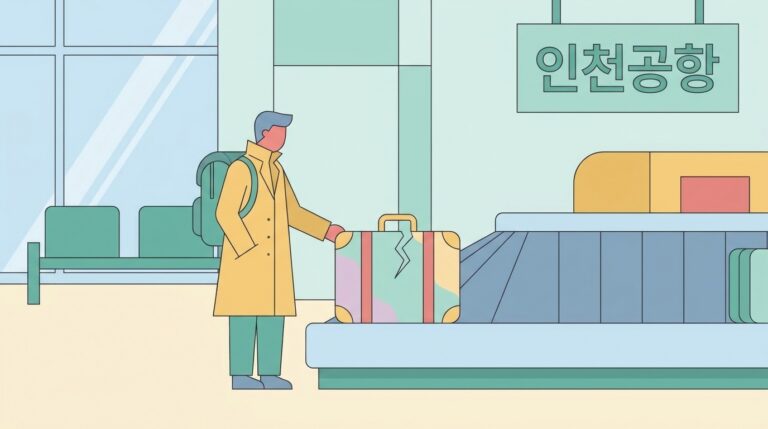
Phase 1: Empathy & Story-Driven Opening
안녕하세요! (Hello!) It’s your Daily Hangul editor here. Picture this: You have just touched down at Incheon International Airport after an exhausting overnight flight, eagerly dreaming of warm convenience store snacks and neon-lit Seoul streets. You wait patiently at baggage carousel number 9. When your suitcase finally tumbles down the chute, your jaw drops: one wheel has snapped off completely, and the hard shell looks like it survived an action movie explosion! Panic sets in. Do you yell? Do you panic? Based on years of assisting international travelers in Korea, panicking never works—but speaking the right polite, assertive Korean does. Today, we will master the exact words you need to report luggage damage and claim compensation effortlessly!
Phase 2: Top 3 Core Expressions
1. 캐리어 바퀴가 부러졌어요 (Kaelieo bakwiga bureojyeosseoyo)
- Pronunciation: [Kaelieo bakwiga bureojyeosseoyo] (Sounds like: ka-ree-uh bah-gwee-gah boo-raw-jyeo-ssaw-yo)
- Meaning: Literal: “The carrier wheel broke.” / Nuance: “A wheel on my suitcase has snapped off/broken.”
- K-Culture Moment: In K-dramas, when the protagonist arrives back in Seoul and their suitcase dramatically loses a wheel, signifying a bumpy start to their journey!
- Editor’s Insight: Koreans almost universally call rolling suitcases 캐리어 (kaelieo) from the English word carrier, rather than yeohaeng gabang (travel bag). 부러지다 (bureojida) is specifically used when rigid objects like sticks, bones, or wheels snap in two.
- Situation Spectrum: Casual: ⚠️ (Use 부러졌어 with close friends) | Semi-formal: ✅ (캐리어 바퀴가 부러졌어요) | Formal: ✅ (캐리어 바퀴가 부러졌습니다)
- 🤔 Think About It: In English, we say “my luggage is damaged,” but Korean often pinpoints the specific component first (carrier wheel -> broke). How does this change how you explain problems?
2. 겉면이 심하게 깨져 있어요 (Geonmyeoni simhage kkaejyeo isseoyo)
- Pronunciation: [Geonmyeoni simhage kkaejyeo isseoyo] (Sounds like: gawn-myeo-nee seem-ha-geh kkae-jyeaw ee-ssaw-yo)
- Meaning: Literal: “The outer surface is severely cracked/broken.” / Nuance: “The hard shell is heavily cracked.”
- K-Culture Moment: Picture a travel vlogger inspecting their hard-shell case on YouTube and showing the camera a visible split along the zipper seam.
- Editor’s Insight: 깨지다 (kkaejida) refers to brittle, hard materials cracking or shattering (glass, ceramics, hard polycarbonate). The combination -어 있다 (-eo itda) indicates a continuing state of being broken.
- Situation Spectrum: Casual: ⚠️ | Semi-formal: ✅ (겉면이 심하게 깨져 있어요) | Formal: ✅ (겉면이 심하게 깨져 있습니다)
- 🤔 Think About It: Notice the adverb 심하게 (simhage – severely). Adding this helps airline agents immediately grasp the urgency without you having to sound angry.
3. 파손 신고서를 작성하고 싶어요 (Pason singoseoreul jakseonghago sipeoyo)
- Pronunciation: [Pason singoseoreul jakseonghago sipeoyo] (Sounds like: pah-sohn sheen-goh-saw-reul jahk-ssawng-hah-goh shee-paw-yo)
- Meaning: Literal: “I want to fill out a damage report form.” / Nuance: “I’d like to file an official baggage damage claim.”
- K-Culture Moment: At airport service counters, calm and collected travelers skip emotional rants and directly ask for official documentation.
- Editor’s Insight: 파손 (pason) is Sino-Korean for structural breakage/damage, and 신고서 (singoseo) means official declaration form. Using precise terms triggers the airline’s standard operating procedure (SOP) immediately.
- Situation Spectrum: Casual: 🚫 | Semi-formal: ✅ (파손 신고서를 작성하고 싶어요) | Formal: ✅ (파손 신고서를 작성하고자 합니다)
- 🤔 Think About It: Why is asking to fill out documentation often received better in Korea than demanding an immediate cash refund?
Phase 3: Textbook Korean vs. Real Korean
Situation A: Explaining the problem at the luggage service desk
- 📖 교과서 한국어 (Textbook): 제 짐이 손상되었으니 보상해 주십시오. (Je jimi sonsangdoeeosseuni bosanghae jusipsio. – My baggage is damaged, so please compensate me.)
- 🗣️ 진짜 한국어 (Real-life): 캐리어가 깨져서 나오는데, 보상 절차가 어떻게 되나요? (Kaelieoga kkaejyeoseo naoneunde, bosang jeolchaga eotteoke doenayo? – My suitcase came out cracked; could you tell me how the compensation process works?)
- 💡 Why the difference? Textbook phrasing sounds like a legal demand letter. Real native speakers use the softening connector -는데 (-neunde) to provide context gently before asking for instructions.
Situation B: Asking if the bag can be repaired
- 📖 교과서 한국어 (Textbook): 이것을 수리하는 것이 가능합니까? (Igeoseul surihaneun geosi ganeunghamnikka? – Is it possible to repair this?)
- 🗣️ 진짜 한국어 (Real-life): 혹시 이거 수리 지원이나 교환이 가능한가요? (Hoksi igeo suri jiwon-ina gyohwani ganeunghangayo? – By any chance, is repair support or replacement available for this?)
- 💡 Why the difference? Adding 혹시 (hoksi – by any chance) shows courtesy (ye-ui), making the desk agent far more eager to advocate for your case.
Phase 4: K-Culture Deep Dive & Non-Verbal Manners
4-1. Nunchi (눈치) & Body Language at the Baggage Desk
When filing a baggage claim in Korea, emotional outbursts will often backfire. Korean customer service staff respond best to composed, respectful communication accompanied by organized physical proof. Hold your baggage claim tag (수하물 표 / suhamul pyo) and boarding pass with both hands when handing them over. When pointing out damage, use an open palm rather than poking a single index finger at the agent or the bag. A slight head nod when speaking signals that you understand the agent is following airline policy, not personally trying to ruin your vacation.
4-2. Cultural Insight: The Incheon “Pali-Pali” vs. Protocol Balance
Incheon Airport is celebrated worldwide for speed and efficiency (ppalli-ppalli culture). However, property claims require strict documentation to prevent fraudulent claims. Airline agents must capture photos, verify baggage tag serials, and fill out system logs. Showing patience while acknowledging their protocol will prompt agents to offer proactive remedies, such as providing a temporary loaner suitcase or arranging door-to-door courier repair while you stay at your hotel.
Phase 5: Real-Life Roleplay Scenario
- Setting: The Baggage Service Counter near Carousel 12 at Incheon Airport Terminal 2.
- Characters:
- Alex (알렉스): Tired traveler holding a cracked suitcase with a missing wheel.
- Agent Min-ji (민지 직원): Diligent ground staff agent with an airline badge.
Turn 1 (Alex): 저기요, 실례지만 수하물에 문제가 있어서요.
(Jeogiyo, sillyejiman suhamure munjega isseoseoyo.)
(Excuse me, I’m sorry to bother you, but there’s a problem with my luggage.)
🎭 Gently stepping up to the counter while holding the boarding pass with both hands
Turn 2 (Min-ji): 네, 고객님. 어떤 문제가 있으실까요? 수하물 표 확인해 드리겠습니다.
(Ne, gogaeknim. Eotteon munjega isseusilkkayo? Suhamul pyo hwaginhae deurigessseumnida.)
(Yes, customer. What seems to be the trouble? May I check your baggage claim tag?)
🎭 Welcoming with a polite bow and receiving the baggage tag
Turn 3 (Alex): 방금 짐을 찾았는데, 캐리어 바퀴 하나가 완전히 부러졌어요.
(Banggeum jimeul chajanneunde, kaelieo bakwi hanaga wanjeonhi bureojyeosseoyo.)
(I just picked up my bag, and one of the suitcase wheels is completely broken off.)
🎭 Pointing to the empty axle on the suitcase base using an open hand
Turn 4 (Min-ji): 아이고, 충격이 컸나 보네요. 많이 놀라셨겠습니다. 파손 부위 확인해 볼게요.
(Aigo, chunggyeogi keonna boneyo. Mani nollasyeotgetseumnida. Pason buwi hwaginhae bolgeyo.)
(Oh dear, it must have taken a hard impact. You must have been so shocked. Let me examine the damaged area.)
🎭 Crouching slightly to inspect the wheel socket and taking photos with a handheld scanner
Turn 5 (Alex): 그리고 옆쪽 겉면도 심하게 깨져 있어요. 파손 신고서를 작성하고 싶어요.
(Geurigo yeopjjok geonmyeondo simhage kkaejyeo isseoyo. Pason singoseoreul jakseonghago sipeoyo.)
(And the outer shell on the side is badly cracked too. I’d like to fill out a damage report.)
🎭 Showing the long crack along the corner
Turn 6 (Min-ji): 확인되었습니다. 이 정도 파손이면 현장 접수 후 수리나 보상 처리가 가능합니다.
(Hwagindoeeosseumnida. I jeongdo pasonimyeon hyeonjang jeopsu hu surina bosang cheoriga ganeunghamnida.)
(Confirmed. With this degree of damage, we can process repair or replacement compensation on-site.)
🎭 Pulling up an official Property Irregularity Report form on the desk screen
Turn 7 (Alex): 다행이네요. 보상 절차는 얼마나 걸리나요?
(Dahaeng-ineyoyo. Bosang jeolchaneun eolmana geollinayo?)
(That is a relief. How long does the compensation procedure take?)
🎭 Sighing in relief while listening attentively
Turn 8 (Min-ji): 신고서 작성해 주시면 담당 부서에서 영업일 기준 3일 내로 연락드립니다!
(Singoseo jakseonghae jusimyeon damdang buseo-eseo yeongeop-il gijun sam-il naero yeollakdeurimnida!)
(Once you complete this form, the claims department will contact you within 3 business days!)
🎭 Handing a stylus and tablet to Alex with a reassuring smile
🔀 Interactive Decision Point
Suppose the agent says that light scratches are not covered by airline policy. How do you respond?
- Choice A: “이건 단순한 흠집이 아니라 바퀴가 빠지고 깨진 파손이에요.” (Igeon dansunhan heumjibi anira bakwiga ppajigo kkaejin pasonieyo. – This isn’t just a simple scratch; the wheel fell off and the shell is cracked.)
👉 Feedback (Best!): Calm, polite, and fact-focused. Distinguishes normal wear from severe structural failure. - Choice B: “당장 매니저 불러요! 책임질 때까지 안 갈 거예요!” (Dangjang maenijeo bulleoyo! Chaegimjil ttaekkaji an gal geoyeyo! – Call the manager right now! I won’t leave until you take responsibility!)
👉 Feedback (Bad): High aggression shuts down goodwill and may summon airport security. - Choice C: “아, 그래요? 그럼 그냥 갈게요.” (A, geuraeyo? Geureom geunyang galgeyo. – Oh, really? Then I’ll just leave.)
👉 Feedback (Risk): Leaving the customs area without an official written report usually voids your right to any compensation later.
Phase 6: 10-Second Emotion Shadowing Drill
Practice these lines out loud, matching the rhythm and emotional nuance!
[🥺 Flustered and distressed]
저기요, / 짐을 찾았는데 / 바퀴가 완전히 부러졌어요.
(Jeogiyo, / jimeul chajanneunde / bakwiga wanjeonhi bureojyeosseoyo.)
(Excuse me, / I picked up my bag / and the wheel is completely broken.)-
[💼 Polite, clear, and assertive]
겉면이 심하게 깨져 있어서 / 파손 신고서를 / 작성하고 싶습니다.
(Geonmyeoni simhage kkaejyeo isseoseo / pason singoseoreul / jakseonghago sipseumnida.)
(Because the outer shell is severely cracked / I would like to / fill out a damage report.) -
[🤝 Collaborative and appreciative]
수리나 대체 가방 지원이 / 가능한지 / 확인 부탁드립니다.
(Surina daeche gabang jiwoni / ganeunghanji / hwagin butakdeurimnida.)
(Whether repair or a replacement suitcase is possible / please / kindly verify for me.)
Phase 7: K-Culture Mini Dictionary
- 수하물 표 (Suhamul pyo) | Baggage Claim Tag
The barcode sticker attached to your boarding pass envelope. In Korean airports, no claim can begin without this number. - 파손 신고서 (Pason singoseo) | Property Irregularity Report (Damage Claim Form)
The formal airline document that proves your suitcase was damaged before clearing arrival customs. - 보상 규정 (Bosang gyujeong) | Compensation Policy / Regulations
Airlines have specific rules determining whether you receive a repair service, a replacement brand-new suitcase, or cash reimbursement. - 감가상각 (Gamgasang-gak) | Depreciation
If you bought a luxury suitcase years ago, airlines may deduct value based on product age when calculating cash payout.
Phase 8: Traveler’s Survival Kit
Top 3 Immediate Survival Phrases
- 이거 공항 밖으로 나가기 전에 접수해야 하죠?
(Igeo gonghang bakkeuro nagagi jeone jeopsuhaeya hajyo?)
Translation: I need to register this before going outside the airport, right?
Pro Tip: Never leave the baggage claim area without filing. Once you pass customs exit doors, claims are routinely rejected. - 사진을 먼저 찍어 둬도 될까요?
(Sajineul meonje jjigeo dwodo doelkkayo?)
Translation: May I take photos first?
Pro Tip: Snap photos showing both the damaged spot and the carousel baggage tag still attached. - 호텔로 대체 가방을 보내 주실 수 있나요?
(Hotello daeche gabang-eul bonae jusil su 있nayo?)
Translation: Could you send a replacement suitcase to my hotel?
Pro Tip: Major Korean airlines frequently deliver brand-new replacement luggage directly to your accommodation.
Editor’s Travel Note
Before stepping onto the plane, check the Incheon Airport Official App Guide for real-time baggage belt announcements and service desk maps. If transit damage leads to a disputed outcome with a local airline, check the Korea Consumer Agency Dispute Information for foreign tourist consumer rights assistance.
Phase 9: A Step Deeper (Thoughts on Korean Service Culture)
In South Korea, frontline staff are often subject to intense emotional expectations, known culturally as 감정 노동 (gamjeong nodong – emotional labor). When frustrated travelers scream or bang desks, staff must remain hyper-formal, but the interaction creates deep stress. However, when an international traveler uses controlled, courteous honorifics (존댓말 / jondaetmal) and frames the issue as an unfortunate accident rather than a personal fault, Korean ground staff routinely go the extra mile—expediting claims and offering top-tier replacement options.
💬 Your Turn: Have you ever experienced a travel disaster like a ruined suitcase? How would you handle it differently after learning these Korean phrases? Share your thoughts below!
Phase 10: FAQ & Common Mistakes
Q: Can I report damaged luggage after arriving at my hotel?
A: Technically, airlines allow reporting within 7 days under international aviation rules, but in practice, proving the damage occurred on the aircraft rather than in a taxi or subway is extremely difficult once you exit customs. Always file the claim inside the baggage hall before stepping outside!
Q: What compensation do Korean carriers usually provide for broken wheels?
A: Korean airlines usually offer three choices: complimentary repair by a partner luggage repair shop (with courier pick-up from your hotel), a brand-new equivalent replacement carrier provided immediately on-site, or a calculated cash payout.
Q: Does travel insurance require the Korean airline’s damage report?
A: Yes! Private travel insurance providers almost always require the official 파손 확인서 (Pason hwaginseo – Damage Certificate) stamped by the airport airline counter before honoring claims.
🚨 Common Mistakes Alert
| Mistake | Why It Harms You | Correct Action |
|---|---|---|
| Throwing away the barcode sticker | Agents cannot look up the bag in the system | Keep the 수하물 표 taped securely to your passport/pass |
| Leaving the baggage hall immediately | Airlines assume damage occurred during transit outside | Walk directly to the airline counter next to the carousel |
| Shouting in English demanding cash | Creates language anxiety and freezes resolution | Calmly say: “파손 신고서 작성하고 싶어요” |
Phase 11: Action Mission & Community Challenge
- 🥉 Bronze Level: Practice saying “캐리어 바퀴가 부러졌어요” three times in front of the mirror with confident, polite eye contact.
- 🥈 Silver Level: Post a photo of your travel suitcase on your social feed or study journal with the caption: 내 캐리어는 무사해요! (My suitcase is safe!)
- 🥇 Gold Level: Roleplay the 8-turn airport scenario with a language exchange partner, playing both the flustered passenger and the polite agent.
- 🎮 K-Culture Mission: Watch an episode of an airport-themed Korean drama (such as Where Stars Land / 여우각시별) and spot the ground service team uniforms and baggage claim counters!
Phase 12: Interactive Quiz Challenge
1. Situation Judgment: You pick up your suitcase and notice a giant crack. Which phrase should you say to the airline counter staff first?
* (A) 야! 가방 내놔! (Ya! Gabang naenwa!)
* (B) 안녕하세요, 캐리어 겉면이 깨져서 파손 신고하고 싶어요. (Annyeonghaseyo, kaelieo geonmyeoni kkaejyeoseo pason singohago sipeoyo.)
* (C) 비행기 표 환불해 주세요. (Bihaenggi pyo hwanbulhae juseyo.)
2. Fill-in-the-Blank: Complete the sentence with the correct term for “suitcase wheel”:
* 캐리어 _________가 완전히 부러졌어요.
3. True or False: Once you exit through the customs glass sliding doors into the public arrival hall, it is just as easy to get your luggage damage approved by the airline. (True / False)
Click for Answers & Explanations
-
Answer: (B)
Explanation: (B) is polite, clear, and specifically states that the hard shell is cracked while requesting the proper claim process. (A) is rude slang, and (C) demands a flight ticket refund, which is irrelevant. -
Answer: 바퀴 (bakwi)
Explanation: 바퀴 (bakwi) means wheel. (캐리어 바퀴가 완전히 부러졌어요 = The suitcase wheel is completely broken.) -
Answer: False
Explanation: You must report damage before passing customs inspection. Once outside, the airline may claim the suitcase was damaged in a taxi, bus, or hotel escalator.







