

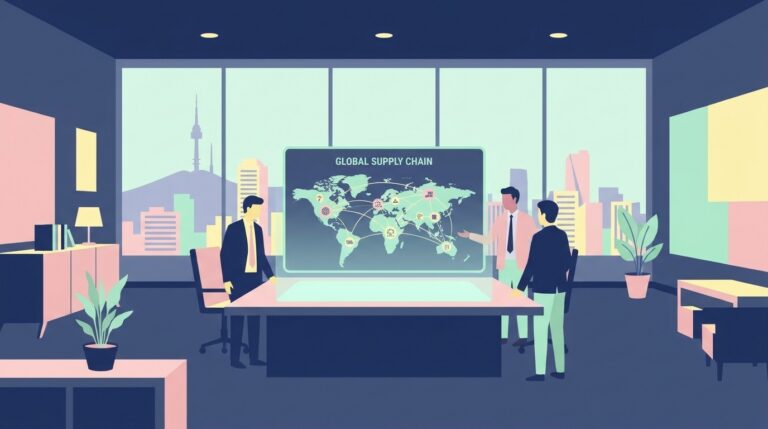
Phase 1: Empathy & Storytelling Opening
안녕하세요! 매일한글 에디터입니다. Have you ever watched a high-stakes K-drama boardroom scene—like in Reborn Rich (재벌집 막내아들) or Agency (대행사)—where executives stare down an unexpected international crisis with tense silence, before someone steps forward with an audacious strategic pivot? In global business, unexpected geopolitical friction, export bans, or single-source dependency can paralyze an entire manufacturing line overnight. For many international professionals navigating Korean corporate culture (대기업), speaking about strategic logistics isn’t just about showing off advanced vocabulary; it’s about projecting authority, reliability, and calm resilience under fire.
Many of our C1-level learners tell us: “I know everyday Korean and standard office phrases, but when geopolitical shocks or supply bottlenecks hit, I sound like an intern reading from a textbook.” Striking the right balance between corporate tact, strategic vision, and decisive boardroom terminology is tough. This guide is crafted directly from field debriefs with seasoned bilingual supply chain directors in Seoul. Master these high-level frameworks today, and you won’t just participate in crisis meetings—you will command them.
Phase 2: Core Expressions Deep Dive
1. 특정 국가에 편중된 원자재 조달 구조를 탈피하다 (Teukjeong gukgae pyeonjungdoen wonjaejae jodal gujoreul talpihada)
- Pronunciation: [Teuk-jeong gook-ga-ae pyeon-joong-doen won-jae-jae jo-dal goo-jo-reul tal-pi-ha-da] (Think: “Teuk” as in ‘took’ with a crisp snap, “talpi” sounding like breaking out of a shell)
- Meaning: Literal: “To shed the raw material procurement structure skewed toward a specific country.” / Executive Nuance: “To decisively eliminate single-country sourcing vulnerability.”
- K-Culture Moment: Evokes the iconic tension in corporate dramas where the executive board realizes an overseas supplier has placed an embargo on semiconductor wafers, demanding a break away from conventional reliance.
- Editor’s Insight: Notice the word 탈피하다 (脫皮하다). It literally means a reptile shedding its skin. In business Korean, using 탈피하다 instead of just 벗어나다 (to escape) signifies an active, painful, yet necessary structural transformation.
- Situation Spectrum: Casual 🚫 | Semi-formal ⚠️ | Formal ✅
- 🤔 Think About It: Why does Korean business favor biological metaphors like ‘shedding skin’ (탈피) when discussing high-level restructuring?
2. 공급망을 다변화하다 (Gonggeupmangeul dabyeonhwahada)
- Pronunciation: [Gong-geup-mang-eul da-byeon-hwa-ha-da] (Flow smoothly: gong-geup-mang rhymes with ‘song’, ‘dabyeonhwa’ rhymes with ‘car-yeon-hwa’)
- Meaning: Literal: “To multi-diversify the supply network.” / Strategic Nuance: “To diversify global supply chain channels across multiple strategic regions.”
- K-Culture Moment: Often featured in economic news segments (KBS News 9, SBS 8 News) analyzing Korea’s battery and EV sectors mitigating resource reliance.
- Editor’s Insight: While beginners learn 다양화하다 (to make various), advanced C1 professionals use 다변화 (多邊化). The Hanja 邊 (byeon) signifies borders or facets, specifically denoting multilateral geographical spreading.
- Situation Spectrum: Casual 🚫 | Semi-formal ✅ | Formal ✅
- 🤔 Think About It: Notice how Korean differentiates between variety of products (다각화/다양화) and geopolitical geographic distribution (다변화).
3. 지정학적 리스크를 선제적으로 관리하다 (Jijeonghakjeok riseukeureul seonjejeogeuro gwanlihada)
- Pronunciation: [Ji-jeong-hak-jeok ri-seu-keu-reul seon-je-jeo-geu-ro gwal-li-ha-da] (Note the sound assimilation: 관리 sounds like ‘gwal-li’, not ‘gwan-ri’)
- Meaning: Literal: “To manage geopolitical risk preemptively.” / Executive Nuance: “To take a proactive, forward-looking stance against cross-border regulatory and political volatility.”
- K-Culture Moment: Picture an executive presenting risk matrices on a sleek glass display during a strategic planning meeting in Pangyo Techno Valley.
- Editor’s Insight: The keyword is 선제적 (先制的). Korean corporate leadership prizes moving before competitors do. Using ‘선제적으로 대응하다/관리하다’ demonstrates C-suite foresight rather than passive damage control.
- Situation Spectrum: Casual 🚫 | Semi-formal ⚠️ | Formal ✅
- 🤔 Think About It: How does the cultural expectation of speed (빨리빨리) evolve into sophisticated preemptive foresight (선제적 대응) at the executive level?
Phase 3: Textbook Korean vs. Real Korean
Situation 1: Explaining supplier expansion in a board meeting
- 📖 교과서 한국어 (Textbook): 위험하니까 여러 나라에서 부품을 사기로 결정했습니다. (Wiheomhago niki yeoreo nara-eseo bupumeul sagiro gyeoljeonghaetseumnida.) – Because it’s dangerous, we decided to buy parts from various countries.
- 🗣️ 진짜 한국어 (Native C1 Executive): 단일 벤더 의존도를 낮추고 리스크를 분산하고자, 조달처 다변화를 신속히 추진했습니다. (Dan-il bendeo uijondoreul natchugo riseukeureul bunsanhagoja, jodalcheo dabyeonhwareul sinsokhi chujinhaetseumnida.) – To curtail single-vendor dependency and disperse vulnerability, we swiftly executed procurement channel diversification.
- 💡 왜 다를까?: Executive Korean drops vague words like ‘위험 (danger)’ or ‘여러 나라 (several countries)’ in favor of precise technical constructs like 단일 벤더 의존도 (single-vendor dependency) and 조달처 (sourcing base).
Situation 2: Reporting ongoing raw material export disruptions
- 📖 교과서 한국어 (Textbook): 그 나라에서 원자재를 안 보내줘서 생산이 멈출 것 같습니다. (Geu nara-eseo wonjaejaereul an bonaejwoseo saengsani meomchul geot gatseumnida.) – Because that country won’t send raw materials, production will likely stop.
- 🗣️ 진짜 한국어 (Native C1 Executive): 해당 국가의 수출 통제 기조로 인해 원자재 수급 불안정이 가중되고 있어, 대체 공급선 확보가 시급합니다. (Haedang gukgaui suchul tongje gijoro inhae wonjaejae sugeup buranjeongi gajungdoego isseo, daeche gonggeupseon hakboga sigeuphamda.) – Due to the export control stance of the nation in question, supply volatility is intensifying, making alternative sourcing critical.
- 💡 왜 다를까?: Real corporate speech refrains from assigning emotional or blunt blame, preferring nominal clauses (수출 통제 기조, 수급 불안정 가중) that remain objective and strategically focused.
Phase 4: K-Culture Deep Dive & Non-Verbal Manners
4-1. 눈치 (Nunchi) & Boardroom Posture
When discussing supply chain crises or massive capital reallocation in Korea, non-verbal cues carry enormous weight. Never raise your voice or present issues as catastrophic failures without an accompanying solution.
* The Visual Plane: When presenting data charts depicting risk exposure, gesture with an open palm—never point fingers or tap sharply with a laser pointer. Hold your tablet or documents with both hands (두 손) when delivering summaries to C-level officers.
* Strategic Eye Contact: Direct, unbroken eye contact during an apology or risk assessment can read as confrontational. In Korean corporate hierarchy, slightly soften your gaze toward the upper lapel or chin area of your executive while speaking firmly, signifying confidence tempered by organizational respect.
4-2. The Cultural Engine: “PPalli-PPalli” Meets Geopolitical Agility
Foreign observers know Korea’s famous 빨리빨리 (hurry-hurry) culture from delivery apps and fast transit. But in SCM (Supply Chain Management), this cultural trait evolves into remarkable corporate resilience. Historically lacking domestic natural resources, Korean industrial conglomerates—from electronics to battery giants—have had to cultivate hyper-alert antennas for global tariff shifts and raw material embargos. Demonstrating mastery of terms like 내재화 (domestic vertical integration) and 다각화 (diversification) tells Korean partners that you share their acute sense of global vulnerability and dynamic adaptability.
Phase 5: Real-World Roleplay Scenario
Setting: The 32nd-floor executive briefing room of a leading battery manufacturer in Yeouido, Seoul.
Character: 상무 한민혁 (Executive Director Han Min-hyuk), an exacting, visionary strategist who hates vague excuses and demands actionable solutions.
- 한민혁 상무: (서류를 검토하며 안경을 살짝 고쳐 쓰고) 김 팀장, 최근 특정 국가의 핵심 광물 수출 통제 움직임, 우리 생산 라인에 미칠 여파는 어떻게 진단하고 있습니까? (Kim timjang, choegeun teukjeong gukgaui haeksim gwangmul suchul tongje umjig-im, uri saengsan rain-e michil yeopaneun eotteoke jindanhago itseumnikka?)
🎭 Examining the executive brief, nudging his glasses with cool authority.
(Team Leader Kim, regarding the recent move to restrict key mineral exports from a certain country—how do you evaluate its ripple effect on our production line?) -
You (김 팀장): (단정한 자세로 태블릿을 들어 보이며) 네, 상무님. 특정 국가에 편중된 원자재 조달 구조로 인해 단기적인 수급 차질 우려가 상존했던 것이 사실입니다. (Ne, sangmunim. Teukjeong gukgae pyeonjungdoen wonjaejae jodal gujoro inhae dangijeogin sugeup chajil uryeoga sangjonhaetteon geosi sasirimnida.)
🎭 Maintaining erect posture, pointing smoothly with an open palm toward the presentation slide.
(Yes, Director Han. It is true that procurement risks were lingering in the short term due to our raw material sourcing structure being concentrated in a specific country.) -
한민혁 상무: (날카로운 눈빛으로) 상존했다는 건, 이미 대안이 가동되고 있다는 뜻입니까? (Sangjonhaetdaneun geon, imi dae-ani gadongdoego itdaneun tteusimnikka?)
🎭 Looking up sharply, searching for readiness.
(Saying it “was lingering”—does that imply an alternative is already operational?) -
You (김 팀장): (확신에 찬 어조로 고개를 끄덕이며) 그렇습니다. 지정학적 리스크를 선제적으로 완화하기 위해, 작년 4분기부터 글로벌 공급망 다변화를 추진해 왔습니다. (Geureotseumnida. Jijeonghakjeok riseukeureul seonjejeogeuro wanhwahagi wihae, jangnyeon sabungibuteo geullobeol gonggeupmang dabyeonhwareul chujinhae watseumnida.)
🎭 Nodding decisively with calm self-assurance.
(Precisely. To preemptively mitigate geopolitical risk, we have actively pursued global supply chain diversification since Q4 of last year.) -
한민혁 상무: (고개를 끄덕이며 자료를 넘긴다) 구체적으로 어느 권역까지 조달처를 확충했지요? (Guchejeogeuro eoneu gwon-yeokkkaji jodalcheoreul hwakchunghaetjiyo?)
🎭 Nodding subtly while turning the briefing page.
(Specifically, into which regions have you expanded our sourcing footprint?) -
You (김 팀장): (수치 그래프를 짚으며) 호주 및 동남아 권역 파트너사와의 장기 공급 계약을 체결하여 조달 포트폴리오를 재편했습니다. (Hoju mit dongnama gwon-yeok pateuneosawaui janggi gonggeup gyeyageul chegyeolhayeo jodal poteupollioreul jaepyeonhaetseumnida.)
🎭 Tracing the data trendline on the display.
(We signed long-term off-take contracts with partners across Australia and Southeast Asia, restructuring our procurement portfolio.) -
한민혁 상무: (만족스러운 미소를 살짝 띠며) 좋습니다. 원가 상승 압박은 어떻게 방어할 계획입니까? (Jotseumnida. Won-ga sangseung apbageun eotteoke bang-eohal gyehwigimnikka?)
🎭 Letting slip a rare, approving nod.
(Well done. And how do you plan to defend against raw material cost pressures?) -
You (김 팀장): (단호하고 안정감 있는 목소리로) 공정 혁신을 통한 원가 절감과 선물 거래를 통한 가격 헷징 전략을 병행하고 있습니다. (Gongjeong hyeoksineul tonghan won-ga jeolgamgwa seonmul georaereul tonghan gagyeok hetjing jeollyageul byeonghaenghago itseumnida.)
🎭 Speaking with firm, measured balance.
(We are concurrently executing process-driven cost reductions alongside price-hedging strategies via commodity futures.)
🔀 Interactive Decision Point
Suppose Director Han suddenly asks: “What happens if our new Southeast Asian suppliers also face policy shifts?” How do you respond?
- Option A: “어쩔 수 없죠. 그 나라 정부 정책까지 우리가 통제할 순 없으니까요.” (Eojjeol su eopjyo. Geu nara jeongbu jeongchaekkkaji uriga tongjehal sun eopseunikkayo. – Nothing we can do. We can’t control another government’s policies.)
👉 Feedback [Bad 🚫]: Defeatist and unprofessional. It signals a lack of executive ownership and crisis awareness. - Option B: “해당 지역의 규제 변화에 발맞춰 2차, 3차 대체 벤더 풀(Pool)을 상시 모니터링하여 즉각적인 롤오버 체계를 구축해 두었습니다.” (Haedang jiyeok-ui gyuje byeonhwawa balmatchwo icha, samcha daeche bendeo pureul sangsi moniteoringhayeo jeukgakjeogin rol-obeo chegyereul guchukhae dueotseumnida.)
👉 Feedback [Best 🌟]: C-level brilliance. Proves proactive multi-tier contingency planning and deep strategic maturity. - Option C: “그쪽 장관님과 이미 친분이 있는 로컬 에이전트가 있어서 아무 문제 없을 겁니다.” (Geujjok janggwannimgwa imi chinbuni inneun rokeol eijeonteuga isseoseo amu munje eopseul geomnida.)
👉 Feedback [Risk ⚠️]: Reliance on unofficial personal networks sounds risky and non-compliant in modern audit environments.
Phase 6: 10-Second Emotional Shadowing Drill
Read these aloud, pausing strictly at / and adopting the designated emotional stance.
[💼 확신에 차고 단호하게 (Confident & Firm)]
특정 국가에 편중된 / 조달 구조를 탈피하여 / 공급망 다변화를 / 성공적으로 완수했습니다.
(Teukjeong gukgae pyeonjungdoen / jodal gujoreul talpihayeo / gonggeupmang dabyeonhwareul / seong-gongjeogeuro wansuhaetseumnida.)
“By breaking free from a single-country sourcing structure, we have successfully diversified our supply chain.”-
[📊 분석적이고 차분하게 (Analytical & Composed)]
지정학적 리스크를 감안할 때, / 단기적 비용 상승보다 / 공급 안정성 확보가 / 훨씬 우선순위입니다.
(Jijeonghakjeok riseukeureul gamanhal ttae, / dangijeok biyong sangseungboda / gonggeup anjeongseong hakboga / hwolssin useonsunwi-imnida.)
“Considering geopolitical risk, securing supply continuity takes clear precedence over short-term cost increases.” -
[🛡️ 든든하고 신뢰감 있게 (Reassuring & Resolute)]
수급 불안정에 대비해 / 핵심 부품의 전략적 비축과 / 대체선 발굴을 / 선제적으로 병행하고 있습니다.
(Sugeup buranjeong-e daebihae / haeksim bupumui jeollyakjeok bichuk-gwa / daecheseon balgureul / seonjejeogeuro byeonghaenghago itseumnida.)
“To prepare for supply instability, strategic stockpiling of critical components and exploration of alternate channels are proceeding concurrently.”
Phase 7: K-Culture Mini Dictionary
- 다변화 (Dabyeonhwa – Multilateral Diversification): Derived from Chinese characters meaning ‘many borders’. Used in Korean business when entering diverse global markets or balancing multi-country logistics channels.
- 편중 (Pyeonjung – Skewed Concentration / Asymmetry): Describes dangerous imbalance. E.g., ‘매출 편중’ (over-reliance on one client), ‘공급망 편중’ (supply chain over-dependence).
- 내재화 (Naejaehwa – Vertical Internalization / In-House Integration): Bringing third-party production, tech, or raw materials inside company walls to insulate operations from external shocks.
- 리스크 헷징 (Riseukeu Hetjing – Risk Hedging): Widely assimilated Konglish used in corporate boardrooms to denote proactive financial or structural cushions against market volatility.
Phase 8: Expat & Professional Survival Kit
Survival Expressions TOP 3
- 비상 계획(컨틴전시 플랜)을 가동해야 합니다. (Bisang gyehoegeul gadonghaeya hamnida.)
→ Pro Tip: Use when market indicators plunge. It sounds authoritative and immediate without causing panic. - 납기 일정에는 차질이 없도록 조치하겠습니다. (Napgi iljeong-eneun chajiri eopdorok jochihagetseumnida.)
→ Pro Tip: The ultimate assurance phrase for clients and upper management when logistics delays loom. - 현지 동향을 면밀히 모니터링하고 있습니다. (Hyeonji donghyang-eul myeonmilhi moniteoringhago itseumnida.)
→ Pro Tip: Perfect for regular updates when foreign regulatory decisions are still pending.
Editor’s Professional Note
To stay updated with Korean industry policy shifts, bookmark the KOTRA 해외시장뉴스 웹사이트 (KOTRA Global Market News Website). It delivers real-time briefings on global trade regulations in the exact, sophisticated Korean required for high-stakes corporate reporting.
Phase 9: A Step Deeper (한 발 더 깊이)
Korea’s industrial modern history is fundamentally defined by overcoming natural resource scarcity through rapid organizational coordination and strategic foresight. For a country that imports nearly all of its petroleum and core industrial minerals, expressions like “원자재 조달 구조 다변화” (procurement diversification) carry deep cultural gravity; they touch upon the core ethos of survival and self-determination (자립). In Korean corporations, discussing supply chain risk is never merely an operational chore; it is an executive performance displaying how well you safeguard the collective community against external vulnerability.
💬 Your Turn: Does your company or country view single-source dependency as an acceptable cost-efficiency trade-off, or as an existential risk? Let’s discuss in the comments below!
Phase 10: FAQ & Common Mistakes
Q: Is there a distinction between 공급망 다변화 and 공급망 다양화?
A: Yes. While 다양화 refers to qualitative variety (offering various products or types of components), 다변화 explicitly denotes geographical or channel dispersion across borders. In SCM, always opt for 공급망 다변화.
Q: Can I use 탈피하다 for small business issues?
A: 탈피하다 implies breaking out of an ingrained, long-standing habit or institutional status quo. For minor everyday changes, use 벗어나다; reserve 탈피하다 for structural, systemic turnarounds.
Q: What is the most natural way to present an alternative supplier to a Korean boss?
A: Introduce them as an 대체 조달처 (alternative procurement channel) or 세컨드 벤더 (secondary vendor), framing them as a calculated hedge rather than an impulsive reaction.
🚨 Common Mistakes Alert
- Saying “공급망을 바꿨어요” (Gonggeupmangeul bakkwoesseoyo): Too conversational for an executive briefing. Use 공급망을 다변화했습니다 or 조달 체계를 재편했습니다.
- Mispronouncing ‘조달’ (Jodal) as ‘조절’ (Jojeol): 조달 is procurement/sourcing; 조절 is adjustment. Mixing them up causes major confusion in SCM meetings.
- Overusing “위험” instead of “리스크” or “불확실성”: Saying “위험이 큽니다” can sound overly alarmist. In Korean strategic meetings, 리스크 요인 (risk factor) or 불확실성 (uncertainty) conveys objective professionalism.
Phase 11: Action Mission & Engagement
- 🥉 Bronze Mission: Record yourself shadowing Phase 6’s first drill with firm executive vocal cadence. Check that “탈피하여” sounds smooth without hesitation.
- 🥈 Silver Mission: Write a 2-sentence corporate status report using 편중 and 다변화 in the comments section below for direct editorial feedback.
- 🥇 Gold Mission: In your next cross-border team sync or mock presentation, replace conversational vocabulary with 선제적 대응 (preemptive response) and 공급망 다변화 (supply chain diversification).
- 🎮 K-Culture Mission: Watch an episode of a Korean business drama (like Misaeng or Agency) and write down every time an executive uses the word 리스크 or 선제적.
Phase 12: Interactive Quiz Challenge
1. [상황 판단] A board member asks how you plan to handle impending raw material export limits. Which response demonstrates the highest level of C1 Korean professionalism?
* (A) 그냥 기다리다가 가격이 내려가면 사겠습니다.
* (B) 특정 지역 의존도를 탈피하여 대체 조달처 다변화를 신속히 실행하겠습니다.
* (C) 위험해서 다른 부품으로 바꾸면 됩니다.
2. [빈칸 채우기] Fill in the appropriate strategic term:
“단일 공급선에 대한 지나친 ______ 구조를 해소하기 위해 계약처를 분산했습니다.”
(Hint: Means ‘skewed concentration’ or ‘imbalance’)
3. [True or False] In Korean corporate culture, stating “단일 국가 의존도 탈피” indicates simple cost-cutting rather than structural risk management. (T/F)
👉 정답과 해설 보기 (Click to view Answers & Explanations)
-
정답: (B)
해설: (B) exhibits textbook-perfect C1 executive Korean by pairing ‘탈피’ with ‘대체 조달처 다변화’. (A) is passive and careless; (C) is overly simplistic and grammatically elementary. -
정답: 편중 (Pyeonjung)
해설: 편중 refers to the dangerous skewing or over-concentration of resources into a single source. -
정답: False
해설: 탈피 (shedding the old structure) signifies a comprehensive geopolitical and strategic risk-mitigation initiative, far beyond simple operational cost reduction.






