

Preserving Soul in the City: Navigating Gentrification and ‘Win-Win’ Agreements in Korea
Phase 1: Empathy & Story Opening
안녕하세요! 매일한글 에디터입니다. (Hello! I’m your Daily Hangul editor.)
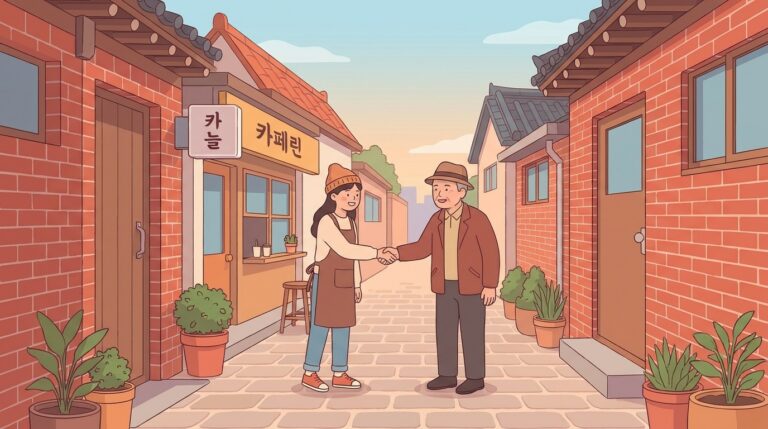
Picture this: You are wandering through the charming, labyrinthine alleys of Seongsu-dong or Ikseon-dong. You discover a cozy, warm-lit book cafe tucked between old red-brick factories, run by an independent roaster who curates poetry on every cup sleeve. Six months later, you return with your friends, excited to show them your secret haven—only to find the warm wooden door replaced by the neon sign of an international fast-fashion franchise or a sterile corporate chain cafe.
Your heart sinks. In Korea, this heartbreaking reality is known as 둥지 내몰림 (dungji naemollim)—literally, “being pushed out of one’s nest.” As indie artists and passionate local creators breathe life into forgotten alleyways, rents skyrocket, forcing the very pioneers who made the neighborhood vibrant to pack their bags.
However, there is an inspiring twist happening right now across Korean cities. Rather than surrendering to unchecked displacement, forward-thinking district offices, kind property owners, and young entrepreneurs are sitting down together at the negotiation table. They are signing 상생 협약 (sangsaeng hyeobyak)—voluntary “mutual coexistence agreements” designed to freeze or stabilize rents, protect local creators, and keep the authentic heartbeat of Korean neighborhoods alive.
Today, we are diving deep into B2-level conversational and cultural mastery. By mastering these expressions, you will go beyond ordering coffee; you will be able to discuss real social topics with Korean friends, appreciate the deep communal bond (jeong, 정) underpinning neighborhood economies, and speak with the refined nuance of a true local insider. Let’s explore together!
Phase 2: Core Expressions Deep Dive
Here are three essential B2 expressions that capture the essence of modern neighborhood dynamics in Korea.
1. 상생 협약 (Sangsaeng Hyeobyak)
- Pronunciation: [sang-saeng hyeob-yak] (Think of ‘sung-sang’ + ‘hyup-yahk’, blending smoothly without a harsh final ‘k’)
- Meaning:
- Literal: Mutual Life Agreement
- Real Nuance: A voluntary win-win covenant where landlords, local authorities, and shop owners commit to capping rent hikes and coexisting sustainably.
- K-Culture Moment: You will hear this term in modern urban K-dramas like Itaewon Class or news specials whenever independent street entrepreneurs fight for their right to build community value alongside landlords.
- Editor’s Insight: The word 상생 (sangsaeng) is made of ‘상’ (相, mutual) and ‘생’ (生, life). It implies that neither side can survive alone; the landlord’s building loses all value if the creative tenant leaves, and the tenant cannot thrive without fair space.
- Situation Spectrum: Casual ⚠️ | Semi-formal ✅ | Formal ✅
- 🤔 Think About It: In your hometown, are lease disputes regulated purely by legal statutes, or do you have community-led “win-win pledges” like Korea’s sangsaeng culture?
2. 둥지 내몰림 (Dungji Naemollim)
- Pronunciation: [doong-ji nae-mol-lim] (Flows like ‘doong-jee nay-mohl-leem’)
- Meaning:
- Literal: Pushed out of the nest
- Real Nuance: The native, empathetic Korean expression for gentrification, highlighting the vulnerability of local shopkeepers and artisans being displaced from their creative homes.
- K-Culture Moment: Used by documentary hosts and indie vloggers exploring historic neighborhoods like Euljiro (Hip-jiro) or Mullae-dong Art Village to lament rising commercialization.
- Editor’s Insight: While Koreans also borrow the loanword 젠트리피케이션 (jenteuripikeisyeon), cultured speakers and civic groups favor 둥지 내몰림 because it appeals to emotional solidarity rather than sterile economic theory.
- Situation Spectrum: Casual ⚠️ | Semi-formal ✅ | Formal ✅
- 🤔 Think About It: How does naming an economic issue “nest eviction” change the way citizens empathize with evicted shopkeepers compared to the technical word “gentrification”?
3. 골목상권을 살리다 (Golmoksang-gwoneul sallida)
- Pronunciation: [gol-mok-sang-gwon-eul sal-li-da] (Pronounce as ‘gohl-mohk sahng-gwuhn-eul sahl-lee-dah’)
- Meaning:
- Literal: To bring the alleyway commercial rights back to life
- Real Nuance: To revitalize traditional, hidden neighborhood alleys into culturally thriving hubs while protecting mom-and-pop shops.
- K-Culture Moment: This is the iconic mission phrase of the smash-hit variety show Baek Jong-won’s Alley Restaurant (골목식당), where veteran culinary mentors help struggling alleyway restaurants flourish.
- Editor’s Insight: In Korean culture, a 골목 (golmok) isn’t just an alleyway; it symbolizes warm memories, neighborly chats over low fences, and childhood playground energy. Revitalizing a golmok means reviving community warmth.
- Situation Spectrum: Casual ✅ | Semi-formal ✅ | Formal ✅
- 🤔 Think About It: What kind of alleys or backstreets exist in your city? Are they considered sketchy back alleys, or vibrant spots of cultural heritage like in Seoul?
Phase 3: Textbook Korean vs. Real Korean
Let’s see how native speakers actually discuss gentrification and neighborhood preservation in daily conversation.
Situation 1: Describing a neighborhood where original businesses were forced out
- 📖 교과서 한국어 (Textbook):
- 이 지역은 임대료가 너무 많이 올라서 기존 상인들이 떠났습니다.
- (I jiyeogeun imdaeryoga neomu mani ollaseo gijon sang-indeuri tteonasseumnida. / In this region, rents increased excessively, so the existing merchants departed.)
- 🗣️ 진짜 한국어 (Real-life):
- 여긴 동네가 뜨자마자 둥지 내몰림 때문에 터줏대감들이 다 밀려났어요.
- (Yeogin dongnega tteujamaja dungji naemollim ttaemune teojutdaegamdeuri da millyeonasseoyo. / As soon as this neighborhood got popular, the original mainstays all got pushed out due to nest-eviction.)
- 💡 왜 다를까? (Why is it different?): Native Koreans use lively idiomatic verbs like 뜨다 (tteuda) (to blow up/trend) and historic cultural terms like 터줏대감 (teojutdaegam) (the long-standing neighborhood guardians/pioneers) instead of clinical textbook phrasing.
Situation 2: Praising a building owner who agreed not to raise rent
- 📖 교과서 한국어 (Textbook):
- 건물주와 세입자가 원만하게 임대 계약을 체결했습니다.
- (Geonmuljuwa seipjaga wonmanhage imdae gyeyageul chegyeolhaesseumnida. / The building owner and tenant concluded the lease contract amicably.)
- 🗣️ 진짜 한국어 (Real-life):
- 건물주님이 상생 협약에 동참해 주셔서 임대료 동결하고 계속 가기로 했대요!
- (Geonmuljunimi sangsaeng hyeobyage dongchamhae jusyeoseo imdaeryo donggyeolhago gyesok gagiro haettaeyo! / The landlord joined the win-win agreement and froze our rent, so we can keep running the shop long-term!)
- 💡 왜 다를까? (Why is it different?): Koreans frequently add the honorific suffix -님 (-nim) to 건물주 (geonmulju – landlord) to show sincere gratitude, paired with modern civic buzzwords like 상생 협약에 동참하다 (join the mutual coexistence pact) and 임대료 동결 (rent freeze).
Phase 4: K-Culture Deep Dive & Non-Verbal Manners
4-1. Nunchi & Gestures: Negotiating with Grace
When Korean shopkeepers, local creators, and older landlords negotiate leases or neighborhood compacts, emotional etiquette (nunchi, 눈치) is critical.
* Two-Handed Respect: When presenting a petition, lease draft, or even handing over a cup of warm tea during a meeting, always hold it with both hands or support your right wrist with your left hand (두 손으로 건네기).
* Sympathetic Posture: In discussions about rising street taxes and maintenance fees, lean forward slightly and use warm affirmative nods accompanied by “아이고, 어르신 말씀이 맞습니다” (Aigo, eoreusin malsseumi matseumnida – “Ah, you are completely right, sir/ma’am”). Direct confrontational staring or aggressive body posture will immediately close off negotiations. Korean landlords value relational loyalty and respect far more than aggressive cold-call tactics.
4-2. Cultural Code: The ‘Local Creator’ Phenomenon
In neighborhoods like Seongsu, Euljiro, and Gangneung, young Koreans are rejecting corporate ladder jobs to become 로컬 크리에이터 (Local Creators). They repurpose 50-year-old shoemaking factories, rice mills, and carpentry shops into boutique stationery stores, microbreweries, and artisan bakeries. However, when big conglomerates notice their success, commercial rent hikes threaten to wipe them out. The 상생 협약 serves as an urban peace treaty. It represents modern Korea’s effort to balance rapid economic capitalism with 상생 (living together), preserving the tactile soul of community heritage.
Phase 5: Real-World Roleplay Scenario
Setting: A quiet evening inside an artisan ceramic cafe in Euljiro. Min-woo (31), a local creator, is serving roasted barley tea to Mr. Park (68), his building owner who has owned the property for four decades.
Characters:
* 민우 (Min-woo): Creative entrepreneur striving to maintain his workshop.
* 박 사장님 (Mr. Park): Traditional building owner who values community pride but faces pressure from franchise developers.
- 민우: 🎭 (두 손으로 따뜻한 찻잔을 건네며 부드러운 미소로) 어르신, 요즘 날씨가 많이 쌀쌀하죠? 따뜻한 보리차 좀 드세요.
(Eoreusin, yojeum nalssiga mani ssalssalhajyo? Ttatteutan boricha jom deuseyo. / Sir, the weather has gotten quite chilly lately, hasn’t it? Please have some warm barley tea.) -
박 사장님: 🎭 (차를 한 모금 마시며 허허 웃는다) 고마워, 민우 씨. 그나저나 요즘 우리 골목에 외지인들이 부쩍 많이 찾아오더군.
(Gomawo, Min-woo ssi. Geunajeona yojeum uri golmoge oejijindeuri bujjeok mani chajaodeogun. / Thanks, Min-woo. By the way, a lot of outsiders seem to be flocking to our alley these days.) -
민우: 🎭 (차분하게 고개를 끄덕이며) 네, 젊은 친구들이 우리 골목의 옛 정취를 좋아하더라고요. 그런데 솔직히 임대료가 너무 오를까 봐 걱정도 커요.
(Ne, jeolmeun chin-gudeuri uri golmogui yet jeongchwireul joaharadeoragoyo. Geurende soljikhi imdaeryoga neomu oreulkka bwa geokjeongdo keoyo. / Yes, young folks really love the vintage charm of our alley. But honestly, I’m quite worried that the rents will skyrocket.) -
박 사장님: 🎭 (한숨을 쉬며 안타까운 눈빛으로) 맞아. 건너편 인쇄소 자리도 프랜차이즈가 들어오면서 터줏대감들이 쫓겨났어. 둥지 내몰림이 남 일이 아니야.
(Maja. Geonneopyeon inswaeso jarido peuraenchaijeuga deureo-omyeonseo teojutdaegamdeuri jjotgyeonasseo. Dungji naemollimi nam iri aniya. / True. The print shop across the street got replaced by a franchise, pushing out long-time owners. Gentrification is not someone else’s problem anymore.) -
민우: 🎭 (조심스럽게 서류 봉투를 펴며 눈을 맞춘다) 사장님, 그래서 구청과 함께 준비 중인 ‘상생 협약’에 대해 말씀드리고 싶었어요.
(Sajangnim, geuraeseo gucheonggwa hamkke junbi jung-in ‘sangsaeng hyeobyak’e daehae malsseumdeurigo sipeosseoyo. / Mr. Park, that’s actually why I wanted to talk to you about the ‘win-win agreement’ the district office is preparing.) -
박 사장님: 🎭 (돋보기안경을 고쳐 쓰며 흥미로운 표정으로) 상생 협약? 그게 구체적으로 어떤 거지?
(Sangsaeng hyeobyak? Geuge guchejeogeuro eotteon geoji? / Win-win agreement? What does that involve specifically?) -
민우: 🎭 (진심 어린 어조로 정중하게 설득한다) 임차인은 골목 문화를 지키고, 건물주님은 임대료를 급격히 올리지 않는 대신 구청에서 세제 혜택과 골목 보수 지원을 해준대요.
(Imchain-eun golmok munhwareul jikigo, geonmuljunimeun imdaeryoreul geupgyeokhi olliji anneun daesin gucheong-eseo seje hyetaekgwa golmok bosu jiwoneul haejundaeyo. / Tenants maintain the alley’s unique culture, and in return for building owners agreeing not to spike rents, the district offers tax benefits and alleyway renovation support.) -
박 사장님: 🎭 (무릎을 탁 치며 환하게 웃는다) 듣고 보니 우리 골목상권을 함께 살리는 좋은 방법이네! 내 기꺼이 서명하지!
(Deutgo boni uri golmoksang-gwoneul hamkke sallineun joeun bangbeobine! Nae gikkeoi seomyeonghaji! / Hearing that, it sounds like a wonderful way to revive our neighborhood commercial district together! I will gladly sign it!)
🔀 Interactive Decision Point
Imagine you are Min-woo. How would you follow up after Mr. Park agrees?
- Choice A: “사장님, 정말 감사합니다! 약속하신 거니까 당장 10년 계약서에 도장부터 찍으시죠!” (“Thank you! Since you promised, let’s stamp a 10-year contract right now!”)
- Choice B: “어르신, 골목의 미래를 위해 큰 결단 내려주셔서 진심으로 감사드립니다. 내일 구청 담당자와 함께 찾아뵙겠습니다.” (“Sir, thank you from the bottom of my heart for making such a generous decision for the future of our alley. I’ll visit you tomorrow with the district coordinator.”)
- Choice C: “다른 건물주들은 욕심부리느라 다 거절하던데, 사장님은 역시 다르시네요!” (“Other landlords are too greedy and rejected it, but you are truly different!”)
[Feedback on Your Choice]
- Choice A (Risk): Pushing legal stamps and long commitments too abruptly right after an emotional breakthrough breaks the mood and evokes defensive caution.
- Choice B (Best): Extremely respectful, acknowledges his civic leadership, and establishes official, comfortable next steps.
- Choice C (Bad): Criticizing other neighborhood elders can backfire, as landlords in close-knit Korean districts are often lifelong friends or relatives.
Phase 6: 10-Second Emotion Shadowing Drill
Practice these lines out loud. Match the rhythm using the slashes (/) as brief breath pauses!
[🤝 진심 어린 눈빛으로 신뢰를 담아 / With earnest trust]
지자체와 건물주가 / 상생 협약을 맺은 덕분에 / 우리 골목상권을 / 오래 지킬 수 있게 되었어요.
(Jijachaewa geonmuljuga / sangsaeng hyeobyageul maejeun deokbune / uri golmoksang-gwoneul / orae jikil su itge doeeosseoyo.)-
[🥺 아쉽고 안타까운 한탄을 섞어서 / With tender sorrow and regret]
정성껏 가꾼 골목인데 / 둥지 내몰림 때문에 / 예술가들이 다 떠나다니 / 너무 속상해요.
(Jeongseongkkeot gakkun golmoginde / dungji naemollim ttaemune / yesulgadoeri da tteonadani / neomu soksanghaeyo.) -
[💪 자신감 넘치고 당차게 / With proud conviction]
우리는 단순한 카페가 아니라 / 이 동네의 매력을 만드는 / 당당한 로컬 크리에이터예요!
(Urineun dansunhan kapega anira / i dongne-ui maeryeogeul mandeuneun / dangdanghan rokeol keurieiteoyeyo!)
Phase 7: K-Culture Mini Dictionary
| # | Term (Hangul + Romanization) | Translation | Everyday & Civic Context |
|---|---|---|---|
| 1 | 상생 (Sangsaeng) | Coexistence / Mutual Prosperity | Widely used in Korean corporate, municipal, and labor sectors to emphasize sustainable harmony between major firms and local artisans. |
| 2 | 착한 임대인 (Chakhan Imdaein) | Kind Landlord (Socially Responsible Landlord) | A title created during COVID-19 and urban revitalization movements for building owners who voluntarily discount or freeze rents to help struggling tenants. |
| 3 | 로컬 크리에이터 (Rokeol Keurieiteo) | Local Creator | Young entrepreneurs who blend local natural heritage, history, and craft traditions with fresh branding to build unique neighborhood cultures. |
| 4 | 골목투어 (Golmok-tueo) | Alleyway Walking Tour | A major K-Travel trend where travelers explore historical alleys in Jongno, Seongsu, or Busan instead of crowded mega-malls. |
Phase 8: Traveler’s Survival Kit
Top 3 Survival Phrases
-
여기 동네 분위기가 정말 정겨워요.
(Yeogi dongne bunwigiga jeongmal jeonggyeowoyo.)
Pro Tip: Say this to an older shopkeeper. 정겹다 (jeonggyeopda) means “full of warm affection and nostalgia”—they will likely offer you extra treats (service!) on the spot. -
이 건물에 오래 계셨던 터줏대감 가게가 어디인가요?
(I geonmure orae gyesyeotdeon teojutdaegam gagega eodi-ingayo?)
Pro Tip: Perfect when searching for legendary, authentic local eats hidden behind newly gentrified hipster cafes. -
로컬 창작자분들이 모여서 만든 공간인가요?
(Rokeol changjakjabundeuri moyeoseo mandeun gonggan-ingayo?)
Pro Tip: Great icebreaker when visiting indie lifestyle select shops or artisan ceramic studios in Seongsu or Mullae.
Editor’s Travel Note
When exploring these neighborhoods, avoid standard international mapping apps which frequently miss tiny Korean alley shops. Always use Naver Map App Download to uncover hidden workshops. Search terms like “로컬 크리에이터 팝업” (Local Creator Pop-up) or “골목 문화공간” (Alley Cultural Space) to find unique spots participating in sustainable district projects.
Phase 9: Step Deeper (Reflective Essay)
In many Western metropolitan cities, gentrification is often accepted as the inevitable, cold arithmetic of capital flow. However, in Korea, the rapid transformation of historic neighborhoods sparks a profound cultural tension between rapid modernization and 공동체 의식 (gongdongche uisik – community consciousness).
Koreans carry a deep collective attachment to 정 (jeong)—the unwritten, emotional glue that binds neighbors together. When a neighborhood loses its cobblers, printing presses, and elderly teahouses to shiny corporate franchises, citizens feel a collective loss of identity. The emergence of the 상생 협약 (win-win agreement) demonstrates that Korean society is actively looking for a third way: an urban ecosystem where economic dynamism and human warmth survive side-by-side.
💬 Your Turn: Has your favorite local hangout ever disappeared due to rising rents? How does your city handle gentrification compared to Korea’s collaborative agreements? Share your story in the comments below!
Phase 10: FAQ & Mistake Prevention
Q: Can ‘상생’ be used in everyday casual chats with friends?
A: While 상생 is predominantly used in social, civic, or business contexts, you can humorously apply it casually! For instance, if you and your roommate split chores, you can say: “우리 룸메이트끼리 상생 협약 좀 맺자! 내가 설거지할 테니 네가 청소해.” (“Let’s sign a win-win agreement between roommates! I’ll do dishes if you clean.”)
Q: What is the exact difference between ‘젠트리피케이션’ and ‘둥지 내몰림’?
A: 젠트리피케이션 is the broader academic loanword referring to the socioeconomic phenomenon of capital moving into working-class areas. 둥지 내몰림 focuses specifically and poignantly on the displacement of the creators, tenants, and small merchants who built the neighborhood’s original charm.
Q: Does a ‘상생 협약’ have the same power as a legal court contract?
A: Generally, a 상생 협약 is a voluntary social compact facilitated by local district offices (구청). While it carries less punitive legal muscle than a statutory court order, it grants building owners real civic incentives—like municipal tax breaks, building renovation grants, and public honorific plaques—creating strong social motivation to uphold it.
🚨 Common Mistakes Alert
| Mistake | What Learners Say | Why It’s Wrong | Correct Action |
|---|---|---|---|
| 1. Confusing Tenant & Landlord | “저는 임대인이라서 월세를 내요.” | 임대인 (imdaein) is the landlord who rents out; 임차인 (imchain) is the tenant who pays rent. | Say: “저는 임차인이라서 매달 월세를 내요.” |
| 2. Overusing Clinical Jargon in Daily Talk | “이 카페는 젠트리피케이션에 저항하는 중입니다.” | Sounds like a dry academic thesis statement rather than friendly conversation. | Say: “이 카페는 골목의 원래 색깔을 지키려고 노력 중이래요.” |
| 3. Mispronouncing Sangsaeng | Pronouncing ‘상생’ as sang-song or sang-seong. | Incorrect vowels distort the meaning towards ‘sanctuary’ or other terms. | Articulate clearly: 상 (sang – open ‘ah’) + 생 (saeng – flat ‘ae’). |
Phase 11: Action Mission & Community Challenge
- 🥉 Bronze Mission (Solo Mastery): Read the Phase 6 Shadowing Drill sentences 3 times in front of the mirror, matching the precise facial expressions indicated in the brackets.
- 🥈 Silver Mission (Social Sharing): Pick a photo of your favorite indie cafe or neighborhood alleyway. Post it on your social media with the Korean caption:
“골목상권의 매력을 지키는 상생을 응원합니다! #매일한글 #상생협약 #로컬크리에이터” - 🥇 Gold Mission (Real Life Application): Visit an independent shop or cafe in Korea and compliment the owner on their distinct aesthetic using the survival phrase:
“골목 분위기가 정말 정겨워요!” - 🎮 K-Culture Mission: Watch Episode 1 or 2 of Itaewon Class or an episode of Baek Jong-won’s Alley Restaurant. Spot when characters discuss landlord conflicts, rent pressures, or revitalizing the street scene!
Phase 12: Interactive Quiz Challenge
Test your understanding of today’s lesson!
Quiz 1. Context Judgment
Which sentence is the most natural, respectful way for a young cafe creator to praise an elderly landlord who signed a win-win agreement?
* A) 우리 건물주 형님이 쿨하게 도장 찍어줬어요.
* B) 건물주 어르신께서 상생 협약에 동참해 주셔서 큰 힘이 됩니다.
* C) 건물주가 돈 욕심을 버려서 다행이라고 생각해요.
👉 Check the Answer & Explanation
- Correct Answer: B
- Explanation: In Korean culture, addressing an elderly property owner respectfully as 건물주 어르신 (geonmulju eoreusin) and acknowledging that their participation gives you great strength (큰 힘이 됩니다) hits the perfect B2-level cultural etiquette. Choice A is overly casual/disrespectful, and Choice C is insulting.
Quiz 2. Fill in the Blank
“유명한 예술가들이 모여 살던 오래된 골목이었는데, 최근 임대료가 너무 올라 원래 살던 사람들이 쫓겨나는 ( ) 현상이 심각해지고 있습니다.”
- A) 상생 협약 (Sangsaeng hyeobyak)
- B) 둥지 내몰림 (Dungji naemollim)
- C) 골목상권 (Golmoksang-gwon)
👉 Check the Answer & Explanation
- Correct Answer: B) 둥지 내몰림
- Explanation: The context refers to original residents and artists being forced out due to rising rents—which is the exact definition of 둥지 내몰림 (nest displacement / gentrification).
Quiz 3. True or False Cultural Quiz
- Statement: A ‘상생 협약 (win-win agreement)’ is solely enforced by the Korean Supreme Court with mandatory prison sentences for landlords who raise rents.
- [ ] True
- [ ] False
👉 Check the Answer & Explanation
- Correct Answer: False
- Explanation: A 상생 협약 is typically a voluntary, collaborative covenant mediated by local district offices (구청), landlords, and tenant associations. It relies on community spirit, civic pride, and municipal tax/maintenance incentives rather than direct criminal penalties.







