

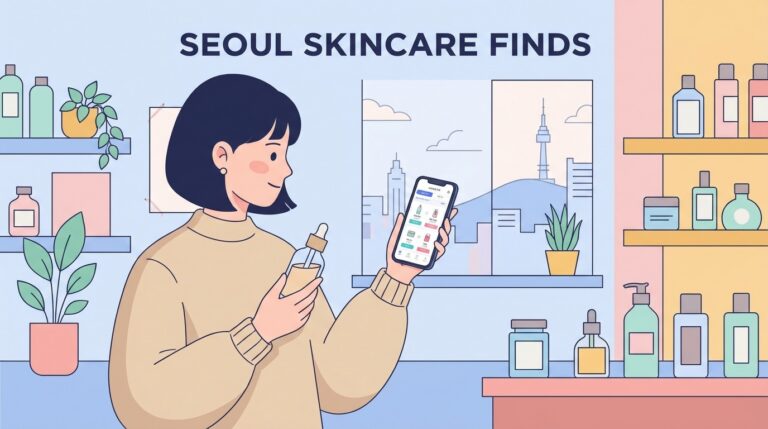
Master the Art of ‘Webrooming’ in Korea: How to Shop Smart in Offline Stores
Phase 1: Empathy & Story-Driven Opening
안녕하세요! 매일한글 에디터입니다.
Imagine walking down the lively alleys of Seongsu-dong or stepping into a multi-story flagship store in Myeongdong. Your smartphone screen is glowing with Naver shopping tabs, ingredient breakdowns on Hwahae, and detailed reviews on Musinsa. You have spent hours scrutinizing user ratings, color swatches, and sizing charts late at night. But instead of clicking “Buy Now” and waiting for a parcel, you are standing right in front of the physical display shelf.
You carefully pick up the tester, check the tactile finish of the fabric, smell the subtle citrus notes of the fragrance, and smile. You already know every single technical specification; you simply came to verify the real thing with your own senses and walk out holding the shopping bag.
In modern Korean consumer culture, this shopping behavior is called 역쇼루밍 (Webrooming / Reverse-Showrooming). While showrooming (쇼루밍) involves checking products offline to buy them cheaper online, webrooming flips the script: thorough digital research precedes immediate offline gratification. Alongside lifestyle buzzwords like 디토 소비 (Ditto Consumption), 도파밍 (Dopamine Farming), and 텍스트힙 (Text-Hip), webrooming defines how modern Koreans make smart, regret-free purchases.
Many intermediate Korean learners feel tongue-tied when transitioning from silent mobile research to speaking naturally with store associates. Based on real feedback from our Daily Hangul learners, this guide equips you with nuanced B2-level Korean expressions, body language etiquette, and cultural confidence so you can navigate Korean retail spaces like a true local.
Phase 2: Core 3 Expressions In-Depth Breakdown
1. 역쇼루밍 (Yeok-syoruming)
- Pronunciation: [Yeok-syo-ru-ming] (Phonetic analogy: Think of a crisp ‘Yuck’ transitioning smoothly into ‘Show-rooming’ without an over-enunciated ‘k’ sound)
- Meaning: Webrooming / Reverse Showrooming (Researching online, purchasing offline)
- K-Culture Moment: Commonly heard in economic news segments, retail marketing podcasts, and lifestyle vlogs explaining why Gen Z shoppers still flock to flagship pop-ups in The Hyundai Seoul.
- Editor’s Insight: Unlike showrooming (which brick-and-mortar stores dread), retail associates welcome 역쇼루밍 because it leads to immediate counter sales. Use this noun when discussing retail trends with Korean colleagues or friends.
- Situation Spectrum: Casual: ✅ | Semi-formal: ✅ | Formal: ✅
- 🤔 Think About It: Why do you think Korean consumers crave physical confirmation even within the world’s fastest, overnight e-commerce delivery system?
2. 실물 확인하고 사려고요 (Silmul hwag-inhago saryeogoyo)
- Pronunciation: [Sil-mul hwa-gin-ha-go sa-ryeo-go-yo] (Phonetic analogy: ‘Sil-mool’ like silk+pool, ‘Hwah-geen’ like checking in at a counter)
- Meaning: Literal: “I intend to buy after checking the actual item.” | Nuance: “I’ve already done my research online; I’m here to inspect the real item before completing my purchase.”
- K-Culture Moment: Used when an attentive store clerk asks, “찾으시는 상품 있으세요?” (Are you looking for a specific product?).
- Editor’s Insight: The suffix
-고요(-goyo) provides a soft, polite ending that clarifies your definitive intent without sounding dismissive or blunt.- Situation Spectrum: Casual: ⚠️ (drop ‘-요’ with peers) | Semi-formal: ✅ | Formal: ✅
- 🤔 Think About It: How does clearly stating your intent to buy change the energy between you and a retail salesperson compared to just saying “그냥 둘러보는 거예요” (I’m just looking around)?
3. 온라인 최저가랑 비교해 봤어요 (On-rain choejeogarang bigyohae bwasseoyo)
- Pronunciation: [On-ra-in choe-jeo-ga-rang bi-gyo-hae bwa-sseo-yo] (Phonetic analogy: ‘Choe-jeo-ga’ sounds like ‘chweh-juh-gah’)
- Meaning: Literal: “I compared it with the online lowest price.” | Nuance: “I’ve checked the online benchmark price and know the market value.”
- K-Culture Moment: Tech YouTube reviews discussing whether buying electronics offline with immediate bundled gifts (사은품) beats lowest-bidder open-market listings.
- Editor’s Insight: Mentioning the online benchmark price in Korea does not make you sound stingy; it frames you as a savvy consumer (스마트 컨슈머). However, maintain a polite smile so it sounds informative rather than confrontational.
- Situation Spectrum: Casual: ✅ | Semi-formal: ✅ | Formal: ⚠️ (rephrase formally in business settings)
- 🤔 Think About It: In your culture, is it normal or considered rude to openly talk about online prices inside a physical retail shop?
Phase 3: Textbook Korean vs. Real-Life Korean
Situation 1: Explaining you already researched the item
- 📖 교과서 한국어 (Textbook Korean):
“저는 인터넷에서 이 물건의 정보를 이미 다 읽었습니다.”
(Jeoneun inteones-eseo i mulgeon-ui jeongboreul imi da ilgeosseumnida. / I have already read all the information about this item on the internet.) - 🗣️ 진짜 한국어 (Real Native Korean):
“온라인에서 리뷰 다 찾아보고 실물 보러 왔어요.”
(On-rain-eseo ribyu da chajabogo silmul boreo wasseoyo. / I searched all the reviews online and came to see the real thing in person.) - 💡 왜 다를까? (Why the difference?): The textbook version sounds like an official written report. Native speakers naturally combine “리뷰 찾아보다” (to search reviews) and “실물 보러 오다” (to come see the physical item) for natural conversational flow.
Situation 2: Asking to test an item before paying
- 📖 교과서 한국어 (Textbook Korean):
“이것을 시험해 본 뒤에 구매를 결정할 수 있습니까?”
(Igeoseul siheomhae bon dwie gumaereul gyeoljeonghal su itsseumnikka? / Can I decide on the purchase after testing this?) - 🗣️ 진짜 한국어 (Real Native Korean):
“테스터 한 번 써보고 바로 결제해도 될까요?”
(Teseuteo han beon sseobogo baro gyeoljehaedo doelkkayo? / Can I try the tester once and pay right away?) - 💡 왜 다를까? (Why the difference?): Words like 시험하다 (to test/experiment) and 구매를 결정하다 (to determine a purchase) sound overly rigid. Real Korean shoppers use 써보다 (to try out/use) and 결제하다 (to pay/checkout).
Phase 4: K-Culture Deep Dive & Non-Verbal Manners
4-1. 눈치 (Nunchi) & Retail Body Language
When engaging in webrooming in Korea, there is no need to sneakily hide your phone under the counter as if comparing prices is forbidden. Korean retail workers are accustomed to smartphone-savvy shoppers.
- The Screen-Sharing Gesture: When seeking a specific item, hold your phone gently at chest level and turn the screen toward the associate while saying: “이 모델 실물 보고 싶어서 왔어요” (I came to see this model in person).
- Handling Testers: Never open a sealed box from the regular shelf to inspect it. Always search for the acrylic stand marked ‘테스터’ (Tester). Handle cosmetic testers or luxury leather goods using both hands (양손) to project respect.
4-2. The Cultural Code: Dopamine Farming & Sensory Retail
Why has 역쇼루밍 surged despite Korea’s ultrafast “Dawn Delivery” (새벽배송)? The answer lies in 도파밍 (Dopamine Farming) and experiential flagship spaces. While online shopping is quick, it lacks visceral excitement. Modern Korean flagship stores in Seongsu, Hannam, and Hongdae are designed like contemporary art galleries with customized ambient soundtracks, visual installations, and signature store scents. Korean shoppers do the analytical homework online, but seek out physical stores to harvest immediate sensory dopamine and confirm their aesthetic instincts.
Phase 5: Real-Life Roleplay Scenario
- Setting: A trendy tech accessory and lifestyle store in Seongsu-dong.
- Characters:
- 알렉스 (Alex): A discerning intermediate Korean speaker looking for a minimalist laptop pouch.
- 민호 (Minho): A helpful, fashion-forward store associate.
[Dialogue]
민호: “안녕하세요! 혹시 찾으시는 특정 디자인 있으세요?”
(Annyeonghaseyo! Hoksi chajeusineun teukjeong dijain isseuseyo? / Hello! Are you looking for any specific design?)
🎭 [Approaches with a warm smile and a subtle, welcoming bow]
알렉스: “네, 온라인에서 리뷰 보고 왔는데 실물 크기 좀 확인할 수 있을까요?”
(Ne, on-rain-eseo ribyu bogo wanneunde silmul keugi jom hwag-inhal su isseulkkayo? / Yes, I checked the reviews online, but could I inspect the actual size in person?)
🎭 [Politely shows the saved product bookmark on his smartphone screen]
민호: “아, 이 제품 인기 정말 많죠! 이쪽 진열대에서 바로 착용해 보실 수 있어요.”
(A, i jepum ingi jeongmal manjyo! Ijjok jinyeoldae-eseo baro chagyonghae bosil su isseoyo. / Ah, this one is super popular! You can try fitting it right here on this display shelf.)
🎭 [Carefully lifts the display unit with both hands and offers it to Alex]
알렉스: “사진으로 볼 때보다 재질이 훨씬 탄탄하네요. 온라인 최저가랑 가격 차이도 거의 없네요?”
(Sajin-euro bol ttaeboda jaejiri hwolssin tantanhaneyo. On-rain choejeogarang gagyeok cha-ido geoi eomneyo? / The material feels much sturdier than in the photos. And there’s barely any difference with the online lowest price, right?)
🎭 [Gently inspects the zipper and stitch finishing with his fingertips]
민호: “네, 맞아요! 지금 매장 프로모션 기간이라 추가 10% 현장 할인도 적용되거든요.”
(Ne, majayo! Jigeum maejang peuromosyeon gigan-ira chuga sip-peosenteu hyeonjang harindo jeog-yongdoego-deunyo. / Exactly! We’re running an in-store promotion right now, so an extra 10% on-site discount applies.)
🎭 [Points cheerfully to the promotional tabletop banner next to the counter]
알렉스: “배송 기다릴 필요 없이 바로 가져갈 수 있으니 매장에서 사는 게 낫겠어요.”
(Baesong gidaril piryo eop-si baro gajyeogal su isseuni maejang-eseo saneun ge natgesseoyo. / Since I don’t have to wait for delivery and can take it right away, buying in-store is much better.)
🎭 [Nods in satisfaction, making a decisive purchasing decision]
민호: “탁월한 선택이세요! 새 상품으로 바로 준비해 드릴까요?”
(Tak-wolhan seontaeg-iseyo! Sae sangpum-euro baro junbihae deurilkkayo? / Excellent choice! Shall I prepare a brand new, boxed item for you?)
🎭 [Retrieves a fresh packaged box from the lower storage cabinet]
알렉스: “네, 새 제품으로 바로 결제해 주세요!”
(Ne, sae jepum-euro baro gyeoljehae juseyo! / Yes, please charge it for a brand new one!)
🎭 [Hands over his credit card using both hands courteously]
🔀 Interactive Choice Point
If Minho had informed you that the item was sold out in-store, how would you respond?
- Option A: “인터넷에서는 재고 많던데 왜 매장에는 없어요? 깎아주세요.” (Internet has lots of stock, why don’t you? Give me a discount.)
❌ Feedback (Bad): Retail chains maintain separate distribution channels for online and offline stock. Complaining or demanding random discounts breaches Korean retail etiquette. - Option B: “아쉽네요! 혹시 다른 지점에 재고 있는지 확인해 주실 수 있나요?” (What a shame! Could you check if another branch has it in stock?)
✅ Feedback (Best): Exceptionally polite and practical! Korean associates can instantly look up inventory across other district branches via their internal terminal. - Option C: “그럼 그냥 인터넷으로 살게요. 안녕히 계세요.” (Then I will just buy it on the internet. Bye.)
⚠️ Feedback (Risk): Grammatically correct, but walking away abruptly can feel slightly blunt. Soften it with: “네, 확인 감사합니다! 조금 더 고민해 볼게요.” (Thank you for checking! I will think about it a bit more).
Phase 6: 10-Second Emotion Shadowing Drill
Practice these lines aloud, paying attention to the emotion brackets and breath pauses marked with /.
[🧐 꼼꼼하고 호기심 어린 목소리로 / Inquisitive & Thorough]
“온라인에서 스펙 다 확인했는데요, / 실물 마감 처리가 궁금해서 왔어요.”
(On-rain-eseo seupek da hwag-inhaenneundeyo, / silmul magam cheoriga gunggeumhaeseo wasseoyo.)
“I checked all the specs online, / but came because I was curious about the real product’s finishing quality.”-
[😊 반갑고 흔쾌한 태도로 / Delighted & Decisive]
“인터넷 최저가랑 비교해 봤는데, / 매장 혜택이 더 좋아서 바로 결제할게요!”
(Inteonet choejeogarang bigyohae bwasseoneunde, / maejang hyetaegi deo jo-aseo baro gyeoljehalgeyo!)
“I compared it with the online lowest price, / but the store perks are better so I will pay right now!” -
[✨ 확신에 차고 시원시원하게 / Confident & Energetic]
“택배 기다리기 싫어서 / 직접 확인하고 바로 사러 왔어요!”
(Taekbae gidarigi sireoseo / jikjeop hwag-inhago baro sareo wasseoyo!)
“I didn’t want to wait for package delivery / so I came to check it myself and buy it on the spot!”
Phase 7: K-Culture Mini Dictionary
- 역쇼루밍 (Yeok-syoruming) | Webrooming
Usage: The consumer habit of exhaustively examining prices and specs digitally before heading into an offline shop to purchase the physical item immediately. - 디토 소비 (Dito Sobi) | Ditto Consumption
Usage: A consumer phenomenon where buyers bypass traditional marketing to purchase items simply because a specific influencer, webtoon character, or tastemaker recommended it (“Ditto! Me too!”). - 도파밍 (Dopaming) | Dopamine Farming
Usage: The relentless pursuit of brief, intense bursts of happiness and novelty through pop-up stores, micro-trends, and instant retail therapy. - 텍스트힙 (Tekseuteu-hip) | Text-Hip
Usage: A lifestyle trend celebrating the reading of print books, physical essays, and philosophical writings as a cool, counter-cultural aesthetic statement in an image-saturated world.
Phase 8: Traveler’s Survival Kit
Top 3 Survival Phrases for Offline Shopping
- “새 제품으로 재고 있나요?” (Sae jepum-euro jaego innayo? / Do you have this in unopened, new stock?)
Pro Tip: Floor models are constantly touched by visitors. Always confirm that your unit comes fresh from storage. - “인터넷 공식몰이랑 가격 같은가요?” (Inteonet gongsikmorirang gagyeok gateungayo? / Is the price the same as your official online store?)
Pro Tip: Official brand stores often match their own website promotions or throw in gift sachets. - “텍스 리펀 바로 되나요?” (Tekseu ripeon baro doenayo? / Can I get an immediate tax refund here?)
Pro Tip: Many flagship shops offer instant tax deductibility at the register if you present your physical passport.
Editor’s Travel Note
- Essential App Setup: Before touring shopping districts, complete your 네이버 지도 앱 다운로드 to save curated boutique locations and view real-time operating hours.
- Live Inventory Check: If you’re on a beauty run, access the 올리브영 앱 실시간 매장 재고 확인 feature to verify whether your specific foundation shade is physically in stock before taking the subway.
Phase 9: “One Step Deeper” (Reflective Cultural Essay)
역쇼루밍 illustrates the captivating paradox of contemporary Korean society. South Korea possesses one of the fastest, most reliable logistics infrastructures on earth—where packages ordered before midnight appear outside your front door at 6 AM. Yet, Korean consumers deliberately dedicate their weekend afternoons to visiting physical brick-and-mortar storefronts.
This behavior proves that human connection, tactile confirmation, and ambient experiences cannot be replaced by efficient algorithms. Rather than choosing between digital convenience and physical presence, modern Koreans synthesize both: they leverage digital literacy to eliminate purchasing blunders (실패 없는 소비), while embracing offline spaces for sensory delight. Shopping in Korea is no longer merely acquiring goods; it is an active, curated lifestyle ritual.
💬 Your Turn: Do you prefer pure online delivery, or do you practice webrooming for items like clothing, perfume, or tech? What is one item you must touch in person before buying? Tell us in the comments below!
Phase 10: FAQ & Avoiding Misunderstandings (FAQ Schema)
Q: Is it considered rude to check my smartphone for price comparisons while standing inside a Korean shop?
A: Not at all! Korean retail staff view phone-checking as standard behavior. Comparing ingredient safety ratings on apps or checking reviews reflects that you are a smart, intentional shopper.
Q: What is the primary difference between 쇼루밍 (Showrooming) and 역쇼루밍 (Webrooming)?
A: 쇼루밍 is browsing in physical stores only to abandon them and buy at the cheapest online vendor later. 역쇼루밍 is the exact reverse: doing exhaustive research online first, then deliberately heading to a physical store to verify quality and buy on the spot.
Q: Can I negotiate or haggle over prices inside Korean flagship stores or department stores?
A: No. Haggling is strictly confined to traditional open-air wet markets (전통시장). In shopping malls, department stores, and branded boutiques, prices are fixed. Instead of asking for discounts, ask about member points or promotional freebies: “혹시 매장 구매 사은품 있나요?” (Are there any in-store purchase gifts?).
🚨 Common Mistakes Alert
- Mistake: Handing the display tester directly to the cashier without speaking.
Correct Action: Place the tester down and politely say: “새 상품으로 하나 꺼내주세요.” (Please take out a new, unopened product for me). - Mistake: Saying “인터넷이 더 싼데요” (The internet is cheaper) in an argumentative tone.
Correct Action: If prices differ, ask constructively: “매장 구매 시 추가 혜택이 있을까요?” (Are there any additional benefits when purchasing in-store?). - Mistake: Translating “I’m just webrooming” literally into English-Korean syntax like “저는 역쇼루밍 중이에요”.
Correct Action: Use natural descriptive actions: “온라인에서 보고 실물 확인하러 왔어요.” (I saw it online and came to check the actual item).
Phase 11: Action Missions
- 🥉 Bronze Mission (Solo Practice): Read the phrase “실물 확인하고 사려고요” out loud three times, matching the natural rising and falling rhythm demonstrated in Phase 6.
- 🥈 Silver Mission (Social Media Share): Take a photo of an item you recently researched online. Share it on Instagram or Threads with the tags
#역쇼루밍 #매일한글and write one Korean sentence explaining why you wanted to inspect it in person. - 🥇 Gold Mission (Real-Life Trial): Visit a Korean beauty, stationery, or fashion boutique. Pick up a tester item and ask the store associate: “이거 실물로 보고 싶었는데 테스터 써봐도 될까요?” (I wanted to see this in person; may I try the tester?).
- 🎮 K-Culture Mission: Watch a recent Korean “What’s in My Bag” (#왓츠인마이백) or “Seongsu Haul” vlog on YouTube. Listen closely for how Korean creators describe testing items at offline pop-up events before buying them.
Phase 12: Interactive Quiz Challenge
Test your understanding of today’s lesson with these 3 questions!
Q1. Situation Judgment
You are visiting a fragrance flagship store in Hannam-dong after reading dozens of online scent reviews. You want to tell the associate that you are there to smell the fragrance in person before purchasing. Which phrase is the most natural and polite?
– (A) 인터넷에서 다 배웠으니까 물건 바로 주세요.
– (B) 온라인에서 리뷰 많이 보고 왔는데, 향 한 번 맡아보고 바로 사려고요.
– (C) 온라인 최저가로 맞춰주지 않으면 안 살 거예요.
Q2. Fill-in-the-Blank
Fill in the blank with the correct natural Korean vocabulary:
“온라인에서 상품 스펙을 꼼꼼히 조사한 뒤 오프라인 매장에서 물건을 직접 확인하고 바로 구매하는 방식을 ‘_______’이라고 불러요.”
Q3. True or False
In modern Korean retail culture, looking at your phone to check product specifications and reviews while browsing inside a store is considered highly disrespectful to retail clerks. (True / False)
👉 Click here to reveal the answers and explanations!
- A1 Answer: (B)
(Explanation: Option B captures the exact essence of polite webrooming: acknowledging prior research while stating your intent to test the sensory aspect before buying. Option A is condescending, and Option C is rude fixed-price haggling.) -
A2 Answer: 역쇼루밍 (Yeok-syoruming / Webrooming)
(Explanation: Researching digitally and buying physically is called ‘역쇼루밍’.) -
A3 Answer: False
(Explanation: Checking product specs, ingredient ratings, and customer reviews on your phone is standard practice in Korea. Staff recognize it as the hallmark of a discerning, smart consumer.)







