

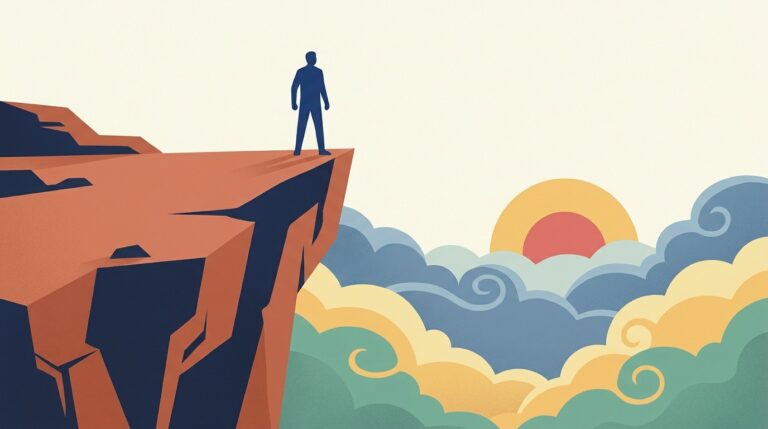
Facing the Abyss: How Koreans Describe Being Pushed to the Brink
Phase 1: Empathy (Story-Driven Opening)
안녕하세요! 매일한글 에디터입니다. (Hello! This is your Daily Hangul editor.)
Picture this scene from a gripping K-drama: The boardroom is dead silent. Stock prices are plummeting, creditors are pounding on the glass doors, and the CEO looks out the floor-to-ceiling window onto the rain-soaked skyline of Seoul. The lead character whispers under their breath: “We are completely ruined”? No, at this cinematic, heart-stopping C1 level, they never say something as pedestrian as “너무 위험해요” (It’s too dangerous) or “망했어요” (We’re doomed). Instead, they look into their trusted partner’s eyes and murmur: “우리는 지금 벼랑 끝에 내몰렸어” (We have been driven to the edge of a cliff), or in a national news broadcast, the anchor declares: “회사의 운명이 백척간두에 섰습니다” (The company’s fate stands on the tip of a hundred-foot pole).
If you have ever felt your heart pound in Korean—whether watching high-stakes thrillers like Squid Game or Queen of Tears, or navigating high-pressure corporate negotiations in Teheran-ro—you know that standard intermediate phrases collapse under the weight of existential crises. Today, drawing from ten years of coaching executives, diplomats, and passionate K-culture fans, I will walk you through the ultimate Korean metaphors of life-or-death peril. By the end of this guide, you will not just understand Korean crisis vocabulary—you will feel the visceral tension and unyielding grit woven into the very fabric of Korean history and language.
Phase 2: Core Expressions Deep Dive
1. 벼랑 끝에 내몰리다 (Byeorang kkeute naemollida)
- Pronunciation: [Byeorang kkeute naemollida] (Think: “Byuh-rang” like the sound of a resonant gong, “kkeut-eh” like the sharp edge of “cut-eh”, “nae-mol-li-da”)
- Meaning: Literally: “To be chased/driven to the very edge of a sheer cliff.” Figuratively: To be forced into an existential crisis with absolutely zero room to maneuver or retreat.
- K-Culture Moment: Used relentlessly in economic investigative thrillers and sports dramas when a team or protagonist has exhausted all funding, legal appeals, or timeouts and faces absolute elimination.
- Editor’s Insight: Notice the passive verb 내몰리다 (naemollida – to be driven out/herded). Unlike an active choice, this idiom conveys external pressure—market forces, enemies, or fate itself cornering you against a drop into the abyss.
- Situation Spectrum: Casual: ⚠️ (Can sound melodramatic unless used jokingly about exams) | Semi-formal: ✅ | Formal/News: ✅
- 🤔 Think About It: In English, we say “driven to the wall” or “backed into a corner.” Why do you think Korean uses a natural precipice (벼랑 – cliff) rather than an architectural room corner?
2. 백척간두에 서다 (Baekcheokgandue seoda)
- Pronunciation: [Baek-cheok-gan-du-e seo-da] (Pronounce “Baek” like ‘beckon’, “cheok” like ‘chuck’, “gan-doo-eh”)
- Meaning: Literally: “To stand atop a 100-cheok (approx. 30-meter) bamboo pole.” Figuratively: To be perched in a state of precarious, hair-trigger danger where a single gust of wind means catastrophe.
- K-Culture Moment: Often recited by solemn historical figures in sageuk (Korean historical dramas) or by news anchors reporting on geopolitical standoffs on the Korean Peninsula.
- Editor’s Insight: This four-character idiom (사자성어, Sajaseongeo) comes from classical Zen philosophy, which originally described a state of spiritual ultimate crisis before enlightenment. In modern Korean, however, it denotes a terrifyingly delicate crisis.
- Situation Spectrum: Casual: 🚫 | Semi-formal: ⚠️ | Formal/Media/Business: ✅
- 🤔 Think About It: A pole has no surface area. While a cliff gives you a ledge to fight on, a hundred-foot pole gives you only a point of balance. How does this shift the emotional tone from desperation to sheer terror?
3. 진퇴양난에 빠지다 (Jintoeyangnane ppajida)
- Pronunciation: [Jin-toe-yang-na-ne ppa-ji-da] (Sounds like “Jean-tway-yahng-nah-neh pah-jee-dah”)
- Meaning: Literally: “Advancing or retreating are both equally difficult.” Figuratively: Caught between a rock and a hard place; facing a classic lose-lose dilemma.
- K-Culture Moment: Commonly deployed when a character must choose between betraying their family or going to prison—every road forward leads to devastation.
- Editor’s Insight: Combine this with 빠지다 (ppajida – to fall/sink into). It implies that the dilemma is like a quagmire; the more you struggle without a coherent plan, the deeper you sink.
- Situation Spectrum: Casual: ⚠️ | Semi-formal: ✅ | Formal/Essays/Corporate: ✅
- 🤔 Think About It: Does your native language view crises more as a spatial entrapment (walls, boxes) or as an impasse on a path (advance vs. retreat)?
Phase 3: Textbook Korean vs. Real Native Korean
Situation 1: Explaining that a startup is out of runway and investors are pulling out
- 📖 Textbook Korean: 지금 우리 회사는 아주 위험하고 돈이 없습니다. (Jigeum uri hoesaneun aju wiheomhago doni eopseumnida. / Currently, our company is very dangerous and has no money.)
- 🗣️ Real Native Korean (C1): 투자 유치가 무산되면서, 우리 팀은 지금 완전히 벼랑 끝에 내몰린 셈이에요. (Tuja yuchiga musandoemyeonseo, uri timeun jigeum wanjeonhi byeorang kkeute naemollin semieyo. / With the investment round falling through, our team has essentially been driven to the very edge of a cliff.)
- 💡 Why the difference? C1 Korean relies on metaphorical compression. Saying “dangerous” sounds juvenile in professional settings; invoking the cliff communicates high stakes, urgency, and external victimhood in one stroke.
Situation 2: Describing a critical moment in state examinations or a career crossroad
- 📖 Textbook Korean: 어떻게 해야 할지 모르는 어려운 상황입니다. (Eotteoke haeya halji moreuneun eoryeoun sanghwang-imnida. / It is a difficult situation where I don’t know what to do.)
- 🗣️ Real Native Korean (C1): 물러설 곳도 없는 진퇴양난의 기로에서 결단을 내려야만 합니다. (Mulleoseol gotdo eomneun jintoeyangnanui giroyoeseo gyeoldaneul naeryeoyaman hamnida. / At this fork in the road of total dilemma with nowhere to retreat, I must make a definitive decision.)
- 💡 Why the difference? Advanced speakers pair Sino-Korean nouns (기호, 결단) to create rhythmic, authoritative prose that commands respect.
Phase 4: K-Culture Deep Dive & Non-Verbal Manners
4-1. Nunchi & Body Language of Crisis
When someone in Korea announces that a project is 벼랑 끝에 서 있다 (standing on the edge of a cliff), your physical reaction matters just as much as your verbal response:
* The Neck Grab (목덜미 잡기): In dramas, executives literally grab the back of their neck when blood pressure spikes. In real life, adults show distress by bowing their head, placing two fingers firmly against their temples or the bridge of their nose, and exhaling an audible sigh (한숨).
* Eye Contact (시선 처리): Do not maintain wide-eyed, blank eye contact. Lower your gaze slightly to show that you are bearing the weight of the gravity together. Maintaining an upbeat, smiling posture when someone drops these idioms is a severe breach of Nunchi (눈치).
4-2. The Dramatic Archetype: Boardrooms & Survival Auditions
Watch any K-Pop survival show (like Show Me The Money or Produce/I-LAND). When the mentors evaluate a trainee who has trained for six years and faces age limits, they inevitably describe the trainee’s stance as “벼랑 끝에 선 간절함” (the desperation of standing on a cliff edge). In Korean cultural consciousness, hitting the cliff isn’t just about terror—it is the prerequisite for discovering superhuman willpower (깡 and 오기).
Phase 5: Real-Life Roleplay Scenario
Setting: 11:30 PM, a glass-walled conference room in Teheran-ro, Gangnam. Team Leader Ji-won and you (Product Director) are staring at the rejected contract from a key overseas partner.
- Turn 1 (Ji-won): 이번 계약마저 틀어지면, 우리 다음 달 직원들 월급도 못 줘요. (Ibeon gyeyangmajeo teureojimyeon, uri daeum dal jigwondeul wolgeupdo mot jwoyo.)
- 🎭 Slumps into the office chair, loosening her lanyard badge with trembling fingers.
- “If this contract falls through too, we won’t even be able to pay the staff salaries next month.”
- Turn 2 (You): 상황이 이렇게까지 악화될 줄은 몰랐네요. 완전히 벼랑 끝에 내몰린 기분입니다. (Sanghwangi ireokekkaji akhwadoel jureun mollatneyo. Wanjeonhi byeorang kkeute naemollin gibunimnida.)
- 🎭 Looking over the redline notes on the tablet with a grim expression.
- “I had no idea things would deteriorate this far. I feel like we’ve been driven completely to the edge of a cliff.”
- Turn 3 (Ji-won): 대표님은 플랜 B가 있다고 하시지만, 솔직히 지금 회사는 백척간두에 선 상태예요. (Daepyonimeun peullaen Bga itdago hasijiman, soljikhi jigeum hoesaneun baekcheokgandue seon sangtaeyeyo.)
- 🎭 Leans forward, speaking in a hushed, anxious whisper.
- “The CEO says he has a Plan B, but honestly, our company is standing atop a hundred-foot pole right now.”
- Turn 4 (You): 맞아요. 여기서 한 발자국만 삐끗해도 그대로 끝장입니다. (Majayo. Yeogiseo han baljagukman ppikkeuthaedo geudaero kkeutjang-imnida.)
- 🎭 Nodding slowly, matching her grave tone.
- “Agreed. If we slip even half a step from here, it’s game over.”
- Turn 5 (Ji-won): 외주 개발팀과의 소송을 진행하자니 서비스 런칭이 늦어지고, 합의하자니 자금이 바닥나니… 그야말로 진퇴양난이네요. (Oeju gaebal-tim-gwaui sosong-eul jinhaenghajani seobiseu reonching-i neojeojigo, hab-uihajani jageumi badaknani… geuyamallo jintoeyangnannineyyo.)
- 🎭 Rubbing her tired eyes with both hands.
- “If we sue the outsourcing team, the launch gets delayed; if we settle, our funds run out… It’s truly a total dilemma.”
- Turn 6 (You): 하지만 지원 팀장님, 한국 속담에 호랑이 굴에 들어가도 정신만 차리면 산다고 하잖아요. (Hajiman Ji-won timjangnim, hanguk sokdame horangi gure deureogado jeongsinman charimyeon sandago hajanayo.)
- 🎭 Straightening your back and focusing your gaze with resolve.
- “Still, Team Leader Ji-won, doesn’t the Korean proverb say that even if you enter a tiger’s den, you will survive if you keep your wits about you?”
- Turn 7 (Ji-won): 휴… 맞아요. 지금 주저앉아 있을 때가 아니죠. 돌파구를 찾아봅시다. (Hyu… majayo. Jigeum jujeoanja isseul ttaega anijyo. Dolpagureul chajabobsida.)
- 🎭 A slight, appreciative smile breaks through her exhaustion.
- “Phew… You’re right. Now is not the time to sit and mourn. Let’s find a breakthrough.”
- Turn 8 (You): 네, 배수의 진을 치고 내일 투자자 미팅에 모든 걸 걸어보죠. (Ne, baesuuijineul chigo naeil tujaja miting-e modeun geol georobojo.)
- 🎭 Closing the laptop with a crisp snap.
- “Yes, let’s burn our bridges and bet everything on tomorrow’s investor pitch.”
🔀 Interactive Branching Point: How do you respond to Ji-won in Turn 4?
- Choice A (Best): “맞아요. 여기서 한 발자국만 삐끗해도 끝장입니다. 하지만 배수의 진을 치고 돌파구를 찾아보죠.” (Validates her fear with C1 vocabulary, then pivots to resilience).
- Feedback: Best! Demonstrates emotional intelligence (Nunchi), matches linguistic register, and provides psychological safety.
- Choice B (Bad): “에이, 별일 아니에요! 치맥이나 먹으러 가요!” (Come on, it’s no big deal! Let’s just go get chicken and beer!)
- Feedback: Bad. Completely dismisses her legitimate existential stress. In Korean corporate hierarchy, this marks you as deeply untrustworthy and lacking Nunchi.
- Choice C (Risk): “대표님이 무능해서 우리가 이 꼴이 된 겁니다.” (It’s because the CEO is incompetent that we are in this mess.)
- Feedback: High Risk. Even if true, openly blaming the founder inside company walls during a crisis violates Korean organizational harmony and can burn bridges overnight.
Phase 6: 10-Second Emotion Shadowing Drill
Read these aloud while honoring the emotional pauses (/) and rhythmic accents:
[😰 극도의 절박함과 긴장감으로 / With breathless dread and urgency]
우리는 지금 / 벼랑 끝에 내몰렸어요. / 한 번의 실수가 / 곧 추락입니다.
(Uri-neun ji-geum / byeorang kkeute naemollyeosseoyo. / Han beon-ui silsu-ga / got churak-imnida.)
“We are right now / driven to the edge of the cliff. / A single mistake / means an immediate fall.”-
[🏛️ 중후하고 비장한 어조로 / In a solemn, historic broadcast tone]
국가의 미래가 / 백척간두에 서 있는 / 엄중한 시점입니다.
(Gukga-ui mirae-ga / baek-cheok-gan-du-e seo inneun / eomjung-han sijeom-imnida.)
“The nation’s future / stands on the tip of a hundred-foot pole / at this grave juncture.” -
[😮💨 답답하고 깊은 한숨을 섞어서 / Mixed with a heavy, frustrated sigh]
나아갈 수도, / 물러설 수도 없는 / 완전한 진퇴양난입니다.
(Na-a-gal su-do, / mul-leo-seol su-do eom-neun / wanjeon-han jin-toe-yang-nan-imnida.)
“We cannot advance, / nor can we retreat; / it is an absolute deadlock.”
Phase 7: K-Culture Mini Dictionary
- 사면초가 (Samyeonchoga) | Surrounded by songs of Chu on all four sides
- Meaning: Totally isolated and surrounded by hostility; having zero allies in sight.
- Usage: Used when public opinion turns entirely hostile against a celebrity or brand.
- 배수의 진 (Baesuuijin) | Drawing a battle formation with a river to one’s back
- Meaning: Burning your bridges; cutting off retreat so you must fight to survive.
- Usage: When a candidate quits their stable day job to prepare for the civil service exam full-time.
- 풍전등화 (Pungjeondeunghwa) | A candle flame flickers before the wind
- Meaning: A fragile entity on the verge of being snuffed out at any second.
- Usage: Used to describe a critically ill patient’s condition or a failing company on bankruptcy day.
- 기사회생 (Gisahwisaeng) | Returning to life from the threshold of death
- Meaning: A miraculous recovery or comeback against all conceivable odds.
- Usage: Said when a sports team scores two goals in stoppage time to win the finals.
Phase 8: Traveler’s Survival Kit
Even if you aren’t running a Korean corporation, travel crises do happen! Here are your real-life emergency tools:
- Top 3 Survival Lines:
- 지갑과 여권을 다 잃어버려서 정말 막막합니다. 도와주실 수 있나요? (Jigat-gwa yeogwoneul da ireobeoryeoseo jeongmal makmakamnida. Dowajusil su innayo? / I lost both my wallet and passport and feel completely lost. Could you help me?)
- 마지막 차가 끊겨서 완전히 발이 묶였어요. (Majimak chaga kkeunkyeoseo wanjeonhi bari mukkyeosseoyo. / The last train stopped running, so I am completely stranded.)
- 지금 위급한 상황이라 영어가 가능한 직원분과 연결해 주세요. (Jigeum wigeubhan sanghwang-ira yeong-eoga ganeunghan jigwonbungwa yeongyeolhae juseyo. / This is an emergency situation, please connect me to an English-speaking staff member.)
- Editor’s Travel Note:
When stranded late at night in non-tourist zones where taxis won’t stop, avoid panic. Immediately check the Kakao T taxi booking app to call certified drivers. If you face a medical crisis during weekend hours, bookmark the Emergency Medical Information Center 1339 guide for immediate English medical interpretation.
Phase 9: “One Step Deeper” (Cultural Reflection)
Korean metaphors for crises are uniquely geographic and physical: cliffs (벼랑), isolated battlefields (배수의 진), and sheer drops. Why? Korea’s peninsula history is a chronicle of enduring countless foreign invasions while surviving on rugged mountainous terrain. In the Korean collective psyche, an existential crisis is never abstract; it is tangible. Yet, what makes Korean culture extraordinary is that “the edge of the cliff” is not viewed merely as a place of death—it is the birthplace of 기적 (miracles) and 역전 (comebacks). From the IMF financial crisis of 1997, when ordinary citizens lined up to donate personal gold jewelry to save the national treasury, to K-Pop groups from tiny bankrupt labels rising to conquer the Billboard charts, reaching the cliff edge is where the Korean spirit traditionally ignites.
💬 Your Turn: Have you ever experienced a personal project or career dilemma where you felt “벼랑 끝에 내몰렸다”? How did you find your breakthrough? Let me know in the comments below!
Phase 10: FAQ & Common Mistakes
Q: Can I use ‘벼랑 끝에 내몰리다’ in casual conversations with friends?
A: You can, but only with dramatic hyperbole! For example, if you forgot to study until the morning of your final exam: “나 과제 안 해서 지금 벼랑 끝에 내몰렸어!” (I didn’t do my assignment, I’m pushed to the cliff edge!). If used for trivial things like running out of coffee, it sounds absurdly theatrical.
Q: What is the difference between ‘벼랑 끝에 내몰리다’ and ‘백척간두에 서다’?
A: Focus on the visual metaphor. 벼랑 끝에 내몰리다 emphasizes being actively pushed by outside forces with your back to the void. 백척간두에 서다 is an ancient idiom emphasizing extreme, precarious instability where one false breath could tip the balance. The latter is far more literary and formal.
Q: Does ‘진퇴양난’ mean the same thing as the English ‘catch-22’?
A: Very similar! Both describe situations where contradictory conditions render progress impossible. However, 진퇴양난 focuses strictly on the inability to move either backward or forward, while ‘catch-22’ often highlights bureaucratic absurdity.
🚨 Common Mistakes Warning Board
- Mistake 1: Translating “I’m trapped” as 나는 갇혔다 when talking about life choices.
Correct Action: Use 진퇴양난에 빠졌다 (I fell into a dilemma) or 사방이 막혔다 (All four directions are blocked). - Mistake 2: Saying 벼랑에 갔다 (I went to a cliff) instead of 내몰렸다.
Correct Action: The passive auxiliary 내몰리다 is essential. You didn’t hike there for tourism; circumstances drove you there! - Mistake 3: Using 백척간두 as an adjective directly modifying people (e.g., 나는 백척간두 사람이다).
Correct Action: Always use it with state verbs: 백척간두에 서다 (to stand) or 백척간두의 위기 (a crisis of standing on a hundred-foot pole).
Phase 11: Action Mission & Engagement
- 🥉 Bronze Mission (Solo Shadowing): Stand in front of your mirror and practice the Phase 6 Shadowing Drill #1 three times, matching the dramatic facial gravity of a CEO in a K-drama.
- 🥈 Silver Mission (Social Application): Write a one-sentence Korean social media post or journal entry describing a tough week using the phrase: “이번 주는 정말 진퇴양난의 연속이었다…” (This week was truly a continuous dilemma…).
- 🥇 Gold Mission (Native Dialogue): In your next Korean language exchange or tutoring session, ask your partner: “살면서 가장 ‘벼랑 끝에 내몰렸다’고 느꼈던 순간이 언제예요?” (When was the moment in your life you felt most driven to the edge of a cliff?).
- 🎮 K-Culture Mission: Watch the climax of any historical film (such as The Admiral: Roaring Currents / 명량) and count how many times the script references 백척간두 or 배수의 진!
Phase 12: Interactive Quiz Challenge
Test your mastery of advanced Korean crisis idioms:
- Situational Judgment: You are writing an official corporate report stating that your company has exhausted all negotiation options and any further hostile takeover attempts will destroy the firm. Which idiom fits the official written headline best?
- (A) 나 진짜 어떡해
- (B) 백척간두에 선 우리 기업의 현주소
- (C) 벼랑에 놀러 간 상황
- Fill in the Blank:
적군에게 완전히 포위되어 아군의 지원마저 끊긴 부대는 그야말로 ( _______ )의 상태였다.
(Hint: The classical idiom for being completely isolated with enemies singing on all four sides.) -
True or False: 배수의 진을 치다 implies giving up and surrendering without a fight.
👉 Click to view answers and explanations!
- Answer: (B)
Explanation: “백척간두에 선 우리 기업의 현주소” (The current state of our enterprise standing on a hundred-foot pole) is classic C1/C2 business headline Korean. (A) is too juvenile; (C) makes no sense. - Answer: 사면초가 (Samyeonchoga)
Explanation: Complete isolation without rescue, surrounded by enemy territory, is the textbook definition of 사면초가. - Answer: False!
Explanation: 배수의 진 (backing onto water) means the exact opposite: positioning your soldiers so they cannot retreat, forcing them to fight with do-or-die determination!







