

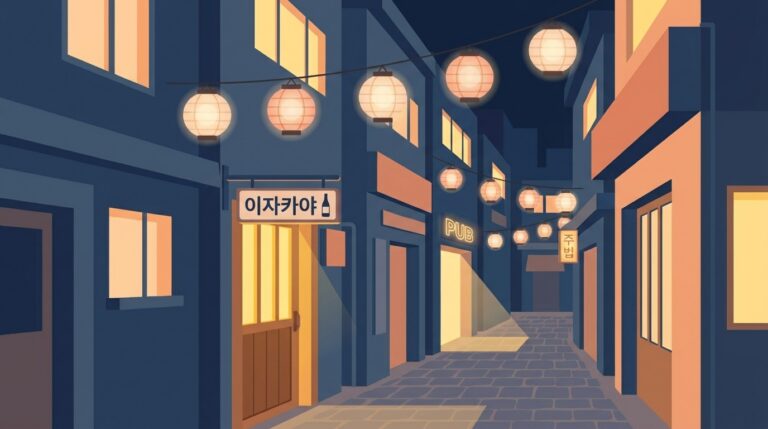
Phase 1: Empathy (Story Opening)
안녕하세요! (Annyeonghaseyo!) I’m your editor from Daily Hangul, your trusted Korean culture and language navigator.
Picture this: You are sitting at a bustling Korean barbecue restaurant in Seoul. The pork belly (samgyeopsal) is sizzling, green soju bottles line the table, and everyone is laughing loudly over clinking glasses. You’ve had an amazing time, but your stomach is completely full and your ears are ringing from the ambient noise. Suddenly, the table clears, and your Korean colleague turns to the group with excited eyes: “자, 2차 갈까?” (Ja, icha galkka? — “So, shall we go to round two?”).
Your heart skips a beat. You want to hang out longer, but you dread going to another loud, high-energy venue. You wish you could politely steer the group toward a cozy, quiet izakaya or a relaxed craft beer pub nearby. How do you suggest this smoothly without dampening the high spirits or sounding like a buzzkill?
Over the past ten years of coaching foreign professionals, exchange students, and K-drama fans living in Korea, the transition between round one and round two is consistently voted the most stressful social hurdle. But once you master a few natural expressions, you transform from a passive tag-along into an active, beloved member of the group. Let’s make sure you walk into your next Korean dinner with total confidence!
Phase 2: Core Expressions Deep Dive
Here are three high-yield expressions tailored for A2 learners that will make you sound natural, considerate, and culturally savvy.
1. 2차는 근처 조용한 데로 갈까요? (Icha-neun geuncheo joyonghan de-ro galkkayo?)
- Pronunciation: [Ee-cha-neun geun-chuh jo-yong-han deh-ro gal-kka-yo?] (Think of “cha” like a cup of tea, and whisper “jo-yong” like a quiet lullaby.)
- Meaning: Literal: “As for round two, shall we go to a quiet place nearby?” | Real Nuance: “How about we head somewhere cozy nearby where we can actually talk?”
- K-Culture Moment: You see this in office K-dramas like Misaeng when junior colleagues want to escape the loud grilling spot to share heartfelt stories over simple snacks.
- Editor’s Insight: The ending
-(으)ㄹ까요?(-eulkkayo?) is the golden key for A2 speakers. It invites collective consensus rather than demanding an order. Replacing “이자카야” (izakaya) or “맥주집” (beer pub) with the simple word “데” (de = place/spot) sounds remarkably authentic. - Situation Spectrum: Casual ✅ | Semi-formal ✅ | Formal ⚠️
- 🤔 Think About It: In many Western outings, a change of venue happens spontaneously without a label. Why do Koreans categorize the evening into numbered rounds (cha)? How does this structure group dynamics?
2. 시원한 맥주 한잔 더 해요! (Siwonhan maekju hanjan deo haeyo!)
- Pronunciation: [See-won-han maek-joo han-jan duh hae-yo!] (Imagine the refreshing sound of “see-won” like an icy drink on a sweltering summer day.)
- Meaning: Literal: “Let’s do one more cool beer!” | Real Nuance: “Let’s grab a light, refreshing drink to wind down!”
- K-Culture Moment: A warm summer night in Euljiro (Hipjiro) where friends wrap up heavy food and walk over to a breezy plastic table outside an alley pub for draft beer.
- Editor’s Insight: In Korean culture, siwonhada means crisp, refreshing, and satisfying. Even if you only intend to drink a single draft beer, saying “한잔” (hanjan = one glass) keeps the pressure low for everyone.
- Situation Spectrum: Casual ✅ | Semi-formal ✅ | Formal 🚫
- 🤔 Think About It: Why do Koreans frequently offer “just one glass” (hanjan) when both parties know the gathering will last another hour? How does linguistic understatement protect social comfort?
3. 저는 주량이 맥주 한 병 정도예요. (Jeoneun juryang-i maekju han byeong jeongdoyeyo.)
- Pronunciation: [Juh-neun joo-ryang-ee maek-joo han byung jung-doh-yeh-yo.]
- Meaning: Literal: “My alcohol capacity is about one bottle of beer.” | Real Nuance: “Just so you know, my drinking limit is around one bottle, so I’ll be sipping slowly!”
- K-Culture Moment: A newcomer joins a friendly dinner and sets clear, healthy personal boundaries with a warm smile before the toasts start.
- Editor’s Insight: Juryang (주량) means alcohol tolerance. In the past, people felt pressured to match their seniors drink for drink. Today, politely stating your juryang upfront shows self-awareness and maturity.
- Situation Spectrum: Casual ✅ | Semi-formal ✅ | Formal ✅
- 🤔 Think About It: Contrast how you decline alcohol in your home country versus framing it around your recognized physical tolerance (juryang) in Korea.
Phase 3: Textbook Korean vs. Real Korean
Situation 1: Suggesting to move to the next venue
- 📖 Textbook Korean: 2차 장소로 이동합시다. (Icha jangsoro idonghapsida. / Let us move to the round two venue.)
- 🗣️ Real Korean: 2차는 간단하게 맥주 한잔 어때요? (Icha-neun gandanhage maekju hanjan eottaeyo? / How about a quick beer for round two?)
- 💡 Why is it different? The textbook phrase sounds like a military battalion commander giving tactical orders. Real Koreans love the softening adverb “간단하게” (gandanhage = simply/lightly) to eliminate pressure.
Situation 2: Politely declining another round to head home
- 📖 Textbook Korean: 저는 더 이상 술을 마실 수 없어서 집에 가겠습니다. (Jeoneun deo isang sureul masil su eopseoseo jibe gagesseumnida. / Because I cannot drink any more alcohol, I will go home.)
- 🗣️ Real Korean: 저는 내일 일정이 있어서 슬슬 들어가 볼게요! (Jeoneun naeil iljeong-i isseoseo seulseul deureoga bolgeyo! / I have an early schedule tomorrow, so I’ll gently get going!)
- 💡 Why is it different? Saying you “cannot drink” feels abrupt and cuts off the mood. Using “슬슬” (seulseul = gently, gradually) softens your exit, letting everyone know you enjoyed the night.
Phase 4: K-Culture Deep Dive & Non-Verbal Manners
4-1. 눈치 (Nunchi) & Table Gestures
Korean drinking etiquette is an art of non-verbal care. Keep these physical manners in mind during rounds one and two:
* Two-Hand Rule: Whenever you pour or receive a drink from someone older or of higher status, use both hands. Place your left hand lightly under your right wrist or across your chest to signal respect.
* The Head Turn: When taking a sip in front of someone senior, turn your head slightly to the side away from them and shield your glass with your hand.
* Read the Energy: Look around before suggesting round two. Are people rubbing their eyes or checking their transport cards? If yes, suggest a quiet, seated spot (joyonghan de) rather than a chaotic karaoke parlor (noraebang).
4-2. Cultural Code: The Meaning of 2차 (Round Two)
Why not stay at one restaurant all evening? In Korean culture, moving venues resets the psychological atmosphere.
* 1차 (Round 1): Focuses on heavy eating, fueling up on pork or chicken, and breaking the ice.
* 2차 (Round 2): Usually a cozy Japanese izakaya, a draft beer hof, or a pub. It features lighter appetizers like dried pollack (meoktae), fruit platters, or warm fish cake soup (eomuk-tang). This is where genuine personal connection and deep conversations happen.
Phase 5: Real-Life Roleplay Scenario
Setting: Outside a busy grilled ribs restaurant in Euljiro at 9:30 PM. The crisp night air hits your face after a hot dinner. Your friendly Korean colleague, Minho, is stretching and looking around.
- Minho: 🎭 Stretches his arms and pats his stomach with a grin
아, 배부르다! 오늘 진짜 맛있었죠? (A, baebureuda! Oneul jinjja masisseotjyo? / Ah, I’m so full! That was delicious today, right?) - You: 🎭 Nods warmly with a smile
네, 정말 맛있었어요! (Ne, jeongmal masisseosseoyo! / Yes, it was really delicious!) - Minho: 🎭 Looks at the group energetically
이대로 헤어지긴 아쉬운데, 2차 갈 사람? (Idaero heeojigin aswiunde, icha gal saram? / It’s too sad to split up now, who wants round two?) - You: 🎭 Steps in gently with a thoughtful suggestion
2차는 근처 조용한 이자카야나 맥주집으로 갈까요? (Icha-neun geuncheo joyonghan ijakayana maekjujib-euro galkkayo? / Shall we go to a quiet izakaya or pub nearby for round two?) - Minho: 🎭 Eyes light up in relief
오, 좋아요! 1차가 너무 시끄러워서 대화하기 힘들었죠. (O, jo-ayo! Ilcha-ga neomu sikkeureowoseo daehwahagi himdeureotjyo. / Oh, great idea! Round one was so loud it was hard to talk.) - You: 🎭 Smiles and gestures down the quiet side street
맞아요. 저기 골목에 분위기 좋은 데 있어요! (Majayo. Jeogi golmok-e bunwigi joeun de isseoyo! / Exactly. There is a cozy place right down that alley!) - Minho: 🎭 Walks alongside you
나이스! 거기서 시원한 맥주 한잔 더 해요. (Naiseu! Geogiseo siwonhan maekju hanjan deo haeyo. / Nice! Let’s have one more cold beer over there.) - You: 🎭 Sets clear, friendly expectations
네! 저는 주량이 약해서 가볍게 마실게요. (Ne! Jeoneun juryang-i yakhaeseo gabyeopge masilgeyo. / Yes! My alcohol tolerance is low, so I will drink lightly.)
🔀 Interactive Decision Point
When Minho asks, “2차 갈 사람?” (Who wants round two?), how do you answer?
- Choice A: “저 내일 출근해야 하니까 지금 당장 집에 갈게요.” (I have work tomorrow, so I will go home right now this instant.)
- Feedback (Bad): While honest, this phrasing sounds abrasive and cuts the happy mood like a cold blade. It ignores the collective warmth built during dinner.
- Choice B: “2차는 근처 조용한 데로 갈까요? 간단히 마셔요!” (Shall we go somewhere quiet nearby for round two? Let’s drink lightly!)
- Feedback (Best): Perfect! You validate the social connection while gently steering the environment toward comfort and moderation.
- Choice C: “저는 술 못 마시니까 2차는 가지 마요.” (I can’t drink alcohol, so let’s not go to round two.)
- Feedback (Risk): Demanding the whole group abandon their plans because of your personal preference creates awkwardness. Instead, you can join and drink soda, or step out gracefully.
Phase 6: 10-Second Emotion Shadowing Drill
Practice these lines out loud! Follow the rhythm pauses marked by / and channel the emotional cues.
[😊 설레고 다정하게 / Warm and Suggestive]
2차는 / 근처 조용한 맥주집으로 / 갈까요?
(Icha-neun / geuncheo joyonghan maekjujib-euro / galkkayo?)-
[🍻 경쾌하고 신나게 / Upbeat and Cheerful]
시원하게 / 생맥주 한잔 / 짠해요!
(Siwonhage / saengmaekju hanjan / jjan-haeyo! / Let’s clink glasses with a cold draft beer!) -
[🥺 조심스럽고 공손하게 / Gentle and Courteous]
저는 / 주량이 약해서 / 사이다 마실게요.
(Jeoneun / juryang-i yakhaeseo / saida masilgeyo. / Since my alcohol tolerance is low, I will drink cider/soda.)
Phase 7: K-Culture Mini Dictionary
- 2차 (I-cha) [Noun]: Round two of a social outing. Used everywhere from university parties to corporate business dinners.
- 주량 (Ju-ryang) [Noun]: Alcohol tolerance limit. Commonly asked during introductory dinners: “주량이 어떻게 되세요?” (What is your drinking tolerance?).
- 건배사 (Geon-bae-sa) [Noun]: A toast speech. Often given by the organizer or the guest of honor before everyone yells “짠!” (Jjan!).
- 막차 (Mak-cha) [Noun]: The last train or bus of the night. The most universally accepted reason to leave round two without hurting anyone’s feelings!
Phase 8: Traveler’s Survival Kit
Top 3 Survival Expressions
- 물 한 잔만 주세요. (Mul han jan-man juseyo.)
- Meaning: Please give me a glass of water.
- Pro Tip: Hydration is key! Korean restaurants provide cold water carafes freely; don’t hesitate to ask for refills.
- 근처에 조용한 술집 있어요? (Geuncheo-e joyonghan suljip isseoyo?)
- Meaning: Is there a quiet pub nearby?
- Pro Tip: Great to ask the cashier when paying at round one.
- 막차 시간 몇 시예요? (Makcha sigan myeot siyeyo?)
- Meaning: What time is the last train?
- Pro Tip: Use this around 11:00 PM to gauge when everyone should begin wrapping up.
Editor’s Travel Note
- Transportation: In Seoul, subways generally stop running between midnight and 12:40 AM on weekdays. Make sure to download Naver Map on your phone to check exact real-time schedule departures for the last train (makcha).
- Splitting the Bill (N-빵): In casual friend circles, round two is frequently split evenly (N-ppang). Have mobile pay or clean cash ready, or take turns paying for alternate rounds.
Phase 9: “One Step Deeper” (Reflective Thought)
In Western individualist contexts, drinking is often seen as a private lifestyle choice. In Korea, however, sitting together over drinks is historically rooted in cultivating Jeong (정)—an affectionate communal bond that dissolves daytime formal hierarchies. When someone invites you to round two, they are not trying to get you drunk; they are extending an invitation into their inner circle. Navigating this respectfully by choosing a cozy venue and drinking at your own pace allows you to experience genuine Korean warmth.
💬 Your Turn: How does going out for drinks with friends or colleagues in your home culture compare to Korea’s round (cha) culture? Share your thoughts in the comments below!
Phase 10: FAQ & Common Mistakes
Q: What should I say if I do not drink alcohol at all?
A: Simply say, “저는 술을 못 마셔서 음료수나 사이다 마실게요!” (I cannot drink alcohol, so I will drink soda!). Koreans are very accommodating of non-drinkers today. As long as your glass is filled with soda or water to participate in the clinking (jjan), everyone will be thrilled.
Q: Is it considered rude to decline round two (2차)?
A: Not at all, provided you excuse yourself gracefully! The polite formula is stating an early morning obligation or catching the last train: “내일 아침 일찍 일정이 있어서 오늘은 먼저 들어가 볼게요!” (I have an early schedule tomorrow, so I will head home first today!). Thank the host for round one.
Q: What does “짠” (Jjan) mean and when do I do it?
A: “짠” is the onomatopoeia for glasses clinking (similar to “cheers!”). Whenever someone initiates a toast, raise your cup, touch glasses lightly, say “짠!”, and take a sip.
🚨 Common Mistakes Warning Board
- Mistake 1: Pouring your own drink (자작 – Jajak). In Korea, pouring your own alcohol when sitting with others can feel isolating. Pour for your neighbor first, and they will gladly return the favor!
- Mistake 2: Leaving silently (Ghosting). Sneaking out without saying goodbye is frowned upon. Always announce your departure warmly to the organizers.
- Mistake 3: Forcing yourself to finish drinks. Leaving your glass half-full is the universal subtle cue in Korea that you do not want another pour.
Phase 11: Action Missions
- 🥉 Bronze Mission (Solo Shadowing): Stand in front of your mirror and practice saying: “2차는 근처 조용한 데로 갈까요?” three times with a bright, welcoming smile.
- 🥈 Silver Mission (SNS Check): Post an Instagram story of your favorite beverage with the Korean caption: “오늘 시원한 맥주 한잔 어때요? 🍻” and tag your language study buddies.
- 🥇 Gold Mission (Real-Life Practice): Next time you grab food or coffee with a friend, use “2차 갈까요?” to suggest heading to a dessert cafe or quiet bench!
- 🎮 K-Culture Mission: Watch an episode of a workplace K-drama (like Business Proposal or Hospital Playlist) and spot when the characters suggest moving to round two.
Phase 12: Interactive Quiz Challenge
Question 1: Situation Judgment
You just finished a heavy dinner. You want to suggest heading to a quiet izakaya. Which sentence is the most natural?
* A) 2차는 무조건 제가 정합니다.
* B) 2차는 근처 조용한 이자카야로 갈까요?
* C) 술은 몸에 안 좋으니 다들 집에 가세요.
Question 2: Fill in the Blank
Complete the sentence to tell someone your alcohol tolerance is two glasses of beer:
* “저는 ( )이 맥주 두 잔 정도예요.”
Question 3: True or False
- True or False: In modern Korean drinking culture, turning down extra alcohol by explaining your tolerance limit (juryang) is considered extremely disrespectful.
Click to reveal answers & explanations!
- Answer 1: B! Asking with
-(으)ㄹ까요?is polite and consensus-building. Option A is demanding, and Option C is lecturing. - Answer 2: 주량 (Juryang). Juryang is the specific term for personal alcohol tolerance.
- Answer 3: False! Respecting personal limits and health is widely embraced in contemporary Korean culture. Stating your boundary politely is appreciated.







