

Phase 1: Empathy (Story Opening)
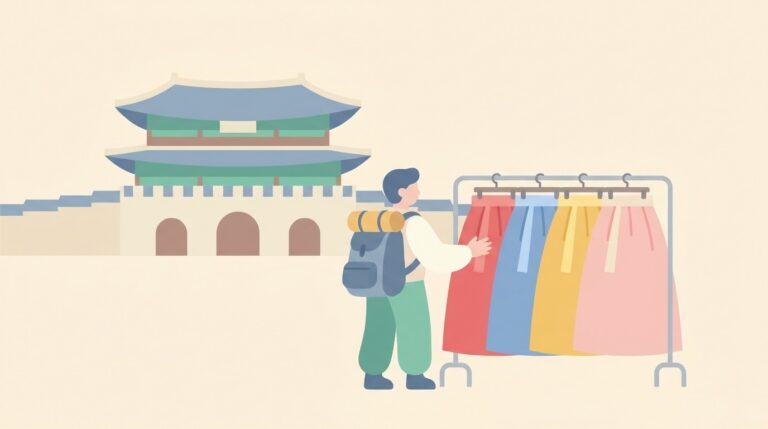
안녕하세요! 매일한글 에디터입니다. (Hello! I’m your Daily Hangul editor.) Have you ever stood in front of a Hanbok rental shop right beside Gyeongbokgung Palace, completely dazzled yet slightly overwhelmed? Imagine this: the morning sunlight strikes the stone walls of the Joseon palace, and right across the street, racks overflowing with crimson, pastel pink, jade, and gold silk skirts flutter gently in the breeze. You step inside, eager to live your favorite historical K-drama fantasy—just like in The King’s Affection or Mr. Queen.
Suddenly, the shop owner—a bustling, warm-hearted Korean Imo (auntie)—walks up to you holding measuring tape, speaking rapid-fire Korean: “몇 분이세요? 어떤 스타일 원해요?” (Myeot bun-iseyo? Eotteon seutail wonhaeyo? / How many people? What style do you want?). Your mind blanks. You know you want that gorgeous pastel royal Hanbok, but how do you ask if you can try it on? Can you change the skirt? How do you ask for that iconic braided hairstyle with the traditional ribbon? You end up pointing timidly and smiling politely, wishing you could speak just a few simple, natural words.
Don’t worry! Every foreign learner visiting Seoul for the first time experiences this exact moment of freeze. In this guide, tailored specifically for A1 beginners, we will turn your Hanbok outing into a breeze. Based on real feedback from dozens of our global students, these simple expressions will make you feel confident, stylish, and respected from the rental shop to the royal courtyard. Let’s step into the royal wardrobe together!
Phase 2: 3 Core Expressions In-Depth Analysis
1. 이거 입어볼 수 있어요? (Igeo ibeobol su isseoyo?)
- Pronunciation: [I-geo i-beo-bol su i-sseo-yo?] (Sound analogy: Think of saying “ee-guh ee-buh-bowl soo ee-ssuh-yo”—smooth and flowing like trying on silk!)
- Meaning: Literal: “Is trying this on possible?” | Nuance: “Can I try this on?”
- K-Culture Moment: In modern Korean boutique vlogs or dramas when travelers point to a stunning pastel royal Hanbok hanging on the center mannequin.
- Editor’s Insight: Traditional Hanbok garments are delicate, and many shops limit fittings to two outfits. Asking this politely shows immense respect for the clothing and gives the staff time to assist you with the inner skirts (sokchima).
- Situation Spectrum: Casual: ⚠️ (Only with close peers: 이거 입어봐도 돼?) | Semi-formal: ✅ (이거 입어볼 수 있어요? – Perfect for shop staff) | Formal: ✅ (이거 입어봐도 되겠습니까? – A bit stiff for a rental shop)
- 🤔 Think About It: Notice how Korean uses “~ㄹ 수 있어요?” (~l su isseoyo?) to express ability and polite request simultaneously, softening direct demands.
2. 추천해 주세요! (Chucheonhae juseyo!)
- Pronunciation: [Chu-cheon-hae ju-se-yo!] (Sound analogy: Sounds like “Chew-chuhn-hae joo-seh-yo”—say it with a bright, trusting smile!)
- Meaning: Literal: “Please recommend!” | Nuance: “Could you recommend something for me? / What do you think suits me best?”
- K-Culture Moment: When tourists or idols visit costume shops on variety shows like Running Man and trust the veteran stylist’s keen eye.
- Editor’s Insight: Koreans love being asked for recommendations because it establishes a cooperative bond (jeong). Hanbok shop owners have dressed thousands of visitors and instantly know which skirt color complements your skin tone and height!
- Situation Spectrum: Casual: 🚫 (추천해 줘 – too blunt for staff) | Semi-formal: ✅ (추천해 주세요 – friendly, natural, universally loved) | Formal: ✅ (추천 부탁드립니다 – very polite, formal)
- 🤔 Think About It: In Western shopping culture, asking for help might feel intrusive, but in Korea, “추천해 주세요” is an invitation for the shopkeeper to take warm, personal care of you.
3. 머리 땋아 주세요. (Meori ttaha juseyo.)
- Pronunciation: [Meo-ri tta-ha ju-se-yo.] (Sound analogy: Pronounce ttaha with a crisp, double ‘t’ pop: “Muh-ri tah-ha joo-seh-yo”.)
- Meaning: Literal: “Please braid hair.” | Nuance: “Please braid my hair with traditional ribbons/pins.”
- K-Culture Moment: The dramatic styling scene in any historical K-drama where the palace maid dresses the heroine’s hair before a royal banquet.
- Editor’s Insight: Most rental shops include free or low-cost hair styling. Saying “머리 땋아 주세요” instantly tells the stylist you want the iconic single braid (daenggi-meori) adorned with flower clips rather than a simple ponytail or bun.
- Situation Spectrum: Casual: ⚠️ (머리 땋아 줘 – friends only) | Semi-formal: ✅ (머리 땋아 주세요 – standard polite request) | Formal: ✅ (머리 손질 부탁드립니다 – salon standard)
- 🤔 Think About It: Hair was considered a sacred gift from parents in Joseon Korea (Shinche Balbu Subu Bumo). Styling hair with a daenggi is not just accessorizing; it is wearing Korean cultural heritage.
Phase 3: Textbook Korean vs Real-World Korean
Situation 1: Asking for a different size or color
- 📖 교과서 한국어: 저에게 맞는 다른 치수가 있습니까? (Jeo-ege manneun dareun chisuga itsseumnikka? / Do you possess another measurement suitable for me?)
- 🗣️ 진짜 한국어: 더 큰 거 있어요? / 다른 색 있어요? (Deo keun geo isseoyo? / Dareun saek isseoyo? / Do you have a bigger one? / Do you have another color?)
- 💡 왜 다를까? Textbook Korean uses formal, literary words like chisu (measurement). Real-life spoken Korean uses ultra-simple, practical phrases using geo (thing), which is effortless and natural for A1 beginners.
Situation 2: Asking how to tie or wear the Hanbok ribbons
- 📖 교과서 한국어: 이것의 옷고름을 어떻게 결속합니까? (Igeoseui otgoreumeul eotteoke gyeolsokhamnikka? / How does one tie the coat strings of this?)
- 🗣️ 진짜 한국어: 이거 어떻게 입어요? (Igeo eotteoke ibeoyo? / How do I put this on?)
- 💡 왜 다를까? Complex vocabulary like otgoreum (coat strings) or gyeolsok (binding) sounds like a historical document. Simply asking “How do I wear this?” will make the staff immediately come over to tie your ribbons for you!
Phase 4: K-Culture Deep Dive & Non-Verbal Manners
4-1. 눈치 (Nunchi) & Gestures in the Rental Shop
- Gathering Your Skirt with Two Hands: Hanbok skirts (chima) are voluminous and floor-length. When walking, gently lift both sides of your skirt with both hands at waist height. Dropping your skirt on dusty floorboards is considered clumsy; lifting it with graceful care shows instant cultural etiquette.
- Shoes Off When Stepping on Fitting Platforms: Most fitting rooms have raised wooden or carpeted stages. Always slip out of your street shoes before stepping onto the stage—never stand on the dress platform wearing outdoor sneakers.
- The Grateful Head Nod: When the stylist finishes your hair or fastens your waist ribbon, place your hands gently together in front and give a warm 15-degree nod with “감사합니다” (Gamsahamnida). Staff will treat you like royalty in return!
4-2. Palace Entry Code: Free Admission with Hanbok
Did you know? If you wear proper Hanbok, admission to all major palaces in Seoul (Gyeongbokgung, Changdeokgung, Changgyeonggung, Deoksugung) is 100% free! Palace guards will wave you straight past the ticket booth with a welcoming smile. This cultural promotion policy exists to celebrate Korean heritage and fill the ancient royal grounds with vibrant, traditional colors. If you take photos near Geunjeongjeon (the main throne hall) or the scenic Hyangwonjeong pavilion, you’ll literally look like you walked onto the set of a high-budget historical drama!
Phase 5: Real-World Roleplay Scenario
- Setting: “Goun Hanbok Rental”, an atmospheric shop bustling with vibrant silks, mirrors, and flower accessories, located 2 minutes from Gyeongbokgung Station Exit 4.
- Character: Auntie Park (Imo), a warm, speedy, 50-something Hanbok expert who can size up your frame in two seconds flat.
- Auntie Park: 어서 오세요! 몇 분이세요? (Eoseo oseyo! Myeot bun-iseyo?)
- English: “Welcome! How many people?”
- 🎭 Action: Hands you a locker key and points toward the colorful racks.
- Learner (You): 두 명이에요! (Du myeong-ieyo!)
- English: “Two people!”
- 🎭 Action: Smiling brightly and holding up two fingers.
- Auntie Park: 치마 먼저 골라보세요. 마음에 드는 거 있어요? (Chima meonjeo golla-boseyo. Maeume deuneun geo isseoyo?)
- English: “Pick your skirt first. Do you see anything you like?”
- 🎭 Action: Glances over the pastel and traditional crimson skirts.
- Learner (You): 음… 추천해 주세요! (Eum… Chucheonhae juseyo!)
- English: “Um… please recommend something!”
- 🎭 Action: Tapping your chin playfully and looking at her for guidance.
- Auntie Park: 이 하늘색 치마 입어봐요! 아주 잘 어울려요. (I haneulsaek chima ibeobwayo! Aju jal eoullyeoyo.)
- English: “Try this sky-blue skirt! It will look wonderful on you.”
- 🎭 Action: Pulls out a shimmering sky-blue silk skirt with embroidered floral borders.
- Learner (You): 와, 예뻐요! 이거 입어볼 수 있어요? (Wa, yeppeoyo! Igeo ibeobol su isseoyo?)
- English: “Wow, it’s pretty! Can I try this on?”
- 🎭 Action: Touching the sleeve gently and nodding.
- Auntie Park: 네, 이쪽으로 들어오세요. 머리도 해드릴게요! (Ne, ijjogeuro deureo-oseyo. Meorido hae-deurilgeyo!)
- English: “Yes, please step this way. I’ll do your hair too!”
- 🎭 Action: Leads you into the fitting stall and adjusts the underskirt hoops.
- Learner (You): 머리 땋아 주세요. 감사합니다! (Meori ttaha juseyo. Gamsahamnida!)
- English: “Please braid my hair. Thank you!”
- 🎭 Action: Sitting down comfortably in front of the vanity mirror.
🔀 Interactive Decision Point
After trying on the skirt, you notice the waist is slightly tight. What do you say to Auntie Park?
* Option A: “더 큰 거 있어요?” (Deo keun geo isseoyo? / Do you have a bigger one?)
* Option B: “이거 너무 작아!” (Igeo neomu jaga! / This is too small!)
* Option C: (Say nothing, suffer silently, and walk around Gyeongbokgung holding your breath.)
- Feedback:
- Option A [BEST]: Natural, respectful, and crystal clear! Auntie will immediately loosen the velcro or fetch the next skirt size with zero awkwardness.
- Option B [RISK]: Grammatically understood, but “너무 작아” is informal (banmal) and sounds like a blunt complaint to someone older than you.
- Option C [BAD]: Hanboks are meant to be comfortable for strolling palace gardens! Never hold your breath; Korean rental sizes are adjustable in seconds.
Phase 6: 10-Second Emotion Shadowing Drill
Repeat these lines out loud with the indicated pausing points (/) and emotional tone:
[😊 Excitement and Awe]- 와, / 진짜 예뻐요! / 추천해 주세요!
- (Wa, / jinjja yeppeoyo! / Chucheonhae juseyo!)
- “Wow, / it’s really pretty! / Please give me a recommendation!”
[🥺 Polite & Inquiring]- 저기요, / 이거 / 입어볼 수 있어요?
- (Jeogiyo, / igeo / ibeobol su isseoyo?)
- “Excuse me, / can I / try this on?”
[💖 Sweet & Expectant]- 머리 / 예쁘게 / 땋아 주세요!
- (Meori / yeppeuge / ttaha juseyo!)
- “Please / braid my hair / beautifully!”
Phase 7: K-Culture Mini Dictionary (4 Key Terms)
- 저고리 (Jeogori)
- Meaning: The traditional upper garment (jacket/top) of a Hanbok.
- Real-world usage: In rental shops, you choose your chima (skirt) first, then the staff will help match a matching jeogori with complementary embroidery on the cuffs and collar.
- 치마 (Chima)
- Meaning: The high-waisted wrap skirt worn by women.
- Real-world usage: Modern rental shops categorize skirts into Jeontong (traditional classic) and Teuksu/Fusion (pastel lace with crinoline hoop petticoats).
- 댕기 (Daenggi)
- Meaning: A long, ornamental silk ribbon used to bind and decorate braided hair.
- Real-world usage: Say “댕기 달아 주세요” (Daenggi dara juseyo / Please attach a daenggi ribbon) if you want that classic palace princess look.
- 노리개 (Norigae)
- Meaning: A delicate decorative hanging tassel accessory attached to the skirt band or coat tie.
- Real-world usage: Rental staff usually offer these at checkout for ₩1,000 to ₩2,000 to add an authentic pop of color to your waistline.
Phase 8: Traveler’s Survival Kit
Top 3 Survival Phrases
- 얼마예요? (Eolmayeyo?)
- Pronunciation: [Eol-ma-ye-yo?]
- Pro Tip: Hanbok rentals usually charge by 2 hours, 4 hours, or all-day. Point to the timer sign and ask this to clarify rental fees.
- 사물함 어디예요? (Samulham eodiyeyo?)
- Pronunciation: [Sa-mul-ham eo-di-ye-yo?]
- Pro Tip: Rental shops provide lockers for your shoes, coats, and backpacks so you can explore the palace hands-free.
- 사진 찍어 주세요. (Sajin jjigeo juseyo.)
- Pronunciation: [Sa-jin jji-geo ju-se-yo.]
- Pro Tip: Use this when you meet other friendly visitors in the palace courtyard! Koreans take incredible full-body aesthetic shots with royal palace gates in the background.
Editor’s Travel Note
- Map Navigation: Google Maps struggles with pedestrian walking routes in Seoul. Make sure you check out our [Naver Map app setup guide for foreign tourists] to pinpoint rental shops right outside Gyeongbokgung Station (Line 3, Exit 4).
- Smart Booking: You can book rentals ahead of time with discounts via foreign reservation portals such as the [Creatrip Hanbok rental booking portal] or Klook.
- Weather Tip: In winter, ask for a fur vest (baega) with: “털조끼 있어요?” (Teoljokki isseoyo? / Do you have a fur vest?). In summer, wear thin, sleeveless cotton innerwear underneath!
Phase 9: “One Step Deeper” (Reflective Question)
In Western fashion, formal vintage clothing often denotes exclusivity or costumery. In contrast, putting on Hanbok in Korea creates an immediate feeling of communal belonging. The moment you step into the courtyard of Gyeongbokgung dressed in silk, Korean grandmothers (halmoni) and palace docents will beam at you, saying, “어머, 참 곱다!” (Oh my, how graceful!). Wearing Hanbok is not viewed as playing dress-up; it is celebrated as an active, joyful participation in living Korean culture.
💬 Your Turn: Which Hanbok style calls to you more: the bold, authentic primary colors (crimson and deep navy) of royal queens, or the soft, shimmering pastel florals of modern fusion Hanbok? Leave your dream style in the comments below!
Phase 10: FAQ & Avoiding Misunderstandings (FAQ Schema)
Q: Can men wear female Hanbok or vice versa in Korean palaces?
A: Absolutely! Rental shops and palace gates welcome all travelers to pick whichever outfit makes them happy. You’ll frequently spot groups of friends swapping warrior robes and royal skirts for hilarious souvenir photos.
Q: Do I need to buy an entry ticket to Gyeongbokgung Palace if I am wearing Hanbok?
A: No! Anyone dressed in Hanbok receives 100% free admission. You do not need to wait in line at the ticket office—simply walk up to the gate attendant, smile, and walk right into the palace.
Q: What if I accidentally step on or rip the rental Hanbok?
A: Minor dirt along the bottom hem from normal walking is standard and covered by the rental fee. However, large tears or stains from street foods (like spicy tteokbokki sauce!) can incur cleaning charges. Keep your skirts lifted slightly on stairs and save spicy snacks for after returning your outfit!
🚨 Common Mistakes (Foreign Learner Pitfalls)
- Mistake 1: Wearing heavy shoes or high heels.
- Correct Action: You will walk thousands of steps on traditional gravel and cobblestone courtyards. Wear white sneakers or comfortable flats that hide easily under your skirt.
- Mistake 2: Leaving hair completely loose with modern sunglasses.
- Correct Action: Modern sunglasses with Hanbok can feel mismatched in photos! Let the shop stylist tie your hair up with ribbons for an authentic period look.
- Mistake 3: Trying to put on the skirt without hoop petticoats (sokchima).
- Correct Action: Always say yes to the underskirt! Without it, the Hanbok skirt will hang flat against your legs rather than holding its iconic bell shape.
Phase 11: Action Mission & Engagement
- 🥉 Bronze Mission (Solo Mastery): Stand in front of your mirror and practice saying: “추천해 주세요! 이거 입어볼 수 있어요?” with a bright smile 5 times.
- 🥈 Silver Mission (Social Connection): Save a photo of your dream Hanbok color palette on Pinterest or Instagram and tag us with
#DailyHangulHanbok. - 🥇 Gold Mission (Real-world Challenge): Next time you walk into a shop or restaurant in Korea, instead of looking puzzled, make eye contact and ask for a recommendation: “추천해 주세요!”
- 🎮 K-Culture Mission: Watch Episode 1 of The King’s Affection or Love in the Moonlight. Spot the hair ribbon (daenggi) and the decorative waist knot (norigae) worn by the characters!
Phase 12: Interactive Quiz Challenge
Test your skills before heading to Gyeongbokgung!
- Situational Quiz: You found a lovely pink skirt, but you want to try it on. What should you ask the staff?
- A) 얼마예요? (Eolmayeyo?)
- B) 이거 입어볼 수 있어요? (Igeo ibeobol su isseoyo?)
- C) 사물함 어디예요? (Samulham eodiyeyo?)
- Fill-in-the-blank: When asking the stylist to braid your hair with a traditional ribbon, you say: “머리 ______ 주세요!”
- Options: [먹어 / 땋아 / 가]
- True or False Cultural Check: Wearing a Hanbok gives you free admission to Gyeongbokgung Palace.
- [ True / False ]
👉 Click to view answers and explanations
- Answer: B (이거 입어볼 수 있어요?) — Perfect! “얼마예요?” means ‘how much is it’, and “사물함 어디예요?” asks for lockers.
- Answer: 땋아 (머리 땋아 주세요) — Ttaha comes from the verb ttata (to braid). Meori ttaha juseyo means “Please braid my hair.”
- Answer: True — Palace gates in Seoul grant 100% free entry to anyone wearing proper Hanbok garments!







