

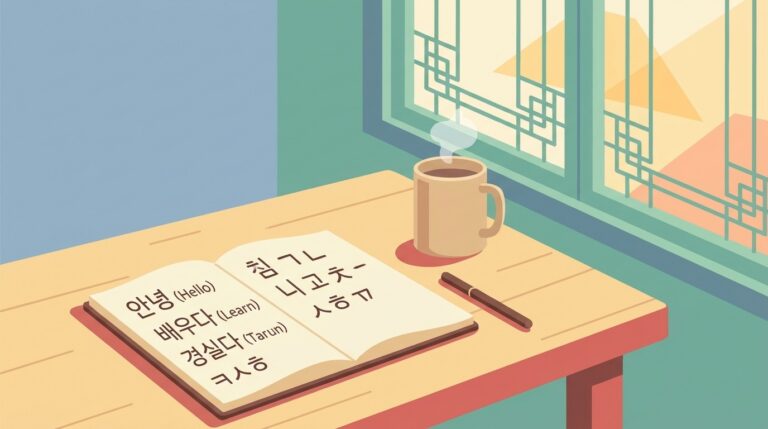
Overcoming Burnout with Morning Pages: Real Korean Expressions for Healing
Phase 1: Empathy & Connection
안녕하세요! 매일한글 에디터입니다. (Hello! This is your Daily Hangul editor!)
Have you ever watched the K-Drama Doctor Slump (닥터슬럼프) or My Liberation Notes (나의 해방일지) and felt your heart ache when the main characters collapse under the sheer weight of relentless expectations? In Korea’s fast-moving society, the pressure to maintain 갓생 (gatsaeng—living an ultra-productive, flawless life) often leads directly to intense burnout (번아웃) and crushing lethargy (무기력증). When my student Maya first reached out to me, she confessed that her brain felt like a tangled web of Korean grammar rules, work deadlines, and unspoken emotional strain. She couldn’t find the words in Korean to express that she was simply drained—not sick, just mentally exhausted.
That was when we introduced a quiet ritual: “모닝 페이지” (morning pages). Sitting with a warm cup of boricha (barley tea) every morning, pouring whatever messy thoughts filled her head straight onto blank paper without self-censorship, completely shifted her mindset. Today, we are moving beyond stiff textbook phrases so you can articulate mental clutter, authentic self-care practices, and genuine relief just like a native speaker. These expressions come straight from real conversations between Korean twenty-somethings sharing how they survive and heal.
Phase 2: Top 3 Core Expressions
1. 머릿속이 복잡하다 (Meorissogi bokjaphada)
- Pronunciation: [Meo-rit-sso-gi bok-jap-ha-da] (Think of the “bok” sounding like the “pock” in pocket, followed by “jap” as in jalapeno without the heat)
- Meaning: Literally “The inside of my head is complicated,” but naturally used as “My mind is completely cluttered” or “I have too much on my mind.”
- K-Culture Moment: Often muttered by overwhelmed leads in office dramas like Misaeng while massaging their temples at the office rooftop.
- Editor’s Insight: Koreans rarely say “I am stressed out” directly in casual conversation; they prefer bodily or spatial imagery. Saying your head is 복잡하다 (bokjaphada) conveys tangled threads waiting to be untangled.
- Situation Spectrum: Casual: ✅ | Semi-formal: ✅ | Formal: ✅
- 🤔 Think About It: In English, we often say “I’m stressed.” Why do you think Korean expresses mental strain as a physical space being “crowded” (복잡하다)?
2. 있는 그대로 적어 내려가다 (Inneun geudaero jeogeo naeryeogada)
- Pronunciation: [In-neun geu-dae-ro jeo-geo nae-ryeo-ga-da] (“In-neun” rhymes with win-noon, “geudaero” sounds like good-air-row)
- Meaning: Literally “To write downwards exactly as it is,” naturally meaning “To pour everything onto paper without judgment or editing.”
- K-Culture Moment: Used frequently in YouTube vlogs focused on journaling (다꾸 / 일기 브이로그) when creators describe therapeutic stream-of-consciousness writing.
- Editor’s Insight: The compound auxiliary verb 적어 내려가다 (jeogeo naeryeogada) adds momentum, visualizing words flowing continuously down a fresh page without hesitation.
- Situation Spectrum: Casual: ✅ | Semi-formal: ✅ | Formal: ⚠️ (Better with 높임말: 적어 내려갑니다)
- 🤔 Think About It: How does describing writing as an uninterrupted downward stream change how you perceive emotional release?
3. 큰 도움이 되다 (Keun doumi doeda)
- Pronunciation: [Keun do-um-i doe-da] (“Keun” sounds like coo-n without rounding your lips, “doum” sounds like dough-oom)
- Meaning: Literally “To become a big help,” naturally “To be immensely helpful” or “To make a world of difference.”
- K-Culture Moment: Frequently heard during celebrity interviews when artists talk about the habits, mentors, or songs that guided them out of a slump.
- Editor’s Insight: Rather than saying something “fixed” a problem, Koreans prefer 도움이 되다 (to become help), reflecting a humble acknowledgment of support rather than absolute self-reliance.
- Situation Spectrum: Casual: ⚠️ (Use 큰 도움 됐어) | Semi-formal: ✅ (큰 도움이 돼요) | Formal: ✅ (큰 도움이 됩니다)
- 🤔 Think About It: Why does Korean grammar make the help an active state of “becoming” (되다) rather than something an object “gives” (주다)?
Phase 3: Textbook Korean vs. Real Spoken Korean
Situation 1: Explaining your mental overload
- 📖 교과서 한국어: “저는 스트레스가 많아서 머리가 아픕니다.” (Jeoneun seuteureseuga manhaseo meoriga apeumnida. / “I have a lot of stress, so my head hurts.”)
- 🗣️ 진짜 한국어: “요즘 생각이 너무 많아서 머릿속이 터질 것 같아요.” (Yojeum saenggagi neomu manhaseo meorissogi teojil geot gatayo. / “Lately I have so many thoughts that my brain feels like it’s going to burst.”)
- 💡 왜 다를까? Textbook Korean sounds like a clinical medical consultation. Native speakers describe psychological overwhelm using dramatic, visceral physical metaphors like 머릿속이 터지다 (my mind is about to explode).
Situation 2: Recommending a daily journaling habit
- 📖 교과서 한국어: “일기를 쓰면 정신 건강에 좋습니다.” (Ilgireul sseumyeon jeongsin geon-gange joeusseumnida. / “Writing a diary is good for mental health.”)
- 🗣️ 진짜 한국어: “아침에 모닝 페이지 쓰면서 생각 정리하는 게 진짜 힐링돼요.” (Achime moning peijji sseumyeonseo saenggak jeongnihaneun ge jinjja hillingdwaeyo. / “Jotting down morning pages to clear my thoughts is genuinely so healing.”)
- 💡 왜 다를까? Real Koreans embrace loan words like 힐링 (healing) as verbs (힐링되다) to capture emotional calm and grounding, rather than the clinical term 정신 건강 (mental health).
Phase 4: K-Culture Deep Dive & Non-Verbal Manners
4-1. Nunchi (눈치) & Mindful Gestures
When discussing burnout or mental fatigue with Korean peers, pay close attention to pacing and physical volume. Koreans often soften raw emotional vulnerability by exhaling gently, looking down at their hands or a warm drink, and lightly touching their chest or temple. Overly dramatic venting in a group can make others uncomfortable because it triggers 부담 (feeling burdened). By describing your remedy—such as morning pages—with a quiet, relieved smile and a gentle nodding gesture, you project emotional maturity (속 깊은 태도) and mindful consideration for your listener’s emotional bandwidth.
4-2. The MZ Generation’s “God-saeng” Paradox
In Korea today, you will constantly encounter the buzzword 갓생 (God-saeng—combining the English word ‘God’ with the Sino-Korean ‘saeng’ for life). It represents the societal trend of waking up at 5:00 AM, studying, working out, and logging every accomplishment on Instagram. However, the dark underbelly of 갓생 is rampant 번아웃 증후군 (burnout syndrome). In response, a counter-culture of quiet mindfulness has emerged: Korean twenty- and thirty-somethings fill stationary shops like Point of View in Seongsu-dong, buying thick textured journals and fountain pens specifically for 다꾸 (diary decorating) and 모닝 페이지 to step off the hamster wheel.
Phase 5: Real-Life Roleplay Scenario
Setting: A sunlit, peaceful independent cafe in Yeonnam-dong. Min-jun notices Sarah staring blankly at her tablet with dark circles under her eyes.
Characters:
* 민준 (Min-jun): Sarah’s considerate Korean coworker and close study buddy.
* 사라 (Sarah): Intermediate Korean learner feeling buried under work and language plateaus.
— Dialogue —
- 민준: 사라 씨, 오늘따라 얼굴이 많이 안 좋아 보여요. 무슨 일 있어요?
(Sarah ssi, oneulttara eolguri mani an joa boyeoyo. Museun il isseoyo?)
“Sarah, you look unusually pale today. Is something going on?”
🎭 [걱정 어린 눈빛으로 따뜻한 캐모마일 티를 건네며] -
사라: 사실 요즘 번아웃이 심하게 와서 아무것도 손에 안 잡혀요.
(Sasil yojeum beon-aut-i simhage waseo amugeotdo sone an japhyeoyo.)
“To be honest, I’ve hit such bad burnout lately that I can’t concentrate on anything.”
🎭 [지친 한숨을 쉬며 머리를 감싸 쥔다] -
민준: 아… 그 기분 뭔지 알아요. 저도 지난달에 완전 무기력증에 빠졌었거든요.
(A… geu gibun mwonji arayo. Jeodo jinandare wanjeon mugiryeokjjeunge ppajyeosseotgeodeunyo.)
“Ah… I know exactly how that feels. I fell into total lethargy last month myself.”
🎭 [공감하며 고개를 천천히 끄덕인다] -
사라: 맞아요. 머릿속이 너무 복잡해서 잠도 제대로 못 자겠어요.
(Majayo. Meorissogi neomu bokjaphaeseo jamdo jedaero mot jagesseoyo.)
“Exactly. My mind is so tangled that I can’t even sleep properly.”
🎭 [답답한 듯 가슴을 가볍게 두드리며] -
민준: 혹시 아침에 ‘모닝 페이지’ 써본 적 있어요?
(Hoksi achime ‘moning peijji’ sseobon jeok isseoyo?)
“Have you ever tried writing ‘morning pages’ in the morning?”
🎭 [가방에서 낡았지만 손때 묻은 작은 노트를 꺼내 보이며] -
사라: 모닝 페이지요? 일기 같은 거예요?
(Moning peijjiyo? Ilgi gateun geoyeyo?)
“Morning pages? Is it like a diary?”
🎭 [호기심 어린 표정으로 노트를 바라보며] -
민준: 맞춤법 신경 쓰지 말고, 머릿속 생각을 노트에 있는 그대로 다 적어 내려가는 거예요. 저한테는 큰 도움이 됐어요.
(Matchumbeop sin-gyeong sseuji malgo, meorissok saenggageul noteue inneun geudaero da jeogeo naeryeoganeun geoyeyo. Jeohanteneun keun doumi dwaesseoyo.)
“Without worrying about spelling, you just pour whatever is in your head onto the paper. It made a huge difference for me.”
🎭 [따뜻하게 미소 지으며 노트를 사라 쪽으로 밀어준다] -
사라: 아, 평가 없이 그냥 쏟아내는 거군요! 내일부터 바로 해볼게요.
(A, pyeong-ga eopsi geunyang ssodanaeneun geogunyo! Naeilbuteo baro haebolgeyo.)
“Ah, so pouring it all out without judging yourself! I’ll definitely try it starting tomorrow.”
🎭 [표정이 한결 밝아지며 펜을 쥐어본다]
🔀 Interactive Decision Branch
What should Sarah say next to deepen the conversation gracefully?
- Option A: “민준 씨도 힘들 때 언제든 저한테 털어놓으세요. 고마워요.” (Min-jun, feel free to vent to me whenever you’re having a hard time too. Thank you.)
👉 Best! Demonstrates genuine Korean reciprocity (상부상조), deepening friendship while keeping the boundary comfortable. - Option B: “그런데 효과 없으면 어떡해요?” (What if it has no effect?)
👉 Risk! Sounds slightly dismissive of Min-jun’s personal, vulnerable recommendation. - Option C: “선생님, 다음 주까지 번아웃 고쳐주세요.” (Teacher, please cure my burnout by next week.)
👉 Bad! Treating a peer like an obligated therapist creates awkward 부담 (unwanted social burden).
Phase 6: 10-Second Emotion Shadowing Drill
Practice these lines out loud, honoring the intonation pauses (/) and emotional cues:
[😮💨 지치고 답답한 한숨과 함께 - Weary & Overwhelmed]
요즘 / 생각이 너무 많아서 / 머릿속이 터질 것 같아요.
(Yojeum / saenggagi neomu manhaseo / meorissogi teojil geot gatayo.)
“Lately / with so many thoughts / my head feels like it’s about to burst.”-
[🌿 차분하고 다정하게 위로하듯 - Calm & Comforting]
맞춤법은 신경 쓰지 말고 / 있는 그대로 / 적어 내려가 보세요.
(Matchumbeobeun sin-gyeong sseuji malgo / inneun geudaero / jeogeo naeryeoga boseyo.)
“Don’t worry about spelling / just as it is / try pouring it onto paper.” -
[✨ 마음이 놓이고 홀가분해진 어조 - Relieved & Hopeful]
노트에 다 쏟아내고 나니까 / 마음에 큰 도움이 됐어요.
(Noteue da ssodanaego nanikka / maeume keun doumi dwaesseoyo.)
“After pouring everything onto the notebook / it brought such immense relief to my mind.”
Phase 7: K-Culture Mini Dictionary
- 번아웃 (Beon-aut) | Burnout Syndrome
Used everywhere in modern Korean workplaces. When you run out of fuel completely, Koreans say “번아웃이 오다” (burnout has arrived) as if it were an uninvited visitor. - 무기력증 (Mugiryeokjjeung) | Lethargy / Anhedonia
Composed of 무 (without) + 기력 (vital energy) + 증 (symptom). It describes the paralysis where you want to do things, but your body refuses to move. - 끄적거리다 (Kkeujeokgeorida) | To scribble / To doodle mindlessly
A delightful onomatopoeic/mimetic verb. It captures the comforting friction of a pen scribbling absentmindedly on paper without pressure to produce a masterpiece. - 마음 챙김 (Maeum chaenggim) | Mindfulness / Mental Self-Care
The Korean term for mindfulness. 챙기다 means to pack or take care of something diligently—here, treating your inner self as someone worth looking after.
Phase 8: Traveler & Expat Survival Kit
Top 3 Survival Phrases for Burnout Recovery Days
- “혼자 조용히 쉬고 싶어요.” (Honja joyonghi swigo sipeoyo.)
Pronunciation: [Hon-ja jo-yong-hi swi-go si-peo-yo]
Pro Tip: Perfect when Korean friends or roommates invite you out for late-night food (야식) and you desperately need solitude to recharge your social battery. - “노트랑 펜은 어디에 있나요?” (Noteurang peneun eodie innayo.)
Pronunciation: [No-teu-rang pen-eun eo-di-e in-na-yo]
Pro Tip: Essential when shopping at Korean design shops or bookstores to pick up quality journaling supplies. - “생각 정리할 시간이 좀 필요해요.” (Saenggak jeongnihal sigani jom piryohaeyo.)
Pronunciation: [Saeng-gak jeong-ni-hal si-gan-i jom pi-ryo-hae-yo]
Pro Tip: A polite, sophisticated way to step back from group discussions or ask for a rain check on plans without offending anyone.
Editor’s Travel Note: Finding Healing Spaces in Seoul
If you are traveling or living in Seoul and feel that familiar burnout creeping in, skip the crowded tourist spots. Head to a quiet aesthetic stationery shop to find your morning pages companion.
* Take the subway to Gwanghwamun Station and explore Kyobo Book Centre stationery on Naver Map to touch artisan Korean paper and explore fountain pens.
* If you need cozy, quiet cafe recommendations with natural morning light, open your phone and download KakaoMap navigation app to locate hidden “book cafes” (북카페) in Yeonnam-dong or Buam-dong where talking loudly is discouraged.
Phase 9: One Step Deeper (한 발 더 깊이)
In traditional Korean culture, endurance (인내 / 참을성) was regarded as one of the highest moral virtues. For generations, complaining about mental exhaustion was brushed off with phrases like “다들 그렇게 살아” (“Everyone lives like that”). However, today’s generation is redefining strength. Writing morning pages in Korean isn’t merely an organizational tool; it is a quiet act of emotional rebellion. By writing down uncurated thoughts 있는 그대로 (without filter), you grant yourself permission to exist outside social validation and collective demands.
💬 Your Turn: Have you ever experienced burnout while trying to master a new language or career? How do you clear your head? Drop your thoughts or a simple journal entry in the comments below!
Phase 10: FAQ & Avoiding Misunderstandings
Q: Can I use “일기” (ilgi) instead of “모닝 페이지” (morning pages)?
A: Yes, but with a nuance shift! 일기 (ilgi) implies a reflective daily diary entry, usually written at night summarizing what happened during the day. 모닝 페이지 refers specifically to the morning ritual of free-form, unedited thought-dumping to detox your mind before the day begins.
Q: Does “복잡하다” only refer to traffic or places?
A: Not at all! While 길이 복잡하다 means the road is crowded or traffic is bad, Koreans just as often say 머릿속이 복잡하다 (my mind is cluttered) or 마음이 복잡하다 (my feelings are conflicted/turbulent).
Q: How do I say “I feel lethargic” naturally without sounding clinically depressed?
A: Avoid saying “저는 우울증입니다” (I have clinical depression) unless that is what you intend. Instead, use everyday colloquial expressions like “요즘 좀 무기력해요” (I feel a bit unmotivated/lethargic lately) or “의욕이 안 생겨요” (I can’t seem to find motivation).
🚨 Common Mistakes Warning Board
- ❌ Saying “나는 스트레스를 만들어요” (I make stress).
✅ Correct: Say “스트레스(를) 받아요” (I receive/experience stress) or “스트레스가 쌓여요” (Stress is piling up). - ❌ Saying “머리가 복잡해요” to mean you have a headache.
✅ Correct: For physical head pain, say “머리가 아파요”. Use “머릿속이 복잡해요” strictly when your mind is full of confusing thoughts. - ❌ Saying “도움을 줬어요” when thanking a peer for their advice.
✅ Correct: Saying someone “gave you help” (도움을 주다) can sound stiff and third-person. Say “(저한테) 큰 도움이 됐어요!” (It was a huge help to me!).
Phase 11: Action Missions
- 🥉 Bronze Level: Take out a notebook right now. Write one single Korean sentence describing your current headspace using: “오늘 제 머릿속은 조금 [복잡해요 / 평화로워요].”
- 🥈 Silver Level: Share a photo of your notebook or coffee mug on Instagram or Threads with the caption: “오늘 아침 생각 정리 완료! 큰 도움이 됐어요. #매일한글 #모닝페이지”
- 🥇 Gold Level: During your next language exchange or Korean chat, answer the question “요즘 어때요?” by sharing your self-care routine: “요즘 번아웃을 극복하려고 매일 아침 모닝 페이지를 적어 내려가고 있어요.”
- 🎮 K-Culture Mission: Watch an episode of a healing slice-of-life drama (like Summer Strike / 아무것도 하고 싶지 않아) and listen for characters saying “머릿속이 복잡하다” or “쉬고 싶다”!
Phase 12: Interactive Quiz Challenge
1. Situational Judgment:
Your Korean friend looks visibly depleted and tells you they can’t concentrate on anything. What is the most empathetic B1-level response?
* (A) “왜 일을 그렇게 많이 했어요? 바보 같아요.”
* (B) “번아웃이 왔군요. 머릿속 생각들을 노트에 한번 적어 내려가 보세요.”
* (C) “한국어 시험공부를 더 열심히 하세요.”
2. Fill-in-the-Blank:
Completing morning pages brought immense relief to my state of mind.
“모닝 페이지를 쓰는 게 제 마음에 큰 ( ).”
3. True or False:
In Korean culture, telling a friend 머릿속이 복잡하다 means you are literally suffering from a neurological migraine. (True / False)
👉 Click here to reveal answers and explanations!
-
Answer: (B)
Explanation: Option (B) acknowledges their burnout (번아웃) with deep empathy and gently recommends the stream-of-consciousness writing technique (적어 내려가 보세요). (A) is rude, and (C) is the last thing an exhausted person needs! -
Answer: 도움이 됐어요 (or 도움이 되었습니다)
Explanation: The core expression is 큰 도움이 되다 (to be of great help). Conjugated in the past tense, it becomes 도움이 됐어요. -
Answer: False
Explanation: 머릿속이 복잡하다 is a psychological metaphor meaning your mind is packed with tangled thoughts and worries. A physical migraine or headache is expressed as 두통이 있다 or 머리가 아프다.







