

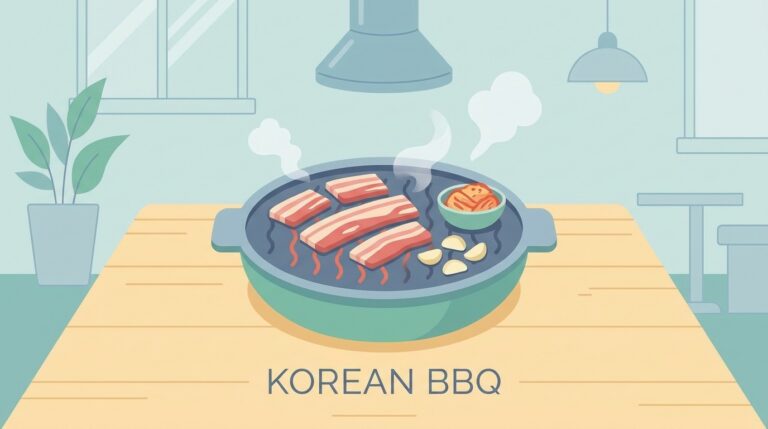
Can You Grill Kimchi at K-BBQ? How to Ask Your Server Like a Pro
Phase 1: Empathy & Story Opening
안녕하세요! 매일한글 에디터입니다. (Hello! I’m the Daily Hangul editor.)
Picture this: You are sitting inside a bustling, neon-lit Korean BBQ restaurant in Hongdae. Thick strips of pork belly (samgyeopsal) are sizzling happily over the roaring heat. Right beside your plate sits a mountain of cold, bright-red fermented kimchi and a bowl of sliced raw garlic. You watch the luscious pork fat pool toward the edge of the grill. Your instinct screams: “Throw that kimchi and garlic right into that pork fat!”
Suddenly, panic sets in. You look around. The grill has delicate thin wire mesh. Will the kimchi sauce burn instantly into an acrid black crust? Will the busy Imo-nim (restaurant auntie) come rushing over to scold you? You freeze with your tongs mid-air. Many of our international students tell us this exact moment makes their palms sweat. The fear of ruining the grill—or breaking an unspoken culinary taboo—keeps travelers from experiencing one of Korea’s greatest flavor miracles: caramelized, pork-fat-braised kimchi.
Don’t let embarrassment keep you hungry! Today, we’re giving you the exact words, body language, and cultural radar (nunchi) to ask your server with confidence. Based on real classroom scenarios and field-tested in Seoul’s best meat joints, this guide turns awkward hesitation into smooth, local-level mastery.
Phase 2: Top 3 Core Expressions Deep Dive
1. 김치랑 마늘도 불판 위에 구워도 돼요? (Kimchirang maneuldo bulpan wie guwodo dwaeyo?)
- Pronunciation: [Gim-chee-rahng mah-neul-doh bool-pahn wee-eh goo-waw-doh dweh-yo?] (Think of ‘dwae’ like the ‘dwe’ in ‘dwell’ with a warm upward inflection.)
- Meaning: Literal: “Kimchi and garlic also, on top of the grill plate, is it okay to grill?” / Actual Nuance: “Excuse me, is it alright if we put the kimchi and garlic directly on the grill?”
- K-Culture Moment: Think of popular K-dramas like Weightlifting Fairy Kim Bok-joo, where grilling side dishes in meat grease is treated as an essential artistic craft.
- Editor’s Insight: The key grammar pattern here is -아/어도 돼요? (-a/eodo dwaeyo?), meaning “May I / Is it okay to…?” It is the golden key of Korean politeness for asking permission at restaurants.
- Situation Spectrum: Casual: ⚠️ (Use
구워도 돼?only with close friends) | Semi-formal: ✅ (구워도 돼요?perfect for staff) | Formal: ✅ (구워도 됩니까?polite, but slightly stiff for dining) - 🤔 Think About It: In English, you might just ask “Can we put this on here?” In Korean, specifying the target surface (bulpan wie / on the grill plate) shows respect for the equipment provided by the shopkeeper.
2. 불판 갈아 주세요. (Bulpan gara juseyo.)
- Pronunciation: [Bool-pahn gah-rah joo-seh-yo] (Say ‘bulpan’ like ‘bull-pahn’, and ‘gara’ rhyming with the start of ‘garage’.)
- Meaning: Literal: “Grill plate, please exchange.” / Actual Nuance: “Could you please change our grill plate?”
- K-Culture Moment: When you burn marinated meat (galbi) or kimchi, you’ll hear table after table around you chant this exact phrase in chorus.
- Editor’s Insight: Don’t wait until the grill is completely pitch-black. Korean servers expect to change the plate multiple times. You don’t need a lengthy apology—a crisp, courteous request is standard etiquette.
- Situation Spectrum: Casual: 🚫 | Semi-formal: ✅ (Standard friendly customer tone) | Formal: ✅
- 🤔 Think About It: Why does Korean dining treat changing the cooking surface as a free, routine service, whereas Western steakhouses keep the pan in the back kitchen? It highlights the participatory nature of Korean table cooking.
3. 고기 다 익었어요? (Gogi da eigeosseoyo?)
- Pronunciation: [Goh-gee dah eeg-aw-ssaw-yo?] (The double ‘ss’ sounds crisp and short, like ‘saw’ with an extra snap.)
- Meaning: Literal: “Meat, completely cooked?” / Actual Nuance: “Is the meat fully done yet? / Can we eat now?”
- K-Culture Moment: In variety shows like I Live Alone, guests hover over sizzling pork waiting for the grill master or host to give the official green light.
- Editor’s Insight: Foreign learners often worry about checking doneness. Using eok-da (to be cooked/ripened) instead of mandeulda (to make) is the natural phrasing for food.
- Situation Spectrum: Casual: ⚠️ (
다 익었어?for friends) | Semi-formal: ✅ (다 익었어요?to staff or peers) | Formal: ✅ - 🤔 Think About It: In Korea, pork is strictly cooked well-done, while beef (hanwoo) is eaten rare or medium. Asking this question shows you respect the correct culinary timing.
Phase 3: Textbook Korean vs. Real Korean
Situation 1: Asking if you can grill side dishes
- 📖 교과서 한국어 (Textbook Korean): 여기 김치와 마늘을 조리해도 괜찮습니까? (Yeogi kimchiwa maneureul jorihaedo gwaenchansseumnikka?) — “Is it permissible to cook kimchi and garlic here?”
- 🗣️ 진짜 한국어 (Real-Life Korean): 사장님, 김치도 올려도 돼요? (Sajangnim, kimchido ollyeodo dwaeyo?) — “Boss, can we throw the kimchi on too?”
- 💡 왜 다를까? (Why the difference?): Real Korean favors vivid action verbs like ollida (to put on / raise onto) rather than formal Sino-Korean cooking terms like jorihada (to cook/prepare food).
Situation 2: Asking for a clean grill grate
- 📖 교과서 한국어 (Textbook Korean): 그릴 표면이 오염되었으니 교체해 주시겠습니까? (Geuril pyomyeoni oyeomdoe-eosseuni gyochehae jusigesseumnikka?) — “The grill surface has become contaminated, so would you replace it?”
- 🗣️ 진짜 한국어 (Real-Life Korean): 저기요, 판 한 번만 갈아 주세요! (Jeogiyo, pan han beonman gara juseyo!) — “Excuse me, could you swap our pan once please?”
- 💡 왜 다를까? (Why the difference?): Real diners say pan (plate) instead of geuril (grill), and soften requests naturally using han beonman (“just once”), which conveys politeness without sounding overly academic.
Phase 4: K-Culture Deep Dive & Non-Verbal Manners
4-1. 눈치 (Nunchi) & Grill Plate Analysis
Before speaking, look down at your grill. This is peak Nunchi (reading the room):
1. The Solid Iron / Stone Slab (돌판/무쇠판): Usually tilted with a small drain hole at the bottom. Green Light! You are practically obligated to grill kimchi at the bottom edge so it absorbs the cascading pork lard.
2. The Wire Mesh / Charcoal Grid (석쇠/그물망): Red light! The red pepper flakes and sugars in kimchi marinade will drop through onto the hot coals, triggering thick white smoke and charred bitterness. If you put kimchi here, the server will rush over in distress.
Gesture Tip: Point your tongs toward the edge of the plate, make eye contact, and tilt your head slightly when asking. Never place cold kimchi right in the dead center where raw meat goes!
4-2. Cultural Code: The Trinity of Samgyeopsal
In Korean food philosophy, grilling isn’t just heating food; it’s an orchestration of elements. The savory pork fat (gireum) acts as a high-heat frying medium for the sour lactic acid of aged mugeunji (ripe kimchi) and the pungent allicin of sliced garlic. Once grilled, garlic turns sweet and nutty, while kimchi loses its sharp raw sourness and becomes rich and buttery. Eating them together wrapped inside a perilla leaf (kkaennip) is called the complete bite.
Phase 5: Real-Life Roleplay Scenario
- Setting: A lively neighborhood pork bistro in Mapo, Seoul. Charcoal smoke drifts through the air, glasses clink, and retro 90s K-Pop plays softly.
- Characters:
- Alex: A curious traveler craving authentic barbecue.
- Imo-nim (이모님): A warm, experienced server wearing a bright floral apron and holding metal tongs.
Alex: 저기요, 사장님! 삼겹살 2인분 먼저 주세요.
(Jeogiyo, sajangnim! Samgyeopsal i-inbun meonjeo juseyo.)
“Excuse me, boss! Two portions of pork belly first, please.”
🎭 Smiles and raises right hand with index and middle finger up.
Imo-nim: 네~ 삼겹살 둘! 불판 달궈지면 고기 올리세요.
(Ne~ samgyeopsal dul! Bulpan dalgwojimyeon gogi olliseyo.)
“Sure thing~ Two pork bellies! Put the meat on once the plate gets hot.”
🎭 Sets down sizzling grill plate and side dishes with practiced speed.
Alex: 와, 냄새 진짜 좋다! 저… 혹시 김치랑 마늘도 불판 위에 구워도 돼요?
(Wa, naemsae jinjja jota! Jeo… hoksi kimchirang maneuldo bulpan wie guwodo dwaeyo?)
“Wow, smells incredible! Um… by any chance, can we grill kimchi and garlic on the pan too?”
🎭 Holds tongs politely, pointing gently toward the rim of the pan.
Imo-nim: 그럼요! 대신 김치는 기름 빠지는 아래쪽에 둬요. 안 그러면 타요!
(Geureomyo! Daesin kimchineun gireum ppajineun araejjoge dwoyo. An geureomyeon tayo!)
“Of course! But place the kimchi at the lower side where grease drains. Otherwise it burns!”
🎭 Uses tongs to quickly slide the kimchi to the bottom slope.
Alex: 아, 기름 흐르는 쪽에요? 알겠습니다!
(A, gireum heureuneun jjogeyo? Algesseumnida!)
“Ah, where the fat flows down? Understood!”
🎭 Nods enthusiastically with an appreciative smile.
Imo-nim: 마늘은 이 작은 참기름 그릇째로 올려줄게.
(Maneureun i jageun chamgireum geureutjjaero ollyeojulge.)
“I’ll put the garlic on inside this little sesame oil cup for you.”
🎭 Places a cute mini foil cup with bubbling garlic cloves onto the grill.
Alex: 대박! 고기 거의 다 익었어요? 지금 먹어도 돼요?
(Daebak! Gogi geoui da eigeosseoyo? Jigeum meogodo dwaeyo?)
“Awesome! Is the meat almost fully cooked? May we eat now?”
🎭 Leans in with chopsticks ready.
Imo-nim: 노릇노릇하네! 쌈 싸서 맛있게 먹어요!
(Noreut-noreuthane! Ssam ssaseo mas-itge meogeoyo!)
“It’s golden brown! Wrap it up with lettuce and enjoy!”
🎭 Gives an encouraging thumbs up before checking the next table.
🔀 Interactive Branching Point
The server just walked away, and you notice your kimchi is starting to smoke and turn black on a wire mesh grill. What do you do?
- Choice A: Scrape it off secretly with your chopsticks and hide it under lettuce leaves.
- Choice B: Press the call bell (ding-dong!) or politely call out, “사장님, 불판 갈아 주세요!” (Sajangnim, bulpan gara juseyo!)
- Choice C: Pour a glass of cold drinking water directly onto the coals to put out the smoke.
Branch Feedback:
* Choice A (Risk): Your table will fill with bitter acrid smoke, making nearby patrons cough. Not a disaster, but definitely uncool!
* Choice B (Best!): Perfect reaction! Korean servers handle this dozens of times a night with a quick, dual-tong flip of the grill grate.
* Choice C (Bad): Dangerous! Cold water on burning charcoal splashes hot ash everywhere and ruins the temperature balance. Never do this!
Phase 6: 10-Second Emotion Shadowing Drill
Practice speaking these real phrases out loud with rhythm and feeling. Pause briefly at each / mark.
[🥺 조심스럽고 공손하게 - Careful & Polite]
저기요… / 혹시 김치도 / 불판에 구워도 돼요?
(Jeogiyo… / hoksi kimchido / bulpane guwodo dwaeyo?)
“Excuse me… / by any chance / is it okay to grill kimchi on the pan too?”-
[🙋♂️ 활기차고 자연스럽게 - Energetic & Natural]
사장님! / 불판 한 번만 / 갈아 주세요!
(Sajangnim! / bulpan han beonman / gara juseyo!)
“Boss! / Just once / please change our grill plate!” -
[🤤 기대감 넘치며 - Excited & Hungry]
우와, / 고기 다 익었어요? / 먹어도 돼요?
(Uwa, / gogi da eigeosseoyo? / meogodo dwaeyo?)
“Ooh, / is the meat fully cooked? / Can we eat now?”
Phase 7: K-Culture Mini Dictionary
-
불판 (Bulpan)
Literal: Fire-plate.
Meaning: The grill grate, iron plate, or stone slab used for indoor Korean tabletop barbecue.
Usage: Used universally when ordering adjustments: “불판 갈아 주세요” (Change the plate, please). -
노릇노릇 (Noreut-noreut)
Literal: Golden-yellow-ish.
Meaning: The appetizing golden-brown, crispy hue achieved when meat or scallion pancakes are cooked to perfection.
Usage: Say “노릇노릇하게 구워 주세요” (Please grill it until golden brown) when asking someone to cook meat well. -
마늘 기름장 (Maneul Gireumjang)
Literal: Garlic sesame-oil dish.
Meaning: A tiny stainless steel or foil cup filled with pure sesame oil and raw garlic cloves that cooks gently on the grill without burning.
Usage: If raw garlic falls through the grate, ask: “마늘 기름장 종지 있어요?” (Do you have a small dish for garlic in sesame oil?). -
볶음밥 (Bokkeumbap)
Literal: Fried rice.
Meaning: The sacred finale of K-BBQ where leftover grilled kimchi, pork scraps, seaweed, and rice are stir-fried directly on the cast-iron plate.
Usage: Never leave without saying: “밥 하나 볶아 주세요!” (Please stir-fry one portion of rice!).
Phase 8: Traveler’s Survival Kit
Top 3 Survival Expressions
- 참기름 종지 주세요. (Chamgireum jongji juseyo.)
Pronunciation: [Chahm-gee-reum jong-jee joo-seh-yo]
Pro Tip: If your grill is wire mesh, this gets you a little cup of sesame oil to confit your garlic safely over the coals! - 앞치마 하나만 주세요. (Apchima hanaman juseyo.)
Pronunciation: [Ahp-chee-mah hah-nah-mahn joo-seh-yo]
Pro Tip: Kimchi and pork fat splatter aggressively. Wear an apron immediately to protect your favorite outfit. - 상추 더 주실 수 있어요? (Sangchu deo jusil su isseoyo?)
Pronunciation: [Sahng-choo daw joo-sheel soo ee-ssaw-yo?]
Pro Tip: Ssam vegetables are almost universally free for refills. Don’t hesitate to ask for fresh greens.
Editor’s Travel Note
- Navigation: When hunting for famous pork belly alleys in Seoul (like Mapo or Jongno 3-ga), rely on local maps rather than international alternatives. We recommend you download Naver Map on your phone to find restaurants rated by real locals.
- Reservations & Waitlists: For trendy grill houses in Seongsu or Gangnam, table lines can exceed two hours. Install and create an account on Catch Table Korea to monitor remote wait times.
- Transit After BBQ: The savory charcoal aroma clings to clothes. Subway stations and convenience stores in Korea frequently sell fabric refresher spray (Fébrèze style) near the exits!
Phase 9: A Step Deeper (한 발 더 깊이)
In many Western culinary settings, dining is individualized: your steak arrives on your private plate cooked precisely to your personal order. Korean BBQ, however, is an exercise in communal harmony. Everyone shares a single, central heat source. Deciding where to place the garlic, when to flip the pork, and who gets the crispiest slice of grilled kimchi requires constant, unspoken attentiveness (nunchi).
When you ask, “김치도 올려도 돼요?”, you aren’t just checking technical kitchen rules—you are participating in a shared ritual of respect for the restaurant’s tools and your dining companions’ shared space.
💬 Your Turn: What is your favorite thing to grill alongside meat in your home country? Have you ever had a funny or awkward dining mishap while traveling in Korea? Share your story in the comments below!
Phase 10: FAQ & Common Mistakes
Q: Can I grill the raw sliced garlic directly on wire grates?
A: If the gaps between the wires are wide, the garlic slices will immediately slip through into the coals and burn. Look for a tiny metal sauce cup or ask the server for “기름장” (gireumjang) so your garlic simmers safely in sesame oil.
Q: Will the server get angry if I ask to change the grill plate too often?
A: Not at all! In Korea, replacing the grill plate (bulpan gyoche) is considered basic hospitality, especially for marinated meats like yangnyeom galbi that char quickly. Calling for a clean pan shows you care about tasting the food at its best.
Q: Is grilled kimchi acceptable at high-end Korean beef (Hanwoo) restaurants?
A: Generally, no. High-grade Hanwoo (Korean beef) is cooked gently to appreciate subtle marbling notes. Grilling heavily spiced, fermented kimchi on a delicate beef grill is considered poor form because the pungent acidity overwhelms the beef’s natural aroma.
🚨 Common Mistakes Alert
- Mistake 1: Placing kimchi at the very top of a sloped iron grill.
Why it’s wrong: Red pepper sauce will run down over the raw meat, boiling it in juice rather than searing it.
Correct Action: Put raw meat at the top; place kimchi at the bottom so rendered pork grease bastes the vegetables naturally. - Mistake 2: Using your personal eating chopsticks to flip raw pork on the grill.
Why it’s wrong: Raw pork carries health risks and transfers raw juices to your eating utensils.
Correct Action: Use the designated metal tongs (jipgae) provided at the center of the table. - Mistake 3: Cutting meat into pieces while it is still completely raw.
Why it’s wrong: Raw meat is tough and slippery, tearing under kitchen scissors.
Correct Action: Sear both sides of the thick pork belly slab first. Once firm and half-cooked, it snips cleanly like paper!
Phase 11: Action Missions & Community
- 🥉 Bronze Mission (Solo Practice): Stand in front of your kitchen mirror with a pair of cooking tongs. Say three times aloud: “사장님, 불판 갈아 주세요!” with a bright, friendly smile.
- 🥈 Silver Mission (Social Connection): Next time you cook at home or visit an Asian restaurant, snap a photo of your sizzling grill plate. Post it with the caption: “김치랑 마늘도 구워도 돼요? #DailyHangul” and tag us!
- 🥇 Gold Mission (Real Life Execution): Step into an authentic Korean barbecue restaurant. Successfully ask the staff for permission to grill kimchi or request a fresh bulpan using only Korean.
- 🎮 K-Culture Mission: Watch an episode of any food-centric K-drama (like Let’s Eat or Hospital Playlist). Spot the exact moment someone cuts the meat or positions the kimchi on the pan, and notice which character holds the tongs!
Phase 12: Interactive Quiz Challenge
1. Situational Judgment
You are sitting at a table with a delicate wire grid (seoksoe) over white-hot charcoal. You want to eat warm kimchi. What is the most culturally savvy move?
* A) Dump the cold kimchi bowl right onto the wire mesh.
* B) Eat the kimchi cold as a refreshing palate cleanser, or ask if they have a small foil container.
* C) Blow on the kimchi until it feels warm.
Click to reveal answer & explanation
Correct Answer: B
Explanation: Wire mesh grills over open coals will scorch kimchi marinade in seconds, creating eye-stinging smoke. On wire grills, it’s best to enjoy kimchi chilled to cut through the rich meat, or ask for a foil dish (eunbakji).
2. Fill-in-the-Blank
Complete the sentence to politely ask for a fresh grill plate:
“저기요, 불판 ______ 주세요!” (Excuse me, please change the grill plate!)
* Clue: The base verb is 갈다 (to exchange/replace).
Click to reveal answer & explanation
Correct Answer: 갈아 (gara)
Full Sentence: 저기요, 불판 갈아 주세요! (Jeogiyo, bulpan gara juseyo!)
3. True or False Cultural Trivia
Statement: In Korea, you must always cook kimchi on every single type of meat grill, including delicate charcoal beef grates.
Click to reveal answer & explanation
Correct Answer: False (F)
Explanation: Kimchi grilling is primarily celebrated with pork cuts like pork belly (samgyeopsal) and pork neck (moksal) on solid iron pans. It is rarely done on charcoal grids with premium Hanwoo beef!







