

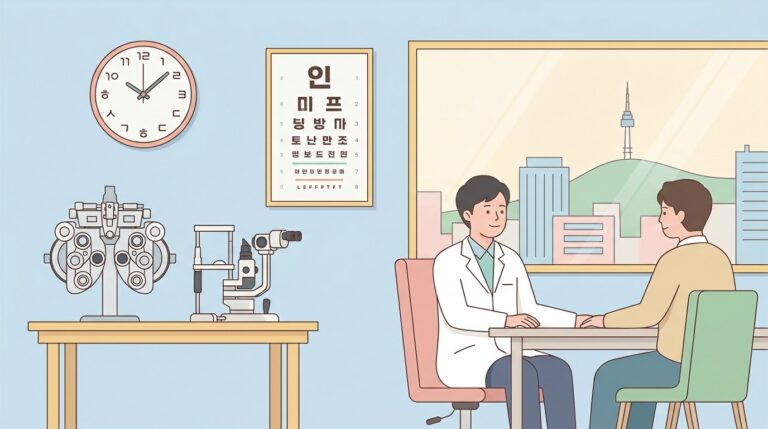
Phase 1: 공감 (Story Opening)
안녕하세요! 매일한글 에디터입니다.
Picture this: You step out of Gangnam Station Exit 10, and you are instantly greeted by towering digital billboards flashing neon advertisements: “SMILE LASIK, 50% Off This Week Only!” or “Same-Day Surgery Event for 890,000 KRW!” Korea is world-renowned for its cutting-edge ophthalmic technology, and it’s tempting to jump right in. But then, you walk into a waiting room that looks like an airport terminal—hundreds of patients shuffled between 50 different machines by assistants with headsets, never seeing the actual surgeon until they are already lying under the laser.
One of our intermediate learners, Sarah, recently shared her harrowing experience: “I went to a clinic because of a flash-sale ad on Instagram. When I tried to ask about corneal thickness and potential halos at night, the consultant just brushed it off and pushed me to sign the surgery consent form immediately. I froze because I didn’t know how to advocate for myself in Korean.”
Your eyes are irreplaceable—you only get one pair for your entire lifetime. Sacrificing safety and aftercare for a quick discount is a gamble no one should take. In this lesson, designed specifically for B2 learners, we’ll move beyond textbook clinic vocabulary. You will master the exact, culturally nuanced Korean expressions needed to bypass high-pressure sales coordinators, critically evaluate a surgeon’s clinical track record, and demand a bulletproof post-operative care plan. Let’s make sure your vision journey in Korea is crystal clear, safe, and entirely on your own terms.
Phase 2: 핵심 표현 3선 심층 분석 (Top 3 Key Expressions)
1. 공장형 안과 (Gongjanghyeong angwa)
- Pronunciation: [Gong-jang-hyeong an-gwa] (Sounds like gong-jahng-hyuhng ahn-gwah — think of ‘gong’ like the instrument, and ‘hyeong’ rhyming with ‘young’).
- Meaning: Literal: “Factory-style eye clinic” | Nuance: High-volume, assembly-line clinics that process hundreds of patients a day using aggressive marketing and deep discounts, often with minimal doctor-patient contact time.
- K-Culture Moment: Frequently featured in consumer advocacy investigative programs like SBS Curious Story Y (궁금한 이야기 Y) or YouTube medical exposés where veteran doctors warn against “ghost doctors” (유령 의사) and assembly-line eye centers.
- Editor’s Insight: While factory-style clinics have top-tier equipment, the consultation is often handled by non-medical sales managers (상담 실장) rather than the doctor. Using this term shows you understand the Korean medical landscape.
- Situation Spectrum: Casual 🚫 | Semi-formal ✅ | Formal ✅
- 🤔 Think About It: In many Western countries, medical advertising is strictly regulated. How does the hyper-commercialized competition in Korea change the way patients must protect their rights?
2. 집도의의 임상 경험 (Jipdoui-ui imsang gyeongheom)
- Pronunciation: [Jip-do-ui-ui im-sang gyeong-heom] (Sounds like jeep-doh-ee-ui eem-sahng gyuhng-huhm — ‘jip’ as in ‘jeep’, ‘imsang’ like ‘eem-sahng’).
- Meaning: Literal: “Operating surgeon’s clinical experience” | Nuance: The primary surgeon’s verified hands-on surgical history, specialized case volume, and surgical expertise.
- K-Culture Moment: In medical K-Dramas like Hospital Playlist (슬기로운 의사생활) or Dr. Romantic (낭만닥터 김사부), patients’ families repeatedly inquire about the 집도의 (lead surgeon) to ensure an intern isn’t performing the high-risk procedure.
- Editor’s Insight: Notice the word 집도의 (Jipdoui) instead of just 의사 (Uisa). ‘집도의’ specifically designates the licensed surgeon who physically operates the laser and holds ultimate legal and ethical responsibility.
- Situation Spectrum: Casual 🚫 | Semi-formal ✅ | Formal ✅
- 🤔 Think About It: In Korean medical settings, being explicit about who holds the scalpel/laser is critical. Why do you think Korean patients emphasize individual surgeon profiles over the clinic’s brand name?
3. 사후 관리 시스템 (Sahu gwanri siseutem)
- Pronunciation: [Sa-hu gwan-ri si-seu-tem] (Sounds like sah-hoo gwahn-ree see-soo-tehm — ‘sa-hu’ literally means ‘after the event’).
- Meaning: Literal: “Post-management system” | Nuance: Follow-up care guarantee, regular post-op checkups, and free emergency management for side effects (like dry eyes, corneal haze, or regression).
- K-Culture Moment: Seen prominently on medical boards and patient guarantee cards (보증서) signed before undergoing procedures in Gangnam or Apgujeong.
- Editor’s Insight: Low-cost clinics often charge extra for eye drops, emergency visits, or follow-up exams 3 months post-op. A reliable clinic offers a transparent, documented 사후 관리 보증제 (guaranteed aftercare program).
- Situation Spectrum: Casual ⚠️ | Semi-formal ✅ | Formal ✅
- 🤔 Think About It: Contrast the concept of customer care in consumer tech with medical warranty in Korea. How does medical warranty reflect the unique intersection of customer service and medical ethics in Korea?
Phase 3: 교과서 한국어 vs 진짜 한국어 (Textbook vs. Native Expressions)
Scenario 1: Inquiring if the lead surgeon handles everything personally
- 📖 교과서 한국어:
- 수술하는 의사가 저를 계속 치료합니까? (Suseulhaneun uisaga jeoreul gyesok chiryohamnikka?)
- “Does the operating doctor continue to treat me?”
- 🗣️ 진짜 한국어:
- 집도의 선생님께서 사전 검진부터 수술, 사후 진료까지 전담해 주시나요? (Jipdoui seonsaengnimkkeseo sajeon geomjinbuteo suseul, sahu jinryokkaji jeondamhae jusinayo?)
- “Will the lead surgeon handle everything personally from my pre-op exam and surgery to my post-op checkups?”
- 💡 왜 다를까? Textbook Korean sounds blunt and childishly robotic. Native intermediate speakers use honorific markers (
~께서,선생님) paired with specialized professional terms like전담하다(to take exclusive charge of).
Scenario 2: Politely rejecting a flash-sale deal to prioritize safety
- 📖 교과서 한국어:
- 할인 가격보다 안전한 것이 더 중요해요. (Harin gagyeokboda anjeonhan geosi deo jung-yohaeyo.)
- “Safety is more important than the discounted price.”
- 🗣️ 진짜 한국어:
- 평생 쓰는 눈인데 이벤트 가격에 흔들리기보다는, 원장님 임상 케이스랑 사후 보장을 먼저 보고 결정하고 싶어요. (Pyeongsaeng sseuneun nuninde ibenteu gagyeoge heundeulligibodaneun, wonjangnim imsang keiseurang sahu bojangeul meonjeo bogo gyeoljeonghago sipeoyo.)
- “Since these are eyes I must use for the rest of my life, rather than being swayed by event pricing, I’d like to decide based on the director’s clinical cases and aftercare warranty.”
- 💡 왜 다를까? Using
~기보다는(rather than) and평생 쓰는 눈인데expresses rational discernment, instantly signaling to the medical coordinator that you cannot be pressured into a quick sale.
Phase 4: K-Culture 딥다이브 & 비언어적 매너 (Deep Dive & Manners)
4-1. 눈치 (Nunchi) & Medical Consultation Manners
In Korean eye clinics, consultations are typically divided into two stages: first with a 상담 실장 (Sangdam siljang – Consultation Director) who handles pricing and scheduling, and second with the 원장님 (Wonjangnim – Head Doctor/Surgeon).
* The Non-Verbal Stance: When talking to the consultation manager, maintain polite eye contact, nod thoughtfully, but keep your posture upright and your hands lightly folded over your notebook or tablet. Avoid smiling excessively or agreeing right away; an overly eager nod is often perceived as willingness to book immediately.
* Asking Critical Questions Without Offense: Instead of aggressively asking “Are you a factory clinic?”, use softening linguistic cushions (쿠션어): 혹시 실례지만... (Excuse me, but perhaps…) or 제가 눈이 워낙 예민한 편이라 꼼꼼히 확인하고 싶은데요... (My eyes are particularly sensitive, so I’d like to check carefully…). This shows firm standards without creating friction.
4-2. Cultural Code Analysis: The Gangnam Medical Hub
Korea’s concentration of ophthalmology clinics in Gangnam and Seocho has fostered unmatched surgical speed and cutting-edge tech (like SMILE Pro and Custom Contoura Vision). However, this hyper-competition creates a stark divide between 공장형 대형 안과 (mega-clinics prioritizing volume) and 1인 원장 맞춤형 안과 (boutique clinics where a single surgeon performs every exam and procedure). In Korean culture, health decisions for the eyes—often called ‘몸이 천 냥이면 눈이 구백 냥’ (“If the body is worth a thousand nyang, the eyes are worth nine hundred”)—command deep caution. Showing that you value surgeon integrity over discount coupons earns immediate professional respect from clinical staff.
Phase 5: 실전 롤플레이 시나리오 (Real-Life Roleplay Scenario)
Setting: Consultation Room at a renowned eye center near Gangnam Station.
Characters:
* 실장님 (Manager Park): A sharp, well-dressed medical coordinator holding a sales brochure.
* 알렉스 (Alex): A cautious intermediate Korean learner seeking SMILE LASIK.
— dialogue start —
- 실장님: 알렉스 님, 오늘 당일 수술 예약하시면 이벤트 특가로 30% 추가 할인 적용되세요! (Arekseu nim, oneul dang-il suseul yeyakhasimyeon ibenteu teukgaro samsip peosenteu chuga harin jeok-yongdoeseyo!)
- 🎭 [Leaning forward with a bright, persuasive smile, pointing at the contract]
- “Alex, if you book your surgery for today, we can apply an additional 30% event discount!”
- 알렉스: 파격적인 가격이긴 한데, 평생 한 번뿐인 눈 수술이라 가격만 보고 급하게 결정하고 싶지는 않아요. (Pageokjeogin gagyeogigin hande, pyeongsaeng han beonppunin nun susurira gagyeongman bogo geubhage gyeoljeonghago sipjineun anh-ayo.)
- 🎭 [Calmly setting down his pen and speaking with measured composure]
- “It’s an exceptional price, but since this is a once-in-a-lifetime surgery on my eyes, I don’t want to rush my decision based on cost alone.”
- 실장님: 아, 물론이죠! 저희 병원이 하루에 수술만 수십 건씩 하는 곳이라 장비는 국내 최고 수준이에요. (A, mullon-ijyo! Jeohui byeong-woni harue suseulman susip geonssik haneun gosira jangbineun gungnae choego sujun-ieyo.)
- 🎭 [Nodding quickly, pointing to a catalog of cutting-edge German laser systems]
- “Ah, of course! Our clinic performs dozens of surgeries a day, so our equipment is top-tier in Korea.”
- 알렉스: 최신 장비도 중요하지만, 무엇보다 집도의 선생님의 임상 경험이 가장 궁금합니다. (Choesin jangbido jung-yohajiman, mueotboda jipdoui seonsaengnimui imsang gyeongheomi gajang gunggeumhamnida.)
- 🎭 [Looking straight into the coordinator’s eyes, asking steadily]
- “Modern equipment is important, but more than anything, I’d like to know about the lead surgeon’s clinical track record.”
- 실장님: 저희 대표 원장님 세 분 모두 수술 경력 15년 이상의 베테랑 안과 전문의세요. (Jeohui daepyo wonjangnim se bun modu suseul gyeongnyeok sibonyeon isang-ui betenang angwa jeonmun-uiseyo.)
- 🎭 [Adjusting her glasses, adopting a more formal, respectful posture]
- “All three of our head directors are veteran board-certified ophthalmologists with over 15 years of surgical experience.”
- 알렉스: 그렇다면 제 검사 결과를 바탕으로 직접 집도하실 원장님과 수술 전 부작용 상담도 가능한가요? (Geureotamyeon je geomsa gyeolgwreul batangeuro jikjeop jipdohasil wonjangnimgwa suseul jeon bujagyong sangdamdo ganeunghangayo?)
- 🎭 [Checking off an item on his personal notes with a polite tone]
- “If so, based on my exam results, is it possible to have a pre-op side-effects consultation directly with the doctor who will actually operate?”
- 실장님: 네, 당연하죠. 검사 차트 나온 후에 원장님 진료실에서 잔여 각막량과 빛 번짐 가능성에 대해 1:1로 꼼꼼히 짚어 드릴 겁니다. (Ne, dang-yeonhajyo. Geomsa chateu naon hue wonjangnim jinryosireseo janyeo gakmangnyanggwa bit beonjim ganeungseong-e daehae il-dae-illo kkomkkomhi jipeo deuril geomnida.)
- 🎭 [Softening her sales pitch, acknowledging the patient’s serious approach]
- “Yes, absolutely. Once your chart is ready, the director will review your residual corneal thickness and potential light halos 1-on-1 in detail.”
- 알렉스: 다행이네요. 수술 후 정기 검진과 응급 상황 시 사후 관리 시스템도 서면으로 확인하고 싶습니다. (Dahaeng-ineyo. Suseul hu jeonggi geomjingwa eunggeup sanghwang si sahu gwanri siseutemdo seomyeon-euro hwaginhago sipseumnida.)
- 🎭 [Folding his hands neatly on the desk, concluding clearly]
- “That’s a relief. I would also like to confirm your regular post-op checkup schedule and emergency follow-up system in writing.”
— dialogue end —
🔀 인터랙티브 분기점 (Interactive Decision Point)
At turn 2, what if Alex had responded differently to the 30% discount pitch?
* Option A: “와, 진짜 싸네요! 오늘 바로 수술받을게요! 계좌이체 할게요!” (Wa, jinjja ssaneyo! Oneul baro suseulbadeulgeyo! Gyejwran-iche halgeyo!)
* Outcome: [Bad] You fall into an impulsive high-pressure sale. You forfeit the chance to assess your pupil dilation, corneal topography, or your surgeon’s identity.
* Option B: “공장형 병원이라 이렇게 싸게 후려치는 거죠? 의사 면허증 먼저 보여주세요.” (Gongjanghyeong byeong-wonira ireoke ssage huryeochineun geojyo? Uisa myeonheojeung meonjeo boyeojuseyo!)
* Outcome: [Risk] Overly combative and hostile. The coordinator and medical team will become defensive, ruining any constructive rapport.
* Option C: “좋은 제안 감사합니다만, 저는 가격보다 집도의의 경력과 사후 관리가 더 우선이라 검진 먼저 차분히 받아보고 싶습니다.” (Joeun jean gamsahamnidaman, jeoneun gagyeokboda jipdoui-ui gyeongnyeokgwa sahu gwanriga deo useon-ira geomjin meonjeo chabunhi badabogo sipseumnida.)
* Outcome: [Best] Highly dignified, assertive, and culturally impeccable. The clinic immediately recognizes you as a knowledgeable patient who expects top medical care.
Phase 6: 10초 감정 섀도잉 드릴 (10-Second Emotion Shadowing)
Practice reading these out loud, observing the / breath pauses and matching the emotional cues!
[🧐 차분하고 단호하게 - Calm and Resolute]- 평생 한 번뿐인 소중한 눈인데 / 이벤트 가격에 현혹되고 싶지 않아요.
- (Pyeongsaeng han beonppunin sojunghan nuninde / ibenteu gagyeoge hyeonhokdoego sipji anh-ayo.)
- “These are my precious eyes, meant for a lifetime / I don’t want to be dazzled by flash-sale prices.”
[🔍 꼼꼼하고 진지하게 - Thorough and Inquiring]- 단순 수술 건수보다 / 저와 비슷한 각막 조건을 수술하신 / 집도의 선생님의 임상 경험을 알고 싶습니다.
- (Dansun suseul geonsuboda / jeowa biseutan gakmak jogeoneul suseulhasin / jipdoui seonsaengnimui imsang gyeongheomeul algo sipseumnida.)
- “Rather than raw surgical volume / I want to know the operating surgeon’s clinical experience / with corneal conditions similar to mine.”
[🛡️ 확신에 차서 - Confident and Safe]- 수술 후 시력 퇴행이나 부작용이 생겼을 때 / 사후 관리 보증이 어떻게 이뤄지는지 / 설명서로 확인해 주세요.
- (Suseul hu siryeok toehaeng-ina bujagyongi saenggyeosseul ttae / sahu gwanri bojeungi eotteoke irwojineunji / seolmyeongseoro hwaginhae juseyo.)
- “If vision regression or side effects occur post-surgery / please verify with documentation / how your aftercare warranty is fulfilled.”
Phase 7: K-Culture 미니 사전 (Mini Dictionary)
- 잔여 각막량 (Janyeo gakmangnyang)
- Meaning: Residual corneal thickness.
- Context: The single most critical safety metric in LASIK/LASEK/SMILE. Korean doctors recommend preserving at least 300~350 microns of residual stroma to prevent corneal ectasia (각막확장증).
- 과잉 진료 (Gwa-ing jinryo)
- Meaning: Overtreatment / Medical upselling.
- Context: Adding unnecessary expensive genetic tests, PRP drops, or cross-linking treatments that inflate the basic bill. Discerning patients ask: “이 검사가 필수인가요, 선택인가요?” (Is this exam mandatory or optional?).
- 빛 번짐 (Bit beonjim)
- Meaning: Light halos / Starbursting at night.
- Context: The most common side effect discussed during pre-op tests, particularly if your optical zone is smaller than your scotopic pupil size (야간 동공 크기).
- 보증서 발급 (Bojeungseo balgeup)
- Meaning: Issuance of a surgical guarantee certificate.
- Context: Many high-standard clinics issue a physical or digital card promising lifetime free follow-up checks and touch-ups if your vision regresses.
Phase 8: 여행자를 위한 생존 키트 (Traveler’s Survival Kit)
Top 3 Survival Phrases
- 1. 동공 확장 안약 때문에 혼자 귀가하기 힘들 수 있나요?
- (Donggong hwakjang anyak ttaemune honja gwigahagi himdeul su innayo?)
- “Will it be difficult to return home alone due to the pupil-dilating eye drops?”
- Pro Tip: Pre-op precision exams always use cycloplegic drops. Your near vision will be blurred for 4–6 hours! Don’t schedule appointments right after.
- 2. 재수술이나 보강 수술 시 추가 비용이 발생하나요?
- (Jaesuseurina bogang suseul si chuga biyongi balsaenghanayo?)
- “Do additional costs incur if I need enhancement surgery or re-operation?”
- Pro Tip: Always ask this before paying deposits to distinguish assembly-line clinics from accountable practices.
- 3. 제 수술을 담당하실 집도의 선생님 성함을 알 수 있을까요?
- (Je suseureul damdanghasil jipdoui seonsaengnim seonghameul al su isseulkkayo?)
- “Could I know the full name of the surgeon who will be operating on me?”
- Pro Tip: Once you have the name, you can search their academic publications and board certifications.
Editor’s Travel Note
- App Recommendation: Download the 모두닥(Modoodoc) 병원 후기 앱 to read authentic Korean patient reviews verified by national health insurance receipts, preventing fake influencer reviews from misleading you.
- Logistics & Transit: Never drive to an eye exam in Gangnam. Use 네이버 지도 앱 to plan your subway route home, as pupil dilation will make sunlight dazzling. Bring dark UV-blocking sunglasses in your pocket!
Phase 9: “한 발 더 깊이” (Reflective Essay)
In traditional Korean thought, the ancient Confucian precept “신체발부 수지부모 (Sinchebalbu sujibumo – our body, hair, and skin are received from our parents and must not be harmed lightly)” placed deep spiritual reverence on bodily preservation. Today, South Korea boasts the highest density of refractive eye surgeries in the world, embracing technological evolution with breathtaking speed. Yet, inside that hyper-modern medical marketplace, the core value remains unchanged: trust between doctor and patient cannot be discounted. Choosing a surgeon based on their clinical experience and aftercare rather than an algorithm-driven flash sale is the modern expression of that ancient wisdom—respecting the only two eyes you will ever have.
💬 Your Turn: If you were undergoing a major procedure abroad, what would be your non-negotiable factor: cutting-edge laser equipment, low cost, or the surgeon’s clinical track record? Tell us in the comments below! (여러분의 선택 기준을 한국어로 댓글에 남겨주세요!)
Phase 10: FAQ & 흔한 실수 예방 (FAQ & Mistakes)
Q: Can medical coordinators (상담 실장) legally determine my surgery eligibility?
A: No. Coordinators explain packages, pricing, and schedules, but legally and medically, only a licensed ophthalmologist (안과 전문의) can evaluate your corneal topography, fundus exam, and declare you fit for surgery.
Q: What is the real difference between a ‘대표원장’ (Chief Director) and a ‘페이닥터’ (Employed Doctor)?
A: A 대표원장 owns or co-manages the clinic and generally stays permanently, ensuring continuous aftercare for years. A 페이닥터 is a salaried associate who might move to another hospital next year, making long-term aftercare slightly harder to track.
Q: Why do prices vary so drastically between 900,000 KRW and 2,800,000 KRW?
A: Older traditional LASIK/LASEK with manual microkeratomes is significantly cheaper. State-of-the-art lenticule extraction (SMILE / SMILE Pro) using high-precision femtosecond lasers requires costly licensing per procedure and high surgeon expertise, hence the higher price tag.
🚨 외국인 학습자의 흔한 실수 TOP 3 (Common Mistakes)
- Saying “수술을 깎아주세요” (Please discount my surgery):
- Why it’s wrong: Sounds like you’re haggling for cabbage at an open fish market.
- Correct Action: Say
"혹시 제휴 할인이나 추가 혜택 조건이 있나요?"(Are there any affiliation discounts or benefit criteria?).
- Confusing ‘라식’ (LASIK) with ‘라섹’ (LASEK):
- Why it’s wrong: They have entirely different healing timelines (1 day vs 5-7 days of recovery).
- Correct Action: Inquire specifically:
"제 각막 두께에는 라식이 안전한가요, 라섹이 안전한가요?"(For my corneal thickness, is LASIK or LASEK safer?).
- Signing consent forms without reading the side-effect clauses:
- Why it’s wrong: Assuming all clinics provide free enhancement surgeries if under-correction occurs.
- Correct Action: Ask to inspect the clause:
"재수술 보장 기간과 사후 진료 규정을 확인하고 싶습니다."(I’d like to check the re-operation warranty period and aftercare regulations).
Phase 11: 액션 미션 & 참여 유도 (Action Missions)
- 🥉 Bronze Mission (Solo Practice): Stand in front of your mirror and practice Phase 6 Emotion Shadowing Sentence #1 three times without stuttering on ‘현혹되고 싶지 않아요’.
- 🥈 Silver Mission (Social Sharing): Share an Instagram Story or tweet about Korean eye clinic culture using the hashtag
#매일한글and include the phrase:평생 쓰는 눈, 집도의가 가장 중요해요!(Eyes are for life; the lead surgeon matters most!). - 🥇 Gold Mission (Real Application): Next time you visit any clinic or salon in Korea, politely turn down an upsell or event bundle by stating: “가격보다는 전문성을 먼저 고려하고 싶어요.” (I prefer to prioritize professional expertise over price).
- 🎮 K-Culture Mission: Watch an episode of a Korean medical drama (like Romantic Doctor, Teacher Kim). Spot the moment a doctor mentions
집도의or부작용and note how the actors deliver the line with gravity.
Phase 12: 인터랙티브 퀴즈 챌린지 (Interactive Quiz)
Q1. [상황 판단] You are consulting at a clinic where the coordinator says, “If you pay right now without doctor consultation, we will take off 500,000 won.” What is the best B2-level response?
* ① “돈 없어요. 그냥 갈게요.” (Don eopseoyo. Geunyang galgeyo.)
* ② “원장님 정밀 상담과 각막 검사 결과 먼저 확인한 뒤에 결정하겠습니다.” (Wonjangnim jeongmil sangdamgwa gakmak geomsa gyeolgwa meonjeo hwaginhoan dwie gyeoljeonghagesseumnida.)
* ③ “50만 원 더 깎아주면 지금 결제할게요.” (Osimman won deo kkak-ajumyeon jigeum gyeoljehalke-yo.)
Q2. [빈칸 채우기] Complete the sentence:
“공장형 병원의 이벤트 가격에 (________)보다 원장님의 풍부한 수술 경험을 믿기로 했어요.”
* Hint: Meaning “rather than being dazzled / misled by”.
Q3. [True / False 문화 퀴즈] In Korea, pre-op refractive surgery exams (정밀 검사) only take 5 minutes and you can drive home immediately.
* (True / False)
👉 정답 및 해설 보기 (Click to view answers & explanations)
- Q1 정답: ②
- 해설: ② is polite, highly rational, and demonstrates that you prioritize medical exam outcomes over high-pressure commercial tactics.
- Q2 정답: 현혹되기 (or 현혹되기보다는)
- 해설:
현혹되다means to be captivated, blinded, or misled by clever marketing or appearances. Combining it with~기보다creates the phrase “rather than being deceived by”.
- 해설:
- Q3 정답: False
- 해설: Comprehensive eye exams in Korea typically involve 40~50 individual tests (corneal topography, endothelial cell count, dilated fundus exam) and take 1.5 to 2 hours. Because pupil dilation drops blur your vision for hours, driving is strictly prohibited!







