

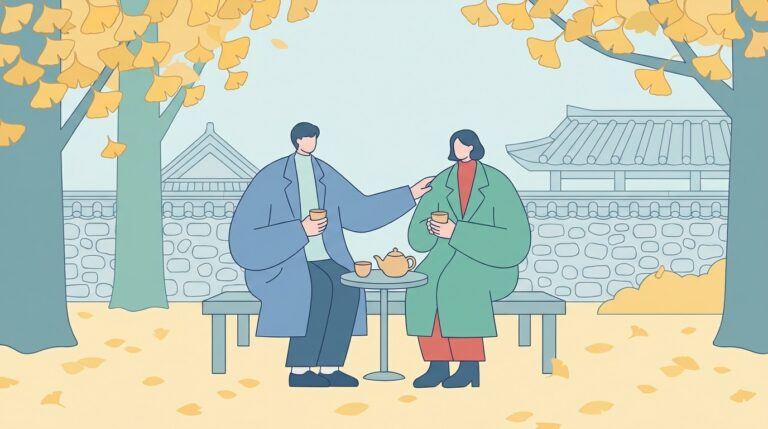
Phase 1: 공감 (Reflecting on Life in Korea)
안녕하세요! 매일한글 에디터입니다.
Have you ever stood in the middle of a bustling subway station in Seoul—surrounded by thousands of commuters briskly moving under glowing neon signs—and suddenly felt a wave of complete, silent isolation? Even if you’ve studied hard and reached an intermediate level, living in Korea often confronts you with subtle cultural barriers: unspoken workplace hierarchies, the nuanced art of reading the room, or that unexpected sting of homesickness inside a tiny studio apartment.
I remember an exchange student who broke down in tears over a bowl of instant ramen because she couldn’t understand why her teammates didn’t directly invite her to lunch. But then came the breakthrough: a kind senior colleague noticed her quiet distress, slid a warm canned coffee onto her desk, and said, “우리 같이 밥 먹으러 가요” (Uri gachi bap meogeureo gayo – Let’s go eat together). It wasn’t formal or dramatic, yet that single moment anchored her. Overcoming culture shock isn’t about mastering grammar tables; it’s about learning the vulnerable, sincere phrases that allow Korean friends and colleagues to hold your hand through the hard days. This guide, refined with feedback from dozens of international residents, will give you the language and cultural confidence to turn lonely days into lifelong connections.
Phase 2: 핵심 표현 3선 심층 분석 (Top 3 Heartfelt Expressions)
1. 덕분에 큰 힘이 되었어요 (Deokbune keun him-i doeeosseoyo)
- Pronunciation: [Deok-bu-ne keun hee-mee doe-eoss-eo-yo] (Think of ‘deok’ like duck, and ‘him’ like the English pronoun, meaning strength)
- Meaning: Literal: “Thanks to you, it became big strength.” | Nuance: “Your support truly kept me going / You gave me so much courage.”
- K-Culture Moment: Think of emotional workplace dramas like Misaeng (Incomplete Life), where a struggling intern expresses heartfelt gratitude to a loyal mentor after wrapping up a grueling project.
- Editor’s Insight: In Korean, saying “Thank you” (감사합니다) can sometimes feel transactional. Adding 덕분에 큰 힘이 되었어요 shows that the person’s presence or actions gave you genuine psychological resilience.
- Situation Spectrum: Casual (덕분에 힘 났어!): ✅ | Semi-formal (덕분에 큰 힘이 돼요): ✅ | Formal (덕분에 큰 힘이 되었습니다): ✅
- 🤔 Think About It: In English, we often say “You saved my life!” or “I appreciate your help.” Why do you think Korean expresses support as “giving strength” (힘을 주다) rather than solving a problem directly?
2. 혼자 끙끙 앓지 마요 (Honja kkeungkkeung alji mayo)
- Pronunciation: [Hon-ja kkeung-kkeung ahl-jee ma-yo] (Make a guttural ‘kk’ sound, like groaning when lifting something heavy)
- Meaning: Literal: “Don’t groan and be sick alone.” | Nuance: “Don’t suffer in silence; talk to me, don’t carry the burden alone.”
- K-Culture Moment: A scene in Hospital Playlist where lifelong friends notice one doctor quietly agonizing over a personal dilemma and demand they share the burden.
- Editor’s Insight: The onomatopoeia 끙끙 mimics groaning under physical or mental strain. When a Korean friend says this to you, it is an invitation into emotional intimacy—they are telling you, “You don’t need to wear a brave face with me.”
- Situation Spectrum: Casual (혼자 끙끙 앓지 마): ✅ | Semi-formal (혼자 끙끙 앓지 마요): ✅ | Formal: ⚠️ (Too intimate for conservative corporate meetings)
- 🤔 Think About It: In your native culture, is keeping problems to yourself seen as independence, or do people expect you to lean on your community?
3. 서로 의지하면서 버텼죠 (Seoro uijihamyeonseo beotyeotjyo)
- Pronunciation: [Seo-ro eui-jee-ha-myeon-seo beo-tyeot-jyo] (Flow smoothly through ‘uiji’, sounding like wee-jee)
- Meaning: Literal: “We endured while leaning on each other.” | Nuance: “We pulled through together by relying on one another.”
- K-Culture Moment: An interview on a variety show where members of a celebrated K-Pop group look back on their tough trainee years sharing a single cramped dorm.
- Editor’s Insight: The verb 버티다 (to endure, hang on) is one of the most culturally loaded Korean words. It doesn’t mean passive waiting; it signifies gritty, active resilience. Pairing it with 서로 의지하다 (to lean on one another) shows that endurance in Korea is rarely a solitary sport.
- Situation Spectrum: Casual (서로 의지하면서 버텼지): ✅ | Semi-formal (서로 의지하면서 버텼죠): ✅ | Formal (서로 의지하며 버텨냈습니다): ✅
- 🤔 Think About It: What does the cultural emphasis on 버티기 (enduring together) reveal about Korea’s rapid historical and economic transformations?
Phase 3: 교과서 한국어 vs 진짜 한국어 (Textbook vs Real Korean)
Situation 1: Expressing sincere gratitude after a long talk about your worries
- 📖 교과서 한국어: 귀하의 따뜻한 조언과 도움에 깊이 감사드립니다. (Gwiha-ui ttatteutan joeon-gwa doum-e gipi gamsadeurimnida. – I express deep gratitude for your warm advice and help.)
- 🗣️ 진짜 한국어: 오늘 언니(형)랑 이야기하니까 꽉 막혔던 게 쑥 내려가는 것 같아요. 진짜 고마워요! (Oneul eonni/hyeong-rang iyagihanikka kkwak makyeotdeon ge ssuk naeryeoganeun geot gatayo. Jinjja gomawoyo! – Talking with you today feels like a huge weight lifted off my chest. Truly, thank you!)
- 💡 왜 다를까?: Textbook formulas sound like official customer service notices. Koreans express emotional relief using visceral, bodily metaphors like “what was clogged went down smoothly” (쑥 내려가다).
Situation 2: Asking a foreign or local friend who looks unusually quiet
- 📖 교과서 한국어: 당신은 현재 심리적인 어려움을 겪고 있습니까? (Dangsin-eun hyeonjae simnijeogin eoryeoum-eul gyeokgo itseumnikka? – Are you currently experiencing psychological difficulties?)
- 🗣️ 진짜 한국어: 요즘 안색이 안 좋아 보여서 걱정돼요. 별일 없죠? (Yojeum ansaegi an joa boyeoseo geokjeongdwaeyo. Byeol-il eopjyo? – You’ve looked a bit pale/tired lately, so I was worried. Everything okay?)
- 💡 왜 다를까?: Asking directly about “psychological difficulties” feels alarming and clinical. Koreans naturally soften concern by observing physical countenance (안색) followed by the gentle check-in 별일 없죠? (No big trouble, right?).
Phase 4: K-Culture 딥다이브 & 비언어적 매너 (Deep Dive & Non-Verbal Manners)
4-1. 눈치 (Nunchi) & Heart-to-Heart Gestures
When a colleague or friend in Korea is struggling, rarely will they announce: “I am deeply depressed today.” Instead, they communicate through quiet micro-signals: sitting alone during tea breaks, answering with short affirmative nods, or letting out a low, subtle sigh (한숨).
* Eye Contact: Don’t stare intensely down into their eyes when they begin confessing personal struggles. In Korean culture, intense unbroken eye contact during emotional vulnerability feels confrontational. Lower your gaze slightly toward their hands or the table between you to offer a gentle, non-judgmental space.
* The Beverage Gesture: The quickest way to extend empathy without demanding an immediate verbal breakdown is offering a warm drink (like yuzu tea or a hot can from the convenience store heater). Hand it over using two hands (양손), with a slight bow of the head.
4-2. Cultural Code: The Healer of Pojangmacha & Chimaek
In countless K-Dramas (such as Itaewon Class or Weightlifting Fairy Kim Bok-joo), the turning point of deep camaraderie happens not in an office boardroom, but under the orange vinyl roof of a Pojangmacha (street cart) or over crisp fried chicken and beer (Chimaek). Sharing food breaks down the strict hierarchy (서열) that governs daytime life. When someone clinks their glass slightly lower than yours, they are showing respect; when they pour your drink, they are weaving 정 (Jeong)—that untranslatable thread of communal affection and mutual responsibility.
Phase 5: 실전 롤플레이 시나리오 (Real-World Roleplay)
Setting: A cozy cafe near Euljiro on a rainy Thursday evening after a stressful work week.
Characters:
* Chris (크리스): An expat in his second year living in Seoul, feeling burnt out by subtle cultural miscommunications at his office.
* Minji (민지): A thoughtful Korean coworker who noticed Chris skipping team dinners lately.
Dialogue:
1. Minji: 크리스 씨, 요즘 얼굴이 좀 수척해 보여요. 회사 일 때문에 많이 힘들죠?
(Keuriseu ssi, yojeum eolguri jom sucheokhae boyeoyo. Hoesa il ttaemune mani himdeuljyo?)
“Chris, you look a bit worn out lately. Is work at the company really wearing you down?”
🎭 행동 지문: Placing a warm cup of camomile tea gently in front of Chris with a soft, concerned smile.
- Chris: 솔직히 말하면… 가끔 문화 차이 때문에 소외감을 느낄 때가 있어요. 제가 뭘 잘못하고 있는 건가 싶기도 하고요.
(Soljiki malhamyeon… gakkeum munhwa chai ttaemune soewegam-eul neukkil ttaega isseoyo. Jega mwol jalmothago inneun geon-ga sipgido hagoyo.)
“Honestly speaking… sometimes I feel isolated because of cultural differences. I even wonder if I’m doing something wrong.”
🎭 행동 지문: Staring down into the steaming tea, gripping the mug with both hands. -
Minji: 에이고, 그랬군요. 혼자 끙끙 앓지 말지 그랬어요. 크리스 씨 잘못이 전혀 아니에요!
(Eigo, geuraetgunyo. Honja kkeungkkeung alji malji geuraesseoyo. Keuriseu ssi jalmogi jeonhyeo anieyo!)
“Oh dear, I see. You shouldn’t have suffered in silence alone! It’s not your fault at all!”
🎭 행동 지문: Nodding empathetically with a warm sigh of validation. -
Chris: 한국어 공부도 열심히 했는데, 직장에서의 미묘한 분위기를 읽는 게 아직도 너무 어려워요.
(Hangugeo gongbudo yeolsimhi haenneunde, jikjang-eseoui mimyohan bunwigireul ingneun ge ajikdo neomu eoryeowoyo.)
“I studied Korean diligently, but reading the subtle atmosphere at work is still so difficult.”
🎭 행동 지문: Shrugging with a self-deprecating smile. -
Minji: 그건 한국 사람들도 어려워해요! 처음에 저도 적응하느라 엄청 울었어요. 크리스 씨는 이미 너무 잘하고 있어요.
(Geugeon hanguk saramdeuldo eoryeowohaeyo! Cheo-eume jeodo jeogeunghaneura eomcheong ureosseoyo. Keuriseu ssineun imi neomu jalhago isseoyo.)
“Even native Koreans struggle with that! I cried so much trying to adapt at first too. Chris, you’re already doing amazingly.”
🎭 행동 지문: Tapping the table lightly to reassure him. -
Chris: 민지 씨가 그렇게 말해 주니까 마음이 놓이네요. 덕분에 큰 힘이 돼요.
(Minji ssiga geureoke malhae junikka ma-eumi no-ineyo. Deokbune keun him-i dwaeyo.)
“Hearing you say that really sets my mind at ease. Thanks to you, it gives me great strength.”
🎭 행동 지문: Looking up, smiling with a sense of genuine relief. -
Minji: 앞으로 답답한 거 있으면 언제든 저한테 털어놓으세요. 우리 같이 버티는 거죠!
(Apeuro dabdaphan geo isseumyeon eonjedeun jeohante teoreoneo-useyo. Uri gachi beotineun geojyo!)
“If anything feels frustrating from now on, open up to me anytime. We’re enduring this together!”
🎭 행동 지문: Clinking her cup against Chris’s with a playful wink. -
Chris: 네! 앞으로 더 용기 내서 적응해 볼게요. 정말 든든해요.
(Ne! Apeuro deo yonggi naeseo jeogeunghae bolgeyo. Jeongmal deundeunhaeyo.)
“Yes! I’ll muster more courage to adapt going forward. It’s truly reassuring to have you.”
🎭 행동 지문: Giving a confident nod.
🔀 인터랙티브 분기점 (Interactive Branching Choice)
Minji finishes her drink and says: “오늘 저녁에 매운 떡볶이 먹으러 갈래요? 스트레스 확 풀려요!” (Shall we grab spicy tteokbokki tonight? It blows stress away!) How do you respond?
- Choice A: “네, 너무 좋아요! 저 매운 거 먹으면서 수다 떨고 싶었어요.” (Ne, neomu joayo! Jeo maeun geo meogeumyeonseo suda tteolgo sipeosseoyo.)
👉 Feedback [Best]: Perfect! Accepting an invitation to share comfort food is the quintessential Korean way to consolidate bonding after an emotional talk. - Choice B: “저는 바쁘니까 나중에 가요.” (Jeoneun bappeunikka najung-e gayo.)
👉 Feedback [Bad]: Too blunt and transactional. It abruptly shuts down the emotional warmth Minji just extended, leaving an awkward coldness. - Choice C: “글쎄요, 위장이 안 좋아서 매운 건 좀 무서워요.” (Geulsseyo, wijang-i an joaseo maeun geon jom museowoyo.)
👉 Feedback [Risk]: Honest about food tolerance, but a bit of a conversational dead-end. Better: “매운 건 잘 못 먹지만, 덜 맵게 해서 같이 가요!” (I can’t eat very spicy, but let’s go together with mild spice!).
Phase 6: 10초 감정 섀도잉 드릴 (10-Second Emotion Shadowing Drill)
Practice these lines out loud. Match the slashes (/) for brief breath pauses, and embody the bracketed emotions.
[🥺 속마음을 솔직히 털어놓으며 - Honest vulnerability]
가끔 문화 차이 때문에 / 외롭고 지칠 때가 / 많았어요.
(Gakkeum munhwa chai ttaemune / oeropgo jichil ttaega / manasseoyo.)
“There were many times / when cultural differences / made me feel lonely and exhausted.”-
[ 감동과 감사를 담아 - Deep, sincere gratitude]
그때마다 / 손잡아 준 친구들 덕분에 / 여기까지 버텼어요.
(Geuttaemada / sonjaba jun chingudeul deokbune / yeogikkaji beotyeosseoyo.)
“Every single time / thanks to friends who held my hand / I endured and made it this far.” -
[😊 씩씩하고 다짐하듯이 - Bright confidence and future resolve]
앞으로는 / 저도 누군가에게 / 든든한 버팀목이 / 되어 주고 싶어요.
(Apeuroneun / jeodo nugun-ga-ege / deundeunhan beotimmogi / doe-eo jugo sipeoyo.)
“From now on / I also want to / become a dependable pillar of support / for someone else.”
Phase 7: K-Culture 미니 사전 (Mini Dictionary)
- 든든하다 (Deundeunhada) | To feel secure, reassured, and deeply backed up.
Used when knowing you have a reliable friend, colleague, or even a full stomach before a tough challenge. Example: “친구가 옆에 있어 줘서 정말 든든해요.” (Having my friend by my side makes me feel so secure.) - 정(情) (Jeong) | Warm emotional bond, attachment, and communal compassion.
More profound than simple liking. Jeong is built over shared meals, shared suffering, and time. Even when friends argue, their underlying jeong keeps them united. - 고비 (Gobi) | A critical juncture, peak obstacle, or turning point.
Often paired with 넘기다 (to overcome). Example: “힘든 고비를 함께 넘겼어요.” (Together, we overcame a difficult hurdle.) - 토닥토닥 (Todak-todak) | The soothing sound or action of patting someone gently on the back.
Frequently used in texts or speech when cheering up someone feeling blue. Example: “오늘 고생 많았어, 토닥토닥!” (You worked so hard today, pat-pat!)
Phase 8: 여행자와 거주자를 위한 생존 키트 (Survival Kit)
서바이벌 표현 TOP 3
- 한국 생활이 아직 서툴러서 많이 도와주세요.
(Hanguk saenghwari ajik seotulleoseo mani dowajuseyo.)
Pro Tip: Perfect self-introduction line when joining a new club, study group, or company team. It immediately disarms people and awakens their protective instinct. - 따뜻하게 맞아 주셔서 정말 감사해요.
(Ttatteuthage maja jusyeoseo jeongmal gamsahaeyo.)
Pro Tip: Say this to homestay hosts, Airbnb owners, or colleagues when welcoming you into their circle. - 다음엔 제가 맛있는 밥 한번 살게요!
(Daeumen jega masinneun bap hanbeon salgeyo!)
Pro Tip: If a Korean treats you to a meal to cheer you up, promise this with a warm smile. Reciprocity in meal-sharing is the bedrock of Korean friendship.
Editor’s Travel & Living Note
Navigating life in Korea requires smooth digital tools. Don’t rely solely on international map engines; ensure you have the 네이버 지도 앱 다운로드 (Naver Map app download) ready for exact subway exit numbers and real-time transit transfers. When coordinating dinner or catching up with local friends, download and connect via 카카오톡 메신저 설치 (KakaoTalk messenger app). Remember: in Korea, when someone treats you to coffee or food because you were feeling down, fighting aggressively at the cashier to pay your share ruins the emotional gift. Simply say “감사히 잘 먹겠습니다!” and pay for the round of coffee or dessert afterward!
Phase 9: “한 발 더 깊이” (Cultural Reflection)
In Western individualist traditions, personal autonomy often teaches us that handling pain entirely by oneself is the ultimate sign of strength. Yet in Korea, the collective psyche operates on the philosophy of 우리 (Uri – We/Our). When a Korean asks you “밥 먹었어?” (Did you eat?) or warns you “혼자 앓지 마” (Don’t suffer alone), they are actively extending an invisible bridge of communal responsibility. Allowing someone in Korea to help you is not a sign of weakness—it is actually a gift that allows Jeong to take root between two souls.
💬 Your Turn: Have you ever experienced a moment when a Korean friend, teacher, or colleague reached out to you during a tough day? What phrase or small gesture helped you pull through? Share your personal memory in the comments below!
Phase 10: FAQ & 흔한 실수 (FAQ & Common Mistakes)
Q: Can I use “고마워요” to older Korean colleagues who helped me?
A: Use caution! While 고마워요 (Gomawoyo) has the polite ‘-요’ ending, it is still considered an informal-polite tier that is best reserved for peers or younger friends. When speaking to older coworkers, team leaders, or professors, always default to “정말 감사합니다” (Jeongmal gamsahamnida) or “도와주셔서 큰 힘이 되었습니다” (Dowajusyeoseo keun him-i doe-eotseumnida).
Q: What is the difference between “외로워요” and “쓸쓸해요”?
A: 외로워요 (Oerowoyo) focuses on the psychological pain of being alone or disconnected from others. 쓸쓸해요 (Sseulsseulhaeyo) evokes a poetic, melancholic feeling of emptiness—like walking down a cold street alone on an autumn night. In daily conversations with friends about culture shock, 외로워요 is much more direct and natural.
Q: Why do Koreans ask “Did you eat?” (밥 먹었어요?) when I look sad?
A: Historically, through poverty and war, checking whether your neighbor had food was the ultimate expression of care. Today, asking about meals is the universal Korean shortcut for “How are you doing? I care about your well-being.”
🚨 흔한 실수 (Common Mistakes) 경고판
- Mistake: Translating “You’re welcome” as “천만에요” (Cheonmaneyo).
- Correct Action: Koreans rarely say 천만에요 in spoken daily life—it sounds like a 1950s novel! Instead, say “아니에요!” (Anieyo! – Oh, it’s nothing!) or “별말씀을요” (Byeolmalsseum-eullyo – Don’t mention it).
- Mistake: Shaking hands while keeping one hand stuck inside your pocket.
- Correct Action: Keep both hands visible! When shaking hands or receiving a comforting cup of tea, support your right forearm lightly with your left hand or hold it with both hands.
- Mistake: Over-apologizing with “죄송합니다” when feeling overwhelmed.
- Correct Action: Having a tough cultural adjustment isn’t a moral wrongdoing. Don’t say sorry for having feelings. Replace excessive apologies with “더 열심히 적응해 볼게요, 감사해요” (I’ll do my best to adapt, thank you).
Phase 11: 액션 미션 & 참여 유도 (Action Missions)
- 🥉 Bronze Mission (Solo Practice): Look into the mirror and practice the phrase: “덕분에 큰 힘이 되었어요” three times with a gentle smile and an appreciative nod.
- 🥈 Silver Mission (KakaoTalk / Social Share): Send a message to a Korean friend or teacher who has helped you lately: “[Name]님, 항상 따뜻하게 챙겨 주셔서 큰 힘이 돼요! 감사합니다.”
- 🥇 Gold Mission (Real-life Practice): Next time you chat with a Korean colleague or classmate, ask them “요즘 별일 없으시죠?” and listen actively to their day.
- 🎮 K-Culture Mission: Watch an episode of a healing Korean slice-of-life drama (like Our Blues or Hospital Playlist). Spot the exact moment someone comforts their friend using 토닥토닥 or 버티다, and write down what they brought to eat!
Phase 12: 인터랙티브 퀴즈 챌린지 (Interactive Quiz)
Test your knowledge from today’s guide!
Quiz 1. Situational Judgment
Your Korean friend notices you are struggling with paperwork and says, “혼자 끙끙 앓지 말고 말해요.” What is the most appropriate response?
1. 네, 혼자서 다 끝낼게요. (Yes, I will finish it all alone.)
2. 고마워요, 사실 이 부분이 이해가 잘 안 됐어요. (Thank you, honestly I didn’t understand this part well.)
3. 죄송하지만 신경 끄세요. (I’m sorry, but mind your own business.)
정답 및 해설 보기 (Click to reveal)
- Answer: 2번
- Explanation: The friend is kindly telling you not to suffer in silence alone. Acknowledging their care and openly asking for clarification on the problem builds trust and genuine rapport.
Quiz 2. Fill in the Blank
Complete the sentence to mean: “Thanks to you, I gained great strength.”
“_______ 큰 힘이 되었어요.”
정답 및 해설 보기 (Click to reveal)
- Answer: 덕분에 (Deokbune)
- Explanation: 덕분에 means “thanks to [you/this]”. When used at the start of a sentence addressing someone, it functions like “Thanks to you.”
Quiz 3. True / False Cultural Check
True or False? In Korea, when a friend tries to cheer you up over a meal, refusing to let them pay and aggressively pulling cash out at the register is considered polite etiquette.
정답 및 해설 보기 (Click to reveal)
- Answer: False
- Explanation: Fighting aggressively over the bill when someone wants to comfort or treat you can diminish their sincere gesture of Jeong. Gratefully accept the treat, say “잘 먹었습니다!”, and offer to buy the coffee right after!







