

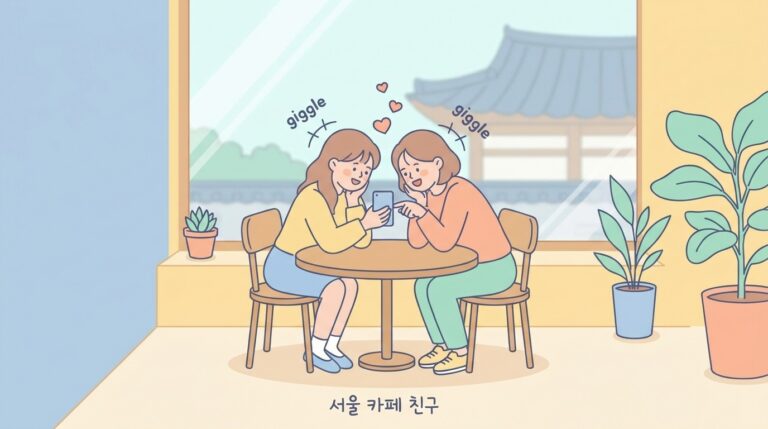
Phase 1: 공감 (Story-Driven Opening)
안녕하세요! 매일한글 에디터입니다. (Hello! I’m your Daily Hangul editor.)
Picture this: It’s Sunday midnight. You just finished binge-watching the latest episode of a smash-hit K-drama rom-com. You watched the main couple trade banter, exchange shy glances under an umbrella, and finally share that heart-fluttering kiss. Your cheeks literally hurt because you’ve been grinning ear-to-ear for sixty minutes straight.
The next day, you excitedly meet your Korean friend and want to rave about the show. But your mind goes blank! The only words that pop up are textbook sentences like: “그 드라마는 재미있었습니다” (That drama was interesting). While grammatically correct, it completely drains the spark and emotion out of what you just experienced!
How do native Koreans describe that electric romantic chemistry that keeps you glued to the screen? They don’t just say an actor is good—they say their cheekbones are ascending to the sky! In today’s A2 guide, you will master the exact, colorful expressions native speakers use to talk about drama chemistry and heart-racing scenes. Let’s make sure your Korean friends smile right along with you!
Phase 2: 핵심 표현 3선 심층 분석 (Top 3 Key Expressions)
1. 둘이 케미가 진짜 좋아요 (Duri kemiga jinjja joayo)
- Pronunciation: Duri kemi-ga jin-jja jo-a-yo (Think: “Do-ree keh-mee-gah jean-jjah jo-ah-yo”)
- Meaning: Literal: “The two have really good chemistry.” / Nuance: “Their on-screen connection is incredible and feels completely authentic!”
- K-Culture Moment: Used when two leads bounce off each other’s energy effortlessly in popular romantic comedies like Queen of Tears or King the Land.
- Editor’s Insight: “케미” (Kemi) comes from the English word “chemistry.” In Korean pop culture, it refers specifically to the magical mutual vibe between two people. Pairing it with “진짜 좋아요” (jinjja joayo – really good) is the natural A2 way to praise co-stars.
- Situation Spectrum:
- Casual (Friends): ✅ 둘이 케미 진짜 좋아! (Duri kemi jinjja joa!)
- Semi-formal (Polite): ✅ 둘이 케미가 진짜 좋아요. (Duri kemiga jinjja joayo.)
- Formal (Official news broadcast): ⚠️ 두 배우의 호흡이 뛰어납니다. (Du bae-u-ui hoheubi ttwieonamnida.)
- 🤔 Think About It: In English, we often say “They have great chemistry.” Why do you think Korean shortened “chemistry” into just “케미” (Kemi) to create an affectionate slang term?
2. 광대가 안 내려와요 (Gwangdaega an naeryeowayo)
- Pronunciation: Gwang-dae-ga an nae-ryeo-wa-yo (Sounds like “Gwang-day-gah ahn neh-ryuh-wah-yo”)
- Meaning: Literal: “My cheekbones won’t come down.” / Nuance: “I couldn’t stop smiling the entire time!”
- K-Culture Moment: Used by fans during sweet confession scenes or cozy dates when you catch yourself grinning uncontrollably at your screen.
- Editor’s Insight: In Korean culture, big smiles push the “광대” (cheekbones) high. Saying your cheekbones refuse to descend means the romantic scene was so cute that your facial muscles are permanently stuck in a goofy grin!
- Situation Spectrum:
- Casual: ✅ 보는 내내 광대 안 내려와! (Boneun naenae gwangdae an naeryeowa!)
- Semi-formal: ✅ 보는 내내 광대가 안 내려와요. (Boneun naenae gwangdaega an naeryeowayo.)
- Formal: 🚫 (Too physical and casual for formal reports)
- 🤔 Think About It: English speakers say “grinning from ear to ear.” Notice how Korean focuses on cheekbones rising rather than mouth widening? How does your language describe uncontrollable smiling?
3. 완전 설레요 (Wanjeon seolleyo)
- Pronunciation: Wan-jeon seol-le-yo (Think: “Wahn-juhn suhl-leh-yo”)
- Meaning: Literal: “Completely fluttering.” / Nuance: “It gives me serious butterflies / My heart is racing!”
- K-Culture Moment: When the male and female leads stand close in an elevator or make accidental eye contact with soft acoustic BGM playing.
- Editor’s Insight: “설레다” (seolleda) expresses that delightful, nervous palpitation of romance. Adding “완전” (wanjeon – totally/completely) turns it into an instant conversational favorite among younger speakers.
- Situation Spectrum:
- Casual: ✅ 완전 설레! (Wanjeon seolle!)
- Semi-formal: ✅ 완전 설레요. (Wanjeon seolleyo.)
- Formal: ⚠️ 매우 설렙니다. (Mae-u seollemnida.)
- 🤔 Think About It: Does your native language have a single verb that encapsulates both joyful romantic anticipation and racing heartbeats like “설레다”?
Phase 3: 교과서 한국어 vs 진짜 한국어 (Textbook vs Real Korean)
Situation 1: Talking about how romantic a scene felt
- 📖 교과서 한국어: 그 장면은 매우 감동적이었습니다. (Geu jangmyeoneun maeu gamdongjeogieotseumnida. – That scene was very touching.)
- 🗣️ 진짜 한국어: 그 장면에서 완전 심쿵했어요! (Geu jangmyeoneseo wanjeon simkung-haesseoyo! – My heart completely skipped a beat in that scene!)
- 💡 왜 다를까?: Textbook Korean uses heavy literary words like “감동적” (gamdongjeok – touching/moving). Real drama fans use “심쿵” (simkung – sound of heart dropping/fluttering) to describe romantic thrill.
Situation 2: Praising the main couple’s interaction
- 📖 교과서 한국어: 두 배우가 서로 잘 어울립니다. (Du bae-uga seoro jal eoullimnida. – The two actors suit each other well.)
- 🗣️ 진짜 한국어: 둘이 케미가 장난 아니에요! (Duri kemiga jangnan anieyo! – Their chemistry is no joke!)
- 💡 왜 다를까?: Native speakers frequently use “장난 아니에요” (jangnan anieyo – literally ‘not a joke’) to emphasize that something is ridiculously good or intense.
Phase 4: K-Culture 딥다이브 & 비언어적 매너 (Culture Deep Dive & Manner)
4-1. 눈치 (Nunchi) & Gestures
When discussing a sweet drama scene with a Korean friend:
* The Cheek Tap: Gently press both hands against your cheeks or cheekbones when saying “광대가 안 내려와요!” (Gwangdaega an naeryeowayo). It physically highlights your emotional engagement.
* Reaction Sound Bites: In Korea, listeners express empathy by chiming in with gentle gasp sounds like “어떡해~” (Eotteokhae~ – Oh no, my heart can’t take it!) or high-pitched nods: “맞아, 맞아!” (Maja, maja! – Exactly, exactly!).
4-2. 문화 코드 분석 (Culture Code: The Power of 로코 ‘Roco’)
Koreans love romantic comedies so much that the genre has its own beloved abbreviation: 로코 (Roco), short for Romantic Comedy. When a Roco airs, fans don’t just watch passively; they engage in 과몰입 (Gwamorip – hyper-immersion). They debate whether the characters’ zodiac signs match, cheer for off-screen dating rumors, and rewatch 30-second clips millions of times on YouTube. Praising the leads’ “케미” is the highest compliment you can give to a Roco drama in Korea!
Phase 5: 실전 롤플레이 시나리오 (Interactive Roleplay Scenario)
- Setting: You and your Korean college buddy, Minji, are sipping iced Americanos at a cafe in Hongdae on Monday afternoon, recapping your weekend drama watch.
민지 (Minji): 주말에 그 드라마 새로 시작한 거 봤어? (Jumare geu drama saero sijakhan geo bwasseo?)
“Did you watch the new drama that started over the weekend?”
You: 응, 봤어! 둘이 케미가 진짜 좋아요. (Eung, bwasseo! Duri kemiga jinjja joayo.)
“Yeah, I did! Their chemistry is really great.” 🎭 [Clapping hands together excitedly]
민지 (Minji): 맞지! 특히 4화 엔딩 장면 봤어? (Matji! Teukhi sahwa ending jangmyeon bwasseo?)
“Right?! Especially, did you see the ending of episode 4?”
You: 네! 그 장면에서 완전 심쿵했어요. (Ne! Geu jangmyeoneseo wanjeon simkung-haesseoyo.)
“Yes! My heart totally skipped a beat in that scene.” 🎭 [Placing a hand over your heart]
민지 (Minji): 나도! 남주 눈빛이 너무 다정하더라. (Nado! Namju nunbichi neomu dajeonghadeora.)
“Me too! The male lead’s gaze was so incredibly tender.”
You: 맞아요, 보는 내내 광대가 안 내려왔어요. (Majayo, boneun naenae gwangdaega an naeryeowasseoyo.)
“I agree, my cheekbones wouldn’t come down the entire time I was watching.” 🎭 [Puffing cheeks and smiling widely]
민지 (Minji): ㅋㅋㅋ 인정! 우리 다음 화도 꼭 같이 챙겨보자. (Kkk injeong! Uri daeum hwado kkok gachi chaenggyeoboja.)
“Haha, totally acknowledged! Let’s make sure to keep watching the next episodes together.”
You: 좋아요! 다음 주말이 벌써 기대돼요. (Joayo! Daeum jumari beolsseogidaedwaeyo.)
“Sounds great! I’m already looking forward to next weekend.” 🎭 [Nodding enthusiastically]
🔀 Interactive Choice Point
Minji asks: “What did you think of the second male lead (서브 남주)?” How do you reply?
- Option A: “서브 남주도 멋있어서 마음이 너무 아파요!” (Seobeu namjudo meosiseoseo maeumi neomu apayo! – The second male lead is also so cool that my heart aches!)
- Feedback: Best! Demonstrates deep empathy with the classic “second lead syndrome” (서브병) that Korean fans love discussing.
- Option B: “배우의 연기 기술이 나쁘지 않았습니다.” (Bae-u-ui yeongi gisuri nappeuji anatseumnida. – The actor’s acting technique was not bad.)
- Feedback: Bad. Sounds like a stern film professor giving a grade. Breaks the friendly cafe vibe!
- Option C: “그 사람은 못생겼어요.” (Geu sarameun motsaenggyeosseoyo. – That person is ugly.)
- Feedback: Risk. Way too blunt! Criticizing actors’ looks harshly can offend someone who might be a fan of that celebrity.
Phase 6: 10초 감정 섀도잉 드릴 (10-Second Emotion Shadowing)
Practice these lines aloud with the emotional cues indicated!
[😊 기쁘고 신나게 / Cheerful and upbeat]
둘이 / 케미가 / 진짜 좋아요!
(Du-ri / ke-mi-ga / jin-jja jo-a-yo!)-
[🥰 벅차고 설레는 목소리로 / Sweet and heart-fluttering]
보는 내내 / 광대가 / 안 내려와요~
(Bo-neun nae-nae / gwang-dae-ga / an nae-ryeo-wa-yo~) -
[💥 깜짝 놀라면서 두근거리게 / Surprised and thrilled]
그 장면에서 / 완전 / 심쿵했어요!
(Geu jang-myeon-e-seo / wan-jeon / sim-kung-haet-seo-yo!)
Phase 7: K-Culture 미니 사전 (Mini Dictionary)
- 케미 (Kemi) | Chemistry | Short for chemistry; indicates romantic or platonic synergy between two people in media or daily life.
- 로코 (Roco) | Romantic Comedy | An acronym for “로맨틱 코미디.” Korea’s most globally renowned drama genre.
- 심쿵 (Simkung) | Heart-thump / Heart-flutter | A compound of “심장” (heart) and “쿵” (thump). Used when something unexpectedly steals your breath away.
- 과몰입 (Gwamorip) | Hyper-fixation / Over-immersion | Being so emotionally invested in a drama or fictional story that it affects your real-world mood.
Phase 8: 여행자를 위한 생존 키트 (Traveler’s Survival Kit)
Top 3 Drama-Fan Survival Phrases:
- 여기 드라마 촬영지 맞아요? (Yeogi drama chwaryeongji majayo?)
Is this the drama filming spot?
Pro Tip: Essential when visiting famous cafes or parks featured in K-dramas. - 사진 한 장만 찍어주실 수 있어요? (Sajin han jangman jjigeojusil su isseoyo?)
Could you take a photo of me, please?
Pro Tip: Perfect for striking iconic drama poster poses. - 어떤 드라마 좋아하세요? (Eotteon drama joahaseyo?)
What kind of dramas do you like?
Pro Tip: A foolproof conversation starter with Korean guesthouse hosts or language partners.
Editor’s Travel Note:
Looking for iconic drama spots in Seoul? Forget Google Maps—it has limited walking navigation in Korea! Instead, refer to the Naver Map app setup guide to find exact alleyways and scenic shooting spots. When visiting outdoor filming locations like Namsan Tower or Han River parks, don’t forget your Climate Card (기후동행카드) or T-money card for seamless subway and bus transfers!
Phase 9: “한 발 더 깊이” (Thought Reflection)
In Korean storytelling, romantic chemistry is rarely just about physical attraction. It is deeply tied to “정” (Jeong)—a warm, enduring emotional bond built through shared meals, protecting one another in vulnerability, and unspoken understanding. When Korean audiences say “광대가 안 내려와요,” they are celebrating that mutual warmth that makes life feel softer. Sharing drama reactions is a communal ritual in Korea that bridges generations.
💬 Your Turn: Which K-drama couple made your cheekbones hurt from smiling the most? Leave a comment below using the phrase “둘이 케미가 진짜 좋아요!”
Phase 10: FAQ & 오해 방지 (FAQ & Common Mistakes)
Q: Can I use “케미” (Kemi) to describe real-life couples or coworkers?
A: Yes! You can say “두 사람 케미가 좋아요” about two friends who tell great jokes together, or two coworkers who execute team projects seamlessly. It is not limited to television actors.
Q: Is “광대가 안 내려와요” rude if said to someone older?
A: While it is not vulgar, it is casual slang. With professors or senior business partners, stick to polite alternatives such as “보는 내내 정말 즐거웠습니다” (I enjoyed watching it the whole time).
Q: What is the opposite of “케미가 좋다”?
A: You can say “케미가 조금 아쉬워요” (Their chemistry is a bit disappointing). It sounds gentle and polite without being needlessly harsh.
🚨 흔한 실수 (Common Mistakes) 경고판:
- Mistake 1: Saying “케미스트리가 좋아요” (Kemiseuteuriga joayo).
- Why: Koreans always shorten it to “케미” (Kemi). Saying the full English word sounds like you are praising their academic chemistry class grade!
- Correct Action: Say 둘이 케미가 좋아요 (Duri kemiga joayo).
- Mistake 2: Saying “내 심장이 떨어졌어요” when you feel romantic butterflies.
- Why: Translating “my heart dropped” literally means you experienced sudden terror or shock.
- Correct Action: Say 완전 심쿵했어요 (Wanjeon simkung-haesseoyo) or 완전 설렜어요 (Wanjeon seollesseoyo).
- Mistake 3: Mispronouncing 광대 as 공대.
- Why: “광대” (Gwangdae) means cheekbones. “공대” (Gongdae) means College of Engineering! You don’t want to say your engineering school won’t come down!
- Correct Action: Pronounce the ‘wa’ clearly: Gwang-dae.
Phase 11: 액션 미션 & 참여 유도 (Action Missions)
- 🥉 Bronze Mission: Stand in front of your mirror, smile brightly, and repeat three times: “광대가 안 내려와요!” (Gwangdaega an naeryeowayo!)
- 🥈 Silver Mission: Find a clip of your favorite K-drama couple on Instagram or YouTube and leave a Korean comment: “둘이 케미 대박! 완전 설레요.”
- 🥇 Gold Mission: Next time you chat with a Korean conversation partner, recommend a rom-com drama using at least two phrases from this lesson!
- 🎮 K-Culture Mission: Watch episode 1 of any current on-air romantic comedy and spot the exact second your own cheekbones start lifting!
Phase 12: 인터랙티브 퀴즈 챌린지 (Interactive Quiz Challenge)
Q1. Situation Judgment
Your friend asks you how the romantic date scene in the drama was. Which reply sounds most natural and enthusiastic?
1. 그 장면은 논리적이었습니다. (Geu jangmyeoneun nollijeogieotseumnida.)
2. 보는 내내 광대가 안 내려왔어요! (Boneun naenae gwangdaega an naeryeowasseoyo!)
3. 배우들의 나이가 비슷합니다. (Bae-udeurui naiga biseuthamnida.)
👉 Click here for the Answer & Explanation
Correct Answer: 2
Explanation: Option 2 captures the delightful feeling of smiling constantly during romantic scenes. Option 1 means “That scene was logical,” and Option 3 means “The actors’ ages are similar,” neither of which expresses romantic excitement!
Q2. Fill-in-the-Blank
Complete the sentence to mean: “The two have really good chemistry!”
* 둘이 ______가 진짜 좋아요! (Duri ______-ga jinjja joayo!)
👉 Click here for the Answer & Explanation
Correct Answer: 케미 (Kemi)
Explanation: “케미” is the quintessential Korean buzzword for on-screen or interpersonal synergy.
Q3. True or False Cultural Quiz
True or False: “로코” (Roco) stands for Romantic Comedy, and fans often describe intense immersion in it as “과몰입” (Gwamorip).
👉 Click here for the Answer & Explanation
Correct Answer: True
Explanation: Spot on! “로코” and “과몰입” are everyday pop-culture words every drama lover should know!







