

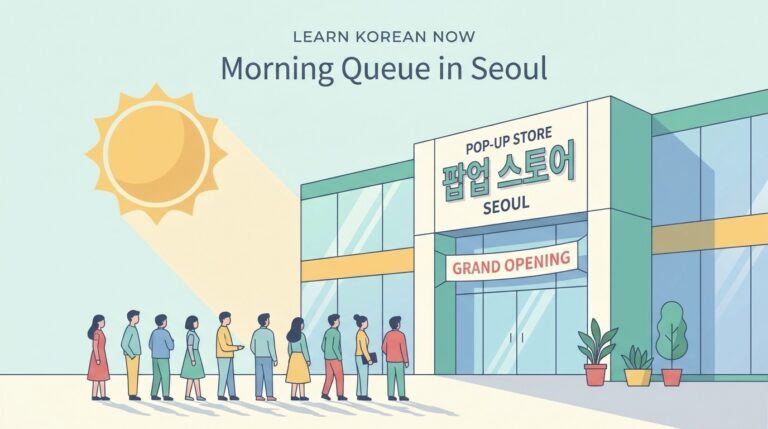
Phase 1: Empathy & Story Opening
안녕하세요! 매일한글 에디터입니다.
Imagine this: you set your alarm for 6:30 AM in Seoul. Today is the day your ultimate favorite K-Pop group—or that viral webtoon character you adore—is hosting an exclusive, limited-time pop-up store at The Hyundai Seoul in Yeouido. You arrive at the department store basement entrance feeling proud, clutching your morning iced Americano. But the moment you turn the corner, your jaw drops. A queue of hundreds of stylish young locals is already snaking around the entire building! You did an “Open Run” (오픈런), yet the line is already impossibly long.
Panic sets in. Where is the end of the line? Do you need a ticket number? What if the limited edition merchandise sells out before you even step foot inside? Don’t worry! That sinking feeling is something almost every local Korean shopper has experienced at least once. With real learner feedback from our Daily Hangul community, this guide will arm you with practical, simple A2-level Korean phrases so you can navigate pop-up store lines, talk to staff or fellow fans, and secure your prized merch with zero stress.
Phase 2: Top 3 Core Expressions Deep Dive
1. 오픈런했는데도 줄이 너무 길어요. (Opeun-reon-haenneunde-do juri neomu gireoyo.)
- Pronunciation: [O-peun-reon-haen-neun-de-do ju-ri neo-mu gi-reo-yo] (Sounds like: “Open run-hand-neh-do joo-ree no-moo kee-raw-yo”)
- Meaning: Literal: “Even though I did an open run, the line is too long.” / Nuance: “I rushed here right at opening, but look at this crazy queue!”
- K-Culture Moment: You will hear this everywhere outside trendy spots in Seongsu-dong or Yeouido whenever a hot brand or limited-edition sneaker drop happens.
- Editor’s Insight: 오픈런 (Open-run) is a famous Konglish compound word combining “Open” and “Run”. The grammar connector -는데도 (-neundedo) means “even though / despite”, which is perfect for expressing polite disbelief or mild frustration.
- Situation Spectrum:
- Casual (to a friend): 오픈런했는데 줄 진짜 길다! (Opeun-reon-haenneunde jul jinjja gilda!)
- Semi-formal (polite polite standard): 오픈런했는데도 줄이 너무 길어요. (Opeun-reon-haenneunde-do juri neomu gireoyo.) ✅
- Formal (business announcement): 개점 대기 인원이 많습니다. (Gaejeom daegi inwoni manseumnida.) 🚫 (Too stiff for shoppers!)
- 🤔 Think About It: In your country, do people wait hours before a store opens for pop-ups, or is buying things mostly an online race?
2. 대기 번호 등록해야 하나요? (Daegi beonho deungnok-haeya hanayo?)
- Pronunciation: [Dae-gi beon-ho deung-nokh-hae-ya ha-na-yo?] (Sounds like: “Day-ghee bun-ho doong-nok-hey-yah ha-na-yo?”)
- Meaning: Literal: “Must I register a waiting number?” / Nuance: “Do I need to sign up on the waiting list tablet first?”
- K-Culture Moment: In modern Korean department stores, physical standing queues are often replaced by digital tablet kiosks (like CatchTable or KakaoTalk waiting systems).
- Editor’s Insight: The pattern -해야 하나요? (-haeya hanayo?) is an essential A2 question structure meaning “Do I have to do [action]?” It sounds very polite and shows good manners.
- Situation Spectrum:
- Casual: 대기 등록 해야 돼? (Daegi deungnok haeya dwae?)
- Semi-formal: 대기 번호 등록해야 하나요? (Daegi beonho deungnok-haeya hanayo?) ✅
- Formal: 대기 명부에 등록해야 합니까? (Daegi myeongbue deungnok-haeya hamnikka?) ⚠️
- 🤔 Think About It: Digital queue systems rely heavily on Korean mobile apps like KakaoTalk. How do service technologies shape our patience when shopping?
3. 한정판 굿즈 벌써 품절됐나요? (Hanjeongpan gutjeu beolsseo pumjeol-dwaennayo?)
- Pronunciation: [Han-jeong-pan gut-jeu beol-sseo pum-jeol-dwaen-na-yo?] (Sounds like: “Hahn-jung-pahn goot-zoo bull-saw poom-jull-dwen-nah-yo?”)
- Meaning: Literal: “Is the limited edition merchandise already sold out?” / Nuance: “Are the exclusive items already out of stock?”
- K-Culture Moment: Used at the checkout counter or information desk when you see empty display shelves inside idol pop-ups or anime collaborations.
- Editor’s Insight: 한정판 (Hanjeongpan) means “Limited Edition”, and 품절 (Pumjeol) means “Sold Out”. Combining it with 벌써 (Beolsseo – already) conveys that dramatic, heart-stopping feeling of missing out on your item.
- Situation Spectrum:
- Casual: 벌써 다 나갔어? (Beolsseo da nagasseo?)
- Semi-formal: 한정판 굿즈 벌써 품절됐나요? (Hanjeongpan gutjeu beolsseo pumjeol-dwaennayo?) ✅
- Formal: 해당 한정판 품목은 품절되었습니까? (Haedang hanjeongpan pummogeun pumjeol-doeeosseumnikka?) ⚠️
- 🤔 Think About It: Why does the label ‘Limited Edition’ (한정판) hold such high collectible value in fast-paced K-Pop and youth street fashion?
Phase 3: Textbook Korean vs. Real Korean
Situation 1: Describing the massive crowd
* 📖 교과서 한국어 (Textbook Korean): 사람이 아주 많습니다. (Sarami aju manseumnida.) — “There are very many people.”
* 🗣️ 진짜 한국어 (Real Korean): 사람 대박 많아요! 줄 미쳤어요. (Saram daebak manayo! Jul michyeosseoyo.) — “There are insane amounts of people! The line is crazy.”
* 💡 왜 다를까? (Why is it different?): While standard textbooks teach formal, neutral grammar, real young shoppers use lively intensifiers like 대박 (daebak – jackpot/crazy) and slang expressions like 미쳤다 (michyeotda – crazy/wild) to express genuine shock at crowd sizes.
Situation 2: Asking if items are gone
* 📖 교과서 한국어 (Textbook Korean): 상품이 모두 팔렸습니까? (Sangpumi modu pallyeosseumnikka?) — “Have all goods been sold?”
* 🗣️ 진짜 한국어 (Real Korean): 벌써 다 나갔어요? (Beolsseo da nagasseoyo?) — “Is it already all gone?”
* 💡 왜 다를까? (Why is it different?): Native speakers casually use the active metaphor 나갔다 (nagatda – exited/left) to describe sold-out stock disappearing from store shelves instead of using passive textbook verbs.
Phase 4: K-Culture Deep Dive & Non-Verbal Etiquette
4-1. Nunchi (눈치) & Line Etiquette
- Queue Positioning: Never cut in line or save spots for multiple friends. If you need to briefly step away to grab water or use the restroom, make polite eye contact with the person behind you, bow your head slightly at 15 degrees, and say: “잠깐 화장실 다녀와도 될까요?” (Jamkkan hwajangsil danyeowado doelkkayo? – May I step to the restroom for a second?).
- Checking Line Ends: Always ask the last person in line to confirm: “혹시 여기가 줄 끝인가요?” (Hoksi yeogiga jul kkeutingayo? – Excuse me, is this the end of the line?). This subtle Nunchi prevents you from accidentally standing in an exit flow or staff entrance!
4-2. The Cultural Phenomenon of the Korean ‘Open Run’
In Korea, pop-up stores are no longer just temporary shops—they are cultural entertainment hubs! From limited K-Pop comeback merchandise (such as photo card binders and character plushies) to viral bakery collaborations (like London Bagel Museum or Salt Bread pop-ups), doing an 오픈런 (Open-run) is considered a dedicated lifestyle hobby. Fans share line updates in real-time on X (formerly Twitter) and Instagram using hashtags like #팝업스토어_현황 (#popupstore_currentstatus).
Phase 5: Real-Life Roleplay Scenario
- Setting: 8:40 AM outside the basement pop-up zone of The Hyundai Seoul. Hundreds of excited shoppers hold branded fans and umbrellas.
- Characters: You (Alex) and Minji, a friendly fellow K-Pop fan standing right in front of you.
Dialogue (8 Turns):
1. Alex: 저기요, 혹시 여기가 팝업스토어 줄 맞나요? (Jeogiyo, hoksi yeogiga pabeop-seuto-eo jul mannayo?)
🎭 [Points politely with two hands toward the line]
(Excuse me, is this the pop-up store line?)
2. Minji: 네, 맞아요! 오늘 사람 진짜 많죠? (Ne, majayo! Oneul saram jinjja manjyo?)
🎭 [Smiles warmly while holding her mini electric fan]
(Yes, it is! There are really so many people today, right?)
3. Alex: 네, 오픈런했는데도 줄이 너무 길어요. (Ne, opeun-reon-haenneunde-do juri neomu gireoyo.)
🎭 [Sighs playfully and wipes brow]
(Yes, even though I did an open run, the line is already super long.)
4. Minji: 그러게요! 혹시 카카오톡 대기 번호 등록하셨어요? (Geureogeyo! Hoksi kakaotok daegi beonho deungnok-hasyeosseoyo?)
🎭 [Points finger toward the tablet stand near the entrance]
(I know, right! By the way, did you register for a waiting number on KakaoTalk?)
5. Alex: 아, 아직 안 했어요! 대기 등록 먼저 해야 하나요? (A, ajik an haesseoyo! Daegi deungnok meonjeo haeya hanayo?)
🎭 [Looks surprised and checks phone screen]
(Ah, not yet! Do I need to register for waiting first?)
6. Minji: 네! 저기 키오스크에 전화번호 입력하고 오시면 돼요. 제가 자리 맡아 드릴게요! (Ne! Jeogi kioseukeue jeonhwabeonho imnyeokhago osimyeon dwaeyo. Jega jari mata deurilgeyo!)
🎭 [Nods enthusiastically and steps slightly aside]
(Yes! Just enter your phone number at that kiosk over there. I will save your spot!)
7. Alex: 정말요? 너무 감사합니다! 금방 다녀올게요! (Jeongmalyo? Neomu gamsahamnida! Geumbang danyeoolgeyo!)
🎭 [Bows slightly with both hands pressed together]
(Really? Thank you so much! I’ll be back right away!)
8. Minji: 네, 조심히 다녀오세요! 파이팅! (Ne, josimhi danyeo-oseyo! Paiting!)
🎭 [Gives a cheering mini fist-pump]
(Sure, take your time! Fighting!)
🔀 Interactive Choice Branching
You successfully register at the kiosk and return to your spot. An hour later, a staff member comes out holding a megaphone. What do you do?
- Option A: Wave at the staff member and shout loudly: “야! 언제 열어?” (Ya! Eonje yeoreo? – Hey! When does it open?)
- 🚫 Feedback (Bad): “야 (Ya)” is extremely rude to strangers and staff! It creates an awkward atmosphere and turns heads in shock.
- Option B: Politely ask Minji or the staff: “실례지만, 입장 시작했나요?” (Sillyejiman, ipjang sijak-haennayo? – Excuse me, has entry started?)
- ✅ Feedback (Best): Perfect! “실례지만 (Excuse me)” softens the tone, and using formal “-했나요?” makes you sound like a considerate, fluent speaker.
- Option C: Leave the line immediately to go buy lunch without telling anyone.
- ⚠️ Feedback (Risk): High risk! Once your queue number is called, you usually have only 5 to 10 minutes to enter before your reservation is canceled.
Phase 6: 10-Second Emotion Shadowing Drill
Follow the pause marks (/) and mirror the emotional guide markers out loud!
[😱 Shocked & Tired]
오픈런했는데도 / 줄이 이미 / 엄청 길게 서 있네요!
(Opeun-reon-haenneunde-do / juri imi / eomcheong gilge seo inneyo!)-
[🤔 Curious & Polite]
실례지만 / 대기 번호 등록 / 어디서 해요?
(Sillyejiman / daegi beonho deungnok / eodiseo haeyo?) -
[🥺 Worried & Hopeful]
인기 굿즈는 / 벌써 / 다 팔렸을까요?
(Inki gutjeuneun / beolsseo / da pallyeosseulkkayo?) -
[😊 Relieved & Cheerful]
자리 맡아 주셔서 / 정말 감사합니다!
(Jari mata jusyeoseo / jeongmal gamsahamnida!)
Phase 7: K-Culture Mini Dictionary
- 오픈런 (Opeun-reon)
- Meaning: Open run (queuing early before opening doors).
- Practical Use: Used across social media to describe early morning lines at department stores, pop-up stores, luxury boutiques, or famous bakeries.
- 굿즈 (Gutjeu)
- Meaning: Merch / Merchandise (goods).
- Practical Use: Widely used for idol photocards, keyrings, character stationery, apparel, and limited-edition collaborative souvenirs.
- 품절 (Pumjeol)
- Meaning: Sold out / Out of stock.
- Practical Use: Often spotted on red stickers placed on pop-up store menu boards: “일시 품절” (Temporarily Out of Stock) or “완판/품절” (Completely Sold Out).
- 웨이팅 (Weiting)
- Meaning: Waiting / Queuing system.
- Practical Use: Replacing traditional lines, restaurants and pop-up stores will say: “웨이팅 걸어 두세요” (Please put your name on the digital waiting list).
Phase 8: Traveler’s Survival Kit
Top 3 Survival Expressions for Lines
- 여기가 줄 끝인가요? (Yeogiga jul kkeutingayo?)
- Meaning: Is this the end of the line?
- Pro Tip: Never join a crowd blindly without checking; Seoul lines often split into “general line” and “pre-reservation line”.
- 얼마나 기다려야 해요? (Eolmana gidaryeoya haeyo?)
- Meaning: How long do I have to wait?
- Pro Tip: Staff will usually answer with numbers like “한 시간 정도요” (About one hour).
- 1인당 구매 제한 있나요? (I-rin-dang gumae jehan innayo?)
- Meaning: Is there a purchase limit per person?
- Pro Tip: Pop-up stores frequently limit purchases to 1 or 2 units per person to stop scalpers (되팔이).
Editor’s Travel Note
- Digital Queue Apps: Many pop-ups require a Korean mobile number for KakaoTalk waitlists. If you have an e-SIM with data only, look for tablets supporting email registration, or consult the staff via [Naver Map app download for real-time location check] to find nearby kiosks!
- Card Payments: Almost all pop-up stores in Seoul are 100% cashless! Bring an international credit card (Visa/Mastercard) or a rechargeable local transit/debit card like WOWPASS or NAMANE Card.
Phase 9: A Step Deeper (한 발 더 깊이)
In South Korea, waiting in a long line is not considered a waste of time—it is an act of shared passion and collective ritual. When young Koreans participate in an 오픈런 (Open-run), they find joy in the anticipation, bonding with strangers in line over mutual fandom, and uploading real-time survival selfies. The queue itself transforms into part of the cultural experience.
Even in a culture world-famous for its speedy “빨리빨리” (Palli-palli: hurry, hurry) mindset, people willingly wait four hours for the right experience because it reflects community connection and mutual enthusiasm.
💬 Your Turn: What is an item or experience in your home country that you would gladly wait in an early morning line for? Tell us in the comments below!
Phase 10: FAQ & Common Mistakes
Q: What should I do if the digital kiosk requires a Korean phone number and I only have a data SIM?
A: Don’t panic! Walk up directly to the staff member standing near the kiosk and say: “외국인인데 번호가 없어요. 도와주실 수 있나요?” (Oeguginde beonhoga eopseoyo. Dowajusil su innayo? – I am a foreigner and don’t have a phone number. Could you help me?). Staff members can often register you manually with an email or hand you a physical numbered paper ticket.
Q: Can my friend join me in line later if I arrived early?
A: No, joining friends later (commonly called 새치기 – saechigi / cutting in line) is strictly frowned upon in Korea. If two people want to enter together, both individuals must usually be present in line or register together as a party on the tablet.
Q: When is the best time to do an open run at The Hyundai Seoul or Coex?
A: Department stores generally open at 10:30 AM, but for high-profile pop-up drops, waiting lists often open outside the building around 8:00 AM to 9:00 AM. Arriving around 8:30 AM usually secures a safe spot for the day!
🚨 Common Mistakes Board
- Mistake 1: Saying “줄 서세요!” (Jul seoseyo!) aggressively to people around you.
- Correct Action: Say softly “줄 서신 건가요?” (Jul seosin geongayo? – Are you in line?) to check their status politely.
- Mistake 2: Leaving the line without telling anyone nearby.
- Correct Action: Say to your line neighbor: “잠깐만 다녀오겠습니다” (Jamkkanman danyeo-ogetseumnida – I’ll be right back) so they recognize your spot.
- Mistake 3: Assuming all merchandise displayed on shelves can be purchased immediately.
- Correct Action: Many pop-ups only display samples! You must check the stock board to verify if it is marked as 품절 (Sold out) before picking it up.
Phase 11: Action Missions
- 🥉 Bronze Mission: Stand in front of your mirror and practice saying: “오픈런했는데도 줄이 너무 길어요!” with dramatic facial expressions three times.
- 🥈 Silver Mission: Next time you see a long line anywhere, take a photo or thought note and caption it on your social media using the Korean hashtag: #오픈런 #줄서기.
- 🥇 Gold Mission: Visit a Korean pop-up or cafe in person and ask the staff: “대기 등록해야 하나요?” (Daegi deungnok-haeya hanayo?) in clear Korean.
🎮 K-Culture Mission: Watch a recent K-Pop idol vlog (자사 예능/Vlog) and spot the moment they say “대박” (Daebak) or “품절” (Pumjeol) when eating or shopping!
Phase 12: Interactive Quiz Challenge
Test your skills with these three quick situational questions!
1. Situation Judgment: You arrive at a pop-up store, and you want to ask the last person if you are standing in the correct spot. Which expression is the most natural?
* (A) 야, 비켜! (Ya, bikyeo!)
* (B) 여기가 줄 끝인가요? (Yeogiga jul kkeutingayo?)
* (C) 물건 다 샀어요? (Mulgeon da sasseoyo?)
2. Fill in the Blank: Complete the sentence with the word that means “Limited Edition”:
* “이거 ________ 굿즈라서 일찍 왔어요.” (Ige ________ gutjeoraseo iljjik wasseoyo. – I came early because this is limited edition merch.)
3. True or False: In Korea, it is acceptable for your group of five friends to enter a pop-up store as long as one person waited in line for everyone.
* (True / False)
Click here to reveal the answers and explanations!
-
Answer: (B) 여기가 줄 끝인가요?
Explanation: (B) is the polite standard way to ask “Is this the end of the line?”. (A) is extremely rude (“Hey, move!”), and (C) means “Did you buy all the goods?”. -
Answer: 한정판 (Hanjeongpan)
Explanation: 한정판 means ‘limited edition’, which is the most common reason people do open runs! -
Answer: False
Explanation: Pop-up lines in Korea have strict anti-cutting rules. Everyone entering must usually be present when queue numbers are verified!







