

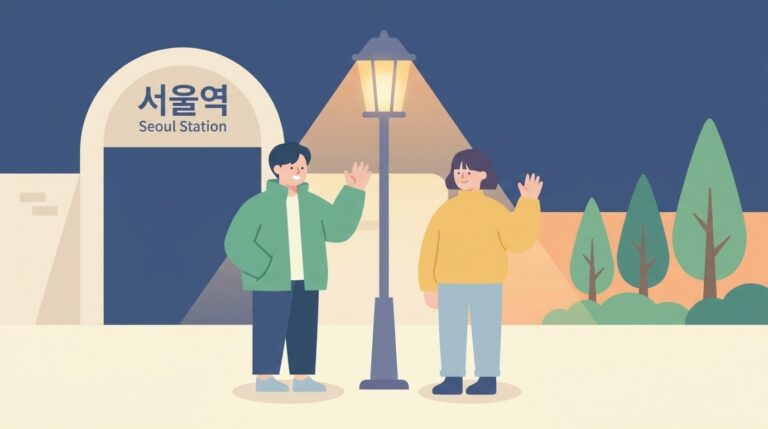
Phase 1: 공감 (Story-Driven Opening)
안녕하세요! 매일한글 에디터입니다. (Annyeonghaseyo! I am your Daily Hangul editor.)
Picture this scene from your favorite K-Drama: It is a crisp evening in Seoul. Two characters just shared a warm bowl of tteokbokki and a heart-to-heart conversation at a buzzing tent bar (pojangmacha). As they step out beneath the warm glow of street lamps, they reach the crosswalk. They do not just say a robotic, formal goodbye and walk away. Instead, one gently turns around, gives a soft two-handed wave, and says with genuine warmth:
“조심히 들어가세요!” (Josimhi deureogaseyo!)
If you have ever relied solely on rigid phrasebooks, you probably learned 안녕히 가세요 (Annyeonghi gaseyo) for every departure. But when our real-life students visit Korea, they frequently tell us about that subtle, awkward pause at the end of a dinner with Korean friends. You want to show you genuinely care about their trip home in the late evening, yet textbook greetings feel distant or stiff. Learning how and when to say 조심히 들어가세요 (Get home safely) transforms you from an outsider reciting memorized lines into a warm, empathetic friend who understands the heartbeat of Korean culture. Today, let’s walk through this everyday expression together so you can leave every evening hangout with confidence!
Phase 2: 핵심 표현 3선 심층 분석 (Top 3 Core Expressions)
1. 조심히 들어가세요 (Josimhi deureogaseyo)
- Pronunciation: [Jo-shim-hi deu-reo-ga-se-yo] (Sounds like “Joe-sheem-hee dew-ruh-gah-say-yo”)
- Meaning: Literal: “Please enter [your home] carefully” | Nuance: “Get home safe and sound!”
- K-Culture Moment: You will hear this constantly at the end of K-dramas when coworkers leave office dinners (hoesik) or when a polite date ends outside the subway station.
- Editor’s Insight: Notice the verb 들어가다 (deureogada – to go in/enter). Koreans think of your destination as “entering your private haven (home).” Saying this implies: I care about your entire journey until you are safely inside your door.
- Situation Spectrum: Casual: 🚫 | Semi-formal: ✅ | Formal: ✅
- 🤔 Think About It: In English, we often say “Have a good night” or “Take care.” Why do you think Korean specifically emphasizes the physical act of safely entering your home?
2. 조심히 가요 (Josimhi gayo)
- Pronunciation: [Jo-shim-hi ga-yo] (Sounds like “Joe-sheem-hee gah-yo”)
- Meaning: Literal: “Go carefully” | Nuance: “Head home safe!”
- K-Culture Moment: Used by friendly acquaintances, shop owners saying goodbye to regular customers, or older peers talking to younger friends in a polite yet cozy setting.
- Editor’s Insight: This shortens the sentence and switches from 들어가다 (to enter) to 가다 (to go). It feels lighter and slightly more relaxed than 조심히 들어가세요, making it perfect for friendly peers.
- Situation Spectrum: Casual: ⚠️ | Semi-formal: ✅ | Formal: 🚫
- 🤔 Think About It: Dropping honorific complexity often brings people emotionally closer. Can you feel how shortening the phrase makes it cozier?
3. 집 도착하면 톡해 (Jip dochak-hamyeon tok-hae)
- Pronunciation: [Jeep do-chak-ha-myeon tok-hae] (Sounds like “Jeep doe-chahk-hah-myun toke-hay”)
- Meaning: Literal: “Message on KakaoTalk when you arrive home” | Nuance: “Text me when you get back safe!”
- K-Culture Moment: The quintessential line spoken between close K-Pop idol besties or young campus couples as one hops on the bus.
- Editor’s Insight: 톡 (Tok) is shorthand for 카카오톡 (KakaoTalk). This is strictly casual language (banmal). Asking someone to text you upon arrival is the ultimate Korean stamp of close personal affection.
- Situation Spectrum: Casual: ✅ | Semi-formal: 🚫 | Formal: 🚫
- 🤔 Think About It: Is texting someone right when you reach home normal in your culture, or is it reserved only for romantic partners?
Phase 3: 교과서 한국어 vs 진짜 한국어 (Textbook vs. Real Korean)
Situation 1: Parting with a colleague or older acquaintance at the subway
- 📖 교과서 한국어: 안녕히 가십시오. (Annyeonghi gasipsio. / “Farewell, go in peace.”)
- 🗣️ 진짜 한국어: 오늘 고생하셨어요, 조심히 들어가세요! (Oneul gosaenghasyeosseoyo, josimhi deureogaseyo! / “Great job today, get home safely!”)
- 💡 왜 다를까?: While 안녕히 가십시오 is grammatically pristine, it sounds like an automated public announcement on an airplane. Real Koreans acknowledge the shared time and effort first (고생하셨어요) before sending you off safely.
Situation 2: Saying goodbye to a close classmate after studying late
- 📖 교과서 한국어: 잘 가세요. (Jal gaseyo. / “Go well.”)
- 🗣️ 진짜 한국어: 조심히 가! 집 가면 톡해~ (Josimhi ga! Jip gamyeon tok-hae~ / “Get home safe! Text me when you’re home~”)
- 💡 왜 다를까?: 잘 가세요 mixes polite endings with basic verbs in an awkward middle ground among true friends. Real friends drop formalities completely and add the affectionate KakaoTalk check-in.
Phase 4: K-Culture 딥다이브 & 비언어적 매너 (Culture Deep Dive & Etiquette)
4-1. 눈치 (Nunchi) & Body Language
When saying 조심히 들어가세요 (Josimhi deureogaseyo), your body language carries half the message:
1. The Gentle 15-Degree Nod: Do not bow at a rigid 90-degree military angle unless you are speaking to your CEO. A light 15-degree nod while maintaining soft eye contact shows warmth and respect.
2. The Polite Two-Hand Wave: Rather than an energetic one-handed American wave, Koreans often do a discreet, shoulder-height wave with two hands, or place one hand near their chest/elbow as they wave.
3. The Taxi Send-Off (배웅 – Baeung): If your companion gets into a taxi first, do not immediately turn your back and walk away. Stand on the sidewalk, wait until the taxi begins driving, and offer one final small wave. Leaving before the car moves can feel abrupt or cold in Korean 눈치 (nunchi) dynamics.
4-2. Culture Code: The Korean Safety Net Culture
Korea is internationally famous for its safe late-night streets, where people walk home at 1:00 AM without fear. Why, then, are Koreans so obsessed with saying 조심히 들어가세요? In Korea, checking in on someone’s journey is not about physical danger; it is an expression of 정 (Jeong – relational bonding and warmth). By telling someone to get home safe and asking for a confirmation text, you are saying: “Our time together was valuable, and your well-being matters to me until you are tucked in bed.”
Phase 5: 실전 롤플레이 시나리오 (Real-World Roleplay Scenario)
Setting: Outside Exit 2 of Hongdae Subway Station at 10:30 PM. You and your Korean coworker, Minji, have just finished late-night chimaek (chicken and beer).
- 민지 (Minji): 벌써 열 시 반이네요! 오늘 진짜 재미있었어요. (Beolsseo yeol si ban-ineyo! Oneul jinjja jaemi-isseosseoyo.)
🎭 Looking at her watch with a friendly smile, adjusting her tote bag.
“It is already 10:30! I had so much fun today.” - 나 (You): 저도요! 오늘 맛있는 치킨 사 주셔서 감사해요. (Jeodoyo! Oneul masinneun chikin sa jusyeoseo gamsahaeyo.)
🎭 Nodding pleasantly with both hands held in front.
“Me too! Thank you so much for treating me to delicious chicken today.” - 민지 (Minji): 아니에요, 다음엔 더 맛있는 거 먹으러 가요. 지하철 타고 가세요? (Anieyo, daeumen deo masinneun geo meogeureo gayo. Jihacheol tago gaseyo?)
🎭 Waving her hand dismissively with a laugh.
“Don’t mention it! Next time let’s get something even tastier. Are you taking the subway?” - 나 (You): 네, 저는 2호선 타고 가요. 민지 씨는요? (Ne, jeoneun i-hoseon tago gayo. Minji ssineunyo?)
🎭 Pointing lightly toward the subway escalator.
“Yes, I’m taking Line 2. What about you, Minji?” - 민지 (Minji): 저는 건너편에서 버스 탈 거예요. 오늘 피곤했을 텐데 푹 쉬세요! (Jeoneun geonneopyeoneseo beoseu tal geoyeyo. Oneul pigonhaesseul tende puk swiseyo!)
🎭 Zipping up her coat against the evening breeze.
“I’m taking the bus across the street. You must be tired today, please rest well!” - 나 (You): 네, 민지 씨도 오늘 고생 많으셨어요. (Ne, Minji ssido oneul gosaeng maneusyeosseoyo.)
🎭 Offering a warm, appreciative smile.
“Yes, thank you for your hard work today too, Minji.” - 민지 (Minji): 네! 내일 회사에서 봬요! (Ne! Naeil hoesa-eseo bwaeyo!)
🎭 Taking two steps backward toward the pedestrian crossing and waving.
“Yes! See you at work tomorrow!” - 나 (You): 네, 조심히 들어가세요! (Ne, josimhi deureogaseyo!)
🎭 Giving a gentle 15-degree bow followed by a small, polite wave.
“Yes, get home safely!”
🔀 Interactive Decision Point
Minji steps toward the crosswalk and waves one last time. What do you do?
- Option A: Shout “잘 가!” (Jal ga!) loudly and run into the subway without looking back.
- Option B: Smile, bow your head slightly, say “네, 조심히 들어가세요!”, and wait until she turns to cross.
- Option C: Say “안녕히 계세요!” (Annyeonghi gyeseyo!) while bowing at a 90-degree angle.
Feedback:
* Option A (Risk): 잘 가 is informal language (banmal). Using it with a workplace colleague will cause immediate embarrassment, making you seem overly casual or rude.
* Option B (Best!): Perfect! It combines polite honorifics, empathetic phrasing, and considerate body language.
* Option C (Bad): 안녕히 계세요 means “Stay peacefully,” which is only used when you are leaving and the other person is staying in the location (like leaving someone’s house or a store). Since both of you are leaving, it is unnatural.
Phase 6: 10초 감정 섀도잉 드릴 (10-Second Emotion Shadowing Drill)
Practice saying these aloud with the specified emotion and rhythmic breath pauses (/ indicates a 0.5-second pause):
- [😊 Warm & Respectful – To an older friend or colleague]
“오늘 너무 즐거웠어요 / 조심히 들어가세요!”
(Oneul neomu jeulgeowosseoyo / josimhi deureogaseyo!)
Pause after ‘즐거웠어요’ and let the ‘들어가세요’ rise slightly at the end with a soft smile. -
[🥺 Affectionate & Reluctant – Parting with a close friend late at night]
“오늘 아쉽다… / 조심히 가고 / 도착해서 톡해!”
(Oneul aswipta… / josimhi gago / dochakhaeseo tok-hae!)
Sigh gently on ‘아쉽다’ (I’m sad to part), then speak ‘톡해’ lightly like a cute reminder. -
[🚕 Quick & Thoughtful – Putting someone into a cab]
“기사님 안전운전 부탁드려요~ / 언니, / 조심히 들어가!”
(Gisanim anjeon-unjeon butakdeuryeoyo~ / Eonni, / josimhi deureoga!)
Direct the first half respectfully to the driver, then turn quickly to your friend with warmth.
Phase 7: K-Culture 미니 사전 (Mini Dictionary)
-
막차 (Makcha)
Meaning: The last train or bus of the night.
Real-World Use: When hanging out in Seoul nightlife hubs, someone will inevitably check their watch and yell, “우리 막차 몇 시야?” (What time is our last train?). Saying 조심히 들어가세요 often follows right before sprinting for the 막차! -
귀가 (Gwiga)
Meaning: Returning home / Heading back to one’s residence.
Real-World Use: Formal and semi-formal contexts. You will see safety banners: 안전한 귀갓길 (Safe path home), or hear people ask: “귀가하셨어요?” (Did you make it home?). -
톡 (Tok)
Meaning: KakaoTalk instant message.
Real-World Use: In Korea, nobody says “send me an SMS.” Everyone says “톡 보내” (Send a KakaoTalk) or “도착하면 톡해” (Tok me when you arrive). -
배웅 (Baeung)
Meaning: Seeing someone off / Walking someone out.
Real-World Use: If a host walks you all the way to the subway gate or elevator, they are performing 배웅. You can politely say: “배웅 안 나오셔도 돼요, 조심히 들어가세요!” (You don’t need to walk me out, please head back inside!).
Phase 8: 여행자를 위한 생존 키트 (Traveler’s Survival Kit)
Survival Expressions TOP 3
- 조심히 들어가세요 (Josimhi deureogaseyo)
Pro Tip: Use this anytime you leave a restaurant or guesthouse where the owner gave you extra care. It brings an instant grandmotherly beam to local shopkeepers. - 저 먼저 일어날게요 (Jeo meonjeo ireonalgeyo)
Meaning: “I will stand up (leave) first.”
Pro Tip: The most polite, natural way to excuse yourself early from an evening gathering without feeling awkward. - 택시 잡았어요? (Taeksi jabasseoyo?)
Meaning: “Did you catch a taxi?”
Pro Tip: Say this when helping a friend flag a ride late on Friday night.
Editor’s Travel Note
Navigating late nights in Korea is easy if you are prepared. Download the Kakao T taxi booking app before heading out for evening food tours, as hailing taxis on the street in nightlife districts like Itaewon or Gangnam past midnight can be difficult. Subway lines usually finish service between 11:30 PM and 12:30 AM, so bookmark the Naver Map subway and bus route guide to keep track of 막차 countdowns in real time!
Phase 9: “한 발 더 깊이” (Going One Step Deeper)
In Western languages, departures often center on personal liberty: “Have fun!”, “Take care!”, or “Have a good evening.” In Korean, departures reflect a community consciousness rooted in 정 (Jeong). When Koreans tell you to “enter carefully” (조심히 들어가세요), they are verbally accompanying you all the way to your door.
It reflects a culture where someone else’s safe return is considered part of the shared gathering. You are not truly “done” hanging out until everyone is safely home. It is a quiet reminder that you belong to a caring circle.
💬 Your Turn: Does your native language have a parting phrase that specifically cares for someone’s physical journey home, or do you focus more on having a good time? Share your language’s farewell style in the comments below!
Phase 10: FAQ & 오해 방지 (FAQ & Common Mistakes)
Q: Can I say “조심히 들어가세요” to a restaurant owner when leaving their shop?
A: Yes, absolutely! If it is late at night or close to their closing time, saying 조심히 들어가세요 or 수고하세요 shows deep gratitude and warms their heart. If it is the middle of the afternoon, a simple 감사합니다, 안녕히 계세요 is more typical.
Q: What is the exact difference between “안녕히 가세요” and “조심히 들어가세요”?
A: 안녕히 가세요 (Go in peace) is a textbook farewell where you remain stationary while the other person departs. 조심히 들어가세요 (Get home safely) specifically recognizes that the other person is traveling home at the end of an activity or day. It feels far more personal, empathetic, and modern.
Q: Can I use “조심히 들어가세요” with someone younger than me?
A: If you want to be polite and maintain a respectful relationship (such as a younger coworker), yes! If you are close and talk casually (반말), you should adapt it to 조심히 들어가 (Josimhi deureoga) or simply 조심히 가 (Josimhi ga).
🚨 Common Mistakes Alert
| Mistake | Why It Happens | Correct Action |
|---|---|---|
| Saying 안녕히 계세요 when both of you are leaving | Translating both farewells as “goodbye” without realizing 계세요 requires the listener to stay | Use 조심히 들어가세요 when parting ways on the street. |
| Using 조심히 들어가세요 in the morning (9:00 AM) | Misunderstanding the phrase as a generic “have a nice day” | Use 좋은 하루 보내세요 (Have a good day) in the morning; save 들어가세요 for after work or night. |
| Pronouncing it as Jo-shim-hee deul-eo-ga-se-yo with a hard English ‘R’ | Stiff pronunciation | Pronounce the ‘ㄹ’ softly like a quick tap ‘L/D’ sound: [deu-reo-ga-se-yo]. |
Phase 11: 액션 미션 & 참여 유도 (Action Missions)
- 🥉 Bronze Mission (Solo Practice): Stand in front of your mirror. Practice bowing 15 degrees while saying “네, 조심히 들어가세요!” three times with a genuine smile.
- 🥈 Silver Mission (Social Media): The next time your favorite Korean creator finishes a live stream, type “오늘 방송 수고하셨어요! 조심히 들어가세요~” in the chat box.
- 🥇 Gold Mission (Real Life): When parting with your Korean tutor, language exchange partner, or a Korean friend after sunset, replace 안녕히 가세요 with 조심히 들어가세요.
- 🎮 K-Culture Mission: Watch the end of any K-drama episode featuring a dinner or date. Listen closely at the street parting scene: can you catch the characters saying 조심히 가 or 들어가? Drop the drama title in the comments!
Phase 12: 인터랙티브 퀴즈 챌린지 (Interactive Quiz Challenge)
Quiz 1. Situational Judgment
You just finished having dinner with your Korean language exchange partner (who is the same age as you and with whom you speak casually). As they step toward their bus, which phrase is the most natural?
- (A) 안녕히 가십시오.
- (B) 집 도착하면 톡해, 조심히 가!
- (C) 안녕히 계세요.
👉 Click to reveal the Answer & Explanation
Answer: (B) 집 도착하면 톡해, 조심히 가!
Explanation: Since you are close peers speaking casually (banmal), (A) is way too stiff/formal, and (C) is inappropriate since neither of you is staying behind. (B) shows natural friendship and care!
Quiz 2. Fill in the Blank
Complete the natural Korean goodbye:
“오늘 늦었으니까 ______ 들어가세요!” (It’s late today, so please get home safely!)
- (A) 맛있게 (Mas-itge)
- (B) 조심히 (Josimhi)
- (C) 비싸게 (Bissage)
👉 Click to reveal the Answer & Explanation
Answer: (B) 조심히 (Josimhi)
Explanation: 조심히 means “carefully” or “safely.” The full sentence becomes 오늘 늦었으니까 조심히 들어가세요! (It’s late today, so please get home safely!).
Quiz 3. True or False Cultural Check
Statement: In Korean culture, it is considered polite to turn around and immediately run home the exact moment your friend steps into their taxi.
- (A) True
- (B) False
👉 Click to reveal the Answer & Explanation
Answer: (B) False
Explanation: Practicing good 배웅 (seeing someone off) means waiting on the sidewalk until the taxi begins driving away, often accompanied by one final subtle hand wave!






