

Conquering the Festival Aftermath: How to Master Campus Cleanup & Recycling Korean Like an Insider
Phase 1: 공감 (Empathy & Campus Festival Reality)
안녕하세요! 매일한글 에디터입니다. (Hello! It’s your Daily Hangul editor.)
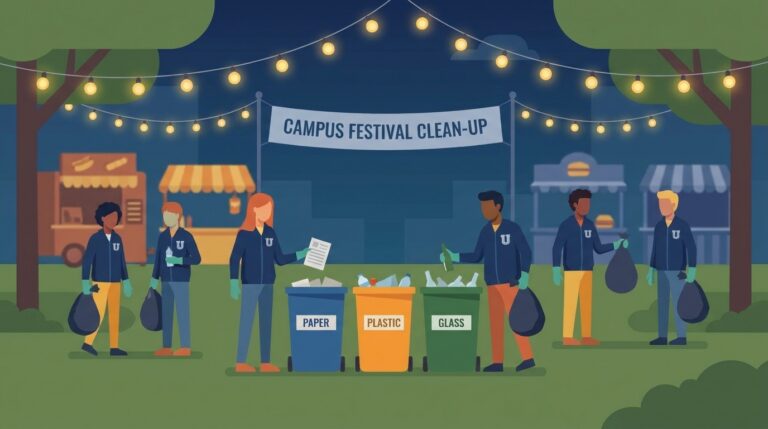
Picture this: It is 11:30 PM on the final night of your university’s Daedongje (대동제 – annual campus festival). For three consecutive days, your department operated a bustling outdoor pub (jujeom, 주점). You grilled hundreds of Korean pancakes, poured endless bottles of makgeolli, and cheered with fellow classmates under the glow of hanging lightbulbs. But as the music fades and the crowds disperse into the cool night air, the real trial begins: the dreaded dwitjeongri (뒷정리 – cleanup and teardown).
Looking around your department’s designated tent area, you see towering stacks of used paper cups, tangled blue tarps, greasy grill pans, and overflowing bags of mixed cans and plastic. In Korea, university festivals operate under strict student council (Chonghak, 총학생회) regulations. If your booth fails the final environmental inspection, your department risks losing its security deposit or facing heavy penalties. Many international students stand frozen in this moment—wanting to help, but terrified of sorting something incorrectly or unsure of how to jump in without getting in the way.
Don’t worry! Cleaning up after a festival isn’t just a chore; it is an iconic rite of passage where deep camaraderie (jeong, 정) is forged over work gloves and trash bags. Today, we’ll master the exact B2-level natural Korean phrases, campus etiquette, and non-verbal nuances you need to navigate booth cleanup smoothly, pass student council inspections, and earn instant respect from your peers.
Phase 2: 핵심 표현 3선 심층 분석 (Top 3 Core Expressions)
1. 깔끔하게 뒷정리하고 가자. (Ggalkkeumhage dwitjeongrihago gaja.)
- Pronunciation: [Ggahl-ggeum-ha-ge dweet-jeong-ri-ha-go ga-ja] (Think of ‘Ggal’ popping crisply like ‘calm’ with a hard snap, followed by ‘dweet-jeong-ree’.)
- Meaning: Literally “Let’s do the back-tidying neatly and go,” but nuanced as “Let’s clean up thoroughly and wrap things up nicely before we leave.”
- K-Culture Moment: You will hear this in youth K-dramas (like Weightlifting Fairy Kim Bok-joo or Cheer Up) when university club members wrap up a long project or festival day and rally each other to finish strong.
- Editor’s Insight: Dwitjeongri (뒷정리) combines dwit (back/after) and jeongri (organization). In Korean culture, how someone leaves a space speaks louder than how they arrived. Finishing ggalkkeumhage (깔끔하게 – neatly/spotlessly) reflects personal integrity and collective respect.
- Situation Spectrum: Casual (Friends/Peers): ✅ | Semi-formal: ⚠️ (Say: 깔끔하게 뒷정리하고 가요) | Formal: 🚫 (Say: 깔끔하게 뒷정리하고 퇴근/이동하겠습니다)
- 🤔 Think About It: In many Western campus cultures, event trash is often handled by paid custodial staff. Why do Korean universities emphasize student-led collective responsibility (gongdongche uisik) down to the last piece of tape?
2. 분리수거 철저하게 해야 검사 통과해요. (Bunrisugeo cheoljeohage haeya geomsa tonggwahaeyo.)
- Pronunciation: [Boon-ree-soo-geo cheol-jeo-ha-ge hae-ya geom-sa tong-gwa-hae-yo]
- Meaning: Literally “Only if we do separate collection thoroughly will we pass inspection,” meaning “We have to sort the recycling strictly by the book to pass the student council inspection.”
- K-Culture Moment: In reality variety shows like Three Meals a Day or campus vlogs, members meticulously rinse sauce containers before putting them into recycling bags while reminding each other not to get penalized.
- Editor’s Insight: Korea has one of the world’s most intricate recycling systems (bunrisugeo). At university festivals, student council officers inspect bags with flashlights. If food waste (janban) is mixed with plastics, your entire booth can be red-flagged. The adverb cheoljeohage (철저하게 – thoroughly/strictly) adds a serious, proactive tone.
- Situation Spectrum: Casual: ⚠️ (Use 해 instead of 해요) | Semi-formal (Peers/Seniors): ✅ | Formal: ✅
- 🤔 Think About It: Notice the grammatical structure -aya/eoya tonggwahada (must do X to pass). How does this conditional logic emphasize group accountability over individual preference?
3. 천막 철거하기 전에 주변 쓰레기부터 싹 쓸어 담자. (Cheonmak cheolgeohagi jeone jubyeon sseuregibuteo ssak sseureo damja.)
- Pronunciation: [Cheon-mahk cheol-geo-ha-gi jeo-ne joo-byeon sseu-re-gi-boo-teo ssahk sseu-reo dahm-ja]
- Meaning: Literally “Before dismantling the tent, let’s sweep up and bag all the surrounding trash completely,” meaning “Let’s sweep up all the ground litter around the booth before we take down the canopy.”
- K-Culture Moment: Seen in disaster recovery scenes or campus festival wind-downs where leaders prioritize clearing walking surfaces so dismantled poles don’t crush hidden debris or break glass bottles.
- Editor’s Insight: Ssak (싹) is a vivid Korean mimetic/onomatopoeic adverb meaning “cleanly, completely, in one sweep.” Adding ssak before a verb transforms mechanical chores into energetic, satisfying collective action.
- Situation Spectrum: Casual: ✅ | Semi-formal: ⚠️ (Change 담자 to 담아요) | Formal: 🚫
- 🤔 Think About It: English often uses verb phrases like “sweep everything up.” Korean uses vivid sensory words like ssak (싹) to convey visual thoroughness. What sensory adverbs exist in your native language for cleaning?
Phase 3: 교과서 한국어 vs 진짜 한국어 (Textbook vs. Real Campus Korean)
Situation 1: Offering to handle the recycling sorting
- 📖 교과서 한국어: 쓰레기를 제가 분리수거하겠습니다. (Sseuregireul jega bunrisugeohagessseumnida.) — “I shall separate the garbage.”
- 🗣️ 진짜 한국어: 캔이랑 플라스틱 분류는 제가 맡아서 할게요! (Kaen-irang peullaseutik bunryuneun jega mat-aseo halgeyo!) — “I’ll take charge of sorting the cans and plastics!”
- 💡 왜 다를까? Textbook Korean sounds like a military report. In real campus life, volunteering for specific materials (cans, plastics, cardboard) using the proactive phrase 제가 맡아서 할게요 demonstrates immediate initiative without sounding stiff.
Situation 2: Asking if the booth area is clean enough for the inspection
- 📖 교과서 한국어: 청소가 모두 완료되었습니까? (Cheongsoga modu wanryodoeotseumnikka?) — “Has the cleaning been entirely finalized?”
- 🗣️ 진짜 한국어: 이 정도면 총학 검사 무조건 프리패스죠? (I jeongdomyeon chonghak geomsa mu-jogeon peuripaeseujyo?) — “With this level of cleanliness, we’re definitely passing the student council inspection on the first try, right?”
- 💡 왜 다를까? Real university students shorten Chonghaksaenghoe (총학생회) to Chonghak (총학) and borrow the slang free pass (프리패스) to describe an effortless, guaranteed approval.
Phase 4: K-Culture 딥다이브 & 비언어적 매너 (Deep Dive & Non-Verbal Manners)
4-1. 눈치(Nunchi) & Gestures: The Art of the Festival Teardown
- The Cotton Glove Etiquette (Mokjanggap, 목장갑): Never stand around with bare hands while others are wearing standard red-rubber-coated cotton work gloves. Put on a pair immediately. Even if you’re just holding a plastic bag open for someone else, wearing gloves communicates: “I am ready to get my hands dirty.”
- The Two-Person Bag Hold: When someone is sweeping debris, never watch passively. Hold the mouth of the 100-liter volume-rate waste bag (jongryangje bongtu, 종량제 봉투) wide open with both hands at knee height. Maintain attentive eye contact and nod slightly when they finish sweeping.
- Welcoming the Student Council Inspector: When the inspection team (Chonghak) arrives with clipboards, stop what you are doing, remove your gloves or hold them behind your back, and give a polite 30-degree bow. Never argue immediately if they point out an unrinsed cup; say “아, 바로 다시 확인하겠습니다!” (Ah, I’ll double-check that immediately!).
4-2. Cultural Code: The Sacred Transition to “Dwitpuri” (뒤풀이)
In Korean campus culture, an event is never truly over until the cleanup is certified. The post-festival after-party (Dwitpuri, 뒤풀이)—where seniors buy fried chicken, soup, and drinks for juniors—only starts once the tent is completely folded and the student council signs off on the grounds. Contributing actively during cleanup elevates your reputation from a casual participant to a dependable peer (eonni, oppa, hyeong, nuna, or dongsaeng).
Phase 5: 실전 롤플레이 시나리오 (Interactive Roleplay Scenario)
Setting: Midnight on the central lawn. Booth #12 (French Literature Dept Pub). The music stage has shut down. Yellow sodium streetlights illuminate piles of crushed cardboard, flattened beer boxes, and scattered skewers.
Characters:
* Min-jun (민준): The tired but responsible student council liaison for your department booth.
* You (Alex): A proactive exchange student determined to make sure your tent passes inspection smoothly.
Min-jun: 🎭 (Wiping sweat from his forehead with the back of his forearm) 휴, 드디어 축제 끝났다! 다들 진짜 고생 많았어. 이제 천막만 치우면 끝이야.
(Hyu, deudieo chukje kkeunnatda! Dadeul jinjja gosaeng manasseo. Ije cheonmakman chiumyeon kkeutiya.)
“Phew, the festival is finally over! Amazing job everyone. Now we just need to take down the tent and we’re done.”
You: 🎭 (Approaching with a roll of giant trash bags and work gloves) 민준 선배, 천막 접기 전에 바닥 쓰레기부터 싹 정리해야 하지 않아요?
(Min-jun seonbae, cheonmak jeopgi jeone badak sseuregibuteo ssak jeongrihaeya haji anayo?)
“Min-jun sunbae, shouldn’t we sweep up all the ground litter completely before folding down the tent?”
Min-jun: 🎭 (Eyes lighting up with relief) 맞아, 알렉스! 바닥에 나무젓가락이랑 잔반 남아있으면 총학 검사에서 바로 탈락이거든.
(Maja, Alex! Badage namujeotgaragirang janban namaisseumyeon chonghak geomsa-eseo baro tallagigeodeun.)
“Exactly, Alex! If wooden chopsticks or food waste are left on the ground, the student council will fail us on the spot.”
You: 🎭 (Handing him a pair of spare gloves) 제가 분리수거함 쪽 맡을 테니까, 선배는 천막 기둥 고정 끈 풀어주실래요?
(Jega bunrisugeoham jjok mateul tenikka, seonbaeneun cheonmak gidung gojeong kkeun pureojusillaeyo?)
“I’ll take charge of the recycling station side, so could you untie the tent pole guide ropes?”
Min-jun: 🎭 (Nodding approvingly) 오, 좋아! 플라스틱 컵 안에 남은 음료는 꼭 전용 잔반통에 비우고 헹궈서 담아줘.
(O, joa! Peullaseutik keop ane nameun eumryoneun kkok jeonyong janbantonge biugo heng-gwoseo damajwo.)
“Oh, perfect! Please make sure any leftover drinks in plastic cups are emptied into the designated waste bucket and rinsed before bagging.”
You: 🎭 (Checking off items meticulously) 네, 투명 페트병 비닐 라벨도 다 떼서 분리수거 완벽하게 해둘게요!
(Ne, tumyeong peteubyeong binil rabeldo da tteseo bunrisugeo wanbyeokhage haedulgeyo!)
“Got it! I’ll also strip all the vinyl labels off the clear PET bottles and sort them perfectly!”
Min-jun: 🎭 (Patting your shoulder with a big grin) 와, 든든하다! 이 정도면 우리 부스가 오늘 가장 먼저 검사 통과하고 뒤풀이 갈 수 있겠다.
(Wa, deundeunhada! I jeongdomyeon uri buseuga oneul gajang meonjeo geomsa tonggwahago dwitpuri gal su itgetda.)
“Wow, you’re such a reliable teammate! At this rate, our booth will pass inspection first and head straight to the after-party.”
You: 🎭 (Smiling and holding up the broom) 얼른 끝내고 시원한 치맥 하러 가요!
(Eolleun kkeunnaego siwonhan chimaek hareo gayo!)
“Let’s wrap this up fast and go grab some refreshing chicken and beer!”
🔀 인터랙티브 분기점 (Interactive Decision Point)
At 12:15 AM, the student council inspectors approach holding a clipboard and flashlight. They point to a black trash bag containing a mixture of paper plates and greasy aluminum foil. How do you respond?
- Option A: “죄송합니다! 기름 묻은 호일은 종량제 일반쓰레기로 빼서 지금 바로 다시 분류하겠습니다!”
- Option B: “원래 축제 때는 다 섞여서 버려지는 거 아닌가요? 대충 넘어가 주세요.”
- Option C: “그건 제가 버린 게 아니라 다른 손님이 버리고 간 거예요.”
* **Option A (Best):** Instant de-escalation! Greasy aluminum foil cannot be recycled as scrap metal; it goes into general waste (*jongryangje*). Acknowledging the sorting mistake immediately and fixing it prevents booth demerits.
* **Option B (Bad):** Disastrous. Asking student council officers to "let it slide" (*daechung neomeoga juseyo*) violates collective campus norms and will likely trigger an immediate demerit penalty.
* **Option C (Risk):** Shifting blame to customers makes you appear unaccountable. The department is collectively responsible for all waste inside its booth zone, regardless of who dropped it.
Phase 6: 10초 감정 섀도잉 드릴 (10-Second Shadowing Drills)
Practice these lines focusing on natural speed, stress pauses (/), and emotional intent:
[💪 기합 넣고 씩씩하게 - Energetic & Determined]- 천막 철거하기 전에 / 주변 쓰레기부터 / 싹 쓸어 담자! (Cheonmak cheolgeohagi jeone / jubyeon sseuregibuteo / ssak sseureo damja!)
[👀 눈치 살피며 꼼꼼하게 - Attentive & Cautious]- 플라스틱 컵은 / 음료 비우고 / 라벨 떼서 / 따로 모아야 돼요. (Peullaseutik keobeun / eumryo biugo / rabel tteseo / ttaro moaya dwaeyo.)
[🎉 안도하며 자랑스럽게 - Relieved & Proud]- 총학 검사 통과했으니까 / 이제 마음 편하게 / 뒤풀이 가자! (Chonghak geomsa tonggwahaesseunikka / ije maeum pyeonhage / dwitpuri gaja!)
Phase 7: K-Culture 미니 사전 (Campus Mini-Dictionary)
- 뒷정리 (Dwitjeongri) | Post-event cleanup / Tidying up afterwards
- Real-world usage: Essential in schools, offices, shared kitchens, and camping sites. Leaving without doing dwitjeongri is considered one of the biggest social faux pas in Korea.
- 대동제 (Daedongje) | University grand festival
- Real-world usage: Literally means “festival of great unity.” Held nationwide every May or September, featuring celebrity performances, department food stalls, and student council games.
- 총학 (Chonghak) | Student Council (Abbreviation of 총학생회)
- Real-world usage: The governing student body that oversees club budgets, festival layout, environmental compliance, and university negotiations.
- 분리수거 (Bunrisugeo) | Separated waste disposal / Recycling sorting
- Real-world usage: Categorized strictly into General Waste (일반쓰레기), Food Waste (음식물/잔반), Plastics (플라스틱), Cans/Glass (캔/병), and Paper/Cardboard (종이/박스).
Phase 8: 여행자와 유학생을 위한 생존 키트 (Campus Survival Kit)
서바이벌 표현 TOP 3 (Survival Phrases)
- 종량제 봉투 어디 있어요? (Jongryangje bongtu eodi isseoyo?) — “Where are the official volume-rate garbage bags?”
- Pro Tip: Always ask this first. Putting trash in random plastic grocery bags won’t be collected by municipal trucks.
- 이거 일반쓰레기예요, 재활용이에요? (Igeo ilbansseuregi-yeyo, jaehwalyong-ieyo?) — “Is this general waste or recyclable?”
- Pro Tip: Use this when unsure about laminated paper cups or greasy takeout containers.
- 장갑 하나만 더 빌려주실 수 있나요? (Jang-gap hanaman deo billyeojusil su innayo?) — “Could you lend me one more pair of work gloves?”
- Pro Tip: Shows you’re eager to participate without expecting others to do manual labor for you.
Editor’s Campus Life Note
- Navigation & Campus Maps: University campuses in Korea are massive hills! Download the official 네이버 지도 앱 다운로드 to pinpoint campus waste disposal hubs and recycling collection centers.
- Festival Timelines: The cleanup rush happens between 11:00 PM and 1:30 AM. Keep your transit card topped up via T-Money or mobile apps, because subways finish running around midnight, and late-night festival cleanups often require sharing night taxis with classmates.
Phase 9: “한 발 더 깊이” (Cultural Essay & Thought Question)
In Korean society, the phrase “머문 자리도 아름답게” (“Make the place you stayed as beautiful as when you arrived”) is inscribed everywhere from public restrooms to mountain trailheads. During university festivals, booth cleanup is not treated as menial labor relegated to cleaners; it is viewed as a litmus test of collective citizenship (gongdongche uisik). When students scrub ground stains and pack away tarps alongside their senior department chairs, social barriers break down. You stop being merely a guest in Korea and become an active, respected member of the community.
💬 Your Turn: How does post-event cleaning work at festivals or sporting events in your home country? Is it shared collectively or handled entirely by hired staff? Share your experiences in the comments below!
Phase 10: FAQ & 오해 방지 (FAQ Schema & Common Mistakes)
Q: Can paper cups soaked in sauce or beer be recycled as paper?
A: No! Paper contaminated with oil, food, or alcohol goes into General Waste (일반쓰레기). Only clean, dried paper products can be recycled.
Q: What should we do with leftover ice and soup broth from the pub booth?
A: Never pour soup broth onto lawn grass or storm drains! Ice can be melted into designated water drains, but all broths and food scraps must go directly into the designated Food Waste buckets (janbantong, 잔반통).
Q: Who actually conducts the tent inspection at the end of the festival?
A: The Student Council Autonomous Inspection Team (Chonghak Jachi Gimundae or festival committee). They check for ground litter, proper sorting bags, and fire extinguisher return before returning your booth safety deposit.
🚨 흔한 실수 (Common Mistakes) 경고판
- Mistake: Throwing wooden chopsticks into recyclable paper or wood.
- Correct Action: Wooden chopsticks (namujeotgarak) are always General Waste (일반쓰레기).
- Mistake: Leaving clear plastic cups full of ice on tables when taking down tents.
- Correct Action: Empty fluids into a bucket, throw lids/straws into plastic, and stack cups neatly.
- Mistake: Standing around checking your phone while waiting for your friends to finish packing.
- Correct Action: Even if your specific booth task is done, ask: “제가 더 도울 일 없을까요?” (Is there anything else I can help with?).
Phase 11: 액션 미션 & 참여 유도 (Action Missions)
- 🥉 Bronze Mission (Solo Shadowing): Practice saying “분리수거 철저하게 해야 검사 통과해요” three times with the emotion drill.
- 🥈 Silver Mission (Social/Study): Share a photo of your recycling setup on Instagram or in your Korean study group with the caption “오늘도 깔끔하게 뒷정리 완료!”.
- 🥇 Gold Mission (Real-World Application): The next time you finish a meal or club meeting with Korean friends, take the initiative and say: “우리 여기 깔끔하게 뒷정리하고 가요!”
🎮 K-Culture Mission: Watch any campus-based K-drama episode featuring a school festival (e.g., Cheese in the Trap or Dear. M) and spot the moment the characters fold their blue tarps or carry trash bags!
Phase 12: 인터랙티브 퀴즈 챌린지 (Interactive Quiz)
Question 1: Situation Assessment
During your department’s festival cleanup, you encounter empty soju and beer bottles. What is the most culturally and environmentally appropriate action?
* A) Put them into general black garbage bags so they don’t break.
* B) Return them in their original plastic crates (soju bakseu) to get the container deposit refund.
* C) Leave them under the table until morning.
🔍 정답 및 해설 보기 (Click to view answer)
정답: B
해설: In Korea, commercial glass bottles (soju and beer) carry a deposit refund (bingwawonjeunggeum). Booth organizers collect them neatly in plastic crates to return to distributors or convenience stores, which keeps the campus safe from broken glass and recovers funds for the booth budget.
Question 2: Fill-in-the-Blank
Complete the sentence with the correct natural adverb meaning “cleanly and in one sweep”:
* “천막 철거하기 전에 주변 쓰레기부터 (________) 쓸어 담자.”
🔍 정답 및 해설 보기 (Click to view answer)
정답: 싹 (Ssak)
해설: Ssak (싹) emphasizes clearing everything away thoroughly without leaving a single trace behind.
Question 3: True or False Cultural Quiz
- Statement: Greasy paper pizza boxes and ramen-stained paper bowls can be placed into the paper recycling bin as long as they are dry.
- [ True / False ]
🔍 정답 및 해설 보기 (Click to view answer)
정답: False
해설: Any paper contaminated with oil, grease, or heavy food stains cannot be pulped for recycling. It must be discarded in the official volume-rate general waste bag (jongryangje ilbansseuregi).







