

Phase 1: 공감 (Story-Immersive Opening)
안녕하세요! 매일한글 에디터입니다.
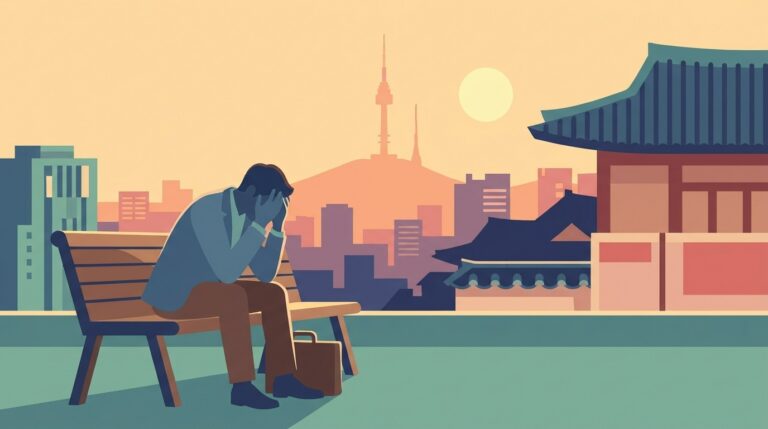
Imagine this scene straight out of a K-drama like Misaeng (미생) or My Liberation Notes (나의 해방일지): It is 10:45 PM on a rainy Tuesday in Teheran-ro, Gangnam. The fluorescent lights of glass office towers buzz relentlessly. You glance around your open-plan workspace; nobody has stood up to leave yet. Even as your temples throb with exhaustion, you open your phone and scroll through social media, bombarded by peers waking up at 5:00 AM for ‘Miracle Morning’ routines and posting their #갓생 (God-saeng, living an ultra-productive, god-like life) checklists. Instead of resting, an insidious voice whispers: “If everyone else can push through, why can’t I?”
This precise dilemma echoes Korean-German philosopher Byung-Chul Han’s diagnosis in his seminal work, The Burnout Society (피로사회). Han argues that modern exhaustion no longer stems from external authoritarian oppression; rather, it thrives on the toxic surplus of positivity—the tyrannical dogma of “Yes, we can.” We become voluntary labor camp wardens of our own minds, exploiting ourselves under the illusion of self-fulfillment until our inner battery is utterly depleted.
Over my decade guiding advanced learners through Korean cultural landscapes, many C1 students tell me: “Editor, I know how to say ‘I’m tired’ (피곤해요), but how do I articulate existential fatigue, boundary-setting, and emotional reclamation in sophisticated Korean without sounding defeated or unprofessional?” Mastering this linguistic nuance is not just about vocabulary; it is about reclaiming your mental sovereignty in high-pressure social spheres. Let’s dive deep into the cultural psychology of burnout and equip you with natural, high-level Korean expressions that allow you to say “enough” with dignity.
Phase 2: 핵심 표현 3선 심층 분석 (Top 3 Core Expressions)
1. 현타 오다 (Hyeon-ta o-da)
- Pronunciation: [Hyeon-ta o-da] (Think of hyeon rhyming with ‘yawn’ but with an ‘h’, followed by a punchy tah and oh-dah)
- Meaning:
- Literal: ‘Reality-check time arrives’ (Abbreviation of 현실 자각 타임, Hyeonsil jagak taim).
- Nuance: The sudden, sobering crash where you realize the frantic efforts you made were utterly meaningless, often triggering emotional numbness or sudden disillusionment.
- K-Culture Moment: Seen frequently in variety shows like You Quiz on the Block when a guest recounts working 80 hours a week for years, only to stare blankly at a convenience store ramen bowl late at night and suddenly ask: “내가 지금 뭘 위해 이렇게까지 살고 있지?” (What am I driving myself this hard for?).
- Editor’s Insight: While originally internet slang, 현타 has graduated into everyday colloquial speech among professionals in their 20s to 40s. It captures that exact moment when the psychological armor of toxic positivity cracks.
- Situation Spectrum: Casual (✅) | Semi-formal (✅) | Formal / Business Meeting (⚠️)
- 🤔 Think About It: In your native language, do you have a word that simultaneously captures self-ridicule, sudden clarity, and existential deflation in just two syllables?
2. 스스로를 채찍질하다 (Seu-seu-ro-reul chae-jjik-jil-ha-da)
- Pronunciation: [Seu-seu-ro-reul chae-jjik-jil-ha-da] (Pronounce chae-jjik with sharp, crisp aspirated tension, mimicking the crack of a whip)
- Meaning:
- Literal: To whip oneself / to flog oneself.
- Nuance: To relentlessly drive, push, or criticize oneself to meet an impossible, self-imposed standard of perfection.
- K-Culture Moment: Frequently featured in artist memoirs or K-Pop documentary interviews (like BTS’s Break the Silence), where idols discuss the unbearable mental burden of continuously perfecting their craft: “완벽해야 한다는 강박 때문에 스스로를 끊임없이 채찍질했어요.” (I continually flogged myself due to the obsession with being perfect).
- Editor’s Insight: This is a sophisticated, literary, yet frequently spoken idiom ideal for C1 essays, therapy discussions, or intimate heart-to-heart conversations (진솔한 대화).
- Situation Spectrum: Casual (✅) | Semi-formal (✅) | Formal (✅)
- 🤔 Think About It: Notice the visceral physicality of Korean metaphors. Why do cultures with rapid economic transformation often rely on self-punitive idioms to express ambition?
3. 숨고르기를 하다 (Sum-go-reu-gi-reul ha-da)
- Pronunciation: [Sum-go-reu-gi-reul ha-da] (Soft and flowing; sounds like a gentle exhale: soom-go-roo-ghee)
- Meaning:
- Literal: To regulate/even out one’s breath.
- Nuance: To deliberately hit the pause button, step back from hyper-productivity, and regain emotional rhythm before moving forward.
- K-Culture Moment: The calming motif in healing travel variety shows like Three Meals a Day (삼시세끼) or Hyori’s Homestay, where protagonists explicitly announce their desire to slow down: “이제는 잠시 숨고르기를 할 때인 것 같아요.” (I think it’s time to take a mindful pause).
- Editor’s Insight: Unlike 쉬다 (to rest/sleep), 숨고르기를 하다 implies strategic emotional resilience. It is not giving up; it is an active choice to prevent cardiac and mental arrest.
- Situation Spectrum: Casual (✅) | Semi-formal (✅) | Formal (✅)
- 🤔 Think About It: How does viewing rest as ‘rhythm regulation’ rather than ‘inactivity’ change your guilt around taking a break?
Phase 3: 교과서 한국어 vs 진짜 한국어 (Textbook vs. Real Korean)
Situation A: Expressing that you are on the verge of mental collapse due to excessive workload
- 📖 교과서 한국어: 저는 업무가 너무 많아서 정신적으로 몹시 피곤하고 힘듭니다. (Jeo-neun eop-mu-ga neo-mu man-a-seo jeong-sin-jeok-eu-ro mop-si pi-gon-ha-go him-deum-ni-da.)
- 🗣️ 진짜 한국어: 계속 무리했더니 번아웃 와서 멘탈이 완전히 털렸어요. (Gye-sok mu-ri-haet-deo-ni beon-a-ut wa-seo men-tal-i wan-jeon-hi teol-lyeot-eo-yo.)
- 💡 왜 다를까?: Textbook Korean relies on dry psychiatric or formal descriptors (정신적으로 피곤하다). Contemporary native speakers prefer kinetic, graphic metaphors: 번아웃 오다 (burnout hits) and 멘탈이 털리다 (one’s mental stamina is shaken out like empty pockets), capturing the visceral sense of inner hollow emptiness.
Situation B: Proposing to scale back toxic self-improvement habits
- 📖 교과서 한국어: 앞으로는 너무 열심히 노력하지 않고 휴식을 취하도록 하겠습니다. (Ap-eu-ro-neun neo-mu yeol-sim-hi no-ryeok-ha-ji an-ko hyu-sik-eul chwi-ha-do-rok ha-get-seum-ni-da.)
- 🗣️ 진짜 한국어: 갓생 살겠다는 강박은 좀 내려놓고, 당분간 마음 챙김에 집중하려고요. (Gat-saeng sal-get-da-neun gang-bak-eun jom nae-ryeo-noh-go, dang-bun-gan ma-eum chaeng-gim-e jip-jung-ha-ryeo-go-yo.)
- 💡 왜 다를까?: Promising “not to try hard” can mistakenly sound irresponsible or lazy in Korean social structures. Using terms like 강박을 내려놓다 (lay down one’s obsession) and 마음 챙김 (mindfulness) reframes your withdrawal as a deliberate act of self-care and maturity.
Phase 4: K-Culture 딥다이브 & 비언어적 매너
4-1. 눈치 (Nunchi) & Non-Verbal Manners in Burnout Contexts
In Korean corporate and social hierarchies, expressing burnout requires nuanced emotional calibration. Admitting you are exhausted directly to a senior (선배 or 부장님) without situational tact can be misinterpreted as complaining (불평) or lacking organizational loyalty (애사심).
* The Heavy Sigh Regulation: In Korean culture, a loud, audible sigh (한숨 쉬기) in a communal office space is taboo because it unconsciously discharges negative energy onto others. When dealing with self-exploitation, Koreans often practice quiet sensory gestures: gently rubbing the bridge of the nose (미간을 짚다), tilting the head slightly downward with a soft smile, and speaking in a calm, lowered pitch.
* The Eye Contact Angle: When admitting burnout to a trusted colleague, maintaining hard, unbroken eye contact feels confrontational. Instead, drop your gaze slightly to your coffee cup or desk corner before re-engaging. This physical posture signals: “I am not attacking the company; I am wrestling with my own internal limits.”
4-2. Cultural Code Analysis: The Tyranny of ‘God-saeng’ (갓생) vs. ‘My Liberation Notes’
Over the past few years, the buzzword 갓생 (God + 生, meaning a god-tier disciplined life: waking up early, working out, studying English, holding a side hustle) gripped Korean youth. However, this trend has brought an acute counter-reaction. In the hit drama My Liberation Notes (나의 해방일지), the protagonist Yeom Mi-jeong embodies the quiet suffering of someone crushed by corporate cheerfulness: “모든 관계가 노동이에요… 난 해방되고 싶어요.” (Every relationship feels like work… I want to be liberated).
Korean society is actively debating whether 갓생 is genuine self-actualization or merely voluntary self-exploitation under capitalist aesthetic packaging. When you utilize expressions like 숨고르기 or 강박 내려놓기 in Seoul today, you tap directly into this profound cultural reclamation project.
Phase 5: 실전 롤플레이 시나리오 (Real-Life Roleplay)
Setting: 8:30 PM. The breezy rooftop terrace of an IT company in Pangyo Techno Valley. The scent of roasted coffee mingles with the cool night air.
Characters:
* Min-woo (민우): Your senior colleague (대리), renowned as a tireless top-performer, staring blankly into the neon city skyline.
* Alex (You): A thoughtful team member who notices Min-woo skipping meals and overworking.
[Dialogue]
턴 1 (Min-woo):
🎭 (Sighs softly, looking down at his paper cup)
알렉스 씨, 아직 퇴근 안 했어요? 프로젝트 마감 맞추려면 오늘 밤새야 할 것 같네요.
(Alex ssi, a-jik toe-geun an haet-eo-yo? Peu-ro-jek-teu ma-gam mat-chu-ryeo-myeon o-neul bam-sae-ya hal geot gat-ne-yo.)
“Alex, haven’t you left yet? Looks like I’ll have to pull an all-nighter to meet the project deadline.”
턴 2 (Alex):
🎭 (Walks up quietly, keeping a gentle, respectful distance)
민우 대리님, 요즘 쉬지도 못하고 너무 달리기만 하시는 것 같아서 걱정돼요.
(Min-u dae-ri-nim, yo-jeum swi-ji-do mot-ha-go neo-mu dal-ri-gi-man ha-si-neun geot gat-a-seo geok-jeong-dwae-yo.)
“Assistant Manager Min-woo, I’m worried because it seems you’ve just been sprinting non-stop lately without resting.”
턴 3 (Min-woo):
🎭 (Smiles self-deprecatingly with tired, bloodshot eyes)
에이, 남들도 다 이만큼은 하잖아요. 제가 역량이 부족하니까 스스로를 더 채찍질할 수밖에 없어요.
(E-i, nam-deul-do da i-man-keum-eun ha-jan-a-yo. Je-ga yeok-ryang-i bu-jok-ha-ni-kka seu-seu-ro-reul deo chae-jjik-jil-hal su-bak-e eop-eo-yo.)
“Come on, everyone else does this much. Since my skills are lacking, I have no choice but to whip myself harder.”
턴 4 (Alex):
🎭 (Shakes head gently with warm empathy)
대리님처럼 유능하신 분이 그렇게 말씀하시면 어떡해요. ‘할 수 있다’는 긍정성도 과하면 독이 되잖아요.
(Dae-ri-nim-cheo-reom yu-neung-ha-sin bun-i geu-reoh-ge mal-ssum-ha-si-myeon eo-tteok-hae-yo. ‘Hal su it-da’neun geung-jeong-seong-do gwa-ha-myeon dok-i doe-jan-a-yo.)
“If someone as competent as you says that, what about the rest of us? Even the positivity of ‘I can do it’ turns into poison when excessive.”
턴 5 (Min-woo):
🎭 (Pauses, hands freezing on his coffee cup)
독이라… 솔직히 말씀드리면, 요즘 아침에 눈뜰 때마다 극심한 현타가 와요. 다 부질없게 느껴지고…
(Dok-i-ra… Sol-jik-hi mal-ssum-deu-ri-myeon, yo-jeum a-chim-e nun-tteul ttae-ma-da geuk-sim-han hyeon-ta-ga wa-yo. Da bu-jil-eop-ge neu-kyeo-ji-go…)
“Poison… To be honest, every morning when I open my eyes, a severe wave of reality-crash (hyeonta) hits me. Everything feels so futile…”
턴 6 (Alex):
🎭 (Nods slowly, validating his emotional weight)
전형적인 번아웃 증상이에요. 지금까지 너무 오래 버티셨어요. 이제는 의무감 내려놓고 숨고르기를 하셔야 할 타이밍이에요.
(Jeon-hyeong-jeok-in beon-a-ut jeung-sang-i-e-yo. Ji-geum-kka-ji neo-mu o-rae beo-ti-syeot-eo-yo. I-je-neun ui-mu-gam nae-ryeo-noh-go sum-go-reu-gi-reul ha-syeo-ya hal ta-i-ming-i-e-yo.)
“That’s a textbook symptom of burnout. You’ve endured for far too long. It’s time to set down the obligation and catch your breath.”
턴 7 (Min-woo):
🎭 (Releases a deep, genuine exhale and rubs his neck)
숨고르기라… 제가 제 자신을 너무 벼랑 끝으로 몰아세웠나 봅니다. 오늘 밤샘은 취소하고 들어가야겠어요.
(Sum-go-reu-gi-ra… Je-ga je ja-sin-eul neo-mu byeo-rang kkeut-eu-ro mor-a-se-wot-na bop-ni-da. O-neul bam-saem-eun chwi-so-ha-go deul-eo-ga-ya-get-eo-yo.)
“Catching my breath… I suppose I drove myself too close to the cliff’s edge. I should cancel pulling an all-nighter tonight and head home.”
턴 8 (Alex):
🎭 (Brightly offers a warm, encouraging smile)
정말 잘 생각하셨어요! 오늘 밤엔 푹 주무시고, 내일 맑은 정신으로 다시 시작해요.
(Jeong-mal jal saeng-gak-ha-syeot-eo-yo! O-neul bam-en puk ju-mu-si-go, nae-il mal-geun jeong-sin-eu-ro da-si si-jak-hae-yo.)
“That is a great decision! Sleep deeply tonight, and let’s start again tomorrow with a clear mind.”
🔀 인터랙티브 분기점 (Interactive Choice)
If Min-woo says: “하지만 제가 쉬면 우리 팀 마감에 차질이 생길까 봐 두려워요” (But I’m afraid that if I rest, our team’s deadline will be disrupted), how do you respond?
- Option A: “대리님이 쓰러지시면 프로젝트가 아예 엎어져요. 팀을 위해서라도 지금 쉬셔야 해요.” (If you collapse, the project will be scrapped entirely. Even for the team’s sake, you must rest now.)
- Option B: “원래 일이라는 게 끝이 없어요. 그냥 다 때려치우고 사직서 냅시다!” (Work is originally endless anyway. Let’s just flip the table and hand in resignation letters!)
- Option C: “걱정 마세요, 제가 대리님 업무 오늘 밤에 다 대신 끝내놓을게요!” (Don’t worry, I will finish all your tasks tonight in your place!)
Feedback:
* Option A [BEST]: Pragmatic, deeply empathetic, and professional. In Korean corporate communication, linking personal rest to collective project stability (팀을 위해서라도) alleviates collective guilt immediately.
* Option B [BAD]: Extremely risky. Inciting premature resignation (사직서) crosses professional etiquette and shifts a philosophical supportive conversation into reckless rebellion.
* Option C [RISK]: You are falling right back into the self-exploitation trap by sacrificing yourself. This perpetuates the burnout cycle instead of solving it.
Phase 6: 10초 감정 섀도잉 드릴 (Emotional Shadowing Drill)
Practice reading these out loud, observing the rhythmic slashes / for breath stops and matching the emotional cues:
[😮💨 지치고 담담하게 - Weary and restrained]
‘할 수 있다’는 말에 갇혀서 / 스스로를 너무 벼랑 끝으로 / 몰아세웠던 것 같아요.
(‘Hal su it-da’neun mal-e gat-hyeo-seo / seu-seu-ro-reul neo-mu byeo-rang kkeut-eu-ro / mor-a-se-wot-deon geot gat-a-yo.)
(Trapped inside the words ‘I can do it’ / I think I drove myself / too close to the edge of a cliff.)-
[🌿 단호하면서도 따뜻하게 - Firm yet comforting]
잠깐 멈춘다고 해서 / 인생이 실패하는 건 아니에요. / 지금 필요한 건 숨고르기예요.
(Jam-kkan meom-chun-da-go hae-seo / in-saeng-i sil-pae-ha-neun geon a-ni-e-yo. / Ji-geum pil-yo-han geon sum-go-reu-gi-ye-yo.)
(Just because you pause for a moment / your life doesn’t become a failure. / What you need right now is to catch your breath.) -
[💡 깨달음을 얻고 후련하게 - Enlightened and unburdened]
갓생이라는 완벽주의 강박을 내려놓으니까 / 비로소 숨통이 좀 트이네요.
(Gat-saeng-i-ra-neun wan-byeok-ju-ui gang-bak-eul nae-ryeo-noh-eu-ni-kka / bi-ro-so sum-tong-i jom teu-i-ne-yo.)
(Now that I put down this perfectionist obsession with God-saeng / I can finally breathe a little easier.)
Phase 7: K-Culture 미니 사전 (Mini Dictionary)
-
번아웃 증후군 (Beon-a-ut jeung-hu-gun)
- Translation: Burnout Syndrome.
- Usage: Officially acknowledged in Korean workspaces and healthcare. Used when someone suffers physical, mental, and emotional exhaustion from prolonged career strain.
- 갓생 강박 (Gat-saeng gang-bak)
- Translation: The Compulsion for Hyper-Productive Living.
- Usage: Describes the social anxiety caused by hyper-curated social media routines where sleeping in or relaxing triggers guilt and inadequacy.
- 마음 챙김 (Ma-eum chaeng-gim)
- Translation: Mindfulness / Emotional Self-Care.
- Usage: The Korean translation of ‘mindfulness’. Commonly used in modern mental wellness retreats, meditation apps, and HR resilience training programs.
- 소확행 (So-hwak-haeng)
- Translation: Small but Certain Happiness.
- Usage: Borrowed originally from Haruki Murakami, this phrase became a lifestyle philosophy in Korea: finding profound solace in simple daily rituals (like an iced Americano in sunlight) instead of unattainable life goals.
Phase 8: 여행자를 위한 생존 키트 (Traveler’s Survival Kit)
Survival Expressions TOP 3
- 여기서 조용히 멍때려도 괜찮을까요? (Yeo-gi-seo jo-yong-hi meong-ttae-ryeo-do gwaen-chan-eul-kka-yo?)
Meaning: Is it okay if I quietly zone out here?
Pro Tip: 멍때리다 (to blank out/zone out) is a celebrated stress-relief practice in Korea. There are even national ‘Spacing Out Contests’ (멍때리기 대회) at the Han River! -
조용한 템플스테이 프로그램 추천해 주실 수 있나요? (Jo-yong-han tem-peul-seu-te-i peu-ro-geu-raem chu-cheon-hae ju-sil su it-na-yo?)
Meaning: Could you recommend a quiet temple stay program?
Pro Tip: When urban Seoul gets overwhelming, booking an overnight temple stay in Mount Odaesan or Haeinsa offers digital detox and silent walking meditation. -
오늘은 일정 없이 그냥 숙소에서 푹 쉬려고요. (O-neul-eun il-jeong eop-si geu-nyang suk-so-e-seo puk swi-ryeo-go-yo.)
Meaning: Today, without any itinerary, I’m just going to rest deeply at my accommodation.
Pro Tip: Use this to politely decline busy touring invites without offending Korean hosts.
Editor’s Travel Note: Escaping Urban Overstimulation
If the neon hyper-pace of Hongdae or Gangnam starts triggering sensory burnout, install the Naver Map application (네이버 지도 앱 다운로드) and search for the keywords ‘불멍’ (fire-gazing cafes), ‘숲멍’ (forest-view tea houses), or ‘북카페’ (silent book cafes) in suburbs like Paju Book City or Yangpyeong. Korea has mastered the architecture of tranquil refuges—places purpose-built for exhausted urbanites to regain their mental equilibrium.
Phase 9: “한 발 더 깊이” (Deep Cultural Reflection)
In traditional Korean agrarian society, the collective ethos of Pumassi (품앗이 – mutual communal labor) and Confucian devotion framed diligence (근면성실) as the supreme moral virtue. Following the Korean War, this collective drive powered the “Miracle on the Han River,” transforming the country from ruins into a global technological powerhouse. However, when this collective diligence was internalized into private psychology, it turned inward as an unyielding censor: an internal voice insisting that whenever you rest, you fall behind.
To heal from burnout in Korea is not merely to take a nap; it requires an intellectual deconstruction of the belief that your human worth equals your productivity output. Real resilience (회복탄력성) begins when we stop treating our bodies as capital instruments to be maximized and recognize our right to pause.
💬 Your Turn: Have you ever experienced an intense period of 현타 caused by over-pushing yourself in study or work? How do you say “I am pausing to catch my breath” in your mother tongue? Share your story in the comments below!
Phase 10: FAQ & 오해 방지 (FAQ & Common Mistakes)
Q: Does admitting burnout in a Korean company make you look incompetent or disloyal?
A: It depends on framing. If you frame it as resentment (“회사 때문에 힘들어요” – It’s hard because of the company), it will trigger defensiveness. But if you frame it using mature resilience vocabulary—such as “장기적인 성과를 위해 잠깐 숨고르기를 하며 컨디션을 조절하고 있습니다” (I am taking a breath and regulating my condition for long-term output)—it reflects high emotional intelligence (EQ) and professionalism.
Q: What is the exact difference between ‘피곤하다’ and ‘번아웃’?
A: 피곤하다 (pigonhada) is physical tiredness that usually resolves with 8 hours of good sleep. 번아웃 (burnout) is chronic emotional, psychological, and existential depletion where sleep does not restore your motivation, accompanied by cynicism and feeling detached (현타).
Q: Is the term ‘멍때리다’ rude to use in formal situations?
A: Yes, 멍때리다 is an informal slang verb. In business or academic contexts, replace it with 재충전의 시간을 갖다 (to have a time of recharging) or 사색의 시간을 가지다 (to have time for reflection).
🚨 Common Mistakes Alert
- Mistake: Using “저는 포기했어요” (I gave up) when you just mean you are taking a break.
Correct Action: Use “잠깐 쉬어가는 중이에요” (I’m just taking a momentary rest on my way). - Mistake: Overusing “화이팅!” (Fighting!) to a colleague who is already crying from exhaustion.
Correct Action: In burnout contexts, shouting 화이팅 feels like another whip. Say: “무리하지 마세요” (Don’t overexert yourself) or “그동안 애쓰셨어요” (You’ve worked so hard all this time). - Mistake: Saying “게을러서 죄송합니다” (Sorry for being lazy) when taking sick leave.
Correct Action: Say “몸과 마음을 잘 추스르고 복귀하겠습니다” (I will tend well to my mind and body and return).
Phase 11: 액션 미션 & 참여 유도 (Action Missions)
- 🥉 Bronze Mission (Solo Practice): Stand before a mirror, take a slow deep breath, and practice the shadowing phrase aloud 3 times: “완벽하지 않아도 괜찮아. 잠깐 숨고르기 하자.” (It’s okay not to be perfect. Let’s catch our breath.)
- 🥈 Silver Mission (Social Share): Post a photo of your evening tea, quiet park walk, or favorite calm corner on Instagram with the Korean hashtag
#숨고르기and#마음챙김. - 🥇 Gold Mission (Real-life Execution): The next time a Korean coworker or study partner sighs heavily or stays up late working, send them this comforting message: “너무 스스로를 채찍질하지 마시고 오늘 밤은 푹 쉬세요!” (Don’t whip yourself too much and get deep rest tonight!)
🎮 K-Culture Mission: Watch an episode of My Liberation Notes or Doctor Slump. Listen carefully for when characters talk about exhaustion and spot if they use words like 방전되다 (battery drained), 버티다 (enduring), or 현타!
Phase 12: 인터랙티브 퀴즈 챌린지 (Interactive Quiz)
Q1. [Context Judgment]
Your team member has worked consecutive 14-hour days and looks completely despondent. Which response demonstrates the highest empathy and psychological safety?
(A) “우리 갓생 살아야죠! 힘내서 화이팅합시다!”
(B) “그동안 너무 스스로를 채찍질하신 것 같아요. 오늘은 다 내려놓고 숨고르기 하세요.”
(C) “역량이 부족할수록 더 노력해야 성공할 수 있어요.”
Q2. [Fill in the Blank]
끊임없이 ‘할 수 있다’며 달렸지만, 결국 찾아온 허탈감 때문에 심한 ( )가 왔다.
(Hint: A 2-syllable term meaning sudden reality crash and disillusionment)
Q3. [True or False]
In Korean culture, telling an overtired coworker “화이팅!” is always considered the most caring and appropriate response. (True / False)
👉 Click to view answers and explanations
- Q1 Answer: (B)
Explanation: (A) reinforces toxic positivity; (C) is cruel self-exploitation. (B) accurately acknowledges the pattern (스스로를 채찍질하다) and prescribes healthy boundary setting (숨고르기). - Q2 Answer: 현타
Explanation: 현타 (Hyeon-ta) perfectly fits the sentence describing existential emptiness following relentless exertion. - Q3 Answer: False
Explanation: To someone on the edge of burnout, “화이팅!” (Fight on!) demands more labor and exertion. Empathetic phrases like “무리하지 마세요” (Don’t push too hard) or “푹 쉬세요” (Rest deeply) are much more supportive.







