

안녕하세요! 매일한글 에디터입니다.
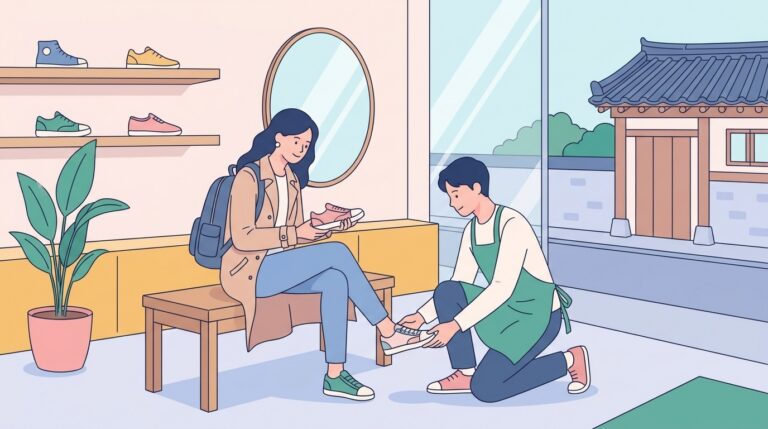
Imagine this: You have just landed in Seoul, ready to explore everything from the winding, cobblestone alleys of Bukchon Hanok Village to the trendy cafe streets of Seongsu-dong. By 3:00 PM, your phone’s step counter proudly flashes 18,500 steps—but your heels are on fire! You spot a sleek boutique showcasing minimalist sneakers and lightweight tote bags. You step inside, eager to trade your stiff shoes for something cloud-soft. But as the friendly clerk approaches with a warm smile, your mind goes completely blank. How do you describe that squishy, cloud-like sole in Korean? How do you ask if this pair will survive a full day of sightseeing without pinching your toes?
You don’t need a heavy grammar dictionary to find your dream walking shoes. Today, we’re unlocking the exact phrase real Koreans use when checking shoe comfort: 쿠션감이 좋아서 오래 걸어도 발이 안 아플 것 같아요 (The cushioning is great, so my feet won’t hurt even after walking long). Curated from real shopping experiences and learner feedback, this A2 guide will give you the confidence to browse, compare colors, and step through Korea with pure comfort.
Phase 2: Core Expressions Deep Dive
1. 쿠션감이 좋아요 (Kusyeongam-i joayo)
- Pronunciation: [Koo-syeon-gam-ee jo-ah-yo] (Think of the English word cushion, followed by gahm like ‘gummy’, and jo-ah-yo).
- Meaning: Literally “The cushion feeling is good.” In natural English: “The cushioning feels amazing!”
- K-Culture Moment: Often heard on lifestyle reality shows like I Live Alone (나 혼자 산다) when celebrities test running shoes or cozy home slippers.
- Editor’s Insight: In Korean, adding 감 (gam, sense/feeling) turns ordinary loanwords into sensory descriptors: 착용감 (chagyonggam, wearing comfort), 그립감 (geuripgam, how an item feels in your hand).
- Situation Spectrum:
- Casual (Friends): 쿠션감 진짜 좋다! (Kusyeongam jinjja jota!) ✅
- Semi-formal (Clerk/Default): 쿠션감이 좋아요. (Kusyeongam-i joayo.) ✅
- Formal (Presentation): 쿠션감이 매우 뛰어납니다. (Kusyeongam-i maeu ttwieonamnida.) ⚠️
- 🤔 Think About It: Why do you think Korean uses the concept of “feeling” (감) to measure shoe quality rather than just saying “It is soft”?
2. 오래 걸어도 발이 안 아플 것 같아요 (Orae georeodo bar-i an apeul geot gat-ayo)
- Pronunciation: [Oh-rae geol-eo-doh bah-ree ahn ah-peul geot gah-tah-yo] (Rhymes closely with long walk-even-if, feet not hurt, seems like).
- Meaning: Literally “Even walking long, feet seem like they won’t hurt.” In natural English: “I think my feet won’t hurt even if I walk for hours.”
- K-Culture Moment: In travel vlogs on Jeju Olle trails, travelers slip on trekking shoes and say this right before embarking on a 15km walk.
- Editor’s Insight: Koreans soften assertions using ~것 같아요 (geot gat-ayo, it seems like). Stating flatly “My feet won’t hurt” sounds overly absolute, while this phrase sounds humble and natural.
- Situation Spectrum:
- Casual: 오래 걸어도 발 안 아플 것 같아. ✅
- Semi-formal: 오래 걸어도 발이 안 아플 것 같아요. ✅
- Formal: 장시간 보행에도 피로감이 적을 것 같습니다. 🚫 (Too stiff for retail!)
- 🤔 Think About It: Notice how polite predictions in Korean gently protect the speaker if the shoes end up blistering later.
3. 다른 색상도 비교해 볼 수 있을까요? (Dareun saeksang-do bigyohae bol su iss-eulkkayo?)
- Pronunciation: [Dah-reun saek-sahng-doh bee-gyo-hae bohl soo ees-seul-kkah-yo?]
- Meaning: “Could I compare other colors as well?”
- K-Culture Moment: In K-Dramas like Crash Landing on You, when a lead character buys a coat or bag and wants to see every shade on the mannequin.
- Editor’s Insight: 색 (saek) is casual everyday talk, whereas 색상 (saeksang) is the polished retail term clerks appreciate.
- Situation Spectrum:
- Casual: 다른 색도 보여줘! ⚠️ (Only to your close friends!)
- Semi-formal: 다른 색상도 비교해 볼 수 있을까요? ✅
- Formal: 다른 색상과 대조해 볼 수 있겠습니까? 🚫 (Sounds like a corporate audit!)
- 🤔 Think About It: In English, we usually ask “Do you have this in blue?” In Korean, asking to “compare” (비교하다) implies you are genuinely considering a thoughtful purchase.
Phase 3: Textbook Korean vs. Real Korean
Situation 1: Expressing that a shoe is super comfortable
- 📖 교과서 한국어: 이 신발은 매우 편안합니다. (I sinbal-eun maeu pyeon-anhamnida. / This shoe is very comfortable.)
- 🗣️ 진짜 진짜 한국어: 와, 착화감이 진짜 대박이에요! (Wa, chakhwagam-i jinjja daebag-ieyo! / Wow, the fit on foot is phenomenal!)
- 💡 왜 다를까?: Textbook Korean leans on formal written adjectives (pyeonanhamnida). Real shoppers and shoe enthusiasts love using 착화감 (chakhwagam, how a shoe feels when worn on feet) paired with upbeat slang like 대박 (daebak).
Situation 2: Asking which color suits you best
- 📖 교과서 한국어: 어떤 색이 저에게 적합합니까? (Eotteon saek-i jeo-ege jeokhaphamnikka? / Which color is suitable for me?)
- 🗣️ 진짜 진짜 한국어: 어떤 색이 저한테 더 잘 어울려요? (Eotteon saek-i jeohante deo jal eoullyeoyo? / Which color looks better on me?)
- 💡 왜 다를까?: “적합하다” sounds like medical screening criteria! Real people use 어울리다 (eoullyeoda, to match/harmonize with one’s vibe or skin tone).
Phase 4: K-Culture Deep Dive & Non-verbal Manners
4-1. Nunchi (눈치) & Body Language at Shoe Stores
- The Shoehorn Courtesy: In Korean stores, clerks will instantly offer a 구두주걱 (gudujugeok, long shoehorn). Always use it! Forcing your heel into a shoe and crushing the heel counter is considered bad store etiquette.
- The Heel Bounce: When checking the cushion, don’t run around the boutique. Take three gentle steps on the display carpet, lightly bounce on your heels twice, and look at the clerk with a slight nod. This non-verbal cue signals: “I am carefully assessing the product.”
- Sock Awareness: If you are wearing sandals, ask the clerk for 덧신 (deotsin, try-on footies) before stepping into display shoes. It shows impeccable manners!
4-2. Cultural Code Analysis: The Seoul Walking Culture
Seoul is a world capital built on steep granite hills. Subway stations often feature deep stairways, and an average day of exploring Hongdae or Ikseon-dong easily reaches 15,000 steps. Because of this, “Gorpcore” (outdoor sneakers paired with daily fashion) and high-cushion platform running shoes are a dominant fashion trend, not just athletic gear. Korean shoppers scrutinize sole bounce because footwear directly determines whether your weekend hangout survives past dinner.
Phase 5: Real-World Roleplay Scenario
- Setting: A boutique sneaker & bag showroom in Seongsu-dong.
- Characters:
- You: Traveler on foot looking for comfortable walking sneakers.
- Staff (Minho): Attentive shop assistant with great styling tips.
Turn 1
* 민호: 손님, 찾으시는 사이즈 있으세요?
(Sonnim, chajeusineun sa-ijeu isseuseyo?)
“Customer, is there a specific size you’re looking for?”
🎭 Hands you the right shoe with two hands, stepping back politely.
Turn 2
* You: 240(이백사십) 사이즈로 신어 볼 수 있을까요?
(Ibaek-sasip sa-ijeuro sineo bol su isseulkkayo?)
“Could I try this on in size 240mm?”
🎭 Points gently toward the cream-colored sneaker on the display stand.
Turn 3
* 민호: 네! 여기 240 사이즈 준비해 드렸습니다. 편하게 신어 보세요.
(Ne! Yeogi ibaek-sasip sa-ijeu junbihae deiryeossseumnida. Pyeonhage sineo boseyo.)
“Yes! Here is size 240 prepared for you. Feel free to try it on comfortably.”
🎭 Places a shoehorn beside you and leaves personal space.
Turn 4
* You: 와, 쿠션감이 좋아서 오래 걸어도 발이 안 아플 것 같아요!
(Wa, kusyeongam-i joaso orae georeodo bar-i an apeul geot gat-ayo!)
“Wow, the cushioning is so great, I don’t think my feet will hurt even after long walks!”
🎭 Gently presses sole on the rug and smiles in pleasant surprise.
Turn 5
* 민호: 맞아요! 밑창에 메모리폼이 들어가 있어서 여행할 때 인기가 정말 많아요.
(Majayo! Mitchang-e memoripom-i deureoga isseoseo yeohaenghal ttae ingiga jeongmal manayo.)
“Exactly! There’s memory foam in the sole, so it’s super popular for traveling.”
🎭 Taps the sole lightly with two fingers to show the material.
Turn 6
* You: 혹시 블랙 색상도 비교해 볼 수 있을까요?
(Hoksi beullaek saeksang-do bigyohae bol su iss-eulkkayo?)
“By any chance, could I compare the black color as well?”
🎭 Tilts head slightly, comparing the sneaker against your outfit.
Turn 7
* 민호: 그럼요! 블랙 색상은 때가 덜 타서 데일리로 신기 아주 좋습니다.
(Geureomyo! Beullaek saeksang-eun ttaega deol taseo deilliro singi aju joseumnida.)
“Of course! The black color doesn’t stain easily, so it’s great for daily wear.”
🎭 Retrieves the black pair and places it right alongside the cream pair.
Turn 8
* You: 둘 다 예쁜데, 블랙 색상으로 할게요!
(Dul da yeppeunde, beullaek saeksang-euro halgeyo!)
“Both are pretty, but I’ll take the black one!”
🎭 Hands your credit card with both hands.
🔀 Interactive Decision Point
The clerk asks: “발볼은 끼이지 않으세요?” (Is the shoe width pinching the sides of your foot?)
- Option A: “괜찮아요! 발볼이 넉넉해서 딱 편해요.” (It’s fine! The toe box is roomy, so it’s perfectly comfortable.)
Feedback: 🌟 Best! Clear, reassuring feedback that lets the clerk know the fit is ideal without awkward sizing adjustments. - Option B: “아니요, 너무 큽니다.” (No, it is too big.)
Feedback: ⚠️ Risk! A bit abrupt. It sounds like you are rejecting the shoe outright rather than asking for a half-size down. - Option C: “그냥 주세요.” (Just give it to me.)
Feedback: 🚫 Bad! Skipping the fit check could mean painful blisters later, and it cuts off a very polite customer service exchange.
Phase 6: 10-Second Emotional Shadowing Drill
Master the natural rhythm and cadence! Listen to the emotion cues before speaking:
[😊 감탄하며 / Delighted & Surprised]
쿠션감이 좋아서 / 오래 걸어도 / 발이 안 아플 것 같아요!
(Kusyeongam-i joaso / orae georeodo / bar-i an apeul geot gat-ayo!)
Rhythm Tip: Put a cheerful lift on ‘좋아서’ (so good!), pause briefly, then drop your pitch naturally at ‘것 같아요’.-
[🤔 진지하게 비교하며 / Thoughtful & Inquiring]
아이보리랑 블랙 중에 / 어떤 색상이 / 더 잘 어울려요?
(Aiborirang beullaek jung-e / eotteon saeksang-i / deo jal eoullyeoyo?)
Rhythm Tip: Emphasize ‘중에’ (between the two) to draw the clerk into your styling dilemma. -
[🤝 정중하게 요청하며 / Polite Request]
이 가방 / 다른 색상도 / 한번 볼 수 있을까요?
(I gabang / dareun saeksang-do / hanbeon bol su iss-eulkkayo?)
Rhythm Tip: Stretch ‘있을까요~’ with a soft rising melody at the end for maximum politeness.
Phase 7: K-Culture Mini Dictionary
- 착화감 (Chakhwagam): Compound of 착화 (wearing shoes) + 감 (feeling). It represents the holistic sensation of how a shoe holds the ankle, supports the arch, and cushions the sole.
- 발볼 (Balbol): The width or ball of the foot. Many Asian shoe models have wider balbol. If a shoe is tight around your pinky toe, say: “발볼이 조금 좁아요” (The width is a bit narrow).
- 실물 (Silmul): Literally “real-life object.” Often used in fashion: “사진보다 실물이 훨씬 예뻐요!” (The item looks way prettier in real life than in photos!).
- 데일리백 (Deillibaek): The daily bag. An effortless, lightweight bag you grab every single day for work, transit, and coffee dates.
Phase 8: Survival Kit for Travelers
Top 3 Survival Phrases
- 한 치수 큰 걸로 신어 볼 수 있나요? (Han chisu keun geollo sineo bol su innayo?)
Meaning: Can I try one size bigger?
Pro Tip: Korean shoe sizing is in millimeters (e.g., US Women 7 = 240mm; US Men 9 = 270mm). Moving up “one size” usually means jumping 5mm (e.g., 240 -> 245). - 이 가방 무게가 진짜 가볍네요! (I gabang mugega jinjja gabyeomneyo!)
Meaning: This bag is seriously lightweight!
Pro Tip: A great icebreaker when buying everyday canvas or nylon shoulder bags in Dongdaemun. - 새 상품으로 있나요? (Sae sangpum-euro innayo?)
Meaning: Do you have this in brand new, boxed condition?
Pro Tip: Display items are tried on by dozens daily. Asking for a sae sangpum ensures a crisp, untouched box.
Editor’s Travel Note
- Navigate Seoul like a Local: Before shoe shopping in Seongsu or Myeongdong, make sure to finish your 네이버 지도 앱 다운로드 to easily check subway station locker locations and elevator exits—saving your legs even before you get new shoes!
- Tax Refund Alert: Look for the “Tax Free” logo at the register. Showing your physical passport allows instant on-site tax refunds (즉시환급) for purchases between 15,000 KRW and 1,000,000 KRW.
Phase 9: “One Step Deeper” (Reflective Question)
In modern Korean fashion philosophy, you will frequently hear the term 꾸안꾸 (kku-an-kku—dressing up as if you didn’t try too hard). Koreans take immense pride in looking sharp and curated, yet the fast-paced subway commute demands functional resilience. Shoes are not merely an accessory; they are a partner in conquering the city’s brisk momentum. When you choose a shoe for its “쿠션감” (cushioning) rather than just its designer logo, you are actively participating in Seoul’s everyday rhythm of sensible elegance.
💬 Your Turn: What matters most to you when traveling: runway aesthetics or cloud-like comfort? Drop your thought below using one Korean word you learned today!
Phase 10: FAQ & Avoiding Misunderstandings
Q: Can I wear shoes into fitting rooms in Korea?
A: Absolutely not! In Korean clothing and bag boutiques, fitting rooms almost always have a raised wooden or carpeted platform. You must slip your shoes off outside the curtain before stepping onto the fitting area.
Q: What if the clerk says a shoe is “품절” (pumjeol)?
A: 품절 means “sold out” (out of stock). If your size is 품절, you can ask: “주문하면 며칠 걸려요?” (How many days does it take if ordered?), or check if another branch nearby has it.
Q: Are shoe sizes in Korea unisex?
A: Most sneakers list unisex millimeter sizes (230, 240, 250, etc.). However, women’s dress shoes and heels usually cap at 250mm, while men’s start from 255mm or 260mm. If you have feet 255mm or above, ask the clerk for unisex lines or dedicated large-size boutiques (빅사이즈 매장).
🚨 Common Mistakes (흔한 실수) Warning Board
- Mistake: Saying “이거 부드러워요” (This is soft) when talking about sole support.
Correct Action: Say “쿠션감이 좋아요” (The cushioning is great). In Korean, budeureopda usually refers to fabric or leather touch, not midsole bounce. - Mistake: Taking off your shoes and walking barefoot across the open store floor.
Correct Action: Stay seated on the fitting bench or test shoes strictly within the designated carpet runner. - Mistake: Forgetting your millimeter shoe size.
Correct Action: Know your exact mm number (e.g., 235mm, 265mm) before asking clerks, as conversion charts vary between brands.
Phase 11: Action Missions
- 🥉 Bronze Level (Solo Practice): Stand in front of your home mirror. Hold your favorite walking shoes and practice saying “쿠션감이 좋아서 오래 걸어도 발이 안 아플 것 같아요!” 3 times out loud with genuine facial expression.
- 🥈 Silver Level (Social Share): Snap a photo of your go-to travel bag or shoes. Post an Instagram story with the caption: “내 최애 데일리 신발! 착화감 최고 👍” and tag a friend who loves Korea.
- 🥇 Gold Level (Real-world Challenge): Visit an ABC-Mart, Nike, or local boutique in Korea (or an online Korean shopping store) and request a color or size comparison using: “다른 색상도 비교해 볼 수 있을까요?”
🎮 K-Culture Mission: Watch any Korean travel variety show (like Earth Arcade or Europe Outside Your Tent). Spot when the cast members complain about foot fatigue or praise their sneakers, and see if you can hear the word 편하다 (pyeonhada) or 신발 (sinbal)!
Phase 12: Interactive Quiz Challenge
Question 1: Scenario Judgment
You are testing a walking shoe at a store in Myeongdong. It feels incredibly soft under your heel, and you want to tell the clerk you think it will prevent foot pain during your vacation. Which sentence is the most natural A2 Korean?
– (A) 이 신발은 사망할 것 같아요.
– (B) 쿠션감이 좋아서 오래 걸어도 발이 안 아플 것 같아요.
– (C) 신발이 너무 빨라서 발이 아파요.
Question 2: Fill-in-the-Blank
Complete the sentence to politely ask to see another bag color:
“이 가방 다른 _______도 비교해 볼 수 있을까요?”
(Hint: The formal noun for ‘color shade’ used in retail!)
Question 3: True or False (Culture)
In Korean shoe stores, you should crush the heel counter of the display shoe with your bare foot to see how flexible the leather is.
– [True / False]
👉 Click to reveal answers & explanations!
- Answer 1: (B)! (A means “I think these shoes will die,” and C means “The shoes are too fast so my feet hurt.”)
- Answer 2: 색상 (saeksang)! (While 색 is okay, 색상 sounds polished and natural in retail settings).
- Answer 3: False! Crushing the heel counter ruins the structural integrity of the shoe. Always use the provided shoehorn (구두주걱)!







