

Never Miss Your Stop Again: How to Give Pinpoint Taxi Directions in Korean
Phase 1: Empathy (Storytelling Opening)
안녕하세요! 매일한글 에디터입니다. (Hello! It’s your Daily Hangul editor!)
Picture this: You have spent an incredible evening walking through the buzzing streets of Mapo, hunting down sizzling tteokbokki and crispy Korean fried chicken. By 10:30 PM, your feet feel like heavy bricks. Blissfully relieved, you hail a sleek Seoul taxi. You slide into the plush seat, give the general neighborhood to the driver (gisa-nim), and relax as the city neon glides by.
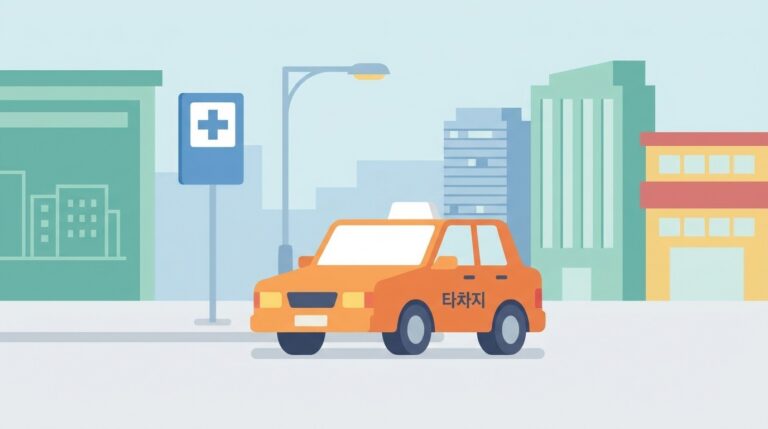
Then, panic strikes. Up ahead, you recognize the turn into your quiet Airbnb alley. You see the exact spot where you want to hop out: that bright blue pharmacy sign! Your heart starts racing. You want to tell the driver to pull over right there, but your mind goes blank. In pure desperation, you freeze, wave your hands, and stutter: “Stop! 저기… (jeogi…) Stop please?!”
The driver, confused by the sudden alert in moving traffic, misses the turn entirely and enters an 8-lane elevated overpass. Suddenly, your cozy 5-minute trip becomes a 20-minute detour around the Han River! Based on real stories from hundreds of our A2 learners, communicating micro-adjustments and pinpoint stopping locations inside a moving Korean taxi is one of the top high-anxiety travel moments. Today, we are turning that stress into pure confidence with one foolproof formula!
Phase 2: 3 Core Key Expressions
1. 저기 보이는 파란색 간판 약국 앞에서 세워 주세요 (Jeogi boineun paransaek ganpan yakguk ap-eseo sewo juseyo)
- Pronunciation: Jeo-gi bo-ee-neun pa-ran-saek gan-pan yak-guk ap-eh-seo seh-wo joo-seh-yo (Think of it like: Juggy boy-neun pah-rahn-sack gahn-pahn yahk-gook ahp-eh-soh say-woh joo-say-yoh)
- Meaning: Literal: “Please stop in front of the pharmacy with the blue sign visible over there.” / Real Nuance: A calm, crystal-clear, and super polite landmark instruction that drivers instantly understand.
- K-Culture Moment: In classic K-dramas, whenever the lead character wants to conceal their secret rooftop apartment (oktapbang), they quickly point out a nearby landmark and say this exact line to hop out early.
- Editor’s Insight: Treat this sentence like building blocks: 저기 보이는 [Landmark] 앞에서 [세워 주세요]. Once you know this structure, swap in any landmark you see!
- Situation Spectrum: Casual 🚫 / Semi-formal (Polite 해요 style) ✅ / Formal (하십시오) ⚠️
- 🤔 Think About It: Why do you think Korean drivers prefer physical visual descriptions (like colors and signs) over GPS street numbers?
2 여기서 내려 주셔도 돼요 (Yeogiseo naeryeo jusyeodo dwaeyo)
- Pronunciation: Yeo-gi-seo nae-ryeo joo-syeo-do dwae-yo (Sounds like: Yuh-gee-soh neh-ryuh joo-shuh-doh dweh-yo)
- Meaning: Literal: “It is okay even if you let me down here.” / Real Nuance: “Right here is totally fine! Don’t worry about trying to squeeze all the way into the alley.”
- K-Culture Moment: Used frequently when a taxi reaches a narrow historic alleyway in Ikseon-dong or Bukchon Hanok Village where driving further is a headache for the driver.
- Editor’s Insight: The grammar
-도 돼요(-do dwaeyo) expresses polite permission and empathy (baeryeo). Taxi drivers genuinely appreciate this considerate attitude. - Situation Spectrum: Casual 🚫 / Semi-formal ✅ / Formal ⚠️
- 🤔 Think About It: In your culture, is it normal to tell a taxi driver to stop early to save them trouble, or do people expect to be dropped off at the exact door?
3. 저기 골목 안쪽으로 들어가 주세요 (Jeogi golmok anjjog-euro deureoga juseyo)
- Pronunciation: Jeo-gi gol-mok an-jjog-eu-ro deu-reo-ga joo-seh-yo (Sounds like: Juggy goal-mohk ahn-jjoak-oo-roh dew-ruh-gah joo-say-yoh)
- Meaning: Literal: “Please enter into the inside of that alley over there.” / Real Nuance: “Could you drive a little further into that alley ahead, please?”
- K-Culture Moment: Often seen in thriller or slice-of-life dramas when coming home late at night and needing safe drop-off right by the residential doorstep.
- Editor’s Insight: The directional particle
-으로(-euro) combined with안쪽(inside area) smoothly guides the driver’s steering wheel without sounding bossy. - Situation Spectrum: Casual 🚫 / Semi-formal ✅ / Formal ⚠️
- 🤔 Think About It: Notice how polite Korean softens commands by turning them into requests with
-아/어 주세요(-a/eo juseyo).
Phase 3: Textbook Korean vs. Real Korean
Situation 1: Telling the driver to stop right here
- 📖 교과서 한국어: “이곳에서 멈춰 주십시오.” (Igosedo meomchwo jusipsio. / Stop at this location.)
- 🗣️ 진짜 한국어: “여기서 내려 주세요!” (Yeogiseo naeryeo juseyo! / Please drop me off here!) or “여기서 세워 주세요.” (Yeogiseo sewo juseyo!)
- 💡 왜 다를까?: The verb 멈추다 (to stop) sounds like an emergency brake command for machines. Real native speakers naturally use 내리다 (to disembark) or 세우다 (to pull over a car).
Situation 2: Stopping in front of a store
- 📖 교과서 한국어: “저 건물의 전방에서 정차 바랍니다.” (Jeo geonmul-ui jeonbang-eseo jeongcha baramnida. / Disembarkation at the fore of that building is desired.)
- 🗣️ 진짜 한국어: “저기 편의점 앞에서 세워 주세요!” (Jeogi pyeon-ui-jeom ap-eseo sewo juseyo! / Please stop in front of the convenience store over there!)
- 💡 왜 다를까?: 정차 (stationary stop) is legal traffic jargon found in driving test manuals! Everyday commuters specify familiar spots like convenience stores (pyeon-ui-jeom) or cafes.
Phase 4: K-Culture Deep Dive & Non-Verbal Manners
4-1. 눈치 (Nunchi) & Gestures
- Eye Contact via the Rearview Mirror: In Korean taxis, looking directly into the rearview mirror (room mirror) when speaking creates instant communication without distracting the driver.
- The Gentle Open-Palm Direction: Never point your index finger sharply at the windshield or close to the driver’s face—it can feel confrontational. Instead, keep your hand low between the front seats and gesture forward gently with an open palm.
- Two-Hand Card Courtesy: When handing over your payment card or T-money transit card at the end, hold it lightly with both hands (yangson). It is an effortless sign of high respect that taxi drivers adore.
4-2. Cultural Code: The Visual Landmark Culture
Although South Korea upgraded to a road-name address system in 2014, urban navigation is still dominated by visual landmarks. Because Korean neighborhoods are packed with commercial shopfronts, drivers rely on prominent brand signboards—such as Olive Young, Paris Baguette, major banks, or brightly lit green and blue pharmacy (yakguk) signs. Mentioning the color of the signboard (ganpan) is the quickest shortcut to being understood.
Phase 5: Real-World Roleplay Scenario
- Location: A rainy evening in Sinchon, Seoul.
- Characters: Sarah (A2 Korean learner heading to her guesthouse) & Driver Kim (Friendly veteran taxi driver with 25 years of Seoul driving experience).
- Sarah: 기사님, 저기 앞에 신호등에서 우회전해 주세요. (Gisa-nim, jeogi ape sinhodeung-eseo uhoejeonhae juseyo. / Driver, please take a right turn at that traffic light ahead.) 🎭 [Gestures gently forward toward the intersection with an open hand]
- Driver Kim: 네, 신호등 우회전이요. 골목 안까지 들어갈까요? (Ne, sinhodeung uhoejeon-iyo. Golmok ankaji deureogalkkayo? / Got it, right turn at the lights. Shall I drive into the alleyway?) 🎭 [Flicks the turn signal with a nod]
- Sarah: 아뇨, 골목이 너무 좁아서요. (Anyo, golmogi neomu job-aseoyo. / No, because the alley is too narrow.) 🎭 [Smiles warmly to ease the driver’s burden]
- Driver Kim: 그래요? 그럼 어디쯤에서 내려 드릴까? (Geuraeyo? Geureom eodijjeum-eseo naeryeo deurilkka? / Is that so? Then around where shall I let you off?) 🎭 [Slows down car speed along the curb]
- Sarah: 저기 보이는 파란색 간판 약국 앞에서 세워 주세요. (Jeogi boineun paransaek ganpan yakguk ap-eseo sewo juseyo. / Please pull over in front of the pharmacy with the blue sign over there.) 🎭 [Points toward the blue illuminated sign on the right]
- Driver Kim: 아, 저 약국 앞! 알겠습니다. 비 오니까 입구 바로 앞에 붙여 드릴게. (A, jeo yakguk ap! Algetseumnida. Bi onikka ipgu baro ape buchyeo deurilge. / Ah, in front of that pharmacy! Got it. It is raining, so I will pull up right next to the entrance.) 🎭 [Smoothly steers up to the curb]
- Sarah: 와, 감사합니다! 카드로 계산할게요. (Wa, gamsahamnida! Kadeu-ro gyesanhalgeyo. / Wow, thank you so much! I will pay by card.) 🎭 [Presents transit card using both hands]
- Driver Kim: 빗길 조심해서 들어가요! 안녕히 가세요. (Bitgil josimhaeseo deureogayo! Annyeonghi gaseyo. / Watch your step in the rain! Take care and goodbye.) 🎭 [Hands receipt back with a warm smile]
🔀 Interactive Branching Point
The driver is about to zoom past your guesthouse alley. What do you say?
* Option A: “야! 지금 멈춰!” (Ya! Jigeum meomchwo!)
* Feedback: [Risk 🚨] Extremely disrespectful! ‘야’ (Ya!) is informal slang for “Hey you!”, and using 반말 (informal speech) with an elder can cause an argument.
* Option B: “기사님, 죄송한데 저기 골목 앞에서 바로 내려 주세요!” (Gisa-nim, joesonghande jeogi golmok ap-eseo baro naeryeo juseyo!)
* Feedback: [Best 🌟] Super polite, fast, and gives a clear reference point without causing panic!
* Option C: “여기는 어디입니까? 저를 내려 주십시오.” (Yeogineun eodi-imnikka? Jeoreul naeryeo jusipsio.)
* Feedback: [Bad ⚠️] Sounds robotic and textbook-stiff. The driver might hesitate while trying to decode your formal phrasing.
Phase 6: 10-Second Emotion Shadowing Drill
-
- [🙋♂️ 다급하지만 정중하게 / Alert yet respectful]:
기사님! / 저기 파란색 간판 / 보이시죠?
(Gisa-nim! / Jeogi paransaek ganpan / boisijyo? / Driver! / That blue signboard over there / you see it, right?)
- [🙋♂️ 다급하지만 정중하게 / Alert yet respectful]:
-
- [😊 명확하고 자신감 있게 / Clear and confident]:
저 약국 바로 앞에서 / 세워 주세요.
(Jeo yakguk baro ap-eseo / sewo juseyo. / Right in front of that pharmacy / please pull over.)
- [😊 명확하고 자신감 있게 / Clear and confident]:
-
- [💖 따뜻하고 배려 깊게 / Warm and considerate]:
여기서 내려 주셔도 돼요. / 감사합니다!
(Yeogiseo naeryeo jusyeodo dwaeyo. / Gamsahamnida! / Dropping me off here is totally fine. / Thank you!)
- [💖 따뜻하고 배려 깊게 / Warm and considerate]:
Phase 7: K-Culture Mini Dictionary
- 간판 (Ganpan) | Signboard / Store sign | Essential urban navigation vocabulary. Because Seoul’s multistory commercial buildings feature dozens of businesses, identifying shop signboards is key.
- 기사님 (Gisa-nim) | Driver / Chauffeur (Honorific title) | Formed by 기사 (driver/technician) + 님 (revered suffix). Never call taxi drivers 아저씨 (ajusshi); using 기사님 sets an instantly respectful mood.
- 세워 주다 (Sewo juda) | To pull over / Stop a vehicle | A compound verb combining 세우다 (to stop/park) and
-어 주다(to do as a courtesy). Essential for any taxi interaction. - 골목 (Golmok) | Alleyway / Residential side street | Historic pathways woven between major boulevards where local Korean eateries, cafes, and residential guesthouses are tucked away.
Phase 8: Traveler’s Survival Kit
Survival Expressions TOP 3
- 여기서 내려 주세요 (Yeogiseo naeryeo juseyo) – Please let me off here. (Pro Tip: Say this roughly 30 meters ahead of time so the driver has time to merge safely!)
- 트렁크 좀 열어 주세요 (Teureongkeu jom yeoreo juseyo) – Please open the trunk. (Pro Tip: Say this as you reach your destination if you have heavy luggage.)
- 카드로 결제할게요 (Kadeu-ro gyesanhalgeyo) – I will pay by card. (Pro Tip: Nearly 100% of Korean taxis accept credit cards and T-money cards!)
Editor’s Travel Note
- Install the Kakao T taxi hailing app guide before departing for seamless automated address inputs.
- Check your live GPS location using the Naver Map English navigation tutorial to anticipate your drop-off street.
- Always have your payment card ready in your fingers before arriving to ensure a fast, seamless disembarkation.
Phase 9: “One Step Deeper” (Reflective Essay)
In many Western cities, navigation centers on house numbers and street names. In South Korea, daily life is organized around vibrant communal storefronts. Because shop names change and neon signs shine bright 24/7, pinpointing a destination through landmarks like a 24-hour convenience store, a bakery, or a blue pharmacy sign is an organic social custom. Navigating a taxi ride in Korea is not just a commercial transaction; it is a collaborative teamwork exercise between you and your gisa-nim.
💬 Your Turn: What is the most memorable landmark near your home or accommodation in Korea? Share in the comments below!
Phase 10: FAQ & Common Mistakes
Q: Can I just point to the GPS map on my smartphone and show it to the driver?
A: While drivers will look if needed, trying to read a small phone screen while steering in high-speed Seoul traffic is stressful and unsafe. Giving a clear verbal cue like “저기 약국 앞이요!” (In front of that pharmacy over there!) is much safer and deeply appreciated.
Q: What is the difference between “세워 주세요” and “내려 주세요”?
A: 세워 주세요 (sewo juseyo) literally translates to “Please halt the car,” focusing on the vehicle pulling over. 내려 주세요 (naeryeo juseyo) means “Please let me alight,” focusing on your disembarkation. Both are completely interchangeable and natural in a taxi!
Q: Is it considered rude to pay with a card for very short rides in Korea?
A: Not at all! In Korea, card payments (including contactless and T-money) are standard even for the basic base fare (around 4,800 won in Seoul). Drivers will never complain about card payments.
🚨 Common Mistakes TOP 3
- Mistake: Shouting “스톱!” (Stop!) right as you pass the building.
- Correct Action: Give a heads-up 20–30 meters early with: “저기 앞에서 세워 주세요” (Please pull over up ahead).
- Mistake: Calling the driver “아저씨!” (Ajusshi).
- Correct Action: Always use the polite professional title: “기사님!” (Gisa-nim).
- Mistake: Reaching out toward the driver’s steering wheel or dashboard GPS.
- Correct Action: Keep your hands comfortably in your lap and use spoken landmark descriptions.
Phase 11: Action Missions
- 🥉 Bronze Mission (Solo Practice): Read the core sentence aloud 5 times in your room until it rolls off your tongue: “저기 보이는 파란색 간판 약국 앞에서 세워 주세요!”
- 🥈 Silver Mission (Social Share): Snap a photo of a unique shop sign in your area and share it with the caption: “#DailyHangul 저기 보이는 [색깔] 간판 앞에서 세워 주세요!”
- 🥇 Gold Mission (Real-World Test): On your next taxi ride in Korea (or during a 1-on-1 Korean conversation session), guide the speaker using at least one visual landmark phrase.
- 🎮 K-Culture Mission: Watch an episode of a modern K-drama (like Hospital Playlist or Business Proposal) and spot whether passengers address the driver as 기사님 (gisa-nim).
Phase 12: Interactive Quiz Challenge
1. Situation Judgment
You are 40 meters away from your hotel, which sits right beside an Olive Young with an olive-green logo. What is the most natural thing to say?
* (A) 저기 올리브영 앞에서 멈춰라!
* (B) 저기 보이는 올리브영 앞에서 세워 주세요.
* (C) 여기서 급정지하십시오.
2. Fill-in-the-Blank
기사님, 저기 파란색 ( ) 약국 앞에서 세워 주세요. (Hint: The Korean noun for a store signboard!)
3. True / False Cultural Quiz
T / F: In Korea, addressing your taxi driver as “기사님” (Gisa-nim) is considered polite and respectful.
Click to reveal answers & explanations
- Answer: (B) – 저기 보이는 올리브영 앞에서 세워 주세요. is polite, natural, and clear. (A) uses rude informal language (반말), and (C) uses stiff military-like wording for an emergency stop.
- Answer: 간판 (ganpan) – Meaning signboard. 파란색 간판 = blue signboard.
- Answer: True (T) – 기사님 (Gisa-nim) is the golden standard honorific for drivers in South Korea!







