

How to Write a Heartfelt Korean Thank-You Letter to Your Teacher
Phase 1: Empathy & Story Opening
안녕하세요! 매일한글 에디터입니다. (Annyeonghaseyo! I’m the Daily Hangul editor.)
Picture this: You are sitting at a quiet corner table in a cozy café near Sinchon, staring blankly at a delicate piece of floral stationery you bought from Artbox. The completion ceremony (수료식 – Suryosik) of your Korean language institute (어학당 – Eohakdang) is tomorrow afternoon. Your teacher, who patiently sounded out difficult vowels with you, handed you warm yuzu tea when you barely passed Level 2, and celebrated every tiny milestone, deserves the world. You pick up your pen, write “선생님, 안녕하세요 (Seonsaengnim, annyeonghaseyo)”… and then freeze.
Suddenly, the anxiety kicks in. If you write “감사합니다 (Gamsahamnida),” it sounds cold and robotic—like an automated invoice receipt! But if you try to express real warmth, you worry about accidentally dropping honorifics or using slang you overheard in a K-drama that sounds downright disrespectful to an elder. How do you strike that magical Korean balance between deep, reverent respect and genuine, tear-jerking warmth? Based on real letter-writing workshops and feedback from hundreds of graduating international students, this guide will walk you through crafting a handwritten letter that your mentor will treasure forever.
Phase 2: 3 Core Expressions Deep-Dive
1. 따뜻하게 이끌어 주셔서 진심으로 감사드립니다 (Ttatteuthage ikkeureo jusyeoseo jinsimeuro gamsadeurimnida)
- Pronunciation: [tah-tteut-ha-geh eek-keul-eo joo-syeo-seo jin-shim-eu-roh gahm-sah-deu-reem-nee-dah] (Sounds like tah-teut with a soft puff of air, followed by eek-keul like pulling someone gently by the sleeve).
- Meaning: Literal: “Thank you sincerely for guiding me warmly.” / Actual Nuance: “Thank you from the bottom of my heart for nurturing and looking after me with such patient care.”
- K-Culture Moment: You hear this line in heartwarming mentor-student reunion scenes in dramas like Crash Course in Romance or Black Dog: Being a Teacher when a student reflects on the teacher who changed their life trajectory.
- Editor’s Insight: The verb 이끌다 (ikkeulda) literally means “to lead” or “guide.” Combining it with the auxiliary honorific verb 주시다 (jusida – to give/do for someone) transforms the dynamic from a simple instructor lecturing at you to a mentor walking beside you, holding your hand through the stormy parts of your Korean learning journey.
- Situation Spectrum: Casual 🚫 | Semi-formal ⚠️ | Formal ✅ (Perfect for letters, graduation speeches, and cards)
- 🤔 Think About It: In English, we often say “Thanks for being a great teacher!” How does the Korean image of being “warmly guided” (따뜻하게 이끌다) highlight the emotional responsibility teachers hold in Korean culture?
2. 선생님 덕분에 한국어에 자신감이 생겼어요 (Seonsaengnim deokbune hangugeoe jasingami saenggyeosseoyo)
- Pronunciation: [seon-saeng-neem deok-boo-neh hahn-goog-uh-eh jah-sheen-gahm-ee saeng-gyuh-ssuh-yoh] (Deokbune sounds like “duck-boo-neh” with a clean, snappy rhythm).
- Meaning: Literal: “Thanks to teacher, confidence emerged in my Korean.” / Actual Nuance: “Because of your belief in me, I finally found my confidence speaking Korean.”
- K-Culture Moment: Seen in variety shows when an idol tearfully thanks their vocal or dance trainer during an award acceptance speech.
- Editor’s Insight: The phrase 덕분에 (deokbune) is one of the most beautiful relational tools in Korean. While “때문에 (ttaemune)” means a neutral or negative “because of,” “덕분에” implies that positive grace and fortune were bestowed upon you through someone else’s generosity. It attributes your success entirely to their kindness.
- Situation Spectrum: Casual 🚫 | Semi-formal ✅ | Formal ✅
- 🤔 Think About It: Contrast “I became good at Korean” with “Thanks to you, I gained confidence.” Why does Korean culture place such heavy rhetorical value on crediting others for personal growth?
3. 늘 건강하시고 행복하세요 (Neul geonganghasigo haengbokhaseyo)
- Pronunciation: [neul geon-gahng-hah-she-goh haeng-bok-hah-seh-yoh] (Neul rhymes with the English vowel in “hook,” said with relaxed lips).
- Meaning: Literal: “Always be healthy and happy.” / Actual Nuance: “Wishing you continued health, peace, and everyday happiness.”
- K-Culture Moment: Standard, heartfelt closing greeting used in Korean handwritten letters (손편지 – Sonpyeonji) across all Korean holidays (Chuseok, New Year’s, and Teacher’s Day).
- Editor’s Insight: In Korean letter etiquette, ending without an explicit wish for the recipient’s physical wellness and peace feels abrupt. It serves the emotional role that “Warmest regards” attempts in English, but connects directly to bodily well-being.
- Situation Spectrum: Casual ⚠️ | Semi-formal ✅ | Formal ✅
- 🤔 Think About It: Why is asking about or wishing for someone’s health (건강 – Geongang) considered the ultimate demonstration of politeness and emotional care (정 – Jeong) in Korea?
Phase 3: Textbook Korean vs Real-Life Korean
Situation 1: Opening the Letter
- 📖 교과서 한국어 (Textbook Korean): 김선생님께, 그동안 안녕하셨습니까? (Gim seonsaengnimkke, geudongan annyeonghasyeosseumnikka? – “To Teacher Kim, have you been in peace all this while?”)
- 🗣️ 진짜 한국어 (Real Korean): 존경하는 김선생님께, 안녕하세요! (Jongyeonghaneun Gim seonsaengnimkke, annyeonghaseyo! – “To the respected Teacher Kim, hello!”)
- 💡 왜 다를까? (Why the difference?): While “안녕하셨습니까?” is grammatically correct, using it in a personal handwritten letter sounds like an official military report or a formal 19th-century declaration. Pairing “존경하는 (respected/admired)” with a bright “안녕하세요!” creates instant warmth while preserving peak respect.
Situation 2: The Final Sign-off
- 📖 교과서 한국어 (Textbook Korean): 안녕히 계십시오. 2024년 8월 20일 제자 올림. (Annyeonghi gyesipsio. 2024-nyeon 8-wol 20-il jeja ollim. – “Stay in peace. August 20, 2024. Your pupil raises this.”)
- 🗣️ 진짜 한국어 (Real Korean): 날씨가 많이 더운데 감기 조심하시고 늘 행복하세요! 선생님의 영원한 학생 알렉스 올림/드림. (Nalssiga mani deounde gamgi josimhasigo neul haengbokhaseyo! Seonsaengnim-ui yeong-wonhan haksaeng Alex ollim/deurim. – “It’s very hot these days, so please be careful not to catch a cold and stay happy! From your forever-student, Alex.”)
- 💡 왜 다를까? (Why the difference?): Real Korean letters wrap up by commenting on the current season or weather (날씨), demonstrating ongoing thoughtfulness. Using “영원한 학생 (forever-student)” conveys deep personal loyalty, melting any teacher’s heart.
Phase 4: K-Culture Deep Dive & Non-verbal Manners
4-1. 눈치 (Nunchi) & Body Language
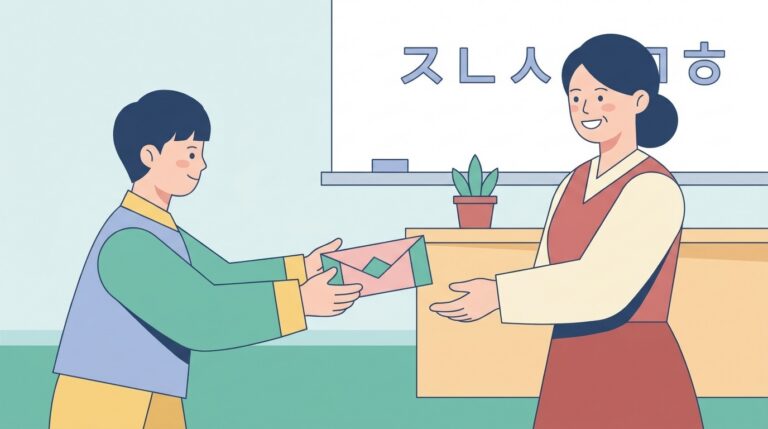
- The Two-Handed Handover (두 손으로 드리기): When you hand your letter (and perhaps a modest gift or bouquet) to your teacher, never use one hand. Hold the envelope with both hands, thumbs positioned gently along the upper edges. Lower your head and torso in a polite 30-degree bow (정중한 목례).
- Gaze & Reaction Timing: After receiving the letter, teachers often place it against their chest and say “어머, 이게 뭐예요? (Oh my, what is this?)” Do not stare directly into their eyes waiting for them to read it right away. Lower your gaze modestly with a shy smile. In Korean etiquette, reading personal letters in private is standard to avoid displaying overwhelming emotion in public.
4-2. Cultural Code Analysis: 스승의 은혜 (The Grace of the Teacher)
In Korea, teachers hold a uniquely sacred role historically summed up by the traditional proverb: 스승의 그림자도 밟지 않는다 (“You do not even step on your teacher’s shadow”). While modern classrooms are significantly more relaxed and collaborative, the concept of 사제지간 (Sajejigan – the sacred bond between master and student) remains powerful.
At a language institute (어학당), teachers become pseudo-parents to foreigners navigating visa crises, loneliness, and housing troubles. Writing a handwritten letter (손편지) is seen as the highest form of respect because it symbolizes your time and effort (정성 – Jeongseong). A KakaoTalk message takes three seconds; finding stationery, writing in unfamiliar Korean handwriting, and erasing pencil guidelines shows that you value them deeply.
Phase 5: Real-Life Roleplay Scenario
Setting: An empty classroom at Yonsei University Korean Language Institute right after the Level 4 completion ceremony. Empty plastic cups, colorful graduation caps, and flower wrapping paper remain on the desks.
Character: 김민지 선생님 (Teacher Min-ji Kim), tucking a stray hair behind her ear, holding an attendance sheet, smiling warmly with slightly teary eyes.
- 김민지 선생님: 알렉스 씨, 오늘 수료식 멋졌어요. 벌써 4급을 끝내다니 시간 참 빠르네요. (Alex-ssi, oneul suryosik meotjyeosseoyo. Beolsseoe sa-geubeul kkeutnaedani sigan cham ppareuneyo. – “Alex, the completion ceremony was wonderful today. Time really flies—I can’t believe you already finished Level 4.”)
- 🎭 행동 지문: Alex takes a deep breath, reaches into his bag, and pulls out an envelope decorated with dried pressed flowers.
- 알렉스: 선생님, 바쁘신데 잠깐 시간 괜찮으세요? 드릴 말씀이 있어서요. (Seonsaengnim, bappeusinde jamkkan sigan gwaenchaneuseyo? Deuril malsseumi isseoseoyo. – “Teacher, do you have a quick moment even though you’re busy? There is something I’d like to tell you.”)
- 김민지 선생님: 그럼요! 무슨 일 있어요? 한국에 더 있는 거죠? (Geureomyo! Museun il isseoyo? Hanguge deo inneun geojyo? – “Of course! What’s going on? You’re staying longer in Korea, right?”)
- 🎭 행동 지문: Alex holds out the handwritten letter with both hands, bowing his head slightly.
- 알렉스: 지난 6개월 동안 부족한 저를 따뜻하게 이끌어 주셔서 진심으로 감사드립니다. 작은 손편지예요. (Jinan yuk-gae-wol dongan bujokhan jeoreul ttatteuthage ikkeureo jusyeoseo jinsimeuro gamsadeurimnida. Jageun sonpyeonji-yeyo. – “Thank you from the bottom of my heart for guiding an imperfect student like me so warmly over the last six months. It’s a small handwritten letter.”)
- 김민지 선생님: 어머나, 손편지요? 세상에… 알렉스 씨 글씨 진짜 많이 늘었네요! 눈물 날 것 같아요. (Eomeona, sonpyeonjiyo? Sesange… Alex-ssi geulssi jinjja mani neureonneyo! Nunmul nal geot gatayo. – “Oh my goodness, a handwritten letter? Wow… Alex, your handwriting has improved so much! I think I might cry.”)
- 알렉스: 선생님 덕분에 말하기 시험도 무사히 통과했고, 한국 생활이 정말 행복했어요. (Seonsaengnim deokbune malhagi siheomdo musahi tonggwahaetgo, hanguk saenghwari jeongmal haengbokhaesseoyo. – “Thanks to you, Teacher, I passed the speaking test safely and my life in Korea was truly happy.”)
- 김민지 선생님: 제가 한 건 별로 없어요. 알렉스 씨가 매일 단어 외우고 노력한 덕분이죠. 편지 소중하게 읽을게요. (Jega han geon byeollo eopseoyo. Alex-ssiga maeil daneo oe-ugo noryeokhan deokbunijyo. Pyeonji sojunghage ilgeulgeyo. – “I didn’t do much. It’s all because you memorized vocab words every day and put in the effort. I’ll read this letter carefully.”)
- 알렉스: 네, 선생님! 늘 건강하시고 다음 학기에도 파이팅하세요! (Ne, seonsaengnim! Neul geonganghasigo da-eum hakgiedo paitinghaseyo! – “Yes, Teacher! Please stay healthy always and fighting for next semester as well!”)
🔀 Interactive Decision Point
How would you conclude your conversation before walking out the classroom door?
* Choice A: “선생님, 그동안 진심으로 감사했습니다. 다음에 또 찾아뵐게요!” (Seonsaengnim, geudongan jinsimeuro gamsahaesseumnida. Da-eume tto chajabwoelgeyo!)
👉 Feedback [BEST]: Superb! Using “찾아뵙다 (chajaboepda)” shows top-tier B1 honorific control (humble form of visiting an elder). Teacher Kim will be bragging about you in the teachers’ lounge.
* Choice B: “선생님 진짜 짱이에요! 나중에 카톡할게 안녕!” (Seonsaengnim jinjja jjang-ieyo! Najunge katokhalke annyeong!)
👉 Feedback [BAD]: Danger zone! Dropping down to 반말 (casual speech) like “카톡할게 안녕” destroys the respectful ambiance in an instant, no matter how close you felt during class.
* Choice C: “선생님, 그동안 수고하셨습니다. 잘 가세요!” (Seonsaengnim, geudongan sugohasyeosseumnida. Jal gaseyo!)
👉 Feedback [RISK]: Major cultural faux pas! Saying “수고하셨습니다 (You worked hard)” or “잘 가세요 (Go well)” to a social elder or teacher sounds condescending. Use “감사했습니다 (Thank you)” and “안녕히 계세요 (Stay in peace)” instead.
Phase 6: 10-Second Emotional Shadowing Drill
Read aloud along the slash markers / paying attention to intonation pauses:
[🥺 감동을 담아 진심 어린 목소리로 / Moved & Heartfelt]
선생님, / 부족한 저를 / 따뜻하게 이끌어 주셔서 / 진심으로 감사드립니다.
(Seonsaengnim, / bujokhan jeoreul / ttatteuthage ikkeureo jusyeoseo / jinsimeuro gamsadeurimnida.)-
[😊 환한 미소와 뿌듯함을 담아서 / Bright Smile & Grateful Pride]
선생님 덕분에 / 한국어 말하기가 / 정말 재미있어졌어요!
(Seonsaengnim deokbune / hangugeo malhagiga / jeongmal jaemi-isseojyeosseoyo!) -
[🙇♂️ 정중하고 다정한 배려의 톤 / Polite, Warm & Caring Tone]
날씨가 쌀쌀한데 / 늘 건강하시고 / 항상 행복하세요.
(Nalssiga ssalssalhande / neul geonganghasigo / hangsang haengbokhaseyo.)
Phase 7: K-Culture Mini Dictionary
-
은사님 (Eunsanim)
Meaning: Gracious Teacher / Respected Mentor
Usage: A high-honorific term combining 은혜 (grace) and 스승 (teacher). Used when referring to a teacher who significantly shaped your character or life values, especially after graduating. -
수료식 (Suryosik)
Meaning: Program Completion Ceremony
Usage: Unlike an official degree graduation (졸업식 – Joreopsik), university language programs hold “수료식” at the end of each 10-week quarter. It is a major emotional checkpoint where students exchange handwritten cards and flowers. -
손편지 (Sonpyeonji)
Meaning: Handwritten Letter
Usage: In a hyper-digitalized society powered by KakaoTalk, writing a physical “손편지” carries immense sentimental currency. It is the ultimate expression of sincerity (진심) in Korean romance, family celebrations, and student-teacher farewells. -
보람 (Boram)
Meaning: Sense of worthwhile reward / fruitful fulfillment
Usage: Teachers frequently say, “학생들이 편지를 줄 때 가장 보람을 느껴요 (I feel the most worthwhile reward when students give me letters).” It defines the warm pride experienced when your hard work bears meaningful fruit for others.
Phase 8: Traveler & Expat Survival Kit
Top 3 Survival Phrases
- 편지봉투 어디에 있어요? (Pyeonjibongtu eodie isseoyo?)
Meaning: Where are the letter envelopes?
Pro Tip: Use this at stationery stores if letter sheets and envelopes are sold on separate racks. - 선생님께 드릴 작은 선물 추천해 주실 수 있나요? (Seonsaengnimkke deuril jageun seonmul chucheonhae jusil su innayo?)
Meaning: Could you recommend a small gift suitable for a teacher?
Pro Tip: Helpful at department stores or tea shops like Osulloc. - 예쁘게 포장해 주실 수 있을까요? (Yeoppeuge pojanghae jusil su isseulkkayo?)
Meaning: Could you wrap this nicely for me?
Pro Tip: Korean gift wrapping is an art form. Most gift counters offer complimentary wrapping if you ask politely.
Editor’s Travel Note: Stationery Hunting in Seoul
Don’t buy generic white office envelopes! Head directly to a stationary boutique to find aesthetic patterned paper. Browse the stationery section at 교보문고 핫트랙스 오프라인 매장 안내 at Gwanghwamun, or visit an Artbox near your campus. When choosing pens, pick a smudge-free 0.38mm or 0.5mm gel pen (like the Monami Olika or Signo) so your written Hangul looks crisp and legible.
Phase 9: “One Step Deeper” (Reflective Question)
In Western communication, when people celebrate achieving intermediate language proficiency, they usually say, “I worked hard and finally passed my exam!” In Korea, however, successful students almost reflexively shift the spotlight outward: “선생님 덕분에 합격했어요 (Thanks to you, Teacher, I passed).” This is not false modesty; it reflects an interconnected worldview where individual accomplishments are viewed as co-authored gifts nurtured by communal care.
When you credit your teacher with “덕분에,” you are acknowledging their emotional labor, their overtime corrections, and the collective spirit of the classroom.
💬 Your Turn: Has someone in your life helped you find your voice in a foreign language? How does your native language express deep gratitude to a mentor compared to Korean?
Phase 10: FAQ & Avoiding Misunderstandings
Q: Can I give a gift card or a box of expensive cosmetics along with my letter?
A: Be careful! Under Korea’s strict anti-graft law (known as the 김영란법 – Kim Young-ran Act), public school teachers and accredited university faculty members are prohibited from accepting expensive gifts or monetary gift cards from active students. However, a heartfelt handwritten letter, a single flower, or inexpensive snacks (like a box of cookies under 10,000 KRW to share in the lounge) are completely acceptable and beloved.
Q: Is it okay to use “당신 (Dangsin)” when addressing my teacher in the letter?
A: Never! While song lyrics and automated translation tools translate “you” as “당신”, in real-life Korean, addressing a superior or teacher as “당신” sounds accusatory, confrontational, or overly intimate (like an old married couple bickering). Always repeat their title: “선생님 (Seonsaengnim)” throughout the entire letter.
Q: How do I sign my name at the very end of the letter?
A: In English letters, we write “From, [Name]”. In Korean letters to a teacher, use the humble humble term 올림 (ollim – raised up) or 드림 (deurim – presented/given). Example: 제자 마이클 올림 (Your student, Michael, raises this up to you).
🚨 Common Mistakes Alert Board
- Mistake: Writing “선생님 수고하셨습니다 (Seonsaengnim, sugohasyeosseumnida)” in the letter.
Correct Action: Never say “수고” to someone older or higher in status! Write “선생님, 애써 주셔서 감사합니다 (Seonsaengnim, aesseo jusyeoseo gamsahamnida)” or “가르쳐 주셔서 감사합니다 (Gareuchyeo jusyeoseo gamsahamnida)”. - Mistake: Writing in casual 반말 because you feel emotionally close.
Correct Action: Always keep the letter in formal polite endings (-습니다 / -시지요) or polite endings (-어요 / -세요). - Mistake: Writing the teacher’s name as “김민지 씨에게 (To Kim Min-ji-ssi)”.
Correct Action: Attaching “-씨 (-ssi)” to a teacher’s name is rude! Use “김민지 선생님께 (To Teacher Min-ji Kim)”.
Phase 11: Action Mission & Engagement
- 🥉 Bronze Level (Solo): Grab a scrap piece of paper right now. Write out the sentence:
선생님, 따뜻하게 가르쳐 주셔서 감사합니다. (Seonsaengnim, ttatteuthage gareuchyeo jusyeoseo gamsahamnida.)three times in your neatest handwriting. - 🥈 Silver Level (Community): Post a photo of your handwritten Korean draft on Instagram or your study blog with the hashtag
#DailyHangulLetterto get gentle feedback from our global community! - 🥇 Gold Level (Real-Life): Buy a physical Korean card, fill it out using our Phase 2 expressions, and slip it into your teacher’s or mentor’s mailbox before your next graduation or course completion.
🎮 K-Culture Mission: Watch any Korean graduation vlog or drama farewell scene this week. Listen closely for the word 덕분에 (deokbune) or 가르침 (teachings). How many times did you spot them?
Phase 12: Interactive Quiz Challenge
Test your mentor-letter etiquette! Click each accordion dropdown to reveal the answer.
Quiz 1. Situational Judgment
You are writing the opening line of your letter to Teacher Park. Which sentence sets the most respectful, natural tone?
1. 박 선생님, 밥 먹었어요?
2. 존경하는 박선생님께, 그동안 잘 지내셨어요?
3. 박선생에게, 안녕!
🔍 Click to view Answer & Explanation
Correct Answer: 2번!
Explanation: Using “존경하는 (respected)” along with the honorific dative marker “-께 (kke – to an elder)” establishes high respect, while “그동안 잘 지내셨어요?” maintains warm, polite concern. Option 1 is too blunt/casual, and Option 3 using “-에게” and “안녕” is disrespectful.
Quiz 2. Fill in the Blank
Complete the iconic closing sentence acknowledging the teacher’s influence:
“선생님 _______ 한국어 실력이 많이 늘었습니다.” (Thanks to the teacher, my Korean skills improved a lot.)
🔍 Click to view Answer & Explanation
Correct Answer: 덕분에 (deokbune)
Explanation: “덕분에” is specifically used when attributing a positive, beneficial outcome to someone’s kindness or effort.
Quiz 3. True or False Cultural Manners
Statement: In Korean culture, it is considered polite to hand a thank-you letter to your mentor with one hand while giving a thumbs-up with the other hand.
🔍 Click to view Answer & Explanation
Correct Answer: False (거짓)!
Explanation: Letters, gifts, and cards must always be given and received with both hands (두 손) accompanied by a slight bow of the head to convey true humility and respect.







