Phase 1: 공감 (Story-Immersive Opening)
안녕하세요! 매일한글 에디터입니다.
Imagine this: You have just survived a 14-hour flight, hauled your luggage across Seoul on the AREX train, and finally made it to your chic boutique hotel in Hongdae. Your feet are throbbing, but the scent of hotel lobby diffusers feels like a warm hug. The front desk clerk gives you a crisp, respectful bow, hands over a sleek key card envelope, and begins speaking rapid, musical Korean.
You catch a few polite honorifics, but suddenly your brain short-circuits. Did he say breakfast is on the 2nd floor, or was that the gym? Is breakfast starting at 7:00 AM, or does it end at 7:00 AM? Too tired to question him, you smile, nod vigorously, and take the elevator up. The next morning at 8:30 AM, jet-lagged and famished, you accidentally step out into a dark, locked conference hall on the 3rd floor.
In my ten years of coaching travelers and K-Culture fans, this exact scenario plays out more times than you would believe. Hotel staff in Korea are remarkably kind, but hotel-specific jargon—like Sino-Korean floor numbers and breakfast hours—can turn into an obstacle course for beginners. Today’s guide is built straight from real traveler feedback: by the end of this lesson, you will walk up to any front desk in Seoul with total confidence, navigate the elevator like a local, and never miss out on that glorious morning buffet.
Phase 2: 핵심 표현 3선 심층 분석 (Top 3 Core Expressions)
1. 조식 식당은 2층에 있어요 (Josik sikdangeun icheung-e isseoyo)
- Pronunciation: [Jo-sik sik-dang-eun ee-cheung-eh ee-sseo-yo] (Sound Analogy: Think of ‘Jo’ like ‘Joe’, ‘sik’ like ‘seek’, ‘ee’ like the letter ‘E’, and ‘cheung’ rhyming with ‘sung’.)
- Meaning: Literal: “Breakfast restaurant is located on 2nd floor.” / Actual Nuance: “The breakfast restaurant is on the second floor.”
- K-Culture Moment: In K-Dramas like King the Land, the luxury hotel setting frequently highlights the front desk staff giving this precise layout orientation to guests upon check-in.
- Editor’s Insight: Notice the word 조식 (Josik). In casual Korean, “breakfast” is simply 아침 (Achim). However, hotels, resorts, and boarding houses almost exclusively use the formal term 조식 (Josik) to signify an organized hotel meal service.
- Situation Spectrum: Casual: ⚠️ | Semi-formal: ✅ | Formal: ✅
- 🤔 Think About It: In English, we say “on the second floor” using a specific preposition of surface. Korean uses the universal location marker -에 (-e) combined with 있어요 (isseoyo – exists/is). Isn’t it neat how Korean simplifies spatial positioning?
2. 조식은 몇 시부터예요? (Josigeun myeot sibuteoyeyo?)
- Pronunciation: [Jo-si-geun myut-see-boo-tuh-yeh-yo?] (Sound Analogy: ‘Myut’ sounds like the start of ‘mutt’ with a quick ‘y’ glide, and ‘buteo’ sounds like ‘boo-tuh’.)
- Meaning: Literal: “Breakfast, from what hour is it?” / Actual Nuance: “What time does breakfast start?”
- K-Culture Moment: You will hear travelers in Korean travel vlogs asking this at guesthouses in Jeju Island right before heading up to their rooms to plan their morning sunrise hike.
- Editor’s Insight: The magic particle here is ~부터 (~buteo), meaning “starting from.” If you want to ask when it ends, simply swap it with ~까지 (~kkaji): 조식은 몇 시까지예요? (Josigeun myeot sikkajiye-yo?)
- Situation Spectrum: Casual: ⚠️ | Semi-formal: ✅ | Formal: ✅
- 🤔 Think About It: Korean time questions place the noun first (조식은 – regarding breakfast) before launching into the question (몇 시부터예요?). How does placing the topic first change your mental focus compared to starting with “What time…?”
3. 체크아웃은 몇 시예요? (Chekeu-a-useun myeot siye-yo?)
- Pronunciation: [Cheh-keu-ah-oo-seun myut-see-yeh-yo?] (Sound Analogy: Just say ‘check out’ with a Korean vowel bounce: ‘che-keu-ah-oot’.)
- Meaning: Literal: “Check-out, what hour is it?” / Actual Nuance: “What time is check-out?”
- K-Culture Moment: A tired tourist in a travel reality show standing at the counter after an all-nighter of K-BBQ and karaoke, desperately hoping check-out is after 11:00 AM.
- Editor’s Insight: Korea adopts English travel terms like “Check-in” and “Check-out” seamlessly! Just add the soft politeness ending ~은 몇 시예요? (~eun myeot siye-yo?) and you have a polite, native-sounding inquiry.
- Situation Spectrum: Casual: ⚠️ | Semi-formal: ✅ | Formal: ✅
- 🤔 Think About It: Why do you think modern Korean embraces Konglish loanwords for hospitality rather than inventing purely traditional terms?
Phase 3: 교과서 한국어 vs 진짜 한국어 (Textbook vs. Real Korean)
Situation 1: Asking where the breakfast area is
- 📖 교과서 한국어: 조식 식당의 위치가 어디입니까? (Josik sikdang-ui wichiga eodiimnikka? – Where is the location of the breakfast dining hall?)
- 🗣️ 진짜 한국어: 조식 어디서 먹어요? (Josik eodiseo meogeoyo? – Where do I eat breakfast?)
- 💡 왜 다를까?: Textbook Korean forces stiff noun phrases like “위치 (location)” and hyper-formal endings. In reality, travelers and front desk staff use active, conversational verbs like “먹다 (to eat)” with polite conversational endings.
Situation 2: Asking when breakfast service ends
- 📖 교과서 한국어: 조식 제공 마감 시간이 언제입니까? (Josik jegong magam sigani eonjeimnikka? – When is the closing time of breakfast provision?)
- 🗣️ 진짜 한국어: 조식 몇 시까지 해요? (Josik myeot sikkaji haeyo? – Until what time do you do breakfast?)
- 💡 왜 다를까?: Native Koreans love using the all-purpose verb 하다 (hada – to do) to replace complex business terms like “제공 마감 (provision deadline)”. It sounds light, friendly, and completely natural.
Phase 4: K-Culture 딥다이브 & 비언어적 매너 (Deep Dive & Manners)
4-1. 눈치 (Nunchi) & Gestures: The Two-Handed Hand-Off
When the hotelier passes you your room key card, Wi-Fi voucher, or breakfast ticket:
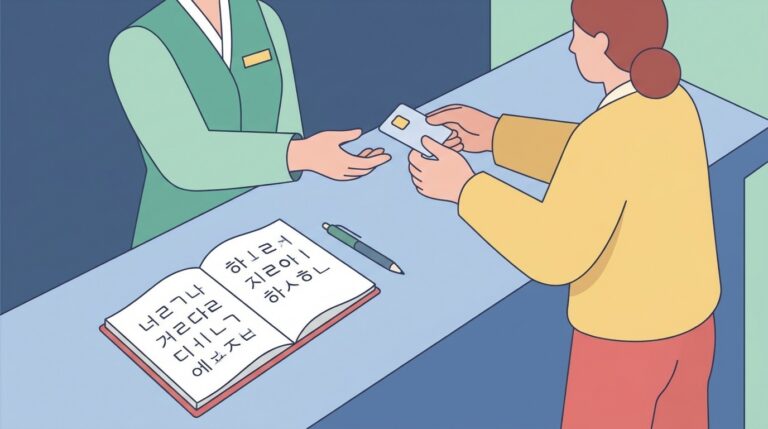
* The Two-Hand Rule (두 손 쓰기): Never grab the card with one casual hand! Always receive it with both hands, or support your right wrist/forearm lightly with your left hand while making a small, respectful bow of the head (목례, mongnye).
* Eye Contact: Avoid an intense, unblinking stare. Offer a gentle, smiling gaze toward their chest or chin level, acknowledging their service.
4-2. Cultural Code: The Craze of “Hocance” (호캉스)
In South Korea, hotels are not just places to crash during a trip. The portmanteau 호캉스 (Hocance = Hotel + Vacance) is a massive cultural trend. Young Koreans book luxury or design boutique hotels purely to enjoy the air conditioning, plush bedding, room service, and—most importantly—the morning buffet (조식 뷔페)! When you ask about breakfast at check-in, hotel staff take pride in guiding you because breakfast is considered one of the pinnacle experiences of a hotel stay in Korea.
Phase 5: 실전 롤플레이 시나리오 (Real-World Roleplay)
Setting: The sleek marble front desk of Lapis Hotel in Myeongdong.
Characters:
* Minho (민호): Polished, kind hotel concierge wearing a neat navy uniform.
* Alex (알렉스): You, an eager traveler checking in after sunset.
- Turn 1 (Minho): 안녕하세요, 체크인 도와드릴까요? (Annyeonghaseyo, chekeu-in dowadeurilkkayo?)
🎭 Smiling warmly and placing hands together politely.
“Hello, may I assist you with check-in?” -
Turn 2 (Alex): 네, 예약했어요. 알렉스입니다. (Ne, yeyakhaesseoyo. Alleksu-imnida.)
🎭 Handing over your passport with both hands.
“Yes, I have a reservation. I’m Alex.” -
Turn 3 (Minho): 확인되었습니다. 카드 키 여기 있습니다. (Hwagoindoe-eotsseumnida. Kadeu ki yeogi itsseumnida.)
🎭 Presenting the room key card folder with both hands.
“Confirmed. Here is your key card.” -
Turn 4 (Alex): 감사합니다! 조식 식당은 어디에 있어요? (Gamsahamnida! Josik sikdangeun eodie isseoyo?)
🎭 Tilting head slightly with an inquiring, polite smile.
“Thank you! Where is the breakfast restaurant?” -
Turn 5 (Minho): 조식 식당은 2층에 있어요. (Josik sikdangeun icheung-e isseoyo.)
🎭 Gently gesturing toward the elevator with an open palm.
“The breakfast restaurant is on the 2nd floor.” -
Turn 6 (Alex): 조식은 몇 시부터예요? (Josigeun myeot sibuteoyeyo?)
🎭 Checking your watch with curiosity.
“From what time is breakfast?” -
Turn 7 (Minho): 아침 7시부터 10시까지예요. (Achim ilgop-sibuteo yeol-sikkajiye-yo.)
🎭 Pointing softly to the printed breakfast timetable on the card sleeve.
“It is from 7:00 AM to 10:00 AM.” -
Turn 8 (Alex): 알겠습니다. 정말 감사합니다! (Algetseumnida. Jeongmal gamsahamnida!)
🎭 Giving a satisfied nod and taking the key card securely.
“Understood. Thank you very much!”
🔀 Interactive Branch Point: You also want to ask about check-out time!
What will you say to Minho?
* Option A: 체크아웃은 몇 시예요? (Chekeu-a-useun myeot siye-yo?)
* Option B: 언제 나가요? (Eonje nagayo? – When do I leave?)
* Option C: 체크아웃 몇 시입니까 해라! (Chekeu-a-ut myeot siimnikka haera!)
Feedback:
* Option A is [BEST]: Natural, respectful, and standard polite Korean. Minho will instantly answer, usually “오전 11시입니다 (It’s 11:00 AM).”
* Option B is [RISK]: Grammatically understood, but “언제 나가요?” sounds bluntly childlike, like “When do I step out the door?”
* Option C is [BAD]: Adding “해라” turns the sentence into an aggressive command! You’d startle poor Minho.
Phase 6: 10초 감정 섀도잉 드릴 (10-Second Shadowing Drill)
Practice speaking these aloud with the pauses (/) and emotional cues:
[😊 Bright & Polite]
조식 식당은 / 2층에 / 있어요!
(Josik sikdangeun / icheung-e / isseoyo!)-
[🤔 Curious & Jet-lagged]
조식은 / 몇 시부터 / 예요?
(Josigeun / myeot sibuteo / yeyo?) -
[😌 Relieved & Courteous]
체크아웃은 / 몇 시예요?
(Chekeu-a-useun / myeot siye-yo?)
Phase 7: K-Culture 미니 사전 (Mini Dictionary)
-
조식 (Josik) | Hotel Breakfast
Unlike regular daily breakfast (아침), 조식 specifically refers to organized breakfast meal programs provided by accommodations or conference centers. -
층 (Cheung) | Floor / Level
Korean uses Sino-Korean numbers for floors: 1층 (il-cheung), 2층 (i-cheung), 3층 (sam-cheung), and basement levels are 지하 1층 (jiha il-cheung). -
호캉스 (Hocance) | Staycation Trend
A lifestyle trend combining “Hotel” and “Vacance”. Experiencing hotel dining and leisure is a common weekend treat in Korea. -
레이트 체크아웃 (Reiteu Chekeu-a-ut) | Late Check-Out
Commonly requested by Hocance guests wanting an extra hour of sleep. You can ask: 레이트 체크아웃 돼요? (Reiteu chekeu-a-ut dwaeyo? – Is late check-out available?)
Phase 8: 여행자를 위한 생존 키트 (Traveler’s Survival Kit)
Survival Phrases TOP 3
- 카드 키 하나 더 주세요. (Kadeu ki hana deo juseyo.)
“Please give me one more key card.”
Pro Tip: Perfect when traveling with a partner so neither of you gets locked out. - 짐 좀 맡겨도 될까요? (Jim jom matgyeodo doelkkayo?)
“Could I leave my luggage here for a while?”
Pro Tip: Essential if you arrive before check-in or want to explore after check-out. - 와이파이 비밀번호가 뭐예요? (Wa-i-pa-i bimilbeonhoga mwoyeyo?)
“What is the Wi-Fi password?”
Pro Tip: Usually written on your key envelope, but great to ask if it’s missing.
Editor’s Travel Note: Smooth Hotel Navigation
- Elevator Button Lore: In Korea, the 4th floor is sometimes labeled with the letter ‘F’ instead of the number 4, because the Sino-Korean pronunciation for four (사, Sa) sounds identical to the character for death (死). Don’t panic if you don’t see a ‘4’—press ‘F’!
- Digital Maps over Google Maps: Google Maps does not provide accurate walking navigation inside Korea. Make sure to complete your Naver Map app download before checking into your hotel to explore the neighborhood cafes effortlessly.
Phase 9: “한 발 더 깊이” (Deep Cultural Reflection)
Korean customer service embodies the spirit of 정성 (Jeongseong)—wholehearted dedication to taking care of someone. When front desk clerks hand you your key card with both hands and detail the breakfast schedule down to the exact floor, it is not merely corporate protocol. In Korean social consciousness, welcoming an outsider into a shared shelter requires immense care to prevent any discomfort (불편, Bulpyeon). By learning to say 조식 식당은 2층에 있어요 or 감사합니다 in return, you are actively participating in this warm cycle of consideration.
💬 Your Turn: Have you ever gotten lost in a foreign hotel or missed breakfast because of confusing time signs? Drop your funniest hotel travel story in the comments below!
Phase 10: FAQ & 오해 방지 (FAQ Schema)
Q: What is the difference between 아침 (Achim) and 조식 (Josik)?
A: 아침 is the general native Korean word for morning or breakfast eaten at home. 조식 is a Sino-Korean term used for formal or commercial meal services at hotels, resorts, and boarding facilities.
Q: Why do hotel clerks use ‘이층’ instead of ‘두층’ for the 2nd floor?
A: Floors in Korean always count with Sino-Korean numbers (일, 이, 삼, 사…), not native Korean numbers (하나, 둘, 셋…). Therefore, the 2nd floor is always 2층 (I-cheung), never 두층.
Q: Can I wear hotel slippers and robes down to the breakfast restaurant?
A: In general Korean city hotels, wearing the provided disposable white slippers or bathrobes down to the breakfast buffet is considered bad etiquette. Casual street clothes and regular shoes are standard etiquette.
🚨 Common Mistakes (흔한 실수) 경고판
| Mistake | Why It Happens | Correct Action |
|---|---|---|
| Saying 두 층에 있어요 | Mixing up native numbers with floor counters | Always use Sino-Korean numbers: 2층 (이층, I-cheung) |
| Taking keys with one limp hand | Habit from Western casual culture | Use both hands or touch your left hand to your right arm |
| Asking 아침 밥 어디예요? | Translating “Where is breakfast food?” literally | Use the refined phrase: 조식 식당은 어디에 있어요? |
Phase 11: 액션 미션 & 참여 유도 (Action Missions)
- 🥉 Bronze Mission (Solo Practice): Stand in front of your mirror with a credit card. Practice handing it to yourself while reciting: 조식 식당은 2층에 있어요 (Josik sikdangeun icheung-e isseoyo) three times with a bright smile.
- 🥈 Silver Mission (Social Audio): Record your voice saying 조식은 몇 시부터예요? on your phone notes, listen back, and compare your vowel rhythm to our pronunciation guide.
- 🥇 Gold Mission (Real Life / Live Call): Next time you stay at a hotel in Korea or practice with a Korean friend, ask for breakfast floor details entirely in Korean without using English!
- 🎮 K-Culture Mission: Watch any hotel check-in scene in a K-Drama (try King the Land or Hotel Del Luna) and listen for the words 체크인 (Check-in) and 층 (Floor)!
Phase 12: 인터랙티브 퀴즈 챌린지 (Interactive Quiz Challenge)
Q1. You want to ask what floor the breakfast hall is on. Which sentence is correct?
a) 조식 식당은 어디 층이에요?
b) 조식 식당은 몇 층에 있어요?
c) 조식 식당은 두 층이에요?
Q2. Fill in the blank:
조식은 아침 7시______ 시작해요. (Breakfast starts from 7:00 AM.)
[ Hint: The particle meaning ‘from’ ]
Q3. True or False:
In Korean elevators, the letter “F” often represents the 4th floor due to cultural number superstitions.
👉 Click to reveal answers & explanations!
- Q1 Answer: b) 조식 식당은 몇 층에 있어요? (Josik sikdangeun myeot cheung-e isseoyo?)
Explanation: “몇 층 (which floor / how many floors)” is the natural, correct interrogative for inquiring about floor numbers. - Q2 Answer: 부터 (buteo)
Explanation: ~부터 means “from (a point in time)”. So 7시부터 means “starting from 7 o’clock”. - Q3 Answer: True!
Explanation: Because the number 4 (사, Sa) sounds like death (死), many Korean elevators label the 4th floor as ‘F’ (Four)!