

Phase 1: Empathy & Storytelling Opening
안녕하세요! (Annyeonghaseyo!) I am your Daily Hangul editor and your personal Korean cultural navigator.
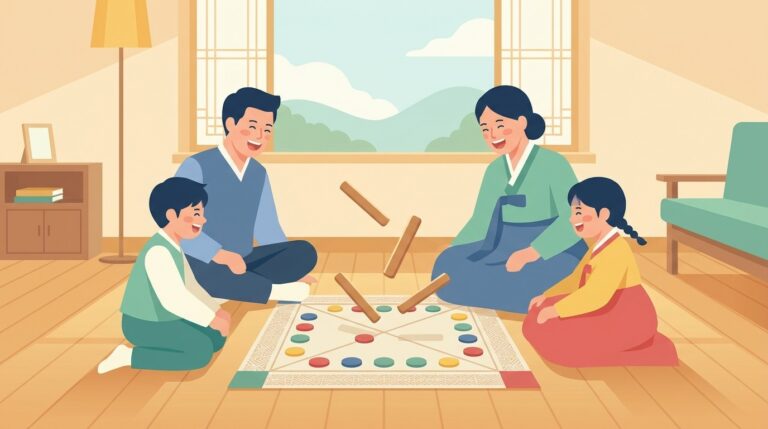
Imagine this scene: You are invited to a cozy Korean home during the holidays. The aromatic scent of savory pancakes (jeon) fills the air, and you are sitting on the warm wooden floor surrounded by your friend’s family. Suddenly, an elder lays out a giant blanket, hands you four heavy wooden sticks, and everyone starts chanting enthusiastically. Your heart starts pounding. What is this game? What do you shout when it is your turn? And how do you greet the grandparents without feeling awkward?
If you have ever felt nervous about joining a traditional Korean holiday gathering, you are definitely not alone. Many beginner learners freeze up during holiday game nights, unsure whether to be ultra-formal or join the fun. This guide is crafted directly from real-life feedback of first-time holiday visitors to Korea. In just a few minutes, you will learn the exact phrases, cultural manners, and game cheers needed to become the favorite guest at any Korean holiday table!
Phase 2: Top 3 Core Expressions for Holiday Game Night
Here are the three essential phrases every beginner needs when gathering around the board.
1. 윷 던져요! (Yut deonjyeoyo!)
- Pronunciation: Yut deon-jyeo-yo (Sounds like: “Yoot” rhyming with “loot” + “dawn” + “jaw” + a friendly “yo”)
- Meaning: Literal: “Throwing the Yut!” / Actual Nuance: “Here goes the throw! / Toss the sticks!”
- K-Culture Moment: You will see this in almost every holiday variety show, from Running Man to 2 Days & 1 Night, right before a dramatic, slow-motion stick toss onto the mat.
- Editor’s Insight: The friendly ending “-yo” keeps the phrase polite toward elders while matching the energetic atmosphere of the game.
- Situation Spectrum: Casual ✅ | Semi-formal ✅ | Formal ⚠️
- 🤔 Think About It: In English, we say “It’s your turn!” focusing on the individual person. Korean often spotlights the shared activity itself: “Throw the sticks!” Why do you think Korean phrases emphasize the group action over the individual player?
2. 새해 복 많이 받으세요 (Saehae bok mani badeuseyo)
- Pronunciation: Sae-hae bok ma-ni ba-deu-se-yo (Sounds like: “Say-hay boke mah-nee bah-deu-say-yo”)
- Meaning: Literal: “Please receive abundant fortune in the New Year.” / Actual Nuance: “Happy New Year!”
- K-Culture Moment: The iconic greeting exchanged after performing the traditional deep bow (sebae) to grandparents while wearing colorful hanbok during Seollal (Lunar New Year).
- Editor’s Insight: Notice the word 복 (bok), which means good fortune and blessing. Rather than merely wishing a “good day,” Koreans wish you an overflowing vessel of life blessings.
- Situation Spectrum: Casual ⚠️ (drop seyo with peer friends: 새해 복 많이 받아) | Semi-formal ✅ | Formal ✅
- 🤔 Think About It: Western greetings often wish an emotional state like “Happy New Year.” Korean wishes an abundance of “fortune.” What does this reveal about communal hopes for prosperity?
3. 한 번 더! (Han beon deo!)
- Pronunciation: Han beon deo! (Sounds like: “Hahn bun duh!”)
- Meaning: Literal: “One time more!” / Actual Nuance: “Bonus roll! / One more time!”
- K-Culture Moment: When a player scores a “Yut” or “Mo” in Yutnori, the entire living room erupts, pumping their fists and demanding the earned bonus turn.
- Editor’s Insight: This phrase is short, punchy, and universally loved. You can use it during board games, karaoke (noraebang), or even when asking for another song at a concert!
- Situation Spectrum: Casual ✅ | Semi-formal ✅ | Formal ⚠️
- 🤔 Think About It: A simple three-syllable cheer breaks through any language barrier during games. Rhythm and enthusiasm matter more than complex grammar!
Phase 3: Textbook Korean vs. Real-World Korean
Let’s see how textbook Korean compares to what families actually say on holiday game nights.
Situation 1: Greeting the elders when you arrive
- 📖 Textbook Korean: 안녕하십니까, 명절을 축하합니다. (Annyeonghasimnikka, myeongjeoreul chukahamnida. – How do you do, congratulations on the holiday.)
- 🗣️ Real-World Korean: 할머니, 새해 복 많이 받으세요! (Halmeoni, saehae bok mani badeuseyo! – Grandma, please receive lots of New Year blessings!)
- 💡 Why it differs: The textbook sentence sounds like an official broadcast speech. Real Korean families use family titles with warm, respectful smiles.
Situation 2: Celebrating a lucky roll in Yutnori
- 📖 Textbook Korean: 매우 좋은 결과입니다. (Maeu joeun gyeolgwa-imnida. – That is a very good outcome.)
- 🗣️ Real-World Korean: 우와, 모 나왔다! 대박! (Uwa, mo nawatta! Daebak! – Wow, we rolled a Mo! Awesome!)
- 💡 Why it differs: Nobody speaks like an instruction manual when having fun! Natural exclamations like Daebak (jackpot/awesome) show authentic excitement.
Phase 4: K-Culture Deep Dive & Non-Verbal Manners
4-1. 눈치 (Nunchi) & Body Language
- Toss within bounds: Always toss the four sticks so they land squarely on the woven mat or blanket. If even one stick tumbles off, it is called a 낙 (Nak – foul) and your turn is wasted!
- Two-handed etiquette: When handing the wooden sticks to older family members, pass them using both hands or support your right forearm with your left hand.
- Sitting posture: While sitting on the floor (ondol), avoid stretching your legs out directly pointing your feet at the grandparents. Sit cross-legged (yangban-dari) or tuck your legs neatly to the side.
4-2. Cultural Code Analysis: The Spirit of Yutnori
- In Korean holiday specials on television, you will notice that Yutnori is never played quietly. It is a game of dramatic reversals where one token can “piggyback” (eopgi) on another or capture the opponent’s piece (japgi) from behind. Alongside the game board, you will always find holiday treats like 떡국 (Tteokguk – rice cake soup) for Seollal or 송편 (Songpyeon – half-moon rice cakes) for Chuseok. Sharing food and shouting cheers makes every participant an equal part of the family circle.
Phase 5: Real-World Roleplay Scenario
Setting: Lunar New Year afternoon in Seoul. Warm living room, the comforting aroma of pan-fried holiday pancakes, and a Yutnori mat laid out across the floor.
Characters: You (guest learner), Minjun (your Korean close friend), Grandma (warm-hearted family matriarch and Yutnori expert).
- Grandma: 우리 손님, 윷 던져 보세요! (Uri sonnim, yut deonjyeo boseyo! – Our guest, please throw the Yut!) [🎭 Hands you the four polished wooden sticks with both hands, eyes twinkling]
- You: 네, 할머니! 던져요! (Ne, halmeoni! Deonjyeoyo! – Yes, Grandma! Throwing now!) [🎭 Shaking the sticks gently above the blanket with a focused smile]
- Minjun: 모 나와라, 모! (Mo nawara, mo! – Give us a Mo, a Mo!) [🎭 Clapping hands in high anticipation]
- You: 얍! 나왔다! (Yap! Nawatta! – Ha! It is out!) [🎭 Tossing the sticks in a neat arc onto the center of the blanket]
- Grandma: 어머나, 모 나왔네! 잘 던졌다! (Eomeona, mo nawanne! Jal deonjyeotta! – Oh my goodness, a Mo came out! What a great throw!) [🎭 Clapping and laughing joyfully]
- Minjun: 대박! 한 번 더 던져요! (Daebak! Han beon deo deonjyeoyo! – Awesome! Throw one more time!) [🎭 Collecting the sticks and handing them back to you]
- You: 감사합니다! 한 번 더! (Gamsahamnida! Han beon deo! – Thank you! One more roll!) [🎭 Pumping your fist in celebration]
- Grandma: 새해 복 다 가져가겠네, 호호! (Saehae bok da gajyeogagenne, hoho! – You are taking all the New Year fortune, hoho!) [🎭 Offering you a glass of sweet rice drink, sikhye]
🔀 Interactive Choice: What do you say back to Grandma?
- Option A: 할머니도 새해 복 많이 받으세요! (Halmeoni-do saehae bok mani badeuseyo! – Grandma, please receive lots of New Year blessings too!)
- Option B: 제가 원래 게임 천재예요. (Jega wonrae geim cheonjaeyeyo. – I am naturally a game genius.)
- Option C: 조용히 하세요, 집중해야 해요. (Joyonghi haseyo, jipjunghaeya haeyo. – Please be quiet, I must focus.)
Feedback:
* Option A (Best): Perfect! Respectful, affectionate, and immediately returns the holiday blessing to the family elder. You will win everyone’s heart!
* Option B (Risk): If said with playful charm it might get a chuckle, but as a beginner, it risks sounding arrogant to traditional elders.
* Option C (Bad): Never tell elders to be quiet during a festive game! Korean holiday games are meant to be boisterous and lively.
Phase 6: 10-Second Emotion Shadowing Drill
Practice reading these lines aloud with the emotional cues. Pause at the slashes (/):
[😊 Bright and cheerful]
새해 복 / 많이 받으세요! (Saehae bok / mani badeuseyo!)[🔥 Hyped and eager]
윷 던져요! / 모 나와라! (Yut deonjyeoyo! / Mo nawara!)[🎉 Triumphant fist-pump]
대박! / 한 번 더! (Daebak! / Han beon deo!)
Phase 7: K-Culture Mini Dictionary
- 윷놀이 (Yutnori): A traditional Korean board game played on major holidays where players toss four wooden sticks to advance tokens around a course.
- 새해 복 (Saehae bok): “New Year’s fortune and blessings.” The foundational concept of wellness and luck wished during Seollal.
- 덕담 (Deokdam): Words of blessing, wisdom, and well-wishes spoken by elders to younger family members during holiday greetings.
- 모 (Mo): The highest regular throw in Yutnori (all four sticks landing flat-side up), which moves a token five spaces and earns an extra turn.
Phase 8: Survival Kit for Travelers
Top 3 Survival Phrases
- 새해 복 많이 받으세요! (Saehae bok mani badeuseyo!)
Pro Tip: Bow slightly with your hands clasped together in front of your waist when saying this to hosts or store owners. - 맛있게 잘 먹었습니다! (Masitge jal meogeotseumnida!)
Meaning: “I ate deliciously!”
Pro Tip: Use this right after finishing home-cooked holiday food to show gratitude. - 규칙이 뭐예요? (Gyu-chigi mwoyeyo?)
Meaning: “What are the rules?”
Pro Tip: Great question when learning house rules for Yutnori or card games like Go-Stop.
Editor’s Travel Note
During Seollal and Chuseok, major highways experience heavy holiday migration (gwiseong-gil). Secure your intercity train tickets weeks in advance through the KORAIL Talk train reservation app. When moving around downtown Seoul, check holiday subway schedules and local restaurant hours using the Naver Map navigation application, as many independent shops close on the day of the holiday.
Phase 9: One Step Deeper
In many Western board games, the objective centers on individual elimination and accumulating private property. Yutnori, by contrast, originated in agrarian communal culture where the four sticks symbolize domestic farm animals (pig, dog, sheep, ox, and horse). Players often join forces in teams, and tokens can “ride together” (eopgi) to advance cooperatively. Victory in Yutnori is considered a collective omen of good harvest and fortune for the entire family.
💬 Your Turn: Does your culture have a traditional game played during big family holidays? What is the lucky roll or magic chant you shout? Tell us in the comments!
Phase 10: FAQ & Common Mistakes
Q: Can I say “새해 복 많이 받으세요” during Chuseok?
A: No. “Saehae” specifically means “New Year,” so keep that phrase for Seollal (Lunar New Year) and January 1st. For Chuseok (Harvest Moon Festival), say: 즐거운 추석 보내세요 (Jeulgeoun Chuseok bonaeseyo – Have a pleasant Chuseok).
Q: What should I do if my Yut stick falls off the mat?
A: Laugh it off and pass the sticks! Falling off the blanket is a foul called 낙 (Nak). Acknowledging it with a playful “아, 아깝다! (Ah, akkaptda! – Ah, so close!)” shows great sportsmanship.
Q: Is Yutnori an individual or team game?
A: Almost always played in teams! Usually divided as elders versus younger folks, or men versus women. That is why cheering loudly for your teammates is so important.
🚨 Common Mistakes Alert
- Mistake: Bowing with hands in your pockets.
Correct Action: Place your hands neatly in front of your stomach (Gongsu stance) and bow with a straight back. - Mistake: Throwing the Yut sticks violently up toward the ceiling.
Correct Action: Toss them gently in an arc just above head height so they land safely on the blanket. - Mistake: Using ultra-casual slang toward elders during exciting game moments.
Correct Action: Keep celebratory cheers polite by adding “-yo” (e.g., 우와, 대박이에요! – Uwa, daebag-ieyo!).
Phase 11: Action Missions
- Bronze Mission: Stand before a mirror, clasp your hands respectfully, and practice saying “새해 복 많이 받으세요! (Saehae bok mani badeuseyo!)” three times smoothly.
- Silver Mission: Share a picture of your favorite festive holiday dish on Instagram with the caption: “새해 복 많이 받으세요! Wishing everyone good fortune!”
- Gold Mission: Greet a Korean friend, tutor, or store clerk using the correct seasonal greeting when the holiday arrives.
- 🎮 K-Culture Mission: Watch a holiday episode of your favorite K-variety show (like Run BTS or Infinite Challenge) playing Yutnori. Count how many times you hear the players shout “모! (Mo!)” or “한 번 더! (Han beon deo!)”.
Phase 12: Interactive Quiz Challenge
1. Situational Judgment: You are playing Yutnori with your host family, toss the sticks, and get the highest score (Mo)! What do you shout to claim your bonus roll?
* A) 규칙이 뭐예요? (Gyu-chigi mwoyeyo?)
* B) 한 번 더! (Han beon deo!)
* C) 안녕히 계세요. (Annyeonghi gyeseyo.)
2. Fill in the Blank: Complete the holiday greeting:
“새해 _____ 많이 받으세요! (Saehae _____ mani badeuseyo! – Please receive lots of New Year fortune!)”
3. True or False: True or False: During Chuseok (autumn harvest), you should greet family by saying “새해 복 많이 받으세요”.
Click here to reveal answers & explanations!
-
Answer: B) 한 번 더! (Han beon deo!)
Explanation: Getting a “Mo” entitles you to an immediate extra turn, so shouting “One more time!” is the perfect reaction! -
Answer: 복 (bok)
Explanation: “Bok” means luck, blessing, and fortune in Korean. -
Answer: False
Explanation: “Saehae” refers to the New Year. For Chuseok, use “즐거운 추석 보내세요 (Jeulgeoun Chuseok bonaeseyo)”.







