

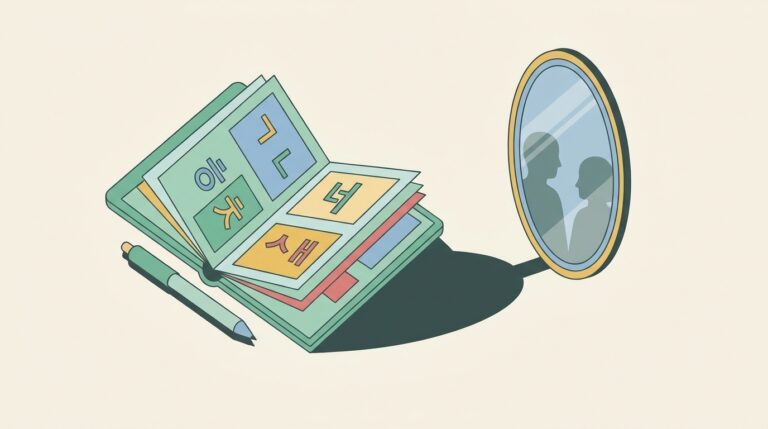
Decoding the Unconscious in Korean Literature: Synthesizing Formalist and Psychoanalytic Criticism
Phase 1: Empathy (스토리 몰입형 오프닝)
안녕하세요! 매일한글 에디터입니다.
Have you ever found yourself sitting in a high-level Korean humanities seminar at Yonsei or SNU, or perhaps dissecting the labyrinthine plot of Park Chan-wook’s Decision to Leave (헤어질 결심) with native cinephiles, only to feel your tongue tied? You understand the surface plot perfectly, but when you want to articulate how a character’s subtle slip of the tongue (말실수) or a recurring visual motif unmasks an intensely repressed trauma (억압된 트라우마), you find yourself stuck using basic phrases like “이 캐릭터는 슬픈 과거가 있어요” (This character has a sad past). It feels frustrating, doesn’t it? You have the intellectual capacity of a seasoned literary critic in your native tongue, yet your Korean feels constrained to elementary descriptions.
Bridging intrinsic formalism (내재적 비평)—the text’s closed internal structure—with extrinsic psychoanalysis (외재적 정신분석 비평) is the holy grail of C2-level Korean proficiency. In this masterclass, derived from over a decade of mentoring international scholars and culture writers in Seoul, we will move past superficial plot breakdowns. You will learn the exact theoretical lexicon, nuances, and conversational gestures required to deconstruct repressed desires and Lacanian lacks like a native scholar.
Phase 2: 핵심 표현 3선 심층 분석 (Key Expressions)
1. 무의식적 욕망이 투사되다 (Muuiseikjeok yongmangi tusadoeda)
- Pronunciation: [Muuiseik-jeok yong-mangi tu-sa-doe-da] (Think of ‘Moo-ee-shik’ rolling smoothly like the whisper of the subconscious, followed by ‘too-sah-dweh-da’ hitting with precise analytical clarity)
- Meaning: “Unconscious desire is projected” | In native critical discourse, it implies that an unacknowledged psychological drive or repressed wound is unconsciously externalized onto another character, an object, or the narrative landscape.
- K-Culture Moment: Used by film critics when explaining how the lavish architectural hierarchy in Bong Joon-ho’s Parasite is not just a setting, but a psychic projection of class anxiety: “저택의 수직적 공간 구조에는 인물들의 무의식적 욕망이 적나라하게 투사되어 있습니다.” (The vertical spatial structure of the mansion starkly projects the characters’ unconscious desires.)
- Editor’s Insight: While English speakers often overuse “반영하다” (to reflect), 투사되다 captures psychoanalytic agency—an active psychological defense mechanism shifting internal lack outward.
- Situation Spectrum: Casual 🚫 | Semi-formal ⚠️ | Formal ✅ (Strictly for academic essays, book salons, or serious reviews)
- 🤔 Think About It: Does your native language differentiate between passive aesthetic reflection and active psychological projection as sharply as academic Korean?
2. 억압된 트라우마의 회귀 (Eogapdoen teuraumaui hoegwi)
- Pronunciation: [Eo-gap-doen teu-ra-u-ma-ui hoe-gwi] (Articulate ‘Eo-gap’ by tightening the throat slightly to mirror the physical feeling of repression, followed by the flowing ‘hoe-gwi’)
- Meaning: “The return of the repressed trauma” (Freud’s Wiederkehr des Verdrängten) | Signifies that an unhealed psychic wound inevitably re-emerges through linguistic errors, recurring nightmares, or compulsive behavioral cycles.
- K-Culture Moment: Commonly employed in literary analyses of Han Kang’s The Vegetarian (채식주의자), identifying Yeong-hye’s radical bodily rejection as the haunting return of childhood patriarchal violence.
- Editor’s Insight: 회귀 (hoegwi) carries a heavy philosophical weight of cyclical inevitability, far superior to the everyday verb 돌아오다 (to come back).
- Situation Spectrum: Casual 🚫 | Semi-formal ⚠️ | Formal ✅
- 🤔 Think About It: How does naming historical violence as a clinical “return of trauma” alter collective responsibility in literature?
3. 텍스트의 균열과 결핍을 포착하다 (Tekseuteuui gyunyeolgwa gyeolpipeul pochakhada)
- Pronunciation: [Tek-seu-teu-ui gyu-nyeol-gwa gyeol-pi-peul po-chak-ha-da] (Crisp ‘gyun-yeol’ echoing a brittle fracture, transitioning into the decisive ‘po-chak’)
- Meaning: “To capture the fissures and existential lacks of the text” | Moving past what the author intended to say, this phrase describes locating the unsaid gaps, slips, and contradictions where the Lacanian Real disrupts the symbolic order.
- K-Culture Moment: Essential vocabulary when discussing postmodern Korean metafiction or ambiguous psychological K-dramas like Beyond Evil (괴물).
- Editor’s Insight: To capture (포착하다) here implies intellectual vigilance—hunting for the exact structural seam where formal harmony breaks down.
- Situation Spectrum: Casual 🚫 | Semi-formal ⚠️ | Formal ✅
- 🤔 Think About It: In Western criticism, “deconstruction” often emphasizes semantic instability; how does Korean literary criticism synthesize structural “fissure” (균열) with emotional “loss” (결핍)?
Phase 3: 교과서 한국어 vs 진짜 한국어 (Textbook vs. Real Korean)
Situation 1: Analyzing an inadvertent slip of the tongue (Freudian slip) in a script
- 📖 교과서 한국어: 이 인물은 실수로 진심을 말해버렸습니다. (I inmureun silsu-ro jinsimeul malhaebeoryeosseumnida. / This character accidentally spoke their true mind by mistake.)
- 🗣️ 진짜 한국어: 단순한 말실수가 아니라 결핍된 욕망이 터져 나온 ‘착오 행위’이자 무의식의 균열점이에요. (Dansunhan malsilsuga anira gyeolpipdoen yongmangi teojyeo naon ‘chago haeng-wi’ija muuiseik-ui gyunyeoljeomieyo. / Rather than a mere slip of the tongue, it is a parapraxis where repressed desire erupted—a structural fracture of the unconscious.)
- 💡 왜 다를까?: In advanced scholarly Korean, “실수” sounds simplistic. Elevating it to Freud’s clinical term 착오 행위 (parapraxis) instantly shifts the register from casual storytelling to psychoanalytic rigor.
Situation 2: Synthesizing intrinsic form with extrinsic trauma
- 📖 교과서 한국어: 시의 형식과 작가의 슬픈 역사를 같이 봐야 합니다. (Si-ui hyeongsik-gwa jakga-ui seulpeun yeoksareul gachi bwaya hamnida. / We must look at the poem’s form and the author’s sad history together.)
- 🗣️ 진짜 한국어: 텍스트 내재적 율격의 파격을 작가가 겪은 역사적 트라우마의 징후로 통섭해야 비로소 행간이 읽힙니다. (Tekseuteu naejaejeok yulgyeok-ui pagyeog-eul jakgaga gyeokkeun yeoksajeok teuraumaui jinghuro tongseophaeya biroso haeng-gani ilk-himnida. / Only when we synthesize the intrinsic metrical rupture as a symptom of the author’s historical trauma can we truly read between the lines.)
- 💡 왜 다를까?: C2 critical Korean thrives on concepts like 통섭 (consilience/synthesis) and 징후 (symptom), treating aesthetic anomalies as psychological indices.
Phase 4: K-Culture 딥다이브 & 비언어적 매너 (Deep Dive & Non-Verbal Manners)
4-1. 눈치(Nunchi) & Intellectual Gestures
In Korean academic circles, psychoanalytic interpretations must be presented with humility rather than dogmatic assertiveness. When pointing out an author’s repressed trauma:
* The Modest Gaze & Head Tilt: Never stare aggressively at your debate opponent. Tilt your head slightly (약 15도 각도) while looking down at the open text, implying your insight originates from textual evidence rather than personal opinion.
* The Open Palm Cadence: When articulating concepts like 무의식적 억압 (unconscious repression), open both hands facing upward at chest level and draw them slowly inward, non-verbally illustrating the internal psychological retraction.
4-2. Cultural Code: ‘결핍’ (Lacanian Lack) in Modern K-Dramas
Why are contemporary Korean masterworks—from My Liberation Notes (나의 해방일지) to Lee Chang-dong’s Burning (버닝)—so obsessively psychoanalytic? Modern Korean culture grapples intensely with collective generational burnout and hyper-capitalist alienation. Characters do not simply seek external goals; they are propelled by Lacanian 결핍 (existential lack) and the elusive 오브제 아 (objet petit a). When Korean critics evaluate these narratives, they do not just judge the plot pacing; they scrutinize whether the internal fissures of the script faithfully map the psychological pathology of contemporary society.
Phase 5: 실전 롤플레이 시나리오 (Graduate Seminar Dialogue)
Setting: A quiet seminar room overlooking a pine courtyard at a humanities research institute in Seoul.
Characters:
* 박민우 (Min-woo Park): A sharp, doctoral candidate in Korean modern literature who leans toward rigid formalist poetics.
* You: A visiting literary scholar synthesizing textual morphology with psychoanalysis.
— Dialogue —
Turn 1 (민우): 🎭 (책장을 단호하게 넘기며 안경을 고쳐 쓴다)
“저는 이 소설의 반복되는 ‘문’이라는 모티프를 순수하게 서사 구조를 완결 짓는 내재적 형식 장치로만 봅니다.”
(Jeoneun i soseol-ui banbokdoeneun ‘mun’-iraneun motipeureul sunsuhage seosa gujoreul wangyeol jinneun naejaejeok hyeongsik jangchiro-man bomnida.)
“I view the recurring motif of the ‘door’ in this novel purely as an intrinsic formal device that achieves narrative closure.”
Turn 2 (You): 🎭 (고개를 완만하게 끄덕이며 펜 끝으로 텍스트의 여백을 가리킨다)
“형식주의적 완성도도 높지만, 인물이 문 앞에서 주저하는 말실수는 어떻게 보시나요?”
(Hyeongsikju-uijeok wanseongdodo nopjiman, inmuri mun ap-eseo jujeohaneun malsilsuneun eotteoke bosinayo?)
“While its formalist craftsmanship is high, how do you interpret the character’s hesitation and slip of the tongue before the door?”
Turn 3 (민우): 🎭 (의아한 표정으로 미간을 찌푸린다)
“단순한 성격 묘사나 극적 긴장감을 유발하기 위한 플롯 상의 지연 아닐까요?”
(Dansunhan seonggyeok myosana geukjeok ginjanggameul yubalhangi wihan peullot sang-ui jiyeon anilkkayo?)
“Wouldn’t that merely be characterization or a plot delay designed to induce dramatic tension?”
Turn 4 (You): 🎭 (차분하지만 확신에 찬 어조로 시선을 맞춘다)
“그 지연이야말로 억압된 트라우마가 상징계의 균열을 뚫고 표출되는 결정적 징후입니다.”
(Geu jiyeon-iyamallo eogapdoen teuraumaga sangjinggye-ui gyunyeoreul ttulkko pyochuldoeneun gyeoljeongjeok jinghu-imnida.)
“That exact delay is the decisive symptom where repressed trauma punctures the fissures of the Symbolic order.”
Turn 5 (민우): 🎭 (팔짱을 풀고 턱을 괴며 깊은 생각에 잠긴다)
“라캉의 이론을 빌려, 그 문을 넘을 수 없는 실재계와의 조우로 해석하시는 거군요?”
(Rakang-ui ironeul billyeo, geu muneul neomeul su eomneun siljaegyewaui jouro haeseokhasineun geogunyo?)
“Borrowing Lacan’s framework, you’re interpreting that door as an encounter with the insurmountable Real?”
Turn 6 (You): 🎭 (상대의 통찰을 긍정하며 양손을 부드럽게 모은다)
“정확합니다. 내재적 문체와 외재적 무의식 분석을 통섭할 때 비로소 텍스트의 심층이 드러납니다.”
(Jeonghwakhamnida. Naejaejeok munchewa oejaejeok muuiseik bunsseogeul tongseophal ttae biroso tekseuteu-ui simcheongi deureonamnida.)
“Precisely. Only when synthesizing intrinsic style with extrinsic unconscious analysis does the text’s psychic depth emerge.”
Turn 7 (민우): 🎭 (살포시 미소를 띠며 수첩에 메모를 남긴다)
“그렇다면 3장의 기이한 어휘 반복도 단순한 리듬감이 아닌 무의식적 강박으로 읽어낼 수 있겠네요.”
(Geureotdamyeon samjang-ui gi-ihan eohwi banbokdo dansunhan rideumgami anin muuiseik-jeok gangbag-euro ilk-eonael su itgenneyo.)
“In that case, the uncanny lexical repetition in Chapter 3 could also be read as an unconscious compulsion rather than mere rhythmic phrasing.”
Turn 8 (You): 🎭 (가볍게 목례하며 화답한다)
“바로 그 지점입니다. 형식미 속에 은폐된 작가의 실존적 결핍을 포착하는 것이 비평의 몫이니까요.”
(Baro geu jijeom-imnida. Hyeongsikmi soge eunpyedoen jakga-ui siljonjeok gyeolpipeul pochakhaneun geosi bipyeong-ui moks-inikkayo.)
“That is exactly it. Because capturing the author’s existential lack concealed beneath formal beauty is the true task of criticism.”
— 🔀 인터랙티브 분기점 (Interactive Choice) —
After Turn 4, if Min-woo had defended strict formalism by claiming: “Psychoanalysis over-interprets the text’s empirical words,” how would you respond?
- Option A (Aggressive): “프로이트 이론도 모르시면서 형식을 논하는 건 낡은 태도 아닌가요?”
Feedback: ❌ Bad. Dismissing an intellectual peer as outdated will immediately freeze the dialogue and breach Korean academic etiquette (예의). - Option B (Synthetic/C2 Master): “내재적 형식 분석의 정밀함 위에 정신분석의 깊이를 얹을 때, 텍스트는 박제된 구조를 넘어 살아 숨 쉬게 됩니다.”
Feedback: 🌟 Best. Acknowledges the value of formalism while poetically illustrating how psychoanalysis animates the textual anatomy. - Option C (Submissive): “아, 제가 너무 자의적으로 나간 것 같네요. 그냥 형식만 보시죠.”
Feedback: ⚠️ Risk. Completely abandoning your critical agency undermines your scholarly authority.
Phase 6: 10초 감정 섀도잉 드릴 (Emotion Shadowing Drill)
Practice these high-register lines with exact emotional inflection and rhythmic pauses (/ marks a breath/pause):
[🧐 날카롭고 분석적으로 - Incisive & Analytical]
“텍스트의 표면적 서사 / 아래에 도사린 / 무의식적 욕망의 파열음을 / 집요하게 추적해야 합니다.”
(Tekseuteu-ui pyomyeonjeok seosa / arae-e dosarin / muuiseik-jeok yongmang-ui payeoreumeul / jibyohage chujeokhaeya hamnida.)
“We must tenaciously track / the ruptures of unconscious desire / lurking beneath / the surface narrative of the text.”-
[🤫 은밀하고 조심스럽게 - Nuanced & Secretive]
“인물의 사소한 말실수는 / 의도된 연출이라기보다, / 은폐된 트라우마가 환유적으로 미끄러진 / 흔적입니다.”
(Inmul-ui sasohan malsilsuneun / uidodoen yeonchuriragiboda, / eunpyedoen teuraumaga hwan-yujeog-euro mikkeureojin / heunjeog-imnida.)
“The character’s minor slip of the tongue / is not an intentional staging, / but a trace / where concealed trauma metonymically slid away.” -
[💡 무릎을 치듯 명쾌하게 - Enlightened & Decisive]
“형식의 완벽한 닫힘 속에서 / 역설적으로 터져 나오는 결핍, / 바로 그것이 이 텍스트의 / 미학적 심연입니다.”
(Hyeongsik-ui wanbyeokhan datchim sog-eseo / yeokseoljeog-euro teojyeo naoneun gyeolpip, / baro geugeosi i tekseuteu-ui / mihakjeok sim-yeon-imnida.)
“The lack bursting out paradoxically / from within the perfect closure of form— / precisely that is / the aesthetic abyss of this text.”
Phase 7: K-Culture 미니 사전 (Core Literary Keywords)
- 통섭 (Tongseop) [Tong-seop]
Consilience / Synthesis. Beyond mere interdisciplinary combination, it refers to unifying disparate critical lenses—such as fusing formal structural analysis with historical and psychoanalytic depth. - 결핍 (Gyeolpip) [Gyeol-pip]
Lacanian Lack / Existential Void. In contemporary Korean literary circles, this is not just “poverty” or “shortage,” but the fundamental, structural hole in the human psyche that perpetually animates language and desire. - 환유 (Hwan-yu) [Hwan-yu]
Metonymy. Contrasted with metaphor (은유), it describes how unconscious trauma continuously shifts and displaces onto adjacent objects or slips of speech without ever revealing itself directly. - 착오 행위 (Chago haeng-wi) [Cha-go haeng-wi]
Parapraxis / Freudian Slip. An involuntary linguistic or behavioral error that betrays the speaker’s deeply repressed psychological reality.
Phase 8: 여행자를 위한 생존 키트 (Scholarly Survival Kit)
Survival Expressions TOP 3
- “행간에 잠재된 무의식을 짚어볼 필요가 있습니다.”
(Haeng-gan-e jamjaedoen muuiseik-eul jipeobol piryoga isseumnida.)
Pro Tip: Use this when a book club or panel moves too quickly over an enigmatic paragraph. It instantly commands silence and reflection. - “형식의 파격은 억압된 죄의식의 표출로 읽힙니다.”
(Hyeongsik-ui pagyeog-eun eogapdoen joeuiseik-ui pyochul-ro ilk-himnida.)
Pro Tip: Excellent for interpreting unconventional Korean free-verse poetry (e.g., Yi Sang’s poetry) where punctuation and spacing are shattered. - “이 모티프의 강박적 반복에 주목해야 합니다.”
(I motipeu-ui gangbakjeok banbog-e jumokhaeya hamnida.)
Pro Tip: When analyzing cinema or novels, deploying this phrase signals that you are tracking Freudian repetition compulsions.
Editor’s Travel Note: For the Wandering Humanities Scholar
When visiting Seoul, skip the mainstream tourist cafes for an afternoon. Head to the subterranean academic section of 교보문고 광화문점 도서 검색 서비스 or visit the independent scholarly hub 풀무질 (Poolmoojil) near Sungkyunkwan University. For payment and transit between universities, always carry an integrated T-money card or register your foreign credit card on the 카카오 T app for instant transit routing.
Phase 9: “한 발 더 깊이” (Cultural Philosophy Essay)
Korean literature has long been perceived through the lens of collective emotion—most notably Han (恨), an unresolvable sorrow woven from centuries of invasion, division, and rapid modernization. However, contemporary C2 criticism moves beyond treating Han as a mystical, romanticized essence. By applying Freud and Lacan, Korean scholars increasingly deconstruct Han as a symptom of national trauma that was violently repressed by military regimes and economic hyper-growth, only to erupt through the fissures of our modern texts. To critique a Korean text psychoanalytically is therefore never an ivory-tower exercise; it is an excavation of the collective Korean psyche, peeling back linguistic defenses to confront the raw historical wounds beneath.
💬 Your Turn: Think of a Korean movie or book you’ve encountered recently. Can you identify an uncanny motif or character slip that signaled a hidden, unresolved 결핍 (lack)? Share your critical thesis below!
Phase 10: FAQ & 오해 방지 (FAQ Schema)
Q: Can I use terms like ‘오이디푸스 콤플렉스’ (Oedipus Complex) freely in Korean literary essays?
A: While technically understood, modern Korean literary criticism favors Lacanian linguistic terminology (상징계, 상상계, 실재계) over heavy classical Freudian biology. Emphasizing language slips and existential lack (결핍) sounds far more contemporary than dogmatic Oedipal formulas.
Q: What is the exact difference between 내재적 비평 and 외재적 비평?
A: 내재적 비평 (Intrinsic Criticism) isolates the text as a self-contained organism, analyzing solely its linguistic structure, tropes, and rhythm (Russian Formalism, New Criticism). 외재적 비평 (Extrinsic Criticism) analyzes the text through external contexts: historical era, class struggle (Marxist), or psychological pathology (Psychoanalytic). Synthesizing them (통섭) is the pinnacle of critical methodology.
Q: Is 말실수 (slip of the tongue) considered too casual for academic papers?
A: In spoken academic debates, 말실수 is acceptable if contextualized immediately with 착오 행위 (parapraxis) or 무의식의 누출 (leakage of the unconscious). In formal written treatises, always prioritize 언어적 착오 행위 or 실언의 징후성.
🚨 흔한 실수 (Common Mistakes) 경고판
- Mistake: Overusing “프로이트적으로 보면…” (Looking from a Freudian way…)
Correction: Use “정신분석학적 층위에서 독해하자면…” (Reading at the psychoanalytic tier…). - Mistake: Confusing 은유 (metaphor) with 환유 (metonymy) when discussing trauma displacement.
Correction: If trauma jumps to an adjacent physical object, consistently term it 환유적 전이 (metonymic displacement). - Mistake: Mispronouncing 통섭 as [Tong-seob].
Correction: Pronounce the final consonant clearly as an unreleased bilabial stop [Tong-seop], avoiding an open ‘b’ sound.
Phase 11: 액션 미션 & 참여 유도 (Action Missions)
- 🥉 Bronze Mission (Solo Mastery): Record yourself reading the 3 Emotion Shadowing sentences in Phase 6, focusing on the dynamic respiratory pauses (
/). - 🥈 Silver Mission (Social Sharing): Pick one Korean poem or song lyric (e.g., from BTS’s Blood Sweat & Tears or IU’s The Red Shoes). Write a 2-sentence C2 critique on Instagram or Threads identifying its 무의식적 욕망이 투사된 모티프.
- 🥇 Gold Mission (Real Academic Engagement): Join a Korean literary group or comment on a Korean literary YouTube essay using the phrase: “텍스트의 표면적 서사보다 결핍이 빚어낸 균열점에 주목해야 합니다.”
- 🎮 K-Culture Mission: Watch Park Chan-wook’s film Decision to Leave. Note the exact moment Seo-rae speaks Korean with formal oddity or translation apps—can you interpret those digital slips as an intentional psychic displacement?
Phase 12: 인터랙티브 퀴즈 챌린지 (Interactive Quiz)
Test your mastery of Korean psychoanalytic literary criticism below!
1. [상황 판단] A literary symposium moderator asks how the protagonist’s recurring nightmare bridges the novel’s poetic rhythm and historical trauma. Which response is most stylistically sophisticated?
(A) 주인공의 꿈은 무서워서 시의 리듬을 망칩니다.
(B) 악몽이라는 모티프는 내재적 리듬의 파격을 통해 억압된 역사적 트라우마의 회귀를 웅변합니다.
(C) 악몽은 그냥 작가의 개인적인 기분 나쁜 기억이 들어간 것입니다.
2. [빈칸 채우기] 텍스트의 표면적 아름다움 뒤에 숨겨진 구조적 빈자리와 채워지지 않는 실존적 빈틈을 가리켜 라캉 이론에서는 [ ](이)라고 부르며, 현대 비평의 핵심 분석 대상이다.
3. [True / False] In Korean academic writing, 통섭(Consilience) means completely discarding intrinsic formal critique in favor of external historical facts.
👉 정답 및 상세 해설 확인하기 (Click to reveal answers & explanations)
-
정답: (B)
해설: (B) elegantly weaves the intrinsic formal rupture (내재적 리듬의 파격) with the extrinsic psychic return of trauma (억압된 역사적 트라우마의 회귀), displaying true C2 mastery. (A) and (C) are too colloquial and superficial. -
정답: 결핍 (Gyeolpip)
해설: Lacanian lack (manque) translates directly to 결핍 in academic Korean, representing the psychic void that drives the signifying chain. -
정답: False
해설: 통섭 does not abandon formalism; it harmoniously synthesizes intrinsic formal mechanics with extrinsic psychoanalytic/socio-historical realities.







