

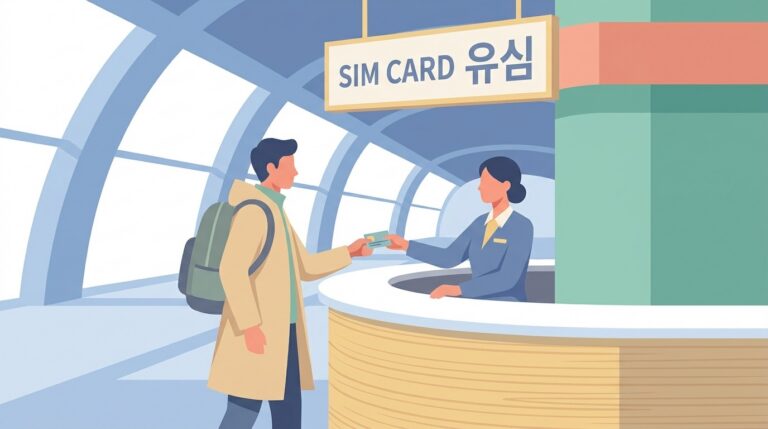
Phase 1: Empathy – Surviving Incheon Airport Without Wi-Fi
안녕하세요! 매일한글 에디터입니다. (Hello! I’m your Daily Hangul editor.)
You’ve just touched down at Incheon International Airport. The flight was long, your legs are stiff, and you finally grab your heavy luggage from the carousel. Your immediate reflex? Pulling out your phone to text your friends: “I made it to Seoul!”
Then comes that cold splash of reality: No Service. The free airport Wi-Fi signals flicker, drop, and leave you staring at a spinning wheel. Suddenly, you feel like the lost protagonist in a K-drama, wandering the sprawling arrival hall trying to find internet access before you can even hail a taxi or navigate Naver Map.
Don’t panic! Finding connectivity in Korea is quick, friendly, and easier than you think. Today, we are learning the exact survival phrases you need to walk up to any telecom kiosk at Incheon Airport and secure your SIM or eSIM in under two minutes. This guide is crafted directly from real feedback from beginner travelers just like you. Let’s make you sound like a confident, respectful visitor from minute one!
Phase 2: Top 3 Core Expressions Deep Dive
1. 유심 어디에서 사요? (Usim eodi-eseo sayo?)
- Pronunciation: [U-sim eo-di-e-seo sa-yo?] (Think: “YOU-seem uh-dee-eh-suh sah-yoh?”)
- Meaning: Literal: “SIM card where at buy?” | Real Nuance: “Where can I buy a SIM card?”
- K-Culture Moment: You will hear travelers ask this at information counters or convenience stores across Seoul. Even K-pop idols traveling abroad use this exact structure when hunting for local SIMs at overseas airports!
- Editor’s Insight: Koreans abbreviate “SIM card” to simply 유심 (Usim). You don’t need to say “SIM card”—just drop the word Usim, and any airport staff member will immediately know what you need.
- Situation Spectrum: Casual 🚫 | Semi-formal (Polite) ✅ | Formal ✅
- 🤔 Think About It: In English, we ask “Where can I buy…?” but Korean gets straight to the point: “Where do I buy?” Why do you think Korean everyday speech skips modal verbs like “can” in routine travel questions?
2. 이심 돼요? (Isim dwaeyo?)
- Pronunciation: [I-sim dwae-yo?] (Sounds like: “EE-seem dway-yoh?”)
- Meaning: Literal: “eSIM becomes/works?” | Real Nuance: “Do you support eSIM? / Can I use an eSIM?”
- K-Culture Moment: Tech-savvy travelers in Korea love skipping physical cards. You’ll see digital nomads in Seongsu cafes flashing their QR codes after asking this simple three-syllable question.
- Editor’s Insight: The magic verb 돼요 (dwaeyo) comes from 되다 (to work, to be possible). It is the single most useful A1 verb in Korea. Point to anything and say “…돼요?” and you’re asking “Does this work? / Can I do this?”
- Situation Spectrum: Casual ⚠️ | Semi-formal (Polite) ✅ | Formal ✅
- 🤔 Think About It: Dwaeyo packs an entire English sentence into two syllables. How does this reflect the Korean cultural desire for fast, friction-free communication?
3. 데이터 무제한이에요? (Deiteo mujehan-ieyo?)
- Pronunciation: [Dae-i-teo mu-je-han-i-e-yo?] (Sounds like: “DAY-ee-tuh moo-jeh-hahn-ee-eh-yoh?”)
- Meaning: Literal: “Data unlimited is it?” | Real Nuance: “Is the data unlimited?”
- K-Culture Moment: In K-dramas, characters binge YouTube or stream music on the Seoul subway without a second thought because Korea’s 5G network is world-renowned. You want that same unlimited freedom while exploring!
- Editor’s Insight: Koreans pronounce “data” as 데이터 (deiteo). Pair it with 무제한 (mujehan), which means “no limits” (無制限).
- Situation Spectrum: Casual 🚫 | Semi-formal (Polite) ✅ | Formal ✅
- 🤔 Think About It: Notice how polite endings like -이에요 (-ieyo) soften questions into courteous inquiries without needing words like “please.”
Phase 3: Textbook Korean vs. Real Korean
Situation 1: Asking where the SIM counter is
- 📖 교과서 한국어 (Textbook): 유심 카드를 어디에서 판매합니까? (Usim kadeureul eodieseo panmaehapnikka?) – “At which location do you vend SIM cards?”
- 🗣️ 진짜 한국어 (Real-life): 유심 어디서 사요? (Usim eodiseo sayo?) – “Where do I buy a SIM?”
- 💡 왜 다를까? (Why the difference?): Old textbooks love ultra-formal words like 판매하다 (to vend/sell). In real life, native speakers shorten 어디에서 (eodieseo) to 어디서 (eodiseo) and use the everyday verb 사다 (to buy).
Situation 2: Checking if your internet is working on the spot
- 📖 교과서 한국어 (Textbook): 인터넷 연결이 정상적으로 작동합니까? (Inteonet yeongyeori jeongsangjeogeuro jakdonghapnikka?) – “Is the internet connection operating normally?”
- 🗣️ 진짜 한국어 (Real-life): 데이터 바로 터져요? (Deiteo baro teojyeoyo?) – “Does the data work right away?”
- 💡 왜 다를까? (Why the difference?): Koreans use the colorful verb 터지다 (to burst/open up) to describe mobile signal and data connecting strongly. Asking if data “bursts” (teojyeoyo) is what true locals say!
Phase 4: K-Culture Deep Dive & Non-Verbal Manners
4-1. 눈치 (Nunchi) & Polite Gestures
When you approach the airport roaming counter (like KT, SKT, or LG U+), eye contact with a gentle nod (목례 – mokrye) sets a warm tone.
* The Two-Handed Handover: When passing your passport and credit card to the staff, always use two hands (or support your right wrist/forearm with your left hand). Handing over payment with one hand can look careless or dismissive.
* The Nunchi Glance: Airport counters are fast-paced. Have your phone unlocked, language set to English (or Korean), and your passport ready in hand before stepping up to the line.
4-2. The “Ppalli-Ppalli” Telecom Booth Culture
Korea is internationally famous for its 빨리빨리 (ppalli-ppalli, hurry-hurry) mindset. At Incheon Airport, staff can swap your physical SIM, test the connection, and tape your original home SIM card to a neat plastic card sleeve in under 60 seconds. Don’t be startled if they work at lightning speed—they are trying to get your Seoul adventure started as smoothly as possible!
Phase 5: Real-Life Roleplay Scenario
Setting: Arrival Hall, Terminal 1, Incheon International Airport. Bright lights, travelers bustling past with luggage. You approach a clean, modern telecom desk staffed by Min-jun (민준).
- You: 저기요, 유심 어디서 사요? (Jeogiyo, usim eodiseo sayo?)
🎭 Walking up with a gentle head tilt and your phone in hand.
(Excuse me, where do I buy a SIM card?) -
Min-jun: 네, 여기서 바로 구매 가능하세요! (Ne, yeogiseo baro gumae ganeunghaseyo!)
🎭 Smiling brightly and pointing to the service menu on the desk.
(Yes, you can purchase one right here!) -
You: 이심 돼요? (Isim dwaeyo?)
🎭 Tapping the back of your smartphone inquiringly.
(Do you support eSIM?) -
Min-jun: 네, 스마트폰 기종이 어떻게 되세요? (Ne, seumateupon gijongi eotteoke doeseyo?)
🎭 Leaning forward slightly to check your phone screen.
(Yes! What smartphone model do you have?) -
You: 아이폰 15예요. 데이터 무제한이에요? (Aipon sibo-yeyo. Deiteo mujehan-ieyo?)
🎭 Showing the settings screen clearly.
(It’s an iPhone 15. Is the data unlimited?) -
Min-jun: 네, 5일 동안 무제한 데이터예요. (Ne, oil dongan mujehan deiteo-yeyo.)
🎭 Pointing to the 5-day package on the printed price guide.
(Yes, it’s unlimited data for 5 days.) -
You: 이걸로 주세요! (Igeollo juseyo!)
🎭 Handing over your passport using both hands.
(Please give me this one!) -
Min-jun: 네, QR 코드 스캔해 드릴게요. 잠시만요! (Ne, QR kodeu seukaenhae deurilgeyo. Jamsimanyo!)
🎭 Handing a printed QR voucher back with two hands.
(Understood, I will help you scan the QR code. Just a moment!)
🔀 Interactive Decision Point
Min-jun points to your phone and asks: “여권 보여주시겠어요? (Can you show me your passport?)” How do you respond?
- Choice A: Say nothing, toss your passport onto the counter with your right hand.
Result: Bad. 🚫 In Korean culture, tossing items or using one hand feels abrupt and slightly impolite. - Choice B: Hand your passport over with both hands and say: “여기 있어요! (Yeogi isseoyo!)”
Result: Best! ✅ Courteous, natural, and shows instant respect for Korean manners. Min-jun will give you top-tier service! - Choice C: Look confused and say: “Passport? No Korean?”
Result: Risk. ⚠️ The staff will switch to English, but you miss out on an easy, confidence-boosting Korean speaking moment!
Phase 6: 10-Second Emotion Shadowing Drill
Practice these short lines out loud with the designated rhythm (/ = brief pause) and emotion!
[😊 Bright & Polite]
저기요, / 유심 어디서 사요?
(Jeogiyo, / usim eodiseo sayo?)-
[🤔 Curious & Direct]
이심 돼요? / 바로 돼요?
(Isim dwaeyo? / baro dwaeyo?) -
[🤩 Relieved & Decisive]
데이터 무제한이에요? / 이걸로 주세요!
(Deiteo mujehan-ieyo? / igeollo juseyo!)
Phase 7: K-Culture Mini Dictionary
- 유심 (Usim) | SIM Card
Short for USIM. Used universally at airports, convenience stores (CU, GS25), and electronics shops across South Korea. - 이심 (Isim) | eSIM
Embedded digital SIM. Rapidly growing in popularity among travelers to avoid removing physical carrier chips. - 통신사 (Tongsin-sa) | Telecommunications Carrier
Refers to Korea’s major telecom brands (SK Telecom, KT, LG U+). Look for these logos as soon as you exit baggage claim. - 무제한 (Mujehan) | Unlimited
Literally “no boundaries.” Essential for checking if your plan has throttling or data caps.
Phase 8: Traveler’s Survival Kit
Survival Expressions TOP 3
- 이걸로 주세요 (Igeollo juseyo) | Please give me this one.
Pro Tip: Simply point to the SIM card package on the desk and say this phrase. - 영수증 주세요 (Yeongsujeung juseyo) | Please give me a receipt.
Pro Tip: Useful if you need to expense your travel internet or keep customer service contact info. - 도와주세요 (Dowajuseyo) | Please help me.
Pro Tip: If your cellular APN settings aren’t connecting automatically, hand your phone over with this phrase.
Editor’s Travel Note
- Where to find booths: In Terminal 1 and Terminal 2, mobile carrier counters are situated immediately outside the Exit Gates on the 1st Floor Arrival Level.
- Essential Pre-Departure Setup: Before you disconnect from airport Wi-Fi, ensure your phone is carrier-unlocked. Download your navigation tools early: search for the official Naver Map mobile app download and install Kakao T taxi hailing app to navigate Korea smoothly.
- Payment Tip: Korea is virtually cashless. International Visa and Mastercard are accepted at all airport telecom kiosks, as are tourist transit cards like WOWPASS.
Phase 9: One Step Deeper
Korean culture places immense value on connection and communal consideration. Notice how Korean beginner phrases frequently finish with the polite suffix -요 (-yo). Even when asking a pragmatic, transactional question in an airport kiosk, adding -yo transforms a bare command into a warm bridge of mutual respect between two strangers. Language in Korea is never just about transferring data; it is about establishing harmony before the conversation even begins.
💬 Your Turn: Have you ever landed in a new country and struggled with phone data? What was the first app you opened? Share your story in the comments below!
Phase 10: FAQ & Common Mistakes
Q: Can I buy a SIM card at airport convenience stores like CU or GS25?
A: Yes! However, you must activate it online through a passport verification portal. If you want instant activation without dealing with online forms, going directly to an official telecom counter (KT, SKT, LG U+) on the 1st floor arrival hall is much faster.
Q: Is an eSIM better than a physical SIM for traveling in Korea?
A: If your smartphone supports eSIM, it is usually faster because you do not have to swap physical cards or risk losing your home country’s tiny SIM tray pin. You simply scan a QR code provided by the booth staff.
Q: Can I make local phone calls with a Korean travel SIM?
A: Most basic tourist travel SIMs offer unlimited data but limited or zero incoming/outgoing voice minutes. If you need to make voice calls to Korean landlines (such as restaurant reservations), ask for a plan that includes a local 010 number with voice capability.
🚨 Common Mistakes Alert!
- Forgetting to check carrier lock: If your phone is locked to your home carrier (AT&T, Docomo, etc.), a Korean SIM card will not work. Call your home provider before flying!
- Throwing away the SIM card plastic holder: Your PIN code, original SIM, and customer service number are on that card. Slip it safely into your wallet.
- Using Google Maps for walking routes: Google Maps does not provide detailed pedestrian directions in South Korea due to domestic mapping regulations. Always rely on Naver Map or KakaoMap.
Phase 11: Action Mission & Engagement
- 🥉 Bronze Mission (Solo Practice): Stand in front of your mirror with your phone. Say “유심 어디서 사요? (Usim eodiseo sayo?)” three times with a bright, welcoming tone.
- 🥈 Silver Mission (Social Share): Save this article, tag a friend you want to travel to Seoul with, and quiz them on the difference between Usim and Isim!
- 🥇 Gold Mission (Real Action): When you land at Incheon Airport, skip English entirely for your first transaction. Use “이심 돼요? (Isim dwaeyo?)” and receive your internet like a true local!
- 🎮 K-Culture Bonus Mission: In your next K-drama binge, listen carefully whenever a character arrives at an airport or asks for a store. See if you can spot the question word 어디 (eodi – where)!
Phase 12: Interactive Quiz Challenge
Question 1 (Situational Choice):
You want to ask the telecom staff member if their data package has no limits. What is the most natural sentence?
a) 데이터 인터넷 좋아요? (Deiteo inteonet joayo?)
b) 데이터 무제한이에요? (Deiteo mujehan-ieyo?)
c) 스마트폰 어디 있어요? (Seumateupon eodi isseoyo?)
Question 2 (Fill-in-the-Blank):
Complete the sentence to ask where to buy a SIM:
“유심 ______ 사요? (Where do I buy a SIM?)”
(Hint: 3 syllables)
Question 3 (True or False Cultural Fact):
In Korea, it is polite to hand over your passport and payment card using only your left hand.
Click to reveal answers & explanations!
- Question 1 Answer: b) 데이터 무제한이에요? (Deiteo mujehan-ieyo?)
Explanation: 무제한 (mujehan) means “unlimited,” making this the exact phrase to check data caps. - Question 2 Answer: 어디서 (eodiseo) or 어디에서 (eodieseo)
Explanation: 어디서 is the everyday conversational contraction of 어디에서 (where at). - Question 3 Answer: False!
Explanation: Always hand items to cashiers and staff using two hands (or right hand supported by your left wrist) as a sign of respect.







