

The Resonance of Silence: How to Speak Volumes by Saying Less in Advanced Korean
Phase 1: Empathy (Story-Driven Opening)
안녕하세요! I’m your editor and cultural navigator from Daily Hangul.
Have you ever watched an award-winning Korean film like Decision to Leave (헤어질 결심) or a contemplative drama like My Liberation Notes (나의 해방일지), only to feel completely floored by a scene where the characters barely say three words? The screen doesn’t ring with long, dramatic monologues. Instead, a character exhales slowly, glances down at a lukewarm cup of tea, and leaves a sentence hanging unfinished in the cool evening air. You sit there, goosebumps prickling your arms, feeling the immense weight of everything that was deliberately left unsaid.
Now, flip that experience over to your own Korean language journey. You’ve conquered advanced grammar, memorized intricate four-character idioms (사자성어), and can debate social phenomena with ease. Yet, one of the most common hurdles experienced C2 learners share with me is what I call the “Hyper-Articulation Trap.” You know so much Korean that you feel compelled to say everything explicitly. When a native speaker uses restraint, trailing off with a delicate ellipsis, learners often rush to fill the void with verbose explanations. The result? You sound grammatically flawless, yet culturally disjointed—like someone banging on an orchestral cymbal in the middle of a temple prayer room.
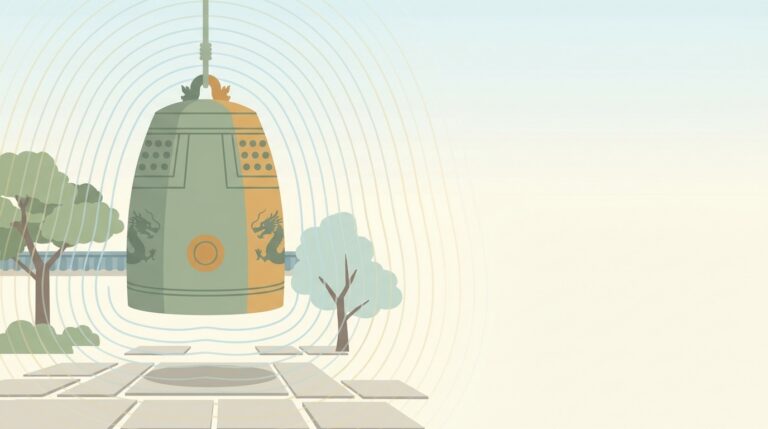
In classical Korean aesthetics, the true majesty of a great temple bell (범종) isn’t the percussive clang of the timber striking the bronze; it is the yeoeum (여음, 餘音)—the undulating, lingering resonance that hums through the mountain mist long after the blow has ceased. In master-level prose and high-register conversation, a brilliant statement doesn’t finish when the period is placed. It begins in the quiet space that opens up inside the listener’s heart. Today, we step beyond mere vocabulary. We are learning the ultimate Korean rhetorical superpower: saying more by saying less through intentional silence, ellipsis, and stylistic understatement (생략과 여운의 미학).
Phase 2: Deep Dive into 3 Core Rhetorical Expressions
To master the art of restraint, you must understand how native Korean stylists engineer intentional gaps. Here are three pinnacle expressions that breathe silence into spoken and written Korean.
1. 말을 아끼다 (Maleul akkida)
- Pronunciation: [Mar-eul ak-kki-da] (Sounds like “mar” as in market, followed by a crisp, tense “kki” like the end of key)
- Meaning:
- Literal: To save / spare one’s words.
- Nuance: To deliberately withhold speech out of respect, solemnity, strategic diplomacy, or profound emotion, understanding that words would only diminish the gravity of the moment.
- K-Culture Moment: Seen frequently in serious legal thrillers or palace sageuk dramas. When a seasoned statesman or mentor is asked to pass judgment on a rival’s tragic mistake, they look into the middle distance and whisper: “지금은 그저 말을 아끼겠습니다” (Jigeumeun geujeo maleul akkigetseumnida / Right now, I will simply spare my words).
- Editor’s Insight: This is not evasive cowardice; it is emotional discipline (jeolje, 절제). Using
말을 아끼다signals that your thought is too vast, painful, or consequential to reduce to cheap soundbites. - Situation Spectrum: Casual: ⚠️ | Semi-formal: ✅ | Formal: ✅
- 🤔 Think About It: In many Western rhetorical traditions, eloquence is measured by assertiveness and exhaustive defense. Why does Korean intellectual culture often equate deliberate silence with the pinnacle of moral depth and dignity?
2. 차마 말을 잇지 못하다 (Chama maleul itji mothada)
- Pronunciation: [Cha-ma mar-eul it-cchi mot-ha-da] (Imagine “Cha” as in chai tea, “ma” like mom, and “itji” with a soft, held stop before the consonant)
- Meaning:
- Literal: Unable to bear connecting one’s words.
- Nuance: Being so overcome with heartbreak, awe, or sorrow that your voice physically falters, leaving the sentence in fragments.
- K-Culture Moment: The climactic scene in My Mister (나의 아저씨) where characters confront shared, unspeakable burdens. Rather than giving a comforting speech, a character catches their breath, looks down, and the script simply reads:
차마 말을 잇지 못한다. - Editor’s Insight: Notice the adverb
차마(chama)—an untranslatable gem implying an internal ethical or emotional inhibition (“cannot bear to”). Pair this with an open-ended trailing sentence (...), and you instantly convey emotional devastation without melodrama. - Situation Spectrum: Casual: ⚠️ | Semi-formal: ✅ | Formal: ✅ (Used extensively in literary journalism, memoirs, and reflective essays)
- 🤔 Think About It: How does allowing your speech to break apart invite the listener to complete your thought, transforming passive listening into shared emotional solidarity?
3. 여운을 남기다 (Yeouneul namgida)
- Pronunciation: [Yeo-un-eul nam-gi-da] (Smooth “Yeo” like the beginning of yawn, followed by an airy “un”)
- Meaning:
- Literal: To leave behind a lingering resonance / aftertaste.
- Nuance: To construct a conclusion—in an essay, a speech, or a parting farewell—that doesn’t lock the door shut, but leaves it gently ajar so its philosophical reverberations echo in the listener’s mind.
- K-Culture Moment: Film critics on Korean cinema programs analyzing a Bong Joon-ho or Lee Chang-dong ending: “결말을 단정 짓지 않고 관객에게 깊은 여운을 남기네요” (Gyeolmareul danjeong jitji anko gwangaegege gipeun yeouneul namgineyo / It leaves a profound lingering resonance for the audience rather than concluding definitively).
- Editor’s Insight: You can use this actively in everyday rhetoric. When finishing an evaluation or heartfelt letter, deliberately end on an evocative image or a rhetorical reflection rather than a tidy summary.
- Situation Spectrum: Casual: ✅ | Semi-formal: ✅ | Formal: ✅
- 🤔 Think About It: In an age of algorithmic content demanding instant resolution, what makes an ambiguous, lingering conclusion (yeoun) feel so profoundly luxurious?
Phase 3: Textbook Korean vs. Real Korean
When foreign learners reach C2, their grammar is spotless, but it often sounds like an academic paper read aloud. Let’s see how native Korean master stylists shift from exhaustive explicitness to exquisite restraint.
Situation 1: Offering Comfort During Profound Tragedy or Loss
- 📖 교과서 한국어 (Textbook):
- 슬픔에 빠진 당신에게 진심으로 깊은 애도를 표하며 부디 힘내시기를 바랍니다. (Seulppeume ppajin dangsinege jinsimeuro gipeun aedoreul pyohamyeo budi himnaesigireul baramnida.)
- “I express sincere deep condolences to you who have fallen into grief and hope you regain your strength.”
- 🗣️ 진짜 한국어 (Literary C2):
- 어떤 말도 지금은 닿지 않겠지만… 그저 곁을 지키겠습니다. (Eotteon maldo jigeumeun datji anketjiman… geujeo gyeoteul jikigetseumnida.)
- “No words could reach you right now, but… I will simply keep watch by your side.”
- 💡 Why the difference? Over-explaining during grief feels transactional and emotionally tone-deaf. Real Korean emotional literacy (gonggam, 공감) acknowledges the sheer inadequacy of human language, letting an ellipsis (
...) carry the heaviest sorrow.
Situation 2: Delivering Nuanced, Critical Feedback on Creative Work
- 📖 교과서 한국어 (Textbook):
- 이 기획안은 논리적인 모순이 많아서 전면적인 수정이 대단히 필요합니다. (I gihoeganeun nollijeogin mosuni manaseo jeonmyeonjeogin sujeong-i daedanhi piryohamnida.)
- “This proposal has many logical contradictions and greatly requires complete revision.”
- 🗣️ 진짜 한국어 (Literary C2):
- 흥미로운 시선입니다만… 작품이 품은 침묵의 결을 조금 더 다듬어보면 어떨까 싶네요. (Heungmiroun siseonimnidaman… jakpumi pumeun chimmugui gyeoreul jogeum deo dadeumeobomyeon eotteolkka simneyo.)
- “It is an intriguing perspective, though… I wonder how it would be if we refined the grain of silence this work holds just a little more.”
- 💡 Why the difference? C2-level professional Korean rarely cuts with blunt knives. By phrasing critique as an inquiry into the work’s “grain of silence” or by trailing off with
어떨까 싶네요, you demonstrate supreme rhetorical finesse without generating defensive friction.
Phase 4: K-Culture Deep Dive & Non-Verbal Manners
4-1. 눈치 (Nunchi) & The Physical Choreography of Restraint
In Korean high-context communication, the period is not placed by your vocal cords; it is punctuated by your body language.
* The Decelerating Gaze: When trailing off on an ellipsis (e.g., 차마...), never maintain laser-sharp eye contact. Native speakers slightly lower their gaze toward the table or tilt it 15 degrees into open space. This signals internal contemplation rather than conversational abandonment.
* The Shared Inhale (호흡 맞추기): When practicing rhetorical silence, don’t freeze like a statue. Take a soft, audible half-breath through your nose and let your shoulders drop slightly. This signals to your partner: “I am not ignoring you; I am sitting with the weight of our shared topic.”
* Nunchi Warning: Never mistake rhetorical silence for a cold shoulder (묵묵부답, mungmungbudap). Silence without warmth is perceived as passive aggression. Pair restraint with a softened brow and gentle posture.
4-2. The Cultural Metaphor: The Divine Bell of King Seongdeok (Emille Bell)
To truly grasp this module, look at Korean sound philosophy. The famous 8th-century Emille Bell (에밀레종) in Gyeongju does not feature a simple hollow chamber; it has an acoustic hollow beneath it on the earth called a yongtong (용통) and an underground resonance pit (myeongdong, 명동). When struck, the initial pitch decays within seconds, but a secondary low-frequency rumble (maekmaek, 맥동현상) pulses for up to three minutes.
Korean literati have revered this phenomenon for millennia. They believe the highest art form is not decorative noise, but yeobaegui mi (여백의 미)—the beauty of empty margins found in Joseon ink wash paintings. When you apply this to Korean rhetoric, you stop trying to cram every thought into sound. You realize that your words exist solely to give contour to the meaningful silence that surrounds them.
Phase 5: Real-Life Roleplay Scenario
Setting: A quiet, traditional tea atelier in Samcheong-dong overlooking rain-slicked tile roofs. You are an author/critic discussing the final cut of an independent art film with Director Han (한 감독), a reclusive, brilliant filmmaker known for poignant minimalism.
Characters:
* 한 감독 (Director Han): Thoughtful, sparing with words, highly attuned to emotional authenticity.
* 나 (You): An articulate cultural critic who understands that deep praise requires restraint.
- 한 감독: 이번 편집본에서 주인공의 마지막 고백 장면을 완전히 덜어냈습니다. 너무 불친절했을까요?
(Ibeon pyeonjipboneseo juingongui majimak gobaek jangmyeoneul wanjeonhi deoreonaetseumnida. Neomu bulchinjeolhaesseulkkayo?)
“In this final cut, I completely excised the protagonist’s closing confession scene. Was it perhaps too unkind to the audience?”
🎭 [차분하게 찻잔을 매만지며 고뇌하는 눈빛으로 / Calmly caressing the teacup with a contemplative gaze] -
나: 아니요, 오히려 그 반대였습니다. 그 대사가 사라진 자리에… 비로소 인물의 생애가 들어앉더군요.
(Aniyo, ohiryeo geu bandaeyeotseumnida. Geu daesaga sarajin jarie… biroso inmului saeng-aega deureoantdeogunyo.)
“No, quite the opposite. In the space where that dialogue vanished… the character’s entire life finally settled in.”
🎭 [나직한 목소리로, 창밖을 잠시 응시하다가 / With a subdued voice, pausing to look out the window] -
한 감독: 인물의 생애라… 말로 채우려 할수록 본질이 달아나는 기분이 들더군요.
(Inmului saeng-aera… mallo chaeuryeo halsurok bonjiri darananeun gibuni deuldeogunyo.)
“The character’s life… The more I tried to fill it with words, the more the essence seemed to flee.”
🎭 [엷은 미소를 지으며 고개를 천천히 끄덕인다 / Nodding slowly with a faint, knowing smile] -
나: 맞습니다. 모든 것을 설명하려는 친절함이야말로 때로는 관객의 상상력을 가두는 법이니까요.
(Matseumnida. Modeun geoseul seolmyeongharyeoneun chinjeolham-iyamallo ttae-roneun gwangaeui sangsangryeogeul gaduneun beobinikkayo.)
“Indeed. That very kindness of attempting to explain everything can sometimes imprison the audience’s imagination.”
🎭 [두 손으로 찻잔을 감싸 쥐며 정중하게 / Cupping the teacup with both hands with gentle reverence] -
한 감독: 평론가님께서 그 여백을 알아봐 주시니, 마음이 한결 놓입니다.
(Pyeongnongannimkkeseo geu yeobaegeul arabwa jusini, maeumi hangyeol noimnida.)
“Hearing that you recognized that negative space sets my mind greatly at ease.”
🎭 [따뜻하게 시선을 맞추며 / Meeting eyes warmly] -
나: 엔딩 크레디트가 다 올라간 뒤에도… 불 꺼진 상영관을 차마 떠나지 못했습니다.
(Ending keurediteuga da ollagan dwiedo… bul kkeojin sang-yeonggwaneul chama tteonaji mothaetseumnida.)
“Even after the end credits fully rolled… I could not bear to leave the darkened theater.”
🎭 [말끝을 부드럽게 흐리며 여운을 남긴다 / Softly trailing off, letting the resonance hover] -
한 감독: 그 긴 침묵이야말로 제가 이 영화를 통해 건네고 싶었던 유일한 문장이었는지도 모릅니다.
(Geu gin chimmug-iyamallo jega i yeonghwareul tonghae geonnego sipeotdeon yuilhan munjang-ieotneunjido moreumnida.)
“That long silence might well have been the only sentence I truly wanted to deliver through this film.”
🎭 [빗소리에 귀를 기울이며 깊은 숨을 쉰다 / Listening to the rain outside, taking a deep breath] -
나: 종소리가 멎은 뒤에 시작되는 울림처럼… 오래도록 가슴에 맴돌 것 같습니다.
(Jongsoriga meojeun dwie sijakdoeneun ullimcheoreom… oraedorok gaseume maemdol geot gatseumnida.)
“Just like the vibration that begins after the bell falls silent… I believe it will circle my heart for a very long time.”
🎭 [미소를 띤 채 침묵을 공유한다 / Sharing the silence with a gentle smile]
🔀 Interactive Branch Point: How Would You Respond Next?
Director Han turns to you and asks: “If you were to sum up this film in your column, would you explain the protagonist’s final choice?”
- Choice A: “당연하죠! 독자들이 결말의 상징성을 이해하지 못하면 안 되니까 모든 복선과 인물의 심리를 하나하나 명쾌하게 논리적으로 풀어낼 예정입니다.”
- Choice B: “아닙니다. 제가 해석을 덧붙이는 순간 영화의 여운을 훼손할 것 같아서, 결말에 대해서는 말을 아끼고 독자 스스로 침묵 속으로 걸어 들어가게 하려 합니다.”
- Choice C: “글쎄요, 쓰기 귀찮으니까 그냥 관객이 알아서 생각하라고 짧게 끝내는 게 제일 편하겠죠.”
Feedback on Your Choice:
- Choice A (Bad – Misses the Aesthetic entirely): While logical, this demonstrates the “hyper-explanation trap.” Telling Director Han you plan to dissect every frame destroys the very artistic space (yeobaek) he fought to protect.
- Choice B (Best – C2 Master Level): Flawless cultural and rhetorical intelligence. You apply
말을 아끼다directly to your critical methodology, acknowledging that the critic’s duty is sometimes to guard the boundary of the unsaid. - Choice C (Risk – Overly flippant): This collapses sophisticated restraint into laziness. Sarcasm or indifference in a high-aesthetic Korean interaction creates serious awkwardness.
Phase 6: 10-Second Emotional Shadowing Drill
Read these sentences aloud. Observe the / markings—these are not pauses for breathing, but structural suspensions where the emotional resonance (yeoun) hangs in the air.
[🍂 긴 여운을 머금고 덤덤하게 / With a calm, lingering resonance]
마지막 마침표를 찍은 뒤에도… / 한동안 펜을 / 내려놓지 못했습니다.
(Majimak machimpyoreul jjigeun dwiedo… / handong-an peneul / naeryeonotji mothaetseumnida.)
“Even after placing the final period… / for quite a while / I could not set the pen down.”-
[🤫 숨을 고르며 나직하게 / Gathering breath, in a hushed undertone]
더 많은 말로 위로하기보다는… / 그저 그 침묵의 곁에 / 나란히 앉아 있고 싶었습니다.
(Deo maneun mallo wirohagibodaneun… / geujeo geu chimmugui gyeote / naranhi anja itgo sipeotseumnida.)
“Rather than comforting with more words… / I simply wanted to sit side by side / next to that silence.” -
[⚖️ 결연하고 무게감 있게 / Resolute and weighted with dignity]
진실의 무게를 알기에… / 오늘은 구차한 변명 대신 / 말을 아끼겠습니다.
(Jinsirui muge-reul algie… / oneureun guchahan byeonmyeong daesin / maleul akkigetseumnida.)
“Knowing the weight of truth… / today, instead of petty excuses / I shall spare my words.”
Phase 7: K-Culture Mini Dictionary
-
여운 (餘韻 – Yeoun)
Literal translation: Lingering sound / resonance.
Real-World Usage: The emotional aftermath of an experience that ripples in your mind long after it concludes. Used to describe books, melodies, breakups, or profound encounters.
Example: “그 영화는 엔딩 크레디트가 끝난 뒤부터 진짜 여운이 시작된다.” (The true resonance of that movie begins only after the credits end.) -
여백의 미 (餘白의 美 – Yeobaegui mi)
Literal translation: The beauty of negative space / blank margins.
Real-World Usage: Originally used in Joseon ink painting, now widely applied to writing, architecture, conversation, and lifestyle minimalism. It means leaving deliberate room for breath and imagination. -
절제 (節制 – Jeolje)
Literal translation: Restraint / moderation / temperance.
Real-World Usage: In Korean literary arts, jeolje is considered the highest virtue. An actor who sheds one quiet tear under a brimmed hat demonstrates far higher jeolje than one wailing uncontrollably on the floor. -
행간 (行間 – Haenggan)
Literal translation: Between the lines.
Real-World Usage: Commonly used in the idiom행간을 읽다(to read between the lines). At the C2 level, you do not just listen to the words spoken; you analyze the intentional silences that bridge the gap between them.
Phase 8: Traveler’s Survival Kit (For Cultural Connoisseurs)
When exploring Korea’s contemplative spaces—zen gardens, temple stays, or classical tea houses—verbal hyper-activity breaks the spell. Here are three sophisticated survival phrases for quiet spaces:
- TOP 1: 고즈넉한 여운이 참 좋네요. (Gojeuneokan yeouni cham jonneyo.)
Translation: “The tranquil, lingering resonance here is truly wonderful.”
Pro Tip: Use this when speaking with a tea master or temple host in places like Bukchon or Tongdosa. It immediately establishes you as someone who values depth over superficial tourism. -
TOP 2: 잠시 생각에 잠겨도 될까요? (Jamsi saenggage jamgyeodo doelkkayo?)
Translation: “May I immerse myself in thought for a moment?”
Pro Tip: Perfect when you want to pause a guided tour at an art museum or quiet palace pavilion without sounding aloof or uncooperative. -
TOP 3: 마음에 오래 머물 것 같습니다. (Maeume orae meomul geot gatseumnida.)
Translation: “I think this will remain in my heart for a long time.”
Pro Tip: The ultimate parting compliment to a chef at a traditional fine dining restaurant or an artisan after a cultural craft experience.
Editor’s Travel Note: Finding the Resonance of Silence in Seoul
If you want to experience the architectural embodiment of yeobaegui mi, visit the Room of Quiet Contemplation (사유의 방) at the National Museum of Korea in Ichon-dong. It houses two National Treasure Pensive Bodhisattvas in a vast, dark, sloping hall filled with profound acoustic silence. Before you go, check the 국립중앙박물관 공식 관람 예약 안내 페이지 for visitor hours, and navigate effortlessly via the 네이버 지도 앱 다운로드 to reach the quieter side pavilions without getting lost in the station rush.
Phase 9: “Going One Step Deeper” (Reflective Cultural Essay)
In classical Western rhetoric rooted in Aristotle and Cicero, the orator wins by proof, volume, logical exhaustion, and undeniable presence. The speaker’s ego must command the room. In East Asian literary theory, however, language has long been viewed with deep epistemological suspicion: “The Tao that can be spoken is not the eternal Tao.”
In Korea, this skepticism merged with centuries of high-context communal life (jeong, 정) and historical tragedies (han, 한). When an ancient Sijo poet wrote the third line of a three-verse poem, convention dictated an emotional twist followed by an open breath: a three-syllable drop into silence. To express grief or devotion entirely in words was considered vulgar—proof that the feeling was shallow enough to be quantified. Deep emotion is like groundwater: the moment it breaches the surface completely, it evaporates. By leaving your sentence suspended with an intentional ellipsis, you are not failing to finish your thought; you are inviting the other soul to step across the threshold and co-create the meaning with you.
💬 Your Turn: Have you ever experienced a moment in your native culture or personal life where saying nothing at all spoke infinitely more than a well-crafted speech? Share your memory in the comments below in Korean using 말을 아끼다 or 여운!
Phase 10: FAQ & Avoiding Common Pitfalls (FAQ Schema Ready)
Q: Does trailing off with an ellipsis (...) make me sound unconfident or hesitant in professional Korean?
A: Context is everything. If you trail off because you don’t know the vocabulary, it registers as hesitation. But if you deliver a crisp premise, lower your vocal pitch, pause with an intentional gaze, and conclude with an understated structure like ~생각해 보게 됩니다..., it signals supreme intellectual maturity and contemplative weight.
Q: How do I know the difference between an awkward silence (어색한 침묵) and a meaningful silence (의미 있는 여운)?
A: Awkward silence happens when both parties are anxious about what to say next, shifting their eyes frantically. A meaningful silence occurs when both parties are honoring what was just said, breathing together, and letting the resonance settle before moving forward.
Q: Can I use 말을 아끼다 when talking to casual friends?
A: You can, but use it with playful or dramatic self-awareness! If a friend asks you for gossip about an ex and you say: “그 사람에 대해선… 말을 아낄게” (Geu sarame daehaeseon… maleul akkilge), it sounds delightfully witty, mysterious, and restrained.
🚨 Common Mistakes Warning Board: Foreign C2 Learners
- Mistake 1: Treating
...as a filler pause (like “um” or “uh”).
Correction: An ellipsis in literary Korean is an active punctuation mark, not a hesitation. Don’t say “어… 그게…” when you mean to craft an understated pause. Hold the silence completely without vocal clutter. - Mistake 2: Over-using
말을 아끼다in business negotiations to avoid accountability.
Correction: In operational meetings where quick decisions are needed, withholding your opinion by saying말을 아끼겠습니다can sound passive-aggressive or uncooperative. Reserve it for ethical, creative, or deeply personal discussions. - Mistake 3: Forgetting the grammar marker in trailing sentences.
Correction: Don’t just stop at random nouns. When native speakers trail off, they anchor it with evocative grammatical endings like~을 텐데요...,~을지도 모르겠습니다만..., or~하기에는....
Phase 11: Action Missions
- 🥉 Bronze Mission (Solo Mastery):
Record a 15-second voice memo on your phone describing your favorite Korean book or film. Incorporate at least one intentional 2-second pause with/and use the phrase깊은 여운을 남기다. - 🥈 Silver Mission (Social Challenge):
Write an Instagram caption or X (Twitter) post about an art exhibition, a tranquil travel destination, or a quiet sunset using an understated closing sentence ending in.... Tag#매일한글 #여운의미학. - 🥇 Gold Mission (Real-World Practice):
In your next long conversation with a native Korean speaker or tutor, deliberately catch yourself before over-explaining a complex emotion. Instead, use차마 다 말로 표현할 수는 없지만...and let the silence bridge the rest. - 🎮 K-Culture Treasure Hunt Mission:
Watch the final 10 minutes of an acclaimed Korean art cinema classic (such as Poetry [시] or Spring, Summer, Fall, Winter… and Spring). Count how many words are spoken in the concluding sequence and analyze how the director used sound design to create yeoeum (여음).
Phase 12: Interactive Quiz Challenge
Test your mastery of Korean rhetorical restraint! Read each question carefully before toggling the spoiler.
1. Context Judgment
Which of the following responses displays the highest level of C2 aesthetic restraint when visiting a memorial or a solemn commemorative site with a Korean colleague?
* A) “여기는 역사적 비극이 일어난 장소이므로 우리는 매우 엄숙한 태도를 취하며 슬퍼해야 마땅합니다.”
* B) “역사의 무게 앞에… 그저 말을 아끼게 되네요.”
* C) “너무 조용해서 심심하니까 다음 장소로 빨리 이동하는 편이 좋겠습니다.”
👉 Click to Reveal Answer & Analysis
Correct Answer: B
Analysis: Option A is a classic textbook over-explanation that states the obvious in stiff, dry prose. Option C is culturally insensitive. Option B uses 말을 아끼다 combined with an open ellipsis (...), capturing the solemnity of history with refined elegance.
2. Fill in the Blank
Complete the sentence using the most fitting rhetorical noun for lingering resonance:
“그 소설의 마지막 문장을 덮고 난 후에도 오랫동안 가슴속에 맑은 ( )이/가 맴돌았다.”
👉 Click to Reveal Answer & Analysis
Correct Answer: 여운 (Yeoun)
Analysis: While 소리 (sound) or 기억 (memory) would be grammatically acceptable, only 여운 (lingering resonance / echo) fits the elevated poetic register of a profound piece of prose circulating in the reader’s heart.
3. True / False Cultural Insight
Statement: In Korean high-context communication, leaving a sentence deliberately incomplete using an ellipsis (...) is always considered a sign of poor grammar and uneducated speech in formal writing.
👉 Click to Reveal Answer & Analysis
Correct Answer: FALSE
Analysis: In high-register literature, literary journalism, memorial addresses, and artistic critiques, intentional ellipsis and restraint (jeolje) are considered the hallmarks of master stylists. Far from being uneducated, knowing when to stop speaking is the ultimate test of advanced language artistry.







