

Phase 1: Empathy (Story-driven Opening)
안녕하세요! 매일한글 에디터입니다. (Hello! This is your Daily Hangul editor.)
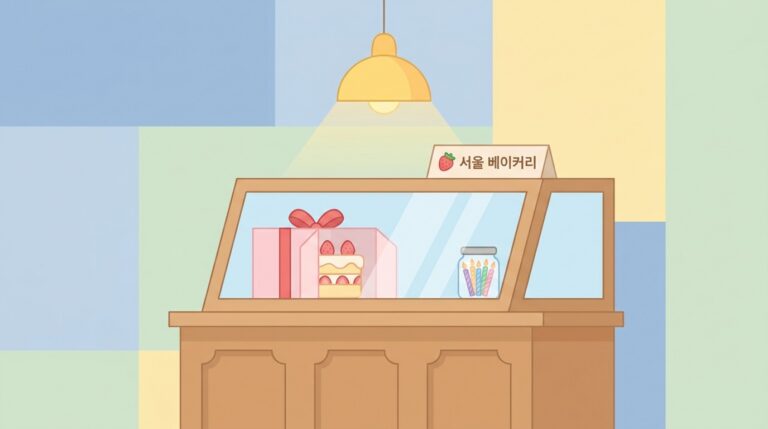
Picture this: You are standing inside an impossibly aesthetic dessert bakery in Yeonnam-dong, Seoul. The air smells like sweet vanilla, melted butter, and fresh espresso. Behind the sparkling glass display case sits a pristine strawberry whipped-cream cake, glowing under the warm café lights. It is your friend’s birthday tonight, and you want to be the hero who brings the centerpiece of the celebration.
You step up to the counter, point at the cake, and the baker smiles warmly. But before you can pull out your card, she asks you a rapid-fire question: “초 몇 개 챙겨 드릴까요?” (Cho myeot gae chaeng-gyeo deu-ril-kka-yo? / How many candles should I pack for you?)
Suddenly, your mind freezes. You know numbers in Korean, but how do you say “candles”? How do you ask for five? And why does the display show both extra-long candles and cute mini candles? Do you have to pay extra for matches and a knife?
If you have ever felt that sudden spike of panic at a Korean bakery counter, breathe easy. You are definitely not alone! Hundreds of our learners have told us that ordering a birthday cake was one of their most nerve-wracking everyday challenges in Korea. In this guide, we will turn that stressful moment into a smooth, fun, and culturally savvy victory. By the end of this lesson, you will confidently say: 생일 케이크로 쓸 건데 초 다섯 개 챙겨 주세요 (Saeng-il ke-i-keu-ro sseul geon-de cho da-seot gae chaeng-gyeo ju-se-yo) like a seasoned Seoul resident!
Phase 2: Key Expressions Deep Dive
1. 생일 케이크로 쓸 건데 초 다섯 개 챙겨 주세요 (Saeng-il ke-i-keu-ro sseul geon-de cho da-seot gae chaeng-gyeo ju-se-yo)
- Pronunciation: [Saeng-il ke-i-keu-ro sseul geon-de cho da-seot gae chaeng-gyeo ju-se-yo] (Pronunciation tip: Think of chaeng-gyeo like the English word “chang” with a soft “gyo” at the end!)
- Meaning: Literal: “I’m going to use it as a birthday cake, so please pack five candles.” Nuance: “It’s for a birthday cake, please include five candles.”
- K-Culture Moment: You will see this scene constantly in K-dramas when the male lead sneaks off to buy a surprise cake for a celebration at the office or on a rooftop.
- Editor’s Insight: Notice the verb 챙겨 주세요 (chaeng-gyeo ju-se-yo) instead of just 주세요 (ju-se-yo). 챙기다 (chaeng-gi-da) means “to take care of,” “to pack thoughtfully,” or “to gather up items so nothing is missed.” Using it sounds much more natural and polite when asking clerks to add accessories or utensils!
- Situation Spectrum: Casual ⚠️ | Semi-formal ✅ | Formal ✅
- 🤔 Think About It: In many Western countries, birthday candles are sold separately in retail aisles. Why do you think Korean bakeries routinely offer complimentary candles and matches with cake purchases?
2. 큰 초 세 개랑 작은 초 두 개 주세요 (Keun cho se gae-rang ja-geun cho du gae ju-se-yo)
- Pronunciation: [Keun cho se gae-rang ja-geun cho du gae ju-se-yo] (Keun rhymes with “gun”, cho sounds like “choh”, and ja-geun sounds like “jah-geun”.)
- Meaning: Literal: “Please give me three big candles and two small candles.” Nuance: “Could I have 3 large candles and 2 small candles, please? (Representing 32!)”
- K-Culture Moment: In Korea, traditional birthday candles decode a person’s age: 큰 초 (keun cho / large candle) equals 10 years, and 작은 초 (ja-geun cho / small candle) equals 1 year. So 32 years old is 3 big candles and 2 small ones!
- Editor’s Insight: If the birthday person is sensitive about showing their age, Koreans often skip the exact count and ask for just a few candles or a single number candle! You can always say: 초 다섯 개만 주세요 (Cho da-seot gae-man ju-se-yo / Just give me five candles, please).
- Situation Spectrum: Casual ⚠️ | Semi-formal ✅ | Formal ✅
- 🤔 Think About It: How does this two-tier candle math system reflect Korean efficiency and attention to communal ritual?
3. 성냥이랑 빵칼도 들어 있나요? (Seong-nyang-i-rang ppang-kal-do deul-eo in-na-yo?)
- Pronunciation: [Seong-nyang-i-rang ppang-kal-do deul-eo in-na-yo?] (Sound metaphor: Seong-nyang sounds like “sung-nyang”, and ppang-kal has a crisp double-P pop like “pahng-kahl”.)
- Meaning: Literal: “Are matches and a bread knife inside too?” Nuance: “Does this come with matches and a cake knife inside?”
- K-Culture Moment: Picture a romantic K-movie picnic at the Han River park at sunset. You pop open the cake box, pull out the long plastic knife, and unscrew the plastic base—revealing tiny matches stored inside the handle! Pure Korean design genius.
- Editor’s Insight: Almost every whole-cake box in Korea comes standard with a plastic cutting knife that hides two matches inside its hollow handle. But asking this sentence confirms that you will not end up at your party with a gorgeous cake and zero way to light it!
- Situation Spectrum: Casual ⚠️ | Semi-formal ✅ | Formal ✅
- 🤔 Think About It: Small conveniences like hidden matches show how Korean service culture anticipates a customer’s every next step. Where else have you noticed this in Korea?
Phase 3: Textbook Korean vs Real-life Korean
Situation 1: Telling the clerk how many candles you need
- 📖 교과서 한국어 (Textbook): 초를 다섯 개 주십시오. (Cho-reul da-seot gae ju-sip-si-o.)
- 🗣️ 진짜 한국어 (Real-life): 초 다섯 개만 챙겨 주세요. (Cho da-seot gae-man chaeng-gyeo ju-se-yo.)
- 💡 왜 다를까? (Why it differs): “-주십시오 (-ju-sip-si-o)” sounds like a military command or a formal public broadcast. Adding the softening particle -만 (-man / only/just) and using 챙겨 주세요 (chaeng-gyeo ju-se-yo) creates a warm, polite, and friendly conversational request.
Situation 2: Stating that the cake is for a birthday celebration
- 📖 교과서 한국어 (Textbook): 이것은 생일 축하용 케이크입니다. (I-geot-eun saeng-il chuk-ha-yong ke-i-keu-im-ni-da.)
- 🗣️ 진짜 한국어 (Real-life): 생일 케이크로 쓸 거라서요. (Saeng-il ke-i-keu-ro sseul geo-ra-seo-yo.)
- 💡 왜 다를까? (Why it differs): Textbook Korean uses stiff Sino-Korean compound nouns like “축하용 (for celebration purpose)”. In everyday spoken Korean, locals use the gentle background clause -(으)로 쓸 거라서요 (Because I’m going to use it as…), which naturally explains why you need the extra accessories.
Phase 4: K-Culture Deep Dive & Non-Verbal Etiquette
4-1. 눈치 (Nunchi) & Body Gestures at the Bakery Counter
When you purchase a cake in Korea, payment and package handoffs follow a subtle, elegant rhythm:
1. The Two-Handed Hand-off (두 손 전달): When the cashier hands you the cake box ribbon handle, receive it using both hands, or support your right forearm lightly with your left hand. Do the same when presenting your payment card.
2. The Polite Head Tilt: As you say “초 다섯 개 챙겨 주세요,” give a small 15-degree nod. It signals warmth and appreciation without feeling rigid.
3. Eye Contact & Cake Inspection: In Korea, the baker will often show you the cake in the box before sealing it shut to let you verify there are no scratches on the frosting. Give a quick nod and say: “네, 좋아요! 감사합니다! (Ne, jo-a-yo! Gam-sa-ham-ni-da! / Yes, it looks great! Thank you!)”.
4-2. Cultural Code: The Korean Birthday Cake Culture
In South Korea, cakes are not just desserts; they are celebratory theater! If you walk down the streets of Hongdae, Gangnam, or Itaewon on a Friday night, you will see countless people walking with colorful square bakery boxes dangling from their fingers.
Korean bakeries also invented the art of minimizing awkwardness: if someone is turning 39 or 45, the staff won’t loudly count out four long candles and five short candles in front of a crowded store. Instead, they will quietly hand you a neat pack or simply ask: “초는 몇 개 드릴까요? (Cho-neun myeot gae deu-ril-kka-yo? / How many candles should I give you?)”. You can freely pick any number of candles you like—many friends simply ask for 3 or 5 cute candles to keep the cake pretty and avoid burning the frosting!
Phase 5: Real Roleplay Scenario
Setting: 달콤 베이커리 (Sweet Bakery), a bright and modern bakery cafe in Seoul.
Characters:
* Alex (알렉스): An international student buying a surprise cake for a classmate.
* Staff (직원 민지): A cheerful bakery staff member tying ribbon boxes.
- 직원 (Staff): 어서 오세요! 케이크 포장 도와드릴까요? (Eo-seo o-se-yo! Ke-i-keu po-jang do-wa-deu-ril-kka-yo?)
Translation: Welcome! Can I help you pack a cake?
🎭 행동 지문:Wipes hands on apron and smiles brightly. - 알렉스 (Alex): 네! 이 딸기 생크림 케이크 하나 주세요. (Ne! I ttal-gi saeng-keu-rim ke-i-keu ha-na ju-se-yo.)
Translation: Yes! Please give me one of this strawberry whipped-cream cake.
🎭 행동 지문:Points gently at the cake display case with two fingers together. - 직원 (Staff): 네, 딸기 생크림 케이크 준비해 드릴게요. 초 필요하세요? (Ne, ttal-gi saeng-keu-rim ke-i-keu jun-bi-hae deu-ril-ge-yo. Cho pil-yo-ha-se-yo?)
Translation: Sure, I’ll prepare the strawberry whipped-cream cake. Do you need candles?
🎭 행동 지문:Carefully lifts the cake box and reaches toward the candle organizer. - 알렉스 (Alex): 네, 생일 케이크로 쓸 건데 초 다섯 개 챙겨 주세요. (Ne, saeng-il ke-i-keu-ro sseul geon-de cho da-seot gae chaeng-gyeo ju-se-yo.)
Translation: Yes, it’s for a birthday cake, please include five candles.
🎭 행동 지문:Speaks clearly and gives a polite head nod. - 직원 (Staff): 긴 초랑 짧은 초 중에 어떻게 드릴까요? (Gin cho-rang jjal-beun cho jung-e eo-tteo-ke deu-ril-kka-yo?)
Translation: How would you like them between long candles and short candles?
🎭 행동 지문:Holds up one long candle and one short candle for Alex to see. - 알렉스 (Alex): 긴 초 두 개랑 짧은 초 세 개 주세요. (Gin cho du gae-rang jjal-beun cho se gae ju-se-yo.)
Translation: Please give me two long candles and three short candles.
🎭 행동 지문:Holds up two fingers, then three fingers with a friendly smile. - 직원 (Staff): 네! 성냥이랑 칼은 상자 안에 넣어 드렸어요. 결제 도와드릴게요. (Ne! Seong-nyang-i-rang kal-eun sang-ja an-e neo-eo deu-ryeot-eo-yo. Gyeol-je do-wa-deu-ril-ge-yo.)
Translation: Yes! Matches and a knife have been placed inside the box. I’ll help you with payment.
🎭 행동 지문:Places the taped plastic knife against the inner side of the box and turns the card reader toward Alex. - 알렉스 (Alex): 감사합니다! 맛있게 먹을게요. (Gam-sa-ham-ni-da! Mas-it-ge meog-eul-ge-yo.)
Translation: Thank you! We will enjoy eating it.
🎭 행동 지문:Hands payment card over using both hands.
🔀 Interactive Branch Point: When the staff asks “초 필요하세요? (Do you need candles?)”
What should you reply if you want candles for a 25th birthday?
* Option A: “그냥 다섯 개만 주세요.” (Geu-nyang da-seot gae-man ju-se-yo. / Just give me five, whatever.)
* Feedback (Risk): The staff will understand, but they won’t know if you want long or short candles, prompting a confused follow-up question.
* Option B: “긴 초 두 개, 작은 초 다섯 개 챙겨 주세요.” (Gin cho du gae, ja-geun cho da-seot gae chaeng-gyeo ju-se-yo. / Please pack two long candles and five short candles.)
* Feedback (Best! ⭐): Perfect Korean! 2 long candles (20) + 5 short candles (5) = 25 years old! The clerk will pack them instantly.
* Option C: “촛불 주세요!” (Chot-bul ju-se-yo! / Please give me candlelight!)
* Feedback (Bad ❌): “촛불” literally means the lit flame on a candle! You might get a bewildered look from the cashier. Always say 초 (cho) for the physical candles.
Phase 6: 10-Second Emotion Shadowing Drill
Practice these lines out loud! Follow the rhythm slashes / for natural pauses:
[😊 설레고 다정하게 / Excited & Friendly]
생일 케이크로 쓸 건데 / 초 다섯 개 / 챙겨 주세요.
(Saeng-il ke-i-keu-ro sseul geon-de / cho da-seot gae / chaeng-gyeo ju-se-yo.)-
[🤔 생각하며 또박또박 / Thoughtful & Articulate]
큰 초 두 개랑 / 작은 초 세 개 / 부탁드려요.
(Keun cho du gae-rang / ja-geun cho se gae / bu-tak-deu-ryeo-yo.) -
[👀 확인하듯 상냥하게 / Inquiring & Sweet]
성냥이랑 빵칼도 / 안에 들어 있나요?
(Seong-nyang-i-rang ppang-kal-do / an-e deul-eo in-na-yo?)
Phase 7: K-Culture Mini Dictionary
-
초 (Cho) | Candle
Everyday Use: The standard counter noun for candles is 개 (gae). Example: 초 세 개 (cho se gae / three candles). -
조각케이크 (Jo-gak ke-i-keu) | Slice Cake
Everyday Use: When visiting dessert cafes with friends, you order 조각케이크 (slice cake) to eat on site and 홀케이크 (whole cake) for parties! -
포장 (Po-jang) | Takeout / Gift Packaging
Everyday Use: If the clerk asks “드시고 가세요, 포장이세요? (Eating here or taking out?)”, answer simply with: “포장해 주세요! (Po-jang-hae ju-se-yo! / Please pack it to go!)”. -
성냥 (Seong-nyang) | Matches
Everyday Use: Used mostly for cakes and camping in modern Korea. The miniature wooden matches are usually tucked neatly inside the plastic cake knife handle.
Phase 8: Traveler’s Survival Kit
Top 3 Survival Phrases for Korean Bakeries
- 포장해 주세요 (Po-jang-hae ju-se-yo)
- English: “Please pack this to go.”
- Pro Tip: Say this right after selecting any pastry from a bakery tray!
- 초는 안 주셔도 돼요 (Cho-neun an ju-syeo-do dwae-yo)
- English: “You don’t need to give me candles.”
- Pro Tip: Use this if you are just buying a whole cake to eat at home with family and don’t need candles.
- 이 케이크 많이 달아요? (I ke-i-keu man-i dal-a-yo?)
- English: “Is this cake very sweet?”
- Pro Tip: Koreans famously compliment desserts by saying “달지 않아서 맛있다! (It’s delicious because it’s not overly sweet!)”. Asking this helps you find balanced, airy cakes.
Editor’s Travel Note
- Navigation Tip: When hunting for the trendiest artisan bakeries in Seoul’s Seongsu or Hannam districts, use the Naver Map mobile app download rather than Google Maps, which often has outdated opening hours for small pastry shops.
- Payment & Transport: Almost all Korean bakeries accept international credit cards, Apple Pay, and local contactless options. If you are taking a cake on the subway, carry it carefully by both handles—Seoul metro doors close quickly!
Phase 9: “One Step Deeper” (Cultural Reflection)
In Korean culture, birthdays are marked by two essential culinary traditions: savory 미역국 (seaweed soup) cooked with love in the morning, and a shared sweet cake in the evening.
Sharing a birthday cake in Korea is deeply communal. Instead of carving the cake into isolated portions in the kitchen, the cake is brought out whole, candles blazing, with everyone gathered tightly around. After blowing out the candles, the birthday person makes the ceremonial first cut, and everyone digs in together with small forks. Ordering the right candles is not just a commercial transaction; it is your personal contribution to that warm, shared ritual of collective celebration (정, Jeong).
💬 Your Turn: How do you celebrate birthdays in your home country? Would you prefer a cake packed with your exact age in candles, or just a few pretty ones? Let us know in the comments below!
Phase 10: FAQ & Misconception Buster
Q: Do I need to pay extra money for the candles, knife, and matches?
A: In almost all traditional Korean bakeries and chain stores (like Paris Baguette or Tous Les Jours), standard long and short candles, plastic knives, and matches are provided completely free with any whole-cake purchase! However, if you want fancy specialty items (like metallic spiral candles, LED letters, or cute bear-shaped wax candles), those are sold separately at the display stand for around 1,000 to 3,000 KRW.
Q: How do I tell the staff the exact age without counting candles in Korean?
A: You can simply tell them the age number! For example, if your friend is 28, you can say: “스물여덟 살이에요 (Seu-mul-yeo-deol sal-i-e-yo / They are 28 years old)”. The staff will automatically pick 2 long candles and 8 short candles for you!
Q: What if I only buy a slice of cake (조각케이크)? Can I still get candles?
A: Yes, absolutely! Just ask politely: “조각케이크인데 초 하나만 주실 수 있나요? (Jo-gak ke-i-keu-in-de cho ha-na-man ju-sil su in-na-yo? / It’s a slice cake, but could I get just one candle?)”. Most café baristas will happily give you one or two candles with a smile.
🚨 Common Mistakes Alert
- Saying “촛불 주세요 (Chot-bul ju-se-yo)”: 촛불 means the literal burning flame, not the wax candle stick! Correct Action: Always ask for 초 (cho).
- Confusing Pure Korean and Sino-Korean Numbers: When counting candles, always use Pure Korean numbers: 하나 (ha-na), 둘 (dul), 셋 (set), 넷 (net), 다섯 (da-seot) combined with the counter 개 (gae). Saying “일 개 (il-gae)” or “오 개 (o-gae)” sounds unnatural.
- Looking Everywhere for Matches: Don’t buy a lighter at the convenience store before checking inside your cake box! Correct Action: Look at the bottom of the plastic knife handle; pop the cap off, and your matches will slide right out.
Phase 11: Action Mission & Engagement
Ready to put your Korean bakery skills to work? Take on our 3-step challenge:
- 🥉 Bronze Level: Stand in front of your mirror and practice the phrase: “생일 케이크로 쓸 건데 초 다섯 개 챙겨 주세요!” three times until your tongue glides over 챙겨 주세요 smoothly.
- 🥈 Silver Level: Find a picture of a delicious Korean cake on Instagram, save it to your story, and caption it in Korean: “초 다섯 개 챙겨 주세요! 🎂”.
- 🥇 Gold Level: Visit a local Korean bakery or cafe this week. Order your treat and ask for candles using our key phrase completely in Korean!
🎮 K-Culture Mission: The next time you watch a modern K-drama, listen closely during any birthday scene. Listen for whether someone says “초 챙겼어? (Did you pack the candles?)” or check if the cake has long and short candles!
Phase 12: Interactive Quiz Challenge
Test your knowledge with these three quick questions:
- Situation Judgment: You are buying a cake for your friend’s 34th birthday. What candle combination should you request from the baker?
- A) 큰 초 4개, 작은 초 3개 (Keun cho ne gae, ja-geun cho se gae)
- B) 큰 초 3개, 작은 초 4개 (Keun cho se gae, ja-geun cho ne gae)
- C) 그냥 초 34개 (Geu-nyang cho sam-sip-sa gae)
- Fill-in-the-Blank: Complete the sentence with the natural verb meaning ‘to pack thoughtfully’:
- “생일 케이크로 쓸 건데 초 좀 ________ 주세요.”
- (Hint: Starts with 챙…)
- True or False Culture Check: In Korea, cake knives often contain matches hidden directly inside their handles. (True / False)
👉 Click to reveal answers & explanations!
-
Answer: B) 큰 초 3개, 작은 초 4개 (Keun cho se gae, ja-geun cho ne gae)
Explanation: In Korean birthday candle etiquette, each large candle (큰 초) represents 10 years, and each small candle (작은 초) represents 1 year. 3 large (30) + 4 small (4) = 34! -
Answer: 챙겨 (chaeng-gyeo)
Explanation: The verb 챙기다 (chaeng-gi-da) means to thoughtfully pack or include accessories so you don’t miss anything. -
Answer: True!
Explanation: Korean bakery plastic knives almost always feature a hollow base that stores two small safety matches, so you never have to scramble for a lighter!







