

안녕하세요! 매일한글 에디터입니다.
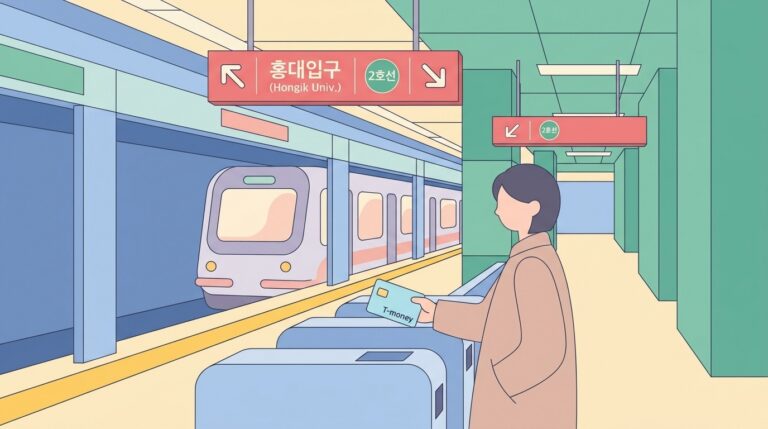
Picture this: You are exploring the vibrant streets of Seoul. You just enjoyed a steaming bowl of tteokbokki in Hongdae, and you are rushing down the stairs into the subway station to catch the green Line 2 train to Gangnam. You tap your transport card with a perky bbi-bik!, breeze through the turnstile, and walk onto the platform. But wait—you look up at the electronic overhead sign, and your heart sinks. The train pulling in is heading toward Sinchon, the exact opposite direction of where you want to go!
You look around frantically. You see metal barriers, turnstiles, and staircases, but no obvious bridge to the other track. Do you have to tap out, pay twice, and lose money? Do you stand there frozen while thousands of busy Seoul commuters rush past you with Olympic speed? We have all been there. Even after living in Korea for years, navigating the maze-like transfer stations like Sindorim or Express Bus Terminal can occasionally throw anyone off balance.
Don’t panic! Making a wrong turn on the subway is practically a rite of passage for every traveler in Korea. The good news? You almost never need to pay twice or get stranded. In this guide, created from real feedback and frequent questions from our beginner students here at Daily Hangul, you will learn the exact phrases you need to ask how to cross over to the opposite platform smoothly, politely, and with total confidence.
Phase 2: Core 3 Expressions Deep Dive
1. 반대편으로 가세요 (Bandaepyeon-euro gaseyo)
- Pronunciation: Bandaepyeon-euro gaseyo (Sounds like: bahn-dae-pyeon-oo-roh gah-seh-yo. Tip: Bandae rhymes with “sundae”!)
- Meaning: Literal: “Please go toward the opposite side.” / Real Nuance: “Cross over to the platform on the other side.”
- K-Culture Moment: You will often hear station workers say this in K-dramas when a panicked main character is rushing across the city to confess love or stop an airplane flight, only to realize they are on the wrong subway track.
- Editor’s Insight: The word 반대편 (bandaepyeon) means “opposite side” (반대 = opposite, 편 = direction/side). The particle -(으)로 (-(eu)ro) indicates direction (“toward”), and 가세요 (gaseyo) is the polite imperative for “please go.”
- Situation Spectrum:
- Casual (Friends): 🚫 반대편으로 가 (Bandaepyeon-euro ga)
- Semi-formal (Everyday polite): ✅ 반대편으로 가세요 (Bandaepyeon-euro gaseyo)
- Formal (Official broadcasts): ✅ 반대편으로 가시기 바랍니다 (Bandaepyeon-euro gasigi baramnida)
- 🤔 Think About It: Notice how Korean gives clear directional focus rather than just saying “you are wrong.” Why do you think polite Korean instructions emphasize where to go instead of pointing out your error?
2. 어디로 건너가요? (Eodiro geonneogayo?)
- Pronunciation: Eodiro geonneogayo? (Sounds like: uh-dee-roh gun-nuh-gah-yoh. Geon-neo sounds like “gun-nuh”!)
- Meaning: Literal: “Where to do I cross over?” / Real Nuance: “How / where can I get to the other side?”
- K-Culture Moment: Seen frequently in Korean travel variety shows when cast members get separated at transfer hubs and hold their phones to their ears asking where the crossover stairs are.
- Editor’s Insight: The verb 건너가다 (geonneogada) means “to cross over” (like crossing a street or an overpass). Pair it with 어디로 (eodiro – where to), and you have a magic sentence when you are trapped on an island platform.
- Situation Spectrum:
- Casual: ⚠️ 어디로 건너가? (Eodiro geonneoga?)
- Semi-formal: ✅ 어디로 건너가요? (Eodiro geonneogayo?)
- Formal: ✅ 어디로 건너가야 합니까? (Eodiro geonneogaya hamnikka?)
- 🤔 Think About It: In English, we often say “How do I get to the other platform?” Korean speakers focus directly on the physical act of crossing (건너다). How does this change your mental visualization of the station?
3. 잘못 탔어요 (Jalmot tasseoyo)
- Pronunciation: Jalmot tasseoyo (Sounds like: jahl-moht tah-ssuh-yoh. The t in jalmot softly blends before tasseoyo.)
- Meaning: Literal: “I incorrectly rode.” / Real Nuance: “I got on the wrong train / I went the wrong way.”
- K-Culture Moment: In slice-of-life K-dramas, university freshmen often text their friends this exact phrase along with crying emojis (ㅠㅠ) when they end up in Incheon instead of Suwon!
- Editor’s Insight: 잘못 (jalmot) is an adverb meaning “wrongly” or “by mistake.” 탔어요 (tasseoyo) is the past tense of 타다 (to ride). Even if you haven’t boarded the train yet, you can say this to an attendant to explain why you are exiting or asking for help.
- Situation Spectrum:
- Casual: ⚠️ 잘못 탔어 (Jalmot tasseo)
- Semi-formal: ✅ 잘못 탔어요 (Jalmot tasseoyo)
- Formal: ✅ 잘못 승차했습니다 (Jalmot seungchahaetseumnida)
- 🤔 Think About It: Admitting a mistake directly (잘못) is very natural and disarming in Korean. Koreans appreciate humility and will jump to help you the moment you admit you made an innocent error!
Phase 3: Textbook Korean vs Real Korean
Situation 1: Asking an attendant for directions across tracks
- 📖 교과서 한국어 (Textbook): “반대편 승강장으로 이동하려면 어떻게 해야 합니까?” (Bandaepyeon seunggangjang-euro idongharyeomyeon eotteoke haeya hamnikka? – In order to transfer to the opposite platform, what must I do?)
- 🗣️ 진짜 한국어 (Real-life): “저기요, 반대편으로 어떻게 건너가요?” (Jeogiyo, bandaepyeon-euro eotteoke geonneogayo? – Excuse me, how do I cross over to the other side?)
- 💡 왜 다를까? (Why is it different?): Textbook Korean loves formal multi-syllable Sino-Korean nouns like 이동 (relocation/movement). Real Koreans use vivid action verbs like 건너가요 (cross over) along with a gentle “저기요” (excuse me).
Situation 2: Explaining your mistake to station staff
- 📖 교과서 한국어 (Textbook): “승차 방향을 착오하였습니다.” (Seungcha banghyang-eul chagohayeotseumnida. – I have mistaken the boarding direction.)
- 🗣️ 진짜 한국어 (Real-life): “반대 방향으로 잘못 들어왔어요!” (Bandae banghyang-euro jalmot deureowasseoyo! – I came into the wrong direction by mistake!)
- 💡 왜 다를까? (Why is it different?): Commuters speak quickly! Stating 반대 방향 (opposite direction) and 잘못 들어왔어요 (entered incorrectly) immediately prompts the station manager to hit the gate buzzer for you without questions.
Phase 4: K-Culture Deep Dive & Non-verbal Manners
4-1. Nunchi (눈치) & Body Language at the Turnstile
When you realize you’re on the wrong platform, don’t just jump the gate! That is a major etiquette violation and will trigger a loud alarm. Instead, activate your 눈치 (Nunchi – social awareness):
* The Head Tilt and Polite Gesture: Approach the station booth or the emergency help gate (비상게이트). Make soft eye contact, bow your head slightly at a 15-degree angle, and point gently toward the opposite direction with your whole open hand (never a single finger!).
* The Help Bell: If the staff desk is empty, look for the intercom button near the wide gate (wheelchair/stroller gate). Press it once, wait two seconds, and speak your phrase clearly into the speaker.
4-2. The Architectural Mystery: 상대식 vs 섬식 Platforms
Why does this happen so often in Korea? Seoul’s subway has two main station layouts:
1. 섬식 승강장 (Island Platform): The track runs on both sides of a single central platform. Here, crossing to the opposite side takes just 5 footsteps! No gates, no stairs.
2. 상대식 승강장 (Side/Opposed Platform): The tracks run down the middle, separated by a wall or deep drop, and platforms are completely separated. Lines 1, 2, and 4 have many older stations where crossing requires walking upstairs, across a concourse, and down again.
* The 15-Minute Seoul Secret: Did you know? If you tap into the wrong turnstile on Seoul Metro (Lines 1–9), you can tap out of that gate and tap into the gate on the opposite side within 15 minutes for FREE! The system recognizes it as the same journey, so your fare won’t be charged twice.
Phase 5: Real-World Roleplay Scenario
- Setting: Express Bus Terminal Station (고속터미널역), Line 3. Neon signs glow, crowds rush by. You tapped in towards Ogeum, but you need to go towards Daehwa.
- Character: Park Minho (박민호), a helpful Seoul Metro station master wearing a crisp navy uniform and glasses.
[Turn 1] You:
저기요, 죄송한데요...
(Jeogiyo, joesonghandeyo...)
"Excuse me, I am sorry to bother you..."
🎭 [Action: Bow slightly and hold your T-money card with both hands.]

[Turn 2] Minho:
네, 고객님! 무엇을 도와드릴까요?
(Ne, gogaeknim! Mueoseul dowadeurilkkayo?)
"Yes, customer! How can I help you?"
🎭 [Action: Steps out of the booth with a warm, attentive smile.]

[Turn 3] You:
제가 반대 방향으로 잘못 들어왔어요.
(Jega bandae banghyang-euro jalmot deureowasseoyo.)
"I entered in the wrong direction by mistake."
🎭 [Action: Point toward the train tracks with a sheepish look.]

[Turn 4] Minho:
아, 대화 방면으로 가셔야 하는데 이쪽으로 오셨군요?
(A, Daehwa bangmyeon-euro gasyeoya haneunde ijjog-euro osyeotgunyo?)
"Ah, you need to go toward Daehwa, but you came this way?"
🎭 [Action: Looks at the overhead directional map and nods understandingly.]

[Turn 5] You:
네, 맞아요. 반대편으로 어떻게 건너가요?
(Ne, majayo. Bandaepyeon-euro eotteoke geonneogayo?)
"Yes, that's right. How do I cross over to the opposite side?"
🎭 [Action: Tilt your head inquiringly with an open posture.]

[Turn 6] Minho:
저기 계단 위로 올라가셔서 반대편 개찰구로 가시면 돼요.
(Jeogi gyedan wiro ollagasyeoseo bandaepyeon gaechalguro gasimyeon dwaeyo.)
"You can go up those stairs over there and head to the turnstile on the opposite side."
🎭 [Action: Points toward the staircase behind the information pillar.]

[Turn 7] You:
카드를 다시 찍어야 해요?
(Kadeureul dasi jjigeoya haeyo?)
"Do I have to tap my card again?"
🎭 [Action: Lightly tap your card against your palm.]

[Turn 8] Minho:
네, 찍고 나가셔도 15분 안에는 무료예요. 비상 게이트 열어드릴 테니 이쪽으로 그냥 가세요!
(Ne, jjiggo nagasyeodo sibobun aneneun muryoyeyo. Bisang geiteu yeoreodeuril teni ijjog-euro geunyang gaseyo!)
"Yes, even if you tap, it's free within 15 minutes. But I'll open this emergency gate for you, so just go through here!"
🎭 [Action: Presses the silver button on the gate with a friendly wink.]
🔀 Interactive Decision Point
Minho just offered to open the emergency gate for you. What should you do now?
- Option A: Say “감사합니다! (Gamsahamnida!)”, bow politely, and walk through the opened emergency gate.
- 👉 Feedback (Best!): Perfect! You accepted his assistance graciously and saved time. Attendants love helping polite travelers.
- Option B: Panic, refuse his help, and insist on climbing over the regular turnstile barrier.
- 👉 Feedback (Bad!): Danger! Never climb over turnstiles. Station alarms will sound, and you could be fined or injure yourself.
- Option C: Tap your card anyway on the emergency sensor, get confused when it doesn’t beep, and stand in the doorway blocking people.
- 👉 Feedback (Risk): Awkward! When the gate is manually opened for you, you don’t need to tap. Just walk through with a cheerful “감사합니다!”
Phase 6: 10-Second Emotion Shadowing Drill
Read these out loud with rhythm! The / symbol indicates a micro-pause to catch your breath and sound like a native Seoulite.
[😰 Flustered & in a hurry]
저기요! / 반대편으로 / 어떻게 건너가요?
(Jeogiyo! / Bandaepyeon-euro / eotteoke geonneogayo?)
“Excuse me! / To the opposite side / how do I cross over?”-
[🥺 Embarrassed but super polite]
죄송한데요, / 반대로 / 잘못 탔어요.
(Joesonghandeyo, / bandaero / jalmot tasseoyo.)
“Excuse me, / in the reverse direction / I mistakenly boarded.” -
[😊 Relieved & extremely grateful]
아, / 계단 위로요? / 정말 감사합니다!
(A, / gyedan wiroyo? / Jeongmal gamsahamnida!)
“Ah, / up the stairs? / Thank you so much!”
Phase 7: K-Culture Mini Dictionary
- 반대편 (Bandaepyeon) | The opposite side / opposite platform
- Real-world usage: Essential when crossing streets or asking about bus stops across the avenue too! e.g., “반대편에서 타세요” (Take it on the opposite side).
- 승강장 (Seunggangjang) | Platform / Boarding area
- Real-world usage: You will see this written on official subway signs indicating train boarding zones.
- 환승 (Hwanseung) | Transfer (between subway lines or bus-to-subway)
- Real-world usage: Look for the multi-colored circle signs marked “환승 (Transfer)” followed by an arrow when changing lines.
- 카드 태그 (Kadeu tae-geu) | Tapping your card on the sensor
- Real-world usage: Koreans say “카드를 태그하다 (to tag a card)” or “카드를 찍다 (to tap/stamp a card)” at the ticket barriers.
Phase 8: Traveler’s Survival Kit
Top 3 Subway Survival Phrases
- 1. 이 기차 어디로 가요? (I gicha eodiro gayo?)
- Pronunciation: Ee gee-cha uh-dee-roh gah-yoh?
- Pro Tip: Point to the arriving train and ask any commuter standing in line. They will instantly confirm the destination!
- 2. 1호선 어디예요? (Il-ho-seon eodiyeyo?)
- Pronunciation: Eel-ho-sun uh-dee-yay-yoh?
- Pro Tip: Replace “1” with any line number: 2호선 (Ee-ho-seon), 3호선 (Sam-ho-seon), etc.
- 3. 반대편 승강장 어디예요? (Bandaepyeon seunggangjang eodiyeyo?)
- Pronunciation: Bahn-dae-pyeon seung-gang-jang uh-dee-yay-yoh?
- Pro Tip: The most foolproof question when lost inside a multi-level terminal.
Editor’s Travel Note
- Must-have App: Don’t rely on generic global map apps in Korea—they don’t display updated platform layouts! Use the [네이버 지도 앱 다운로드 (Download Naver Map app)] or KakaoMap. Both apps show the exact car number to board for the fastest crossover (e.g., “Board at Car 4-2 to cross stairs quickly”).
- The 15-Minute Rule Check: This policy works for all Seoul Metro subway lines when re-entering the exact same station. If you entered the wrong platform, simply tap out and tap into the other side within 15 minutes. It deducts 0 won!
Phase 9: “One Step Deeper” (Reflective Question)
In Korean society, public transit is not merely utilitarian infrastructure; it is a shared community space guided by harmony and collective efficiency. Notice how subway platforms have quiet queuing lines painted on the floor, and how station staff readily hit manual release buttons for confused commuters. The willingness of strangers and staff to guide you when you say “잘못 탔어요” reflects the deep-seated cultural virtue of Jeong (정)—a warm, spontaneous affection and helpfulness toward fellow human beings sharing the same journey.
💬 Your Turn: Have you ever gotten lost on public transit in a foreign country? How did you manage to find your way back? Tell us in the comments below!
Phase 10: FAQ & Common Mistakes
Q: Will I be charged double if I tap out and cross over to the other side?
A: If you are at a Seoul Metro subway station (Lines 1 through 9), no! Thanks to the 15-minute re-entry policy, if you tap out of one turnstile and tap into the opposite platform at the same station within 15 minutes, the transfer is completely free.
Q: What if there is no station attendant in the booth?
A: Look at the wide handicap/luggage gate. You will find a call button labeled 호출 (Call / Intercom) or 도움 (Help). Press it, and speak your magic phrase: “반대편으로 건너가고 싶어요!” (Bandaepyeon-euro geonneogago sipeoyo – I want to cross over to the other side!). They will remotely buzz the gate open.
Q: Does the 15-minute rule work if I change to a different station?
A: No. You must exit and re-enter within the same station on the same subway line. If you travel one stop in the wrong direction and get off, that counts as a regular trip, though transfers still apply within the standard transit discount system.
🚨 Common Mistakes Board
| Mistake | Why it happens | Correct Action |
|---|---|---|
| 1. Jumping the turnstile | Fear of paying twice | Never jump! Use the 15-minute re-tap rule or press the emergency gate intercom button. |
| 2. Saying “Wrong!” in English | Panic in front of staff | Say “반대편으로 가고 싶어요” (I want to go to the opposite side) with a polite bow. |
| 3. Boarding any train hoping it loops | Assuming all lines are loops | Only Seoul Line 2 is a loop line! Other lines will take you far outside the city to Gyeonggi-do. |
Phase 11: Action Missions & Engagement
Take the Daily Hangul Challenge and build your real-world muscle memory:
* 🥉 Bronze Mission (Solo Practice): Stand in front of your mirror and practice saying: “저기요, 반대편으로 어떻게 건너가요?” three times with a polite, confident smile.
* 🥈 Silver Mission (Social Share): Open your notes app or post a story tagging @DailyHangul with the phrase “반대편으로 가세요” and its meaning in your own words!
* 🥇 Gold Mission (Real Field Execution): Next time you ride the Seoul subway, find a station sign with “반대편” or “건너가는 곳” and take a photo of it!
* 🎮 K-Culture Mission: Watch any episode of a subway-commute K-Drama (like My Liberation Notes or Misaeng) and spot when someone checks the directional signs on the platform ceiling!
Phase 12: Interactive Quiz Challenge
Test your subway survival skills! Click the toggle below each question to verify your answers.
1. Situational Judgment
You tapped into the subway platform at City Hall Station, but realized your train to Dongdaemun is on the opposite side. You see an attendant in the booth. What should you say?
* A) 비켜주세요! (Bikyeojuseyo!)
* B) 반대편으로 어떻게 건너가요? (Bandaepyeon-euro eotteoke geonneogayo?)
* C) 여기서 자도 돼요? (Yeogiseo jado dwaeyo?)
👉 Click to reveal Answer & Explanation
Correct Answer: B!
Explanation: Option B politely asks how to cross over to the other platform. Option A means “Get out of my way!” (very rude!), and Option C means “Can I sleep here?”
2. Fill-in-the-Blank
Complete the sentence to tell the subway worker you rode in the wrong direction:
“반대로 ________ 탔어요.” (I rode in the wrong direction by mistake.)
* Hint: It’s the Korean adverb meaning “wrongly / by mistake.”
👉 Click to reveal Answer & Explanation
Correct Answer: 잘못 (jalmot)
Explanation: “반대로 잘못 탔어요” (Bandaero jalmot tasseoyo) is the standard phrase for saying you boarded the wrong way.
3. True or False Cultural Quiz
Statement: “If you tap into the wrong subway turnstile in Seoul, you always have to pay a full second fare to cross over to the other side.”
* True or False?
👉 Click to reveal Answer & Explanation
Correct Answer: False!
Explanation: Thanks to Seoul Metro’s 15-minute free re-entry rule, tapping out and tapping back in at the opposite turnstile of the same station within 15 minutes costs 0 extra won!







