

Phase 1: Empathy (Storytelling Opening)
안녕하세요! 매일한글 에디터입니다.
Have you ever sat in an indie book cafe in Seoul—maybe tucked away in the alleyways of Mullae-dong or near Hyehwa—surrounded by Korean literature enthusiasts passionately debating Bong Joon-ho’s Parasite or Han Kang’s latest masterpiece, and suddenly felt a linguistic wall hit you? You want to contribute something profound. You understand that contemporary Korean media’s sharp critique of socioeconomic polarization didn’t just appear out of nowhere; it has deep roots in the turbulent 1970s and 80s. But when you open your mouth, you find yourself stuck using basic, flat textbook vocabulary like “옛날 사람들은 가난했습니다” (People in the past were poor). It feels disheartening, doesn’t it?
One of our advanced C2 learners, an international relations researcher living in Seoul, shared this exact pain point: “I know what Cho Se-hui did with ‘The Dwarf Launches a Little Ball’ and why Hwang Sok-yong’s ‘The Road to Sampo’ is iconic. But in academic salons, native speakers switch to evocative, high-register idioms and socio-historical terminology that capture the raw paradox of Korea’s hyper-industrialization. Without that lexicon, I felt like an outsider peeking through the window.”
Mastering this register does far more than help you critique classic texts. It equips you with the cultural subtext embedded in modern K-dramas, political debates, and high-level social discourse. In this masterclass, we will deconstruct how authors weaponized magical realism, serial novels (yea-njak soseol), and raw narrative strategies to expose the human cost of Korea’s “Miracle on the Han River.” Let’s unlock the genuine, intellectual Korean you need to hold your own with native literati.
Phase 2: Deep Dive into 3 Core Expressions
1. 개발의 그늘 (Gaebal-ui geuneul)
- Pronunciation: [Gae-bal-ui geu-neul] (Sounds like “geh-bahl-wee goo-nool”—glide smoothly over “ui” like “ee”)
- Meaning:
- Literal: “The shade/shadow of development”
- Real Nuance: The dark underbelly, structural casualties, or severe socioeconomic inequality brought about by rapid modernization and urban redevelopment.
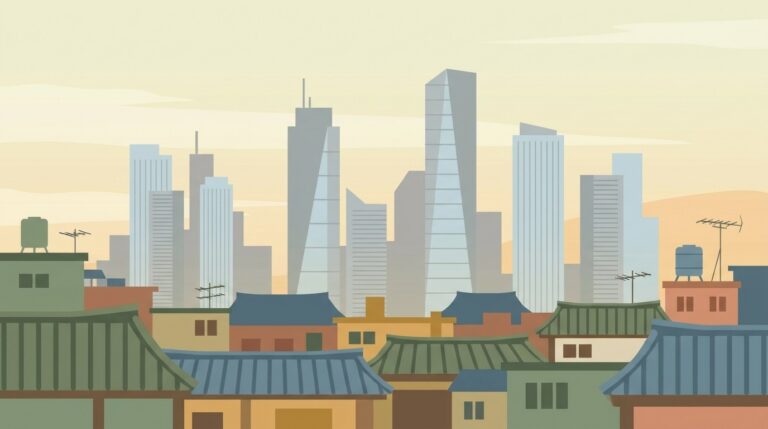
- K-Culture Moment: Used by cultural critics analyzing the contrast between Gangnam’s dazzling towers and Guryong Village in documentaries, or when dissecting the spatial hierarchy in Parasite (기생충).
- Editor’s Insight: “그늘” (shade) is not merely physical darkness; it implies systemic neglect. When paired with “개발” (development), it evokes the historical tragedy of laborers and squatters who were forced into the shadows so the modern skyline could shine.
- Situation Spectrum: Casual: ⚠️ | Semi-formal: ✅ | Formal: ✅
- 🤔 Think About It: Does your native language have an expression that equates modernization with creating “shadows,” or does it view urban expansion primarily as an unmitigated triumph?
2. 뿌리 뽑힌 사람들 (Ppuri ppophin saramdeul)
- Pronunciation: [Ppu-ri ppo-phin sa-ram-deul] (Make the tense “Ppu” explosive, like popping a bubble, followed by aspirated “phin”)
- Meaning:
- Literal: “Uprooted people”
- Real Nuance: Displaced individuals, internal migrants, or the urban working class stripped of their ancestral hometowns (gohyang) and severed from their cultural and emotional origins due to industrial shifts.
- K-Culture Moment: In Hwang Sok-yong’s The Road to Sampo (삼포 가는 길), characters wander frozen roads looking for an idealized hometown that has already been paved over by bulldozers. Literary essays use this exact phrase to describe their existential precarity.
- Editor’s Insight: In Korean collective psychology, your “뿌리” (root) represents your clan, hometown, and ancestral continuity. To say someone is “뿌리 뽑히다” is not just to call them poor; it implies a profound spiritual dispossession.
- Situation Spectrum: Casual: 🚫 | Semi-formal: ✅ | Formal: ✅
- 🤔 Think About It: How does your culture conceptualize displacement? Is moving to the city seen as exciting upward mobility, or as an existential loss of belonging?
3. 압축성장의 이면 (Ap-chuk-seong-jang-ui i-myeon)
- Pronunciation: [Ap-chuk-seong-jang-ui i-myeon] (Crisp dental “Ap” and “chuk”, followed by a flowing “i-myeon”)
- Meaning:
- Literal: “The back/reverse side of compressed growth”
- Real Nuance: The hidden societal costs, ethical compromises, and collective trauma of achieving centuries of economic evolution in just three decades.
- K-Culture Moment: Frequently quoted in literary roundtables discussing Cho Se-hui’s The Dwarf Launches a Little Ball (난장이가 쏘아올린 작은 공), contrasting the hyper-efficient industrial state with the dehumanization of the working poor.
- Editor’s Insight: “압축” (compression) captures the breakneck speed of Korea’s transformation. By using “이면” (the hidden or rear side), you signal an analytical posture that interrogates mainstream triumphalist historical narratives.
- Situation Spectrum: Casual: 🚫 | Semi-formal: ✅ | Formal: ✅
- 🤔 Think About It: Can economic miracles exist without an “이면”? How does naming this duality change public memory?
Phase 3: Textbook Korean vs Real Korean
Situation 1: Analyzing Class Inequality in 1970s Industrial Literature
- 📖 교과서 한국어 (Textbook Korean):
1970년대 노동자들은 공장에서 적은 월급을 받고 힘들게 일했습니다.
(1970-nyeondae nodongjadeureun gongjang-eseo jeogeun wolgeub-eul batgo himdeulge ilhaet-seumnida.)
“In the 1970s, laborers received low salaries and worked hard in factories.” - 🗣️ 진짜 한국어 (Real Literati Korean):
산업화의 최전선에서 노동자들은 저임금 장시간 노동으로 내몰리며 소외를 겪어야 했죠.
(Saneophwa-ui choejeonseon-eseo nodongjadeureun jeo-imgeum jangsigan nodong-euro naemollimyeo so-oereul gyeokkeoya haetjyo.)
“At the front lines of industrialization, workers were cornered into low wages and grueling hours, enduring profound alienation.” - 💡 왜 다를까? (Why is it different?):
The textbook version reads like an elementary historical fact. C2 speakers replace generic words like “힘들게” (hard) with structural descriptors like “최전선” (frontline), “내몰리다” (driven into a corner), and “소외” (Marxist alienation), which precisely mirror the critical vocabulary of Korea’s 1970s realist literature.
Situation 2: Characterizing the Wanderers in Hwang Sok-yong’s Fiction
- 📖 교과서 한국어 (Textbook Korean):
등장인물들은 집이 없어서 계속 길을 떠돌아다닙니다.
(Deungjang-inmuldeureun jibi eopseoseo gyesok gireul tteodora-danimnida.)
“The characters wander around the roads constantly because they have no houses.” - 🗣️ 진짜 한국어 (Real Literati Korean):
급격한 산업화로 삶의 터전을 상실한 채 부초처럼 떠도는 유랑민의 자화상이에요.
(Geupgyeokan saneophwaro salm-ui teojeon-eul sangsilhan chae bucho-cheoreom tteodoneun yurangmin-ui jahwasang-ieyo.)
“It is a self-portrait of itinerant wanderers drifting like duckweed, stripped of their ancestral livelihoods by abrupt industrialization.” - 💡 왜 다를까? (Why is it different?):
Literary discourse in Korea cherishes metaphors drawn from nature. “부초” (floating duckweed) is the archetypal poetic motif for rootless outcasts unable to anchor themselves in an aggressive capitalistic landscape.
Phase 4: K-Culture Deep Dive & Non-Verbal Manners
4-1. 눈치 (Nunchi) & Gestural Nuance in Literary Salons
When discussing works like The Dwarf (난쏘공) or industrial-era democratization literature (Minjung literature) in Korean academic or intellectual circles, tone and body language matter immensely:
* The Solemn Tilt: When mentioning state-sanctioned evictions (gangje cheolgeo) or industrial accidents, lower your vocal pitch slightly and offer a slow, measured nod. Avoid grinning or using overly casual hand gestures, as these topics touch upon real, intergenerational generational trauma.
* The Self-Effacing Qualifier: Before asserting a bold thesis, preface your thought with an intellectual cushion: “제가 감히 덧붙이자면…” (Jega gamhi deotbuchijamyeon… / If I may humbly add…) or “비전문가의 시선일 수도 있지만…” (From a non-specialist’s viewpoint…). This displays intellectual humility, honoring the senior scholars or literary veterans in the room.
4-2. Cultural Code: The Direct Line from ‘The Dwarf’ to ‘Parasite’
Foreign audiences often praise director Bong Joon-ho’s visual metaphors—such as the semi-basement (banjiha) smelling of damp desperation, or the vertical geography where wealth flows upward while rainwater floods the lower class. However, any educated Korean immediately recognizes these visual cues as descendants of Cho Se-hui’s 1978 serial novel The Dwarf Launches a Little Ball (난장이가 쏘아올린 작은 공).
Cho employed fragmented prose and fairy-tale surrealism to describe the eviction of dwarf families in the fictional slum “Eun-gang.” The dwarf symbolizes physical underdevelopment as an allegory for civic disempowerment. When discussing contemporary works like Squid Game or Parasite, bridging them back to Cho Se-hui and Hwang Sok-yong will instantly elevate you from a mere pop-culture fan to an insightful socio-cultural analyst.
Phase 5: Real-Life Roleplay Scenario
Setting: An intimate humanities bookstore and evening literary salon in Euljiro, Seoul. Professor Min-woo (a renowned cultural critic) is leading a seminar on 1970s realism.
Dialogue
- 교수 민우: 이번 주에 읽은 조세희의 ‘난쏘공’과 황석영의 ‘삼포 가는 길’에서 공통적으로 포착되는 당대의 시대적 공기는 무엇이었습니까?
(Ibeon jue ilgeun Jo Se-hui-ui ‘Nanssogong’-gwa Hwang Sok-yong-ui ‘Sampo Ganeun Gil’-eseo gongtongjeogeuro pochakdoeneun dangdae-ui sidajeok gonggineun mueos-ieosseumnikka?)
“What was the overarching cultural atmosphere of that era captured in both Cho Se-hui’s ‘The Dwarf’ and Hwang Sok-yong’s ‘The Road to Sampo’ that we read this week?”
🎭 Adjusts his round glasses, looking around the circle expectantly. -
학습자 (You): 두 작품 모두 압축성장의 화려한 이면에 가려진 민중의 실존적 고통을 정면으로 응시하고 있습니다.
(Du jakpum modu apchukseongjang-ui hwaryeohan imyeon-e garyeojin minjung-ui siljonjeok gotong-eul jeongmyeon-euro eungsi-hago itseumnida.)
“Both works look directly into the existential suffering of the common people hidden behind the flashy facade of compressed growth.”
🎭 Speaking in a steady, thoughtful tone, maintaining eye contact. -
교수 민우: 정면으로 응시한다… 아주 날카로운 지적입니다. 그렇다면 서사 전략의 측면에서는 두 작가가 어떤 차별성을 보이나요?
(Jeongmyeon-euro eungsi-handa… Aju nalkaroun jijeog-imnida. Geureotdamyeon seosa jeonryag-ui cheukmyeon-eseoneun du jakgaga eotteon chabyeolseong-eul boinayo?)
“Looking directly… A very sharp observation. Then, from the perspective of narrative strategy, how do the two authors differ?”
🎭 Nods with genuine curiosity, leaning slightly forward. -
학습자 (You): 황석영이 여로형 구조를 통해 유랑민의 연대와 리얼리즘을 보여줬다면, 조세희는 환상적 기법과 연작소설 형식으로 현실의 모순을 극대화했죠.
(Hwang Sok-yong-i yeorohyeong gujoreul tonghae yurangmin-ui yeondae-wa rieolrijeum-eul boyeojwotdamyeon, Jo Se-hui-neun hwansangjeok gibeop-gwa yeonjaksoseol hyeongsik-euro hyeonsil-ui mosun-eul geukdaehwa-haetjyo.)
“While Hwang Sok-yong utilized a journey motif to portray the solidarity of displaced wanderers and gritty realism, Cho Se-hui deployed fantastic elements and a serialized novel structure to maximize structural paradoxes.”
🎭 Using subtle hand phrasing to demarcate the two literary devices. -
교수 민우: 정확합니다. 특히 조세희 작가가 사실주의에 머물지 않고 환상성을 끌어들인 이유는 무엇이었을까요?
(Jeonghwak-hamnida. Teukhi Jo Se-hui jakgaga sasilju-uie meomulji anko hwansangseong-eul kkeureodeurin iyuneun mueos-ieosseulkkayo?)
“Spot on. Why do you think author Cho Se-hui refused to stay within conventional realism and introduced the fantastical?”
🎭 Eyes lighting up, tapping his notepad. -
학습자 (You): 억압적인 유신 체제하의 검열을 우회하면서도, 파편화된 노동자의 내면을 환기하기 위한 미학적 결단이었다고 봅니다.
(Eog-eapjeogin yusin chejeha-ui geom-yeor-eul uhoe-hamyeonseodo, papyeonhwadoen nodongja-ui naemyeon-eul hwangi-hagi wihan mikhakjeok gyeoldan-ieotdago bomnida.)
“I view it as an aesthetic imperative both to bypass rigid censorship under the authoritarian Yushin regime and to evoke the fragmented interiority of industrial workers.”
🎭 Voice lowering slightly into a deeply reflective cadence. -
교수 민우: 탁월합니다! 텍스트의 미학적 형식과 시대적 억압의 함수관계를 정확히 짚어내셨네요.
(Takwol-hamnida! Tekseuteu-ui mikhakjeok hyeongsik-gwa sidajeok eog-ab-ui hamsugwangyereul jeonghwakhi jipeonaesyeotneyo.)
“Outstanding! You pinpointed the functional correlation between aesthetic form and historical repression with surgical precision.”
🎭 Smiles broadly, jotting your remark down enthusiastically. -
학습자 (You): 과찬이십니다. 교수님의 이전 평론에서 통찰을 얻었습니다.
(Gwachan-isimnida. Gyosunim-ui ijeon pyeongnon-eseo tongchal-eul eotseumnida.)
“You flatter me. I gained that insight from reading your previous critical essays.”
🎭 Inclining head with gracious politeness.
🔀 Interactive Choice Point
How do you conclude your intervention when Professor Min-woo asks if this aesthetic still echoes in modern cinema?
- Choice A (Best): “네, 봉준호 감독이 ‘설국열차’나 ‘기생충’에서 보여준 공간적 은유 역시 난쏘공의 알레고리적 전통과 맥을 같이한다고 생각합니다.” (Draws a brilliant historical-aesthetic continuum).
- Choice B (Bad): “네, 옛날 소설이랑 지금 영화는 둘 다 부자들을 나쁘게 그려서 내용이 거의 비슷해요.” (Oversimplifies complex literature into a blunt, childish dichotomy).
- Choice C (Risk): “하지만 솔직히 70년대 소설은 너무 정치적이라서 순수한 문학적 가치는 현대 작품보다 떨어지지 않나요?” (Risks alienating Korean literary scholars who revere industrial-era literature as the zenith of committed intellectual writing).
Phase 6: 10-Second Emotional Shadowing Drill
Master the rhythmic pauses (/) and emotive contours of sophisticated literary discourse.
[🔥 Resolute & Critical]
눈부신 경제 성장 뒤에는 / 도시 빈민들의 뼈아픈 희생이 / 은폐되어 있었습니다.
(Nunbusin gyeongje seongjang dwieneun / dosi binmindeur-ui ppye-apeun huisaeng-i / eunpyedoeeo isseotseumnida.)
“Behind the dazzling economic growth / the excruciating sacrifices of the urban poor / were systematically concealed.”-
[😔 Bittersweet & Melancholic]
고향을 잃어버린 유랑민들에게 / 산업화된 서울은 / 결코 안식처가 되어주지 못했죠.
(Gohyang-eul ireobeorin yurangmindeurege / saneophwadoen Seour-eun / gyeolko ansikcheoga doeeojuji mothaetjyo.)
“To the uprooted wanderers who had lost their hometowns / an industrialized Seoul / could never serve as a sanctuary.” -
[🔍 Perceptive & Analytical]
조세희의 우화적 문체는 / 단순한 고발을 넘어 / 체제의 모순을 시적으로 응축해 냅니다.
(Jo Se-hui-ui uwhajeok muncheneun / dansunhan gobar-eul neomeo / cheje-ui mosun-eul sijeog-euro eungchukhae naemnida.)
“Cho Se-hui’s allegorical style / transcends simple denunciation / poetically condensing the systemic contradictions.”
Phase 7: K-Culture Mini Dictionary
-
연작소설 (Yeon-jak-so-seol)
Translation: Serial novel / Novel in linked stories.
Usage: A genre where independent short stories share recurring characters, themes, or settings, eventually coalescing into an expansive world. The Dwarf Launches a Little Ball consists of 12 linked pieces. In contemporary discourse, Koreans use this term metaphorically to describe recurring, interconnected societal phenomena. -
판자촌 (Pan-ja-chon)
Translation: Shantytown / Squatter settlement.
Usage: Makeshift shacks constructed out of timber planks (panja) during the postwar and industrial eras. When discussing modern urban planning or gentrification in Seongsu-dong or Mullae, critics frequently invoke panjachon as the origin point of Korea’s urban landscape. -
환상적 리얼리즘 (Hwan-sang-jeok Ri-eol-ri-jeum)
Translation: Magical Realism / Fantastic Realism.
Usage: The integration of fantastical, absurd, or fairy-tale elements into an otherwise brutally authentic socio-political narrative. You can cite this term when discussing the scene where the dwarf climbs a factory chimney to launch a paper plane toward the moon. -
소외 계층 (So-oe Gye-cheung)
Translation: The marginalized / Underprivileged classes.
Usage: Ubiquitous in high-level policy debates, news editorials, and artistic manifestos. It specifically refers to demographics pushed outside the protections and prosperity of mainstream capitalism.
Phase 8: Survival Kit for Travelers & Scholars
Survival Expressions TOP 3
-
혹시 1970년대 산업화 문학 관련 비평집이 있을까요?
(Hoksi cheon-gubaek-chilsip-nyeondae saneophwa munhak gwanryeon bipyeongjibi isseulkkayo?)
“By any chance, do you have critical essay collections regarding 1970s industrial literature?”
Pro Tip: Use this at legendary used book alleys like Sinchon’s Gongjak Chaekbang or Cheonggyecheon’s historic used bookstores. It instantly commands deep respect from shop owners. -
이 작품에 깔린 사회적 맥락을 조금 더 알고 싶습니다.
(I jakpum-e kkallin sahoejeok maekrag-eul jogeum deo algo sipseumnida.)
“I would love to learn more about the underlying social context woven into this work.”
Pro Tip: A stellar conversation-starter during gallery docent tours or independent book talks. -
원작의 환상성(Fantasy)이 영화에서는 어떻게 번안되었나요?
(Wonjak-ui hwansangseong-i yeonghwa-eseoneun eotteoke beon-andoe-eonnayo?)
“How was the original text’s magical realism adapted into the film?”
Pro Tip: Highly effective during Q&A sessions at film festivals like BIFF or independent screenings.
Editor’s Travel Note: The Industrial-Literary Walking Route
If you want to feel the tangible ghost of 1970s literature, skip Myeongdong for an afternoon. Walk along the Cheonggyecheon Stream near the Dongdaemun Peace Market (Pyeonghwa Sijang). Stop at the memorial statue of labor activist Jeon Tae-il, whose self-immolation in 1970 ignited the very worker-advocacy literature exemplified by Hwang Sok-yong and Cho Se-hui. Afterward, head to the 대한민국역사박물관 특별전시 관람 예약하기 to explore tangible artifacts, eviction notices, and original literary manuscripts from the 1970s and 80s.
Phase 9: “One Step Deeper” (Critical Essay)
The Cost of the Miracle: Reclaiming Interiority in a Collectivist Machine
During the Park Chung-hee administration of the 1970s, the entire South Korean nation-state operated under a quasi-military mobilization model. Slogans like “싸우면서 건설하자” (Build while fighting) and “하면 된다” (If you try, it can be done) left no room for individual grief, vulnerability, or failure. To pause and question the speed of development was branded unpatriotic.
In this hyper-functionalist climate, Hwang Sok-yong, Cho Se-hui, and Lee Mun-ku performed a radical act: they returned interiority, poetic melancholy, and moral weight to those whom the state regarded as mere cogs in the machinery of economic growth. By choosing the serial novel (yeonjak soseol), Cho Se-hui constructed a kaleidoscopic mosaic of perspectives—from the dwarf father to the factory-working daughter, and even the conscience-stricken son of a chaebol tycoon. They proved that literature is not an ornament of prosperity, but an emergency brake on dehumanization.
💬 Your Turn: In your home country, which classic literary piece best exposed the hidden human cost of national economic progress? How does its narrative approach compare to Korean industrial realism? Share your thoughts below!
Phase 10: FAQ & Avoiding Misunderstandings
Q: Why did Korean authors use magical realism instead of pure documentary-style realism in the 1970s?
A: Under the draconian Yushin Constitution, direct political protest in print risked severe censorship, confiscation, and imprisonment. By disguising social critique within fables, fairy tales, and poetic fragmentation (e.g., launching a rocket to the moon from a slum chimney), Cho Se-hui evaded state censors while conveying a horror that straightforward realism could barely encompass.
Q: What is the literary significance of Hwang Sok-yong’s ‘Sampo’? Is it a real place?
A: No, “Sampo” in The Road to Sampo is a fictional, idealized haven representing peace and agricultural tranquility. When the wanderers finally approach Sampo, they discover that a modern construction crew is leveling it to build a hotel and harbor. It symbolizes that the Korean traditional homeland had been permanently erased by capital.
Q: How does Lee Mun-ku’s work fit into this industrial narrative?
A: While Cho Se-hui focused on urban factory slums and Hwang Sok-yong on displaced wanderers, Lee Mun-ku (notably in Our Neighborhood / 관촌수필) captured the devastating destruction of the traditional agrarian village from the inside out, using idiosyncratic, rhythmic regional dialects (Satool-i).
🚨 흔한 실수 (Common Mistakes) 경고판
- Mistake: Labeling 1970s laborers solely as “피해자” (Passive victims).
Correct Action: Modern Korean literary scholars emphasize their agency (주체성). Characterize them as active agents resisting subjugation (저항적 주체). - Mistake: Pronouncing ‘난쏘공’ as [Nan-sso-gong] without understanding it’s an abbreviation.
Correct Action: Use the full title 난장이가 쏘아올린 작은 공 in formal scholarly introductions before using the affectionate acronym 난쏘공 in dialogue. - Mistake: Using “공돌이” or “공순이” (derogatory 70s slang for factory workers) without historical framing.
Correct Action: Never use these slangs casually; only quote them when analyzing how the authoritarian state and media historically disparaged young laborers.
Phase 11: Action Mission & Community Challenge
- 🥉 Bronze Level: Read the summary or the opening chapter of Cho Se-hui’s The Dwarf Launches a Little Ball in Korean, and read one sentence out loud using the emotional shadowing drill from Phase 6.
- 🥈 Silver Level: Write a three-sentence critique of a modern Korean movie (e.g., Parasite, Next Sohee, or Default) on your social feed using the terms 개발의 그늘 and 압축성장의 이면.
- 🥇 Gold Level: Visit a local Korean book exchange or join a Discord Korean literature club, and ask: “1970년대 산업화 문학이 오늘날 K-콘텐츠의 사회 비판 의식에 어떤 영향을 주었다고 보시나요?” (How do you think 1970s industrial literature influenced the social critique found in today’s K-content?)
- 🎮 K-Culture Mission: Watch the award-winning Korean indie film Next Sohee (다음 소희) or listen to BTS’s socio-critical track “Baepsae” (뺁새), and identify where the 1970s themes of class fragmentation and systemic exploitation reappear in 21st-century dress.
Phase 12: Interactive Quiz Challenge
Test your mastery of Korean industrial literature and C2 academic discourse!
Question 1: Situational Vocabulary
Which phrase best completes the sentence to convey a scholarly critique of urban renewal?
서울의 무분별한 재개발은 수많은 철거민을 양산하며, 삶의 터전에서 (______)을/를 초래했습니다.
- A) 뿌리 뽑힘 (Displacement / Uprootedness)
- B) 내로남불 (Double standards)
- C) 자중지란 (Internal collapse)
Question 2: Fill in the Blanks
Fill in the missing literary term:
조세희는 여러 개의 단편이 유기적으로 결합하여 하나의 거대한 사회상을 완성하는 (________) 형식을 취하여 검열을 넘어서는 비판적 서사를 구축했다.
Question 3: Cultural True or False
- Statement: In 1970s Korean realism, the “hometown” (gohyang) is consistently portrayed as an eternal, indestructible haven where tired urban workers can always return and live happily ever after. (True / False)
👉 Click to reveal answers & detailed explanations!
-
Question 1 Answer: A) 뿌리 뽑힘
Explanation: “뿌리 뽑힘” (uprootedness) specifically designates the spatial and existential dispossession of squatters and rural migrants during redevelopment. B and C are political/military idioms entirely out of context. -
Question 2 Answer: 연작소설 (Yeon-jak-so-seol)
Explanation: Cho Se-hui’s work consists of 12 linked stories (yeonjak soseol) that form an architectural mosaic of 1970s Korean class society. -
Question 3 Answer: False
Explanation: In Hwang Sok-yong’s The Road to Sampo and across the industrial canon, the idyllic hometown has either been destroyed, turned into an industrial complex, or commodified into an unrecognizable construction site. The tragedy lies precisely in the impossibility of return.







