

Beyond ‘I Am Sorry’: Decoding Strategic Ambiguity and Diplomatic Euphemisms in Korea
Phase 1: Empathy & Story-Driven Opening
안녕하세요! 매일한글 (Daily Hangul) editor here! Have you ever watched a high-stakes Korean political thriller like Designated Survivor: 60 Days or tuned into an intense diplomatic press conference at the Blue House, only to witness an international incident defused—or escalated—by a single, seemingly polite sentence?
A government spokesperson steps to the podium, adjusts the microphone, and solemnly announces: “정부는 이번 사태에 대해 깊은 유감을 표명합니다” (Jeongbuneun ibeon sataee daehae gipeun yugameul pyomyeonghamnida — The government expresses deep regret over this incident). International reporters translate this as an apology, yet domestic civic groups erupt in protest, demanding an actual apology. You find yourself wondering: Wait, isn’t expressing deep regret an apology? Why is everyone still furious?
Welcome to the upper echelon of Korean pragmatics—CEFR Level C2. At this level, fluency is no longer about vocabulary drills; it is about political literacy, legal implications, and strategic ambiguity. In Korean diplomacy and executive crisis communications, 유감 (Yugam – Regret) and 사과 (Sagwa – Formal Apology) inhabit entirely different universes. While an apology legally concedes culpability and obligates restitution, ‘expressing regret’ is a calibrated rhetorical masterpiece designed to acknowledge an unfortunate reality without accepting a shred of legal liability. Based on hundreds of hours dissecting Blue House press releases and guiding foreign diplomats and executives through crisis negotiations, this masterclass will teach you how to decode what Korean officials are actually saying between the lines.
Phase 2: Core Expressions Deep Dive (핵심 표현 3선)
1. 유감을 표명하다 (Yugameul pyomyeonghada)
- Pronunciation: [Yu-gam-eul pyo-myeong-ha-da] (Think: “You-gahm” + “Pyo-myung-ha-da”)
- Meaning:
- Literal: To express feelings of regret/sorrow.
- Nuance: “We acknowledge this event took place and that the outcome is tragic or unfortunate, but we categorically reject formal fault or legal compensation obligations.”
- K-Culture Moment: You will hear this verbatim in K-Dramas like Queenmaker or The Whirlwind, when a corporate conglomerate or politician faces a media storm but strictly refuses to trigger a legal lawsuit.
- Editor’s Insight: The Hanja compound 유감 (遺憾) literally means “leaving behind a feeling of resentment or dissatisfaction.” It expresses a subjective state of sorrow rather than an objective confession of guilt. It is the ultimate diplomatic shield.
- Situation Spectrum: Casual: 🚫 | Semi-formal: ⚠️ | Formal/Statecraft: ✅
- 🤔 Think About It: Does your native language separate an emotional “I’m sorry this happened to you” from a legally culpable “I apologize for my wrongdoing”? How does this distinction protect public institutions?
2. 사과의 뜻을 전하다 (Sagwa-ui tteuseul jeonhada)
- Pronunciation: [Sa-gwa-ui tteu-seul jeon-ha-da] (Think: “Sah-gwa-wee” + “Tteus-eul” + “Jun-ha-da”)
- Meaning:
- Literal: To convey the intention of an apology.
- Nuance: A calculated half-step. It signals moral concession and seeks to soothe public emotion (Gungmin Jeongseo, 국민정서) without signing an ironclad legal settlement.
- K-Culture Moment: Frequently deployed in K-Pop agency crisis notices on Weverse when an idol is involved in a controversy, acknowledging public discomfort while protecting the artist’s commercial contracts.
- Editor’s Insight: Notice the buffer noun 뜻 (Tteut – Meaning/Intention). Instead of saying the unequivocal “사과합니다” (I apologize), embedding 뜻을 전하다 creates an institutional distance, softening the blow while reserving room for legal maneuvering.
- Situation Spectrum: Casual: 🚫 | Semi-formal: ✅ | Formal/Diplomatic: ✅
- 🤔 Think About It: Why do high-profile public statements introduce abstract intermediary nouns like “intention” instead of using direct, active-voice verbs?
3. 심심한 사과의 말씀을 드립니다 (Simsimhan sagwa-ui malsseumeul deurimnida)
- Pronunciation: [Sim-sim-han sa-gwa-ui mal-sseum-eul deu-rim-ni-da] (Think: “Seem-seem-hahn” + “Sah-gwa-wee” + “Mahl-sseum-eul” + “Deu-rim-nee-da”)
- Meaning:
- Literal: I offer words of profound apology.
- Nuance: Absolute, unconditional capitulation. The speaker assumes moral and practical responsibility, signaling total submission to public or diplomatic judgment.
- K-Culture Moment: When a conglomerate CEO steps onto a stage, bows at a 90-degree angle for several seconds before a wall of flashing camera shutters, this is the exact sentence read into the microphones.
- Editor’s Insight: Beware the infamous modern homonym trap! In Sino-Korean, 심심 (甚深) means “exceedingly deep and profound.” However, contemporary young netizens occasionally mistake it for the native Korean adjective 심심하다 (“to be bored”), sparking viral internet debates about declining literacy. In executive and diplomatic Korean, it remains the gold standard of reverence.
- Situation Spectrum: Casual: 🚫 | Semi-formal: ⚠️ | Formal/Diplomatic: ✅
- 🤔 Think About It: When an apology utilizes Sino-Korean archaic vocabulary, does it sound more sincere to you, or does it feel like a calculated theatrical performance?
Phase 3: Textbook Korean vs. Real High-Stakes Korean
At the C2 level, textbook phrases like “죄송합니다” (I’m sorry) sound hopelessly amateurish in strategic boardrooms and diplomatic summits. Here is how authentic high-level discourse operates:
Scenario 1: Addressing a Strategic Intelligence or Data Breach
- 📖 Textbook Korean:
- 정보가 유출되어 죄송하게 생각합니다.
- (Jeongboga yuchuldoe-eo joesonghage saenggakhamnida. / We are sorry that information was leaked.)
- 🗣️ Real Diplomatic Korean:
- 예기치 않은 사안으로 우려를 끼쳐드린 점에 대해 유감스럽게 생각합니다.
- (Yegichi aneun sa-aneuro uryeoreul kkichyeodeurin jeome daehae yugamseureopge saenggakhamnida. / We view with regret that this unforeseen development has caused concern.)
- 💡 Why it differs: The authentic phrase frames the leak as an “unforeseen incident” (distancing direct agency) and expresses regret merely for the concern caused (우려를 끼쳐드린 점), entirely sidestepping fault for the breach itself.
Scenario 2: Refusing Unilateral Demands While Keeping the Door Open
- 📖 Textbook Korean:
- 그 요구는 들어줄 수 없습니다.
- (Geu yoguneun deureojul su eopseumnida. / We cannot accept that demand.)
- 🗣️ Real Diplomatic Korean:
- 귀측의 입장은 충분히 인지하였으나, 현 단계에서 수용하기에는 현실적 한계가 있음을 양해 바랍니다.
- (Gwichuk-ui ipjangeun chungbunhi injihayeosseuna, hyeon dangye-eseo suyonghagie-neun hyeonsiljeok hangyega isseumeul yanghae baramnida. / While we fully take note of your side’s position, we ask for your understanding that realistic constraints preclude acceptance at this stage.)
- 💡 Why it differs: Outright refusal disrupts face-saving protocols (Che-myeon, 체면). Diplomatic Korean utilizes “take note” (인지하다) and requests benevolent understanding (양해를 구하다) to maintain strategic leverage without burning bridges.
Phase 4: K-Culture Deep Dive & Non-Verbal Nuance
4-1. Nunchi & Non-Verbal Diplomatic Posture
In Korean statecraft, physical geography, posture, and micro-expressions carry equal weight to the spoken communique:
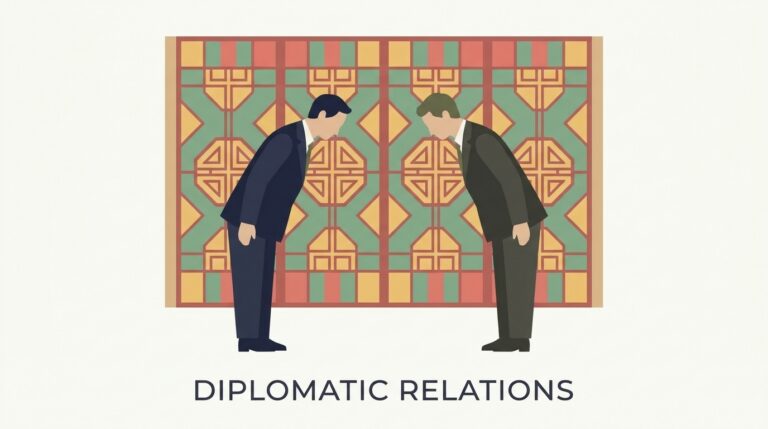
* The Angle of the Bow: A micro-nod (목례, Mongnye) indicates equal bilateral status. A 45-degree bow indicates respect without culpability. The deep 90-degree “folder bow” (폴더 인사) is reserved strictly for total personal surrender or institutional shame. If a diplomat delivers a statement containing the word 유감 while bowing lower than 30 degrees, domestic commentators will accuse them of “humiliating diplomacy” (굴욕 외교).
* Eye Line & Cadence: When delivering 유감, the eyes never rest directly on the counterparty’s pupils nor do they look at the floor. The speaker looks slightly above the cameras, maintaining an unflinching, emotionally neutral expression (포커페이스). The vocal pitch must drop by approximately two semitones, delivered in a steady, unhurried cadence.
4-2. Cultural Code Analysis: The Legacy of Diplomatic Communiqués
In East Asian history and modern Korean geopolitics (such as the Joint Declarations between Korea and Japan or communiqués across the DMZ), the war over words has lasted decades. When the term 통석의 염 (Tongseok-ui yeom – Deep sorrow and anguish) was once used historically instead of 사죄 (Sajoe – Prostration/Penitent Apology), entire parliamentary debates analyzed every syllable.
In Korean corporate life, this same cultural architecture emerges. When an executive says, “심려를 끼쳐 드려 유감입니다” (I regret causing anxiety to stakeholders), foreign investors often interpret it as a guilty plea, while domestic legal counsel smiles in relief knowing that civil damages cannot be pegged to a mere expression of regret.
Phase 5: Real-World Roleplay Scenario
Setting: A tension-filled emergency press briefing room at the Ministry of Foreign Affairs (MOFA) in Seoul following an accidental naval border skirmish.
Characters:
* Director Min (민 국장): Seasoned chief spokesperson, pragmatic and steely-eyed.
* You (Foreign Diplomatic Attaché/Senior Correspondent): Seeking to pin down Korea’s official legal stance.
민 국장: 🎭 (단상에 서서 안경을 고쳐 쓰며, 엄중한 목소리로)
이번 사안의 중대성을 감안할 때, 정부는 매우 무거운 마음으로 상황을 주시하고 있습니다.
(Ibeon sa-an-ui jungdaeseongeul gamanhal ttae, jeongbuneun maeu mugeoun ma-eumeuro sanghwangeul jusihago isseumnida.)
"Considering the gravity of this incident, the government is monitoring the situation with a very heavy heart."

당신: 🎭 (마이크를 잡고 날카롭게 질문하며)
국장님, 그렇다면 이번 작전 오류에 대해 상대국에 공식 사과하실 계획이 있으십니까?
(Gukjangnim, geureotamyeon ibeon jakjeon oryue daehae sangdaeguge gongsik sagwahasil gyehoegi isseusimnikka?)
"Director, does that mean you plan to issue a formal apology to the counterparty for this operational error?"

민 국장: 🎭 (시선을 단호하게 유지하며 서류를 정돈한다)
인명 피해가 발생한 점에 대해서는 인도적 차원에서 깊은 유감을 표명하는 바입니다.
(Inmyeong pihaega balsaenghan jeome daehaeseoneun indojoek chaweoneseo gipeun yugameul pyomyeonghaneun baimnida.)
"Regarding the loss of life, we express profound regret from a humanitarian perspective."

당신: 🎭 (추궁하듯 고개를 기울이며)
유감 표명은 법적 배상 책임을 인정한다는 의미로 해석해도 되겠습니까?
(Yugam pyomyeongeun beopjeok baesang chaegimeul injeonghandaneun uimiro haeseokhaedo doegesseumnikka?)
"May we interpret this expression of regret as an admission of legal liability for compensation?"

민 국장: 🎭 (단호하면서도 차분한 어조로 선을 긋는다)
그것은 확대 해석입니다. 원인 규명을 위한 합동 조사가 선행되어야 함을 분명히 밝힙니다.
(Geugeoseun hwakdae haeseogimnida. Wonin gyumyeongeul wihan hapdong josaga seonhaengdoeeoya hameul bunmyeonghi balkimnida.)
"That is an over-interpretation. We make it explicitly clear that a joint investigation must precede any determination of cause."

당신: 🎭 (메모를 적으며 행간을 짚는다)
결국 공식 사과(Apology)는 아니라는 말씀이시군요?
(Gyeolguk gongsik sagwaneun aniraneun malsseumisigunyo?)
"In essence, you are stating that this is not a formal apology, correct?"

민 국장: 🎭 (마이크를 응시하며 무게감 있게 결론짓는다)
외교적 수사와 법률적 판단은 구분되어야 합니다. 정부의 입장은 명확히 전달되었습니다.
(Oegyojoek susawa beomnyuljeok pandaneun gubundoeeoya hamnida. Jeongbu-ui ipjangeun myeonghwakhi jeondaldoeeotseumnida.)
"Diplomatic rhetoric and judicial determinations must remain distinct. The government's stance has been clearly conveyed."

당신: 🎭 (고개를 끄덕이며 물러선다)
충분히 이해했습니다. 상황을 계속 주시하겠습니다.
(Chungbunhi ihaehaesseumnida. Sanghwangeul gyesok jusihagessumnida.)
"I understand fully. We will continue to follow developments."
🔀 Interactive Decision Point
How would you frame the follow-up editorial dispatch for your international news agency?
- Option A: “Seoul officially apologizes for border escalation, vows compensation.”
- Option B: “Seoul deploys calibrated ‘regret,’ offering humanitarian sympathy while strategically deflecting legal liability.”
- Option C: “Seoul dismisses counterparty concerns, refusing all dialogue.”
Feedback:
* Option A (Bad): Fails C2 linguistic analysis. Conflating 유감 with 사과 will trigger an immediate diplomatic correction from MOFA.
* Option B (Best): Masterful decoding! You recognized that “인도적 차원의 유감” (regret on humanitarian grounds) is designed precisely to provide diplomatic dignity while barricading domestic legal liability.
* Option C (Risk): Misreads the posture. Korea acknowledged the gravity and humanitarian sorrow; they are maintaining strategic ambiguity, not initiating an embargo.
Phase 6: 10-Second Emotion Shadowing Drill
Practice these calibrated deliveries. Notice how cadence, stress, and strategic pauses dictate diplomatic authority.
[🏛️ 엄중하고 흔들림 없는 태도로]
우리는 이번 사태의 / 엄중함을 깊이 인식하고 있으며, / 불미스러운 결과에 대해 / 유감을 표명합니다.
(Uri-neun ibeon satae-ui / eomjunghameul gipi insikhago isseumyeo, / bulmiseureoun gyeolgwawa-e daehae / yugameul pyomyeonghamnida.)-
[🧊 냉철하게 선을 그으며]
상대측의 일방적 주장에 대해서는 / 유감의 뜻을 밝히며, / 사실관계 확인이 / 최우선 과제임을 강조합니다.
(Sangdaecheuk-ui ilbangjeok jujang-e daehaeseoneun / yugam-ui tteuseul balkimyeo, / sasil-gwangye hwagin-i / choe-useon gwaje-imeul gangjohamnida.) -
[⚖️ 절제된 도덕적 무게감을 담아]
피해자분들의 고통에 / 깊이 공감하는 바이나, / 본 사안은 법적 합의의 틀 내에서 / 다루어져야 마땅합니다.
(Pihaejabundeul-ui gotonge / gipi gonggamhaneun baina, / bon sa-aneun beopjeok hab-ui-ui teul nae-eseo / daru-eojyeoya mattanghamnida.)
Phase 7: K-Culture Mini Dictionary
- 전략적 모호성 (Jeollyakjeok Mo-hoseong) | Strategic Ambiguity
- The calculated diplomatic practice of remaining deliberately vague to preserve flexibility and avoid provoking rival superpowers.
- 유감 (遺憾, Yugam) | Diplomatic Regret / Dissatisfaction
- An emotional or rhetorical acknowledgment of an unfortunate outcome that explicitly stops short of conceding fault or legal guilt.
- 면피 (免避, Myeonpi) | Liability Shielding / Face-Saving Evasion
- A pragmatic sociopolitical concept denoting actions or phrasing taken solely to insulate oneself or an institution from legal liability or administrative punishment.
- 국민정서법 (Gungmin-jeongseo-beop) | The Law of National Sentiment
- A uniquely Korean sociopolitical term describing public moral sentiment, which often demands unconditional emotional contrition beyond statutory legal codices.
Phase 8: Expat & Executive Survival Kit
Top 3 Survival Expressions for High-Stakes Friction
- 상황이 이렇게 된 점에 대해 매우 안타깝게 생각합니다.
(Sanghwangi ireoke doen jeome daehae maeu antakkapge saenggakhamnida.)- Pro Tip: Use this in corporate boardrooms when a project fails due to collaborative breakdowns. It registers genuine empathy without signing away contractual rights.
- 오해의 소지가 있었던 점은 유감스럽습니다.
(Ohae-ui sojiga isseotdeon jeomeun yugamseureopseumnida.)- Pro Tip: The ultimate executive phrase for clearing miscommunications. It shifts the burden slightly to the potential for misunderstanding rather than direct malicious intent.
- 상호 존중의 원칙에 따라 대화로 해결해 나가길 기대합니다.
(Sangho jonjung-ui wonchige ttara daehwaro haegyeolhae nagagil gidaehamnida.)- Pro Tip: Deploy this when negotiations hit an aggressive impasse to re-anchor diplomatic decorum.
Editor’s Strategic Navigator Note
When researching current diplomatic postures or drafting enterprise communications, review raw, unedited government releases through the 대한민국 외교부 공식 보도자료 포털 rather than relying on sensationalized second-hand translations. Notice how the phrasing transitions systematically between 유감, 우려 (concern), and 엄중 경고 (stern warning).
Phase 9: “One Step Deeper” (Reflective Essay)
In Korean society, words are never merely transactional; they are ontological markers of social equilibrium. When a private citizen says “사과드립니다” (I apologize), it reflects the Confucian virtue of restoring relational harmony by bearing personal burden. However, when an institution or nation-state operates within modern international jurisprudence, that traditional impulse runs headlong into billions of dollars in legal liability, international precedents, and territorial sovereignty.
This tension birthed the modern art of Korean strategic rhetoric. 유감 is not an attempt to deceive; it is an agonizing rhetorical bridge built to satisfy the Confucian hunger for relational acknowledgment while shielding the modern legal entity from structural vulnerability. Understanding this paradox transforms you from someone who merely speaks Korean into someone who understands the very soul of modern Korea’s legal and political consciousness.
💬 Your Turn: Have you ever encountered a situation in your work or study where saying a direct “I am sorry” would have caused catastrophic legal or contractual damage? How did you maneuver around it?
Phase 10: FAQ & Common Pitfalls
Q: If a Korean CEO says ‘유감을 표합니다’ at an annual shareholder meeting, can shareholders sue for compensation based on that statement?
A: Generally, no. Under Korean civil jurisprudence, an expression of 유감 is classified as a subjective sentiment (정서적 표명) or moral statement, not an admission of tortious conduct (불법행위 인정). Legal liability requires explicit recognition of fault (과실 인정) or breach of contract.
Q: Why do historical victims’ organizations reject ‘유감’ so vehemently?
A: Because historically, 유감 has been used by transgressors to close political files without paying restitution, offering state-level amends, or revising domestic educational curricula. To victims, 유감 feels like an evasive evasion (면피성 발언) rather than restorative justice.
Q: When is it safe for an advanced learner to use ‘유감’ in daily life?
A: Almost never in casual interpersonal relationships! If your Korean friend is upset because you arrived an hour late, and you reply, “늦은 점에 대해 유감을 표명합니다” (I express regret regarding being late), you will sound either like an emotionless cyborg or an arrogant politician mockingly avoiding blame. Reserve this expression strictly for formal debates, legal drafting, and executive negotiations.
🚨 Common Mistakes Board
- ❌ Faux Pas 1: Using 유감 to comfort a grieving friend at a funeral.
- Correct Action: Say “삼가 고인의 명복을 빕니다” (May the deceased rest in peace) or “얼마나 상심이 크십니까” (How great your sorrow must be). Using 유감 here sounds bureaucratic and detached.
- ❌ Faux Pas 2: Treating 사과 (apology) and 사죄 (deep penance/contrition) as exact synonyms.
- Correct Action: Understand that 사죄 (謝罪) carries deep moral weight, often implying kneeling or material penance, reserved for egregious moral or historical offenses.
- ❌ Faux Pas 3: Interpreting 심심한 사과 as “a boring apology.”
- Correct Action: Recognize 심심 (甚深) as Sino-Korean for “deeply profound.” Never mock or question this phrasing in formal settings.
Phase 11: Action Mission & Engagement
The 3-Tier Rhetorical Challenge
- 🥉 Bronze: Record yourself reading the three Phase 6 Shadowing Drills with a completely poker-faced, presidential cadence. Focus on dropping your vocal register.
- 🥈 Silver: Pick an article from a Korean major daily (e.g., Chosun Ilbo, Hankyoreh) reporting on an international trade row. Highlight every instance of 유감, 우려, and 사과, noting who uttered them.
- 🥇 Gold: Draft a 4-sentence mock executive response handling a corporate software outage, deploying 유감스러운 사태 to acknowledge consumer frustration while refusing financial liability. Share it in our discussion forum!
🎮 K-Culture Mission: Watch Episode 1 of any Korean political drama (The Whirlwind on Netflix is a brilliant candidate). Count how many times politicians use 유감 to dodge an interrogation versus 사과 to concede power.
Phase 12: Interactive Quiz Challenge
Test your diplomatic decoding prowess!
1. Situational Judgment
You are the regional director of an international firm in Seoul. A minor supply chain error delayed non-essential deliveries for two days. The client is demanding that you sign an admission of total corporate negligence. What do you say?
* A) 모든 것이 저희 잘못이니 석고대죄합니다.
* B) 예기치 못한 물류 차질로 불편을 겪으신 점에 대해 깊은 유감을 표하며, 조속한 정상화에 만전을 기하겠습니다.
* C) 계약서에 적혀 있지 않으니 사과할 수 없습니다.
🔍 Click for Answer & Analysis
Correct Answer: B
* Why: Option B is an executive masterclass. It uses 깊은 유감을 표하며 to honor the client’s emotional frustration and promises action (만전을 기하겠습니다), while framing the root cause as an “unforeseen logistics disruption” rather than an admission of structural negligence. Option A is an over-the-top archaic capitulation (석고대죄 – kneeling on straw mats awaiting execution), and Option C destroys relational face (체면).
2. Fill in the Blank
In statecraft communiqués, when a government wants to express sorrow for human loss without accepting military liability, they frame the regret through this specific conceptual lens:
“정부는 (____) 차원에서 깊은 유감을 표명합니다.”
* A) 법률적 (Judicial)
* B) 금전적 (Monetary)
* C) 인도적 (Humanitarian)
🔍 Click for Answer & Analysis
Correct Answer: C
* Why: 인도적 차원 (Humanitarian grounds) is the standard diplomatic formula. It isolates human compassion from sovereign or military legal liability.
3. True or False Cultural Nuance
Statement: In contemporary Korean public discourse, expressing 심심한 사과 indicates that the speaker considers the matter trivial and boring.
* [True] / [False]
🔍 Click for Answer & Analysis
Correct Answer: False
* Why: As analyzed in Phase 2, 심심 (甚深) means “exceptionally profound.” Confusing it with the casual adjective “boring” (심심하다) is an internet literacy misconception. In official state and corporate rhetoric, it remains the most solemn apology possible.
Mastering Korean at the C2 level is about commanding the silences, the ambiguities, and the structural beauty of high-level statecraft. Keep refining your geopolitical ear, and see you in the next masterclass at 매일한글!






