

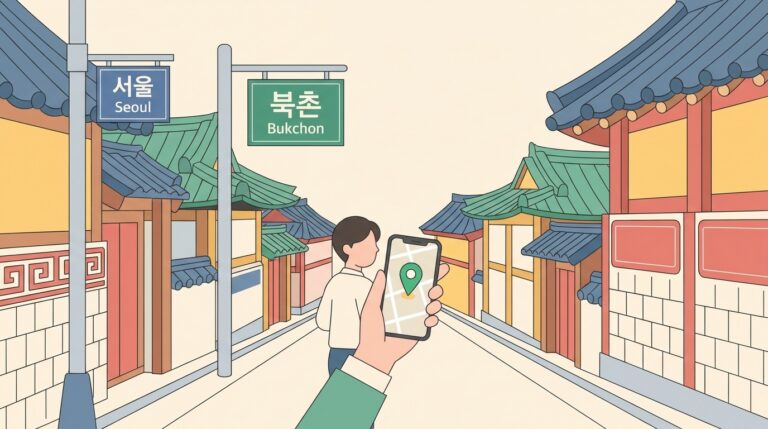
Don’t Get Lost in Seoul! Master Naver Map & Direction Phrases for Beginners
Phase 1: Empathy (Story-Immersive Opening)
안녕하세요! (Annyeonghaseyo!) Daily Hangul editor here, your 10-year Seoul culture navigator and Korean bestie.
Picture this: You just touched down in Seoul. You drop your bags at your guesthouse in Hongdae and decide to hunt down that viral aesthetic salt bread bakery tucked inside the winding alleys of Yeonnam-dong. You pull out your phone, fire up Google Maps, and press “Walking Directions.” Then… disaster strikes. The little blue dot stays stuck on a wall. It spins aimlessly, unable to calculate walking routes. Panic creeps in as twilight settles over the alleyways. You look up, holding your phone with a helpless face, when a warm-hearted local in an oversized trench coat notices you, smiles warmly, and says: “네이버 지도 앱을 켜 보세요” (Neibeo jido aep-eul kyeo boseyo – Try opening the Naver Map app).
If you’ve ever felt that wave of panic in a foreign city, take a deep breath. You are not alone! Over 90% of my beginner students experience this exact “Google Maps blackout” on their first day in South Korea due to local mapping regulations. Today, we are turning that stress into pure confidence. In this lesson, designed specifically for A1 absolute beginners, you’ll master essential walking phrases, discover how locals navigate Seoul’s charming alleys, and unlock the digital magic of Korea’s go-to navigation app. Let’s make sure you never feel lost again!
Phase 2: Core Expressions Deep Dive
Here are the top three golden expressions you need to remember whenever you are out and about in Korea.
1. 네이버 지도 앱을 켜 보세요 (Neibeo jido aep-eul kyeo boseyo)
- Pronunciation: [Nei-beo ji-do ep-eul kyeo bo-se-yo] (Think: “Neighbor” + “G-dough” + “apple” without ‘le’ + “cur” + “bo-say-yo”)
- Meaning: Literal: “Please try turning on the Naver Map application.” vs. Actual Nuance: “Google Maps won’t guide your steps here; switch over to Naver Map to find your way!”
- K-Culture Moment: Seen in trendy travel vlog channels and modern dramas when a helpful local steps in to rescue a bewildered backpacker in Seongsu-dong.
- Editor’s Insight: The ending ~보세요 (-boseyo) comes from 보다 (to see/try). It softens an instruction from a strict command into a caring suggestion: “Give it a try!”
- Situation Spectrum: Casual: ⚠️ | Semi-formal: ✅ | Formal: ✅
- 🤔 Think About It: In many Western countries, one single global app dominates. Why do you think Korea built its own independent digital ecosystem (like Naver and Kakao) that outperforms global giants?
2. 여기가 어디예요? (Yeogiga eodiyeyo?)
- Pronunciation: [Yeo-gi-ga eo-di-ye-yo] (Think: “Yaw-gi-ga” + “uh-dee-yay-yo”)
- Meaning: Literal: “Where is here?” vs. Actual Nuance: “Excuse me, could you show me where we currently are on this map?”
- K-Culture Moment: That classic drama scene where the protagonist emerges from the labyrinthine underground shopping mall of Gangnam Station and tries to find Exit 11.
- Editor’s Insight: 여기 (yeogi) means “here,” and 어디 (eodi) means “where.” Pointing at your screen while saying this short sentence instantly signals your question without needing advanced grammar.
- Situation Spectrum: Casual: ⚠️ | Semi-formal: ✅ | Formal: ✅
- 🤔 Think About It: English says “Where am I?” focusing on the individual person, whereas Korean says “Where is this place?” (여기가 어디예요?), emphasizing the surrounding context. Notice the difference in perspective?
3. 이쪽으로 가세요 (Ijjogeuro gaseyo)
- Pronunciation: [I-jjo-geu-ro ga-se-yo] (Think: “Ee-chog-oo-row” + “gah-say-yo”)
- Meaning: Literal: “Go toward this side.” vs. Actual Nuance: “Head right down this way!”
- K-Culture Moment: An elderly market vendor in Gwangjang Market using both hands to warmly point a food tourist toward the famous mung bean pancake stall.
- Editor’s Insight: 이쪽 (ijjok) means “this side/direction,” and -으로 (-euro) acts like a compass pointer meaning “towards.” When locals speak to you, listen for “이쪽” (this way) or “저쪽” (jeojjok – that way over there).
- Situation Spectrum: Casual: ⚠️ | Semi-formal: ✅ | Formal: ✅
- 🤔 Think About It: Koreans frequently navigate using relative directional landmarks rather than cardinal points like “North” or “West.” Why is relative direction so much more intuitive in dense urban cities?
Phase 3: Textbook Korean vs. Real Korean
Let’s compare what dusty grammar books teach versus what real Koreans say on the street.
Situation 1: Asking someone to open an app
- 📖 Textbook Korean: 네이버 지도를 실행하십시오. (Neibeo jidoreul silhaenghasipsio.) — “Execute the Naver Map application.”
- 🗣️ Real Korean: 네이버 지도 켜 보세요. (Neibeo jido kyeo boseyo.) — “Try opening Naver Map.”
- 💡 Why is it different? The verb 실행하다 (to execute/run) sounds like an IT instruction manual. Real people simply use 켜다 (kyeoda – to switch on/turn on) for apps, screens, and lights.
Situation 2: Asking someone to look at your smartphone screen
- 📖 Textbook Korean: 저의 화면을 봐 주실 수 있습니까? (Jeoui hwamyeoneul bwa jusil su itseumnikka?) — “Would you be able to gaze upon my screen?”
- 🗣️ Real Korean: 이것 좀 봐주세요. (Igeot jom bwajuseyo.) — “Could you take a quick look at this?”
- 💡 Why is it different? Native speakers rely on the magic word 좀 (jom – a little/briefly) to soften any request instantly, making you sound polite and natural without stiff honorific gymnastics.
Phase 4: K-Culture Deep Dive & Non-Verbal Manners
4-1. Nunchi (눈치) & Street Gestures
When approaching someone on the street in Korea:
* The 15-Degree Nod (목례 – Mongnye): Always bow your head slightly before speaking. Jumping right into someone’s face with a phone can startle them.
* Chest-Level Screen: Hold your smartphone comfortably around chest height so both of you can view it. Avoid thrusting the phone directly into someone’s eye line.
* Open Palm Direction: Never point directions or gesture toward an elder with a single index finger! In Korea, indicating a pathway with an open palm facing upward shows deep respect and hospitality.
4-2. Cultural Code: Why Google Maps Doesn’t Work Well in Korea
Under South Korea’s National Spatial Data Security Regulations, high-precision domestic map data cannot be stored on foreign, unverified cloud servers. Because Google stores data globally, it cannot provide full turn-by-turn walking or driving navigation in Korea. Domestic tech giants like Naver engineered hyper-detailed mapping systems that update down to the second—showing bus arrival times, subway car transfer doors, and even the exact staircases of alleyways!
Phase 5: Real-Life Roleplay Scenario
Setting: You are standing on a confusing fork in the road in the trendy neighborhood of Yeonnam-dong. You see Minji, a college student with a friendly smile wearing headphones around her neck.
- Turn 1 (You): 저기요, 실례합니다! (Jeogiyo, sillyehamnida!) — “Excuse me!” [🎭 Giving a small, polite 15-degree head bow]
- Turn 2 (Minji): 네! 무슨 일이세요? (Ne! Museun iriseyo?) — “Yes! What’s the matter?” [🎭 Smiling kindly and taking off one headphone ear]
- Turn 3 (You): 여기가 어디예요? 길을 잃었어요. (Yeogiga eodiyeyo? Gireul ireosseoyo.) — “Where is this place? I’m lost.” [🎭 Pointing gently to the phone screen with an apologetic smile]
- Turn 4 (Minji): 아, 구글 지도 보시는구나! 여기서는 네이버 지도 앱을 켜 보세요. (A, gugeul jido bosineunguna! Yeogiseoneun neibeo jido aep-eul kyeo boseyo.) — “Ah, you’re looking at Google Maps! Over here, try opening the Naver Map app.” [🎭 Gesturing toward your phone app store]
- Turn 5 (You): 아! 네이버 지도 앱이요? 켰어요! (A! Neibeo jido aep-iyo? Kyeosseoyo!) — “Ah! The Naver Map app? I opened it!” [🎭 Tapping the green Naver app icon and showing the search bar]
- Turn 6 (Minji): 네, 여기서 이쪽으로 가세요. 2분 걸려요! (Ne, yeogiseo ijjogeuro gaseyo. I-bun geollyeoyo!) — “Yes, go this way from here. It takes 2 minutes!” [🎭 Pointing down the left alley with an open palm]
- Turn 7 (You): 이쪽이요? 정말 감사합니다! (Ijjog-iyo? Jeongmal gamsahamnida!) — “This way? Thank you so much!” [🎭 Nodding gratefully with both hands resting together in front]
- Turn 8 (Minji): 아니에요, 조심히 가세요! (Anieyo, josimhi gaseyo!) — “No worries, walk safely!” [🎭 Waving gently with a warm smile]
🔀 Interactive Choice Point
Minji points down the left alley and says “이쪽으로 가세요”. What is your best response?
* Option A: Smile, point slightly along that path with an open hand, and ask: “이쪽 맞아요? 감사합니다!” (Ijjok majayo? Gamsahamnida!)
* Option B: Grab her wrist to lead her along with you so she can show you the cafe in person.
* Option C: Wave your hands dismissively and shout in English: “No Korean! English please!”
- Feedback:
- Option A [BEST]: Perfect! Repeating “이쪽 맞아요?” (Is this way right?) verifies the direction, and thanking her immediately shows top-tier Korean manners.
- Option B [BAD]: Critical mistake! Grabbing someone’s arm or invading personal space violates basic Korean social etiquette.
- Option C [RISK]: She already kindly explained the exact route in 2 easy steps! Panicking into English breaks the communication flow and might make her feel uncomfortable.
Phase 6: 10-Second Emotional Shadowing Drill
Practice these lines aloud with the emotional cues and pauses marked with /!
[🥺 Slightly confused and apologetic]
저기요… / 여기가 / 어디예요?
(Jeogiyo… / yeogiga / eodiyeyo?)
— “Excuse me… / where / is this place?”-
[💡 A sudden lightbulb moment]
아! / 네이버 지도 / 켰어요!
(A! / Neibeo jido / kyeosseoyo!)
— “Ah! / Naver Map / I turned it on!” -
[😊 Relieved and super grateful]
이쪽으로 / 가요? / 감사합니다!
(Ijjogeuro / gayo? / Gamsahamnida!)
— “Go / this way? / Thank you!”
Phase 7: K-Culture Mini Dictionary
- 길치 (Gil-chi) | Directionally challenged / Bad with directions
- Usage: Made by combining 길 (road) and 치 (person lacking a skill, like 음치 for tone-deaf). Locals laughingly say: “저 완전 길치예요!” (I’m totally hopeless with directions!)
- 출구 (Chul-gu) | Subway / Building Exit
- Usage: Crucial for meeting anyone in Seoul. Meeting at 홍대입구역 9번 출구 (Hongdae Station Exit 9) is legendary in Korean youth culture.
- 골목 (Gol-mok) | Alleyway
- Usage: The romantic heart of Korean culinary and cafe culture. The hottest hidden bakeries and vintage shops are always tucked away inside a quiet 골목.
- 뚜벅이 (Ttu-beok-i) | Pedestrian / Walking Traveler
- Usage: An endearing slang term for people who travel everywhere on foot and by public transit rather than driving a car.
Phase 8: Survival Kit for Travelers
Top 3 Survival Expressions
- 지도 보여주세요 (Jido boyeojuseyo) — “Please show me on the map.”
- Pro Tip: Hand over your phone with both hands if you need them to pinpoint your destination.
- 어디로 가요? (Eodiro gayo?) — “Which direction do I go?”
- Pro Tip: Short, punchy, and instantly understood by taxi drivers or subway staff.
- 가까워요? (Gakkawoyo?) — “Is it close by?”
- Pro Tip: Ask this to know whether you should keep walking or hop onto a green town bus (마을버스).
Editor’s Travel Note
Before stepping foot onto your flight to Incheon International Airport, head to your app store for the official [네이버 지도 앱 다운로드 (Naver Map App Download)]. Once installed, tap into settings and change the language to English. While Korean text gives the most up-to-date business hours, the English interface displays real-time pedestrian walking paths, subway car numbers for fastest transfers, and bus arrival timers accurately!
Phase 9: One Step Deeper (Reflective Insight)
In many busy global metropolises, stopping a stranger on the street is met with cold stares or hurried brush-offs. But in Korea, you will frequently discover something heartwarming: if you ask an elder or a shopkeeper for directions, they might not just point—they might actually walk alongside you for fifty meters just to ensure you don’t take the wrong turn. This instinct stems from 정 (Jeong)—the uniquely Korean emotional bond of warmth, empathy, and collective care for others within a shared space. When you learn to ask for directions in polite Korean, you aren’t just finding a cafe; you are opening a door into Korea’s communal heart.
💬 Your Turn: Have you ever gotten completely lost while traveling abroad? What saved your day? Share your story in the comments below!
Phase 10: FAQ & Common Mistakes
Q: Why does Google Maps show public transit in Seoul but refuse walking directions?
A: Google Maps licenses public transit schedules from national transit authorities, so subway and bus times appear. However, detailed vector sidewalk mapping requires domestic server hosting, which Google does not maintain in Korea.
Q: Is Naver Map completely in English?
A: Yes, Naver Map supports English, Chinese, and Japanese navigation modes! Major landmarks, subway stops, and road names appear in English, although searching for small mom-and-pop restaurants is easiest if you paste their Korean name.
Q: What should I say if someone speaks too fast when giving directions?
A: Don’t panic! Simply say with a polite smile: “조금 천천히 말씀해 주세요” (Jogeum cheoncheonhi malsseumhae juseyo – Please speak a little slowly).
🚨 Common Mistakes Warning Board
- Mistake: Pointing your index finger directly at an elder’s face while asking for directions.
- Correct Action: Keep your hand relaxed at chest level and gesture with an open palm.
- Mistake: Using casual slang like “어디야?” (Eodiya? – Where is it?) with strangers on the street.
- Correct Action: Always use polite conversational endings: “여기가 어디예요?” (Yeogiga eodiyeyo?).
- Mistake: Assuming everyone in quiet residential alleys speaks fluent English.
- Correct Action: Start with “실례합니다” (Excuse me) and show your Naver Map screen politely.
Phase 11: Action Missions
- 🥉 Bronze Mission (Solo Practice): Repeat our 3 Shadowing Drills from Phase 6 out loud three times until the rhythm feels natural.
- 🥈 Silver Mission (Digital Setup): Download the Naver Map app today, set it to English, and save your top 3 dream Seoul travel spots to your favorites folder!
- 🥇 Gold Mission (Real Interaction): Record yourself saying “네이버 지도 앱을 켜 보세요!” or practice asking for directions with a Korean language exchange partner.
- 🎮 K-Culture Bonus Mission: In your next modern K-Drama binge, watch closely when characters check transit or meet at subway exits—can you spot the green Naver icon on their phones?
Phase 12: Interactive Quiz Challenge
Test your navigation skills! Tap the toggles below to verify your answers.
1. Situational Judgment
You are standing at an intersection and want to ask a passerby which way to head. Which phrase is the most natural and polite?
* A) 어디로 가? (Eodiro ga?)
* B) 이쪽으로 가세요. (Ijjogeuro gaseyo.)
* C) 저기요, 어디로 가요? (Jeogiyo, eodiro gayo?)
👉 Click to reveal Answer & Explanation!
Correct Answer: C
* Explanation: Starting with 저기요 (Excuse me) followed by the polite form 어디로 가요? (Which way do I go?) is the most respectful way to ask. Option A is informal (반말) and rude to strangers. Option B means “Go this way,” which is telling them where to go instead of asking!
2. Fill in the Blank
Complete this natural sentence to ask someone to open their navigation app:
“네이버 지도 앱을 _____ 보세요!” (Please try opening the Naver Map app!)
* A) 닫아 (dada – close)
* B) 켜 (kyeo – turn on)
* C) 사 (sa – buy)
👉 Click to reveal Answer & Explanation!
Correct Answer: B (켜)
* Explanation: 켜다 (kyeoda) means to switch on or launch an app/device. When combined with ~보세요, it becomes 켜 보세요 (kyeo boseyo – try turning on).
3. True or False Cultural Quiz
Statement: In South Korea, Google Maps provides the most accurate, real-time pedestrian walking directions inside traditional alleyways.
* [True / False]
👉 Click to reveal Answer & Explanation!
Correct Answer: FALSE!
* Explanation: Due to national mapping security laws, Google Maps walking navigation is limited. Always keep Naver Map (네이버 지도) installed for walking routes in Korea!







