

안녕하세요! 매일한글 에디터입니다. (Hello! This is your Daily Hangul editor.)
Phase 1: Empathy & Immersion
Imagine sitting in a high-rise conference room overlooking the neon skyline of Yeouido, Seoul. Across the polished mahogany table sits your most ruthless corporate competitor—the very person who undercut your product launch last quarter. Yet, as a sudden global regulatory audit threatens to shut down both your operations overnight, neither of you walks away. Instead, a tense, silent understanding passes between you. Your rival slides a confidential dossier across the table, takes a sip of bitter espresso, and nods slowly.
In Korean corporate dramas like Misaeng or Reborn Rich, this precise moment crackles with electric tension. How do educated native speakers articulate this paradoxical dynamic where sworn enemies must join forces against a catastrophic common threat? They don’t reach for bland corporate jargon. They summon four classical syllables etched in ancient battlefield ink: 오월동주 (吳越同舟).
Many of our advanced C2 learners tell us: “I know basic business Korean, but whenever meetings turn into strategic chess games or high-stakes negotiations, the room shifts into metaphorical idioms that I can’t grasp.” If you have ever felt left out when boardroom strategists or editorial columnists use classical idioms (Gosasunghyeo) to dismantle an argument, this guide is designed specifically for you. Drawing on years of executive tutoring insights, we will unpack how to wield ancient military acumen in modern, nuanced Korean.
Phase 2: Core Strategic Expressions in Depth
1. 오월동주 (吳越同舟)
- Pronunciation: [O-wol-dong-ju] (Think of Oh-wall-dong-joo, rhymes softly with an echoing bell toll)
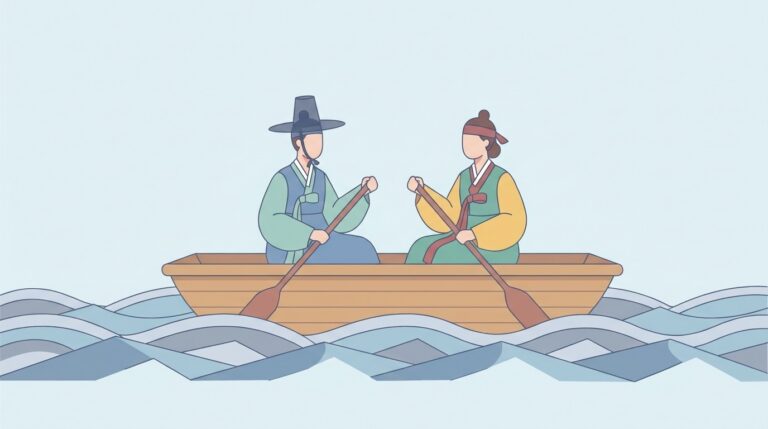
- Meaning: Literal: “The states of Wu and Yue sharing the same boat.” / Nuanced: Bitter adversaries forced into a calculated, temporary alliance under a shared crisis.
- K-Culture Moment: Seen in historical and political thrillers like Secret Forest (Stranger) when the incorruptible prosecutor and a corrupt chaebol executive team up to defeat an even darker cartel.
- Editor’s Insight: Originating from Sun Tzu’s The Art of War, this phrase carries an unspoken caveat: the truce lasts only as long as the storm does. Once shore is reached, swords may be drawn again.
- Situation Spectrum: Casual: ⚠️ | Semi-formal: ✅ | Formal: ✅
- 🤔 Think About It: Does your native culture view temporary alliances with enemies as hypocritical opportunism or high-level tactical maturity?
2. 적과의 동침 (敵과의 同寢)
- Pronunciation: [Jeok-gwa-ui dong-chim] (Think of Juck-gwa-eui dong-chim)
- Meaning: Literal: “Sleeping in the same bed with the enemy.” / Nuanced: An intimate, high-risk strategic cohabitation or partnership fraught with mutual distrust.
- K-Culture Moment: Frequently used in Korean tech news when rival giants like Samsung and Apple simultaneously litigate patents while signing multi-billion dollar OLED supply contracts.
- Editor’s Insight: While Owoldongju emphasizes external crisis survival, Jeokgwa-ui dongchim emphasizes ongoing psychological tension and calculated entanglement.
- Situation Spectrum: Casual: ✅ | Semi-formal: ✅ | Formal: ✅
- 🤔 Think About It: How does the metaphor of ‘sleeping’ shift the perception of professional rivalry into an intimate dilemma?
3. 고육지책 (苦肉之策)
- Pronunciation: [Go-yuk-ji-chaek] (Think of Go-yook-jee-check)
- Meaning: Literal: “The flesh-wounding stratagem.” / Nuanced: A desperate, self-sacrificing measure taken to deceive an opponent or survive an existential crisis.
- K-Culture Moment: In period dramas (Sageuk), a loyal general publicly disgraces himself or undergoes torture to infiltrate enemy ranks convincingly.
- Editor’s Insight: Use this when a company slashes executive bonuses or sells off prized assets to protect jobs during an acquisition.
- Situation Spectrum: Casual: ⚠️ | Semi-formal: ✅ | Formal: ✅
- 🤔 Think About It: Why does Korean strategic language honor suffering and endurance (Gonan) as forms of strategic genius?
Phase 3: Textbook Korean vs. Real-World Korean
Scenario 1: Proposing a Strategic Truce
- 📖 교과서 한국어 (Textbook Korean):
“상황이 위급하니 일단 협력하는 것이 좋겠습니다.”
(Sanghwang-i wigeuphani ildan hyeopryeokhaneun geos-i jokess-seumnida. / “Because the situation is urgent, it would be good to cooperate for now.”) - 🗣️ 진짜 한국어 (Real-World Strategic Korean):
“지금은 피차 오월동주할 수밖에 없는 형국입니다.”
(Jigeum-eun picha owoldongjuhal subakke eomneun hyeong-guk-imnida. / “As things stand, both sides have no choice but to board the same boat.”) - 💡 왜 다를까? (Why the difference?):
Advanced Korean business communication leans on classical metaphor to soften direct vulnerability while framing mutual survival as an objective imperative rather than a personal favor.
Scenario 2: Explaining a Painful Concession
- 📖 교과서 한국어 (Textbook Korean):
“손해를 감수하고 어려운 결정을 내렸습니다.”
(Sonhae-reul gamsuhago eoryeoun gyeoljeong-eul naeryeotseumnida. / “I endured losses and made a difficult decision.”) - 🗣️ 진짜 한국어 (Real-World Strategic Korean):
“조직의 와해를 막기 위한 뼈아픈 고육지책이었습니다.”
(Jojik-ui wahae-reul makgi wihan ppyeoapeun goyukjichaek-ieoss-seumnida. / “It was a bone-chilling, painful sacrifice made strictly to prevent the organization’s collapse.”) - 💡 왜 다를까? (Why the difference?):
Using Goyukjichaek transforms a simple business loss into a strategic, honorable sacrifice for the collective good.
Phase 4: K-Culture Deep Dive & Non-Verbal Manners
4-1. Nunchi & The Art of the ‘Poker-Faced Alliance’
When entering an Owoldongju arrangement in Korea, linguistic selection is only half the battle. Your non-verbal etiquette (Nunchi) signals emotional control:
* The Steady Micro-Bow: When greeting your adversary, maintain a slightly restrained 15-degree nod rather than an exuberant 45-degree bow. It signals professional respect without subservience.
* Honorific Distancing: Even if you share close generational ties, maintain strict formal speech (Hapsyoche /하십시오체). Dropping into casual honorifics (Haeyoche /해요체) too early can be perceived as insincere flattery (Chim-bareun sori).
* Eye Contact Calibration: Avoid unwavering confrontation or submissive downcast eyes; focus smoothly on the bridge of the adversary’s nose during contentious points.
4-2. Cultural Code: The ‘Joint Survival’ Dynamic in K-Media
From the dynamic between entertainment agencies uniting against digital piracy to rival candidates forming last-minute coalition tickets in presidential elections, Owoldongju is the ultimate trope of Korean realpolitik. Koreans distinguish between an Enemy of Principle and an Enemy of Circumstance. When shared survival (Gongjon) is threatened, ideological grudges are immediately subordinated to strategic pragmatism.
Phase 5: Real-World Roleplay Scenario
Setting: A private dining room in Gwanghwamun. Director Min (Rival Studio Executive) and Director Kang (You) meet after an offshore piracy ring threatens both studios’ flagship series.
- Turn 1 (Director Min):
🎭 (Places a cup of cold barley tea down, leaning forward with a wry smirk)
“강 이사님, 우리가 이렇게 마주 앉게 될 줄 누가 알았겠습니까?”
(Kang isa-nim, uri-ga ireoke maju antge doel jul nuga aratgess-seumnikka? / “Director Kang, who would have thought we would end up sitting across from each other like this?”) -
Turn 2 (You):
🎭 (Maintaining an impassive posture, opening the piracy analytics folder)
“달갑지는 않지만, 지금은 배가 가라앉느냐 마느냐의 문제입니다.”
(Dalgapjineun anchiman, jigeum-eun bae-ga garaanneunya maneunya-ui munje-imnida. / “It is hardly pleasant, but right now it is a question of whether the boat sinks or floats.”) -
Turn 3 (Director Min):
🎭 (Taps the table rhythmically with his index finger)
“오월동주라… 좋습니다. 하지만 지식재산권 공동 대응에 우리 쪽 지분이 더 큽니다.”
(Owoldongju-ra… Jotsseumnida. Hajiman jisikjaesangwon gongdong daeeung-e uri jjok jibun-i deo keumnida. / “Rivals in the same boat, eh… Very well. But our stake in this joint intellectual property response is larger.”) -
Turn 4 (You):
🎭 (Direct gaze, calm and measured tone)
“지분 다툼은 폭풍우를 벗어난 뒤에 해도 늦지 않습니다.”
(Jibun datum-eun pokpungu-reul beoseonan dwie haedo neutji anseumnida. / “Arguing over stakes can wait until after we clear the storm.”) -
Turn 5 (Director Min):
🎭 (Nods slowly, conceding the point)
“일리가 있군요. 해외 배급망 차단 프로토콜부터 공유하시죠.”
(Illi-ga itgunyo. Hae-oe baegeupmang chadan peurotokol-buteo gong-yuhasijyo. / “You have a point. Let us start by sharing the overseas distribution blackout protocols.”) -
Turn 6 (You):
🎭 (Hands over the encrypted flash drive)
“우리 측 보안 코드가 담긴 데이터입니다. 상호 검증은 내일까지 끝냅시다.”
(Uri cheuk bo-an kodeu-ga damgin de-iteo-imnida. Sangho geomjeung-eun nae-il-kkaji kkeunnaepsida. / “Here is the data containing our security codes. Let us conclude mutual verification by tomorrow.”) -
Turn 7 (Director Min):
🎭 (Pockets the drive, raising his glass)
“내일 정오까지 검토를 마치죠. 이번 폭풍만 넘기면 다시 승부입니다.”
(Nae-il jeong-o-kkaji geomto-reul machijyo. Ibeon pokpung-man neomgimyeon dasi seungbu-imnida. / “I will finish the review by noon tomorrow. Once we weather this storm, our duel resumes.”) -
Turn 8 (You):
🎭 (Lightly touches glasses, professional detachment intact)
“물론입니다. 그때를 기대하겠습니다.”
(Mullon-imnida. Geuttae-reul gidaehaegess-seumnida. / “Naturally. I will look forward to that day.”)
🔀 Interactive Decision Branch
Director Min pushes for an immediate unilateral joint press release naming his studio first. How do you respond?
- Option A: “지금 서열 따질 때입니까? 싫으면 혼자 망하시든가요.” (Is this the time for ranking? If you don’t like it, feel free to ruin yourself alone.)
Feedback: Bad. Highly confrontational, burns the operational bridge, and reveals emotional volatility unbecoming of a senior executive. - Option B: “공동 전선의 취지를 살려 양사 대표 명의를 알파벳 순으로 병기합시다.” (To honor the spirit of our united front, let’s list both co-CEOs in alphabetical order.)
Feedback: Best. Perfectly balances strategic parity, maintains the pragmatic truce, and avoids petty power struggles. - Option C: “원하시는 대로 하세요. 저희는 조용히 뒤에서 실무만 챙기겠습니다.” (Do as you wish. We will quietly handle the practical matters in the background.)
Feedback: Risk. Cedes complete public narrative dominance to your competitor, undermining your leverage once the crisis passes.
Phase 6: 10-Second Emotion Shadowing Drill
Practice these high-level delivery variations by pausing at / and channeling the indicated emotional state:
[🧊 냉철하고 단호하게 / Cool and calculated]
“감정적인 앙금은 / 접어두고, / 지금은 / 오월동주의 지혜를 / 발휘할 때입니다.”
(Gamjeongjeok-in anggeum-eun / jeobeodugo, / jigeum-eun / owoldongju-ui jiye-reul / balhwihal ttae-imnida. / “Putting emotional grudges aside, now is the time to exercise the wisdom of rivals in the same boat.”)-
[🤝 담담하지만 무게감 있게 / Composed yet weighty]
“서로 총구를 거두지 않으면, / 공멸뿐이라는 사실을 / 피차 잘 알고 있지 않습니까?”
(Seoro chonggu-reul geoduji aneumyeon, / gongmyeol-ppun-iraneun sasir-eul / picha jal algo itji anseumnikka? / “If we do not lower our weapons toward each other, don’t we both know full well that mutual destruction is the only outcome?”)
Phase 7: K-Culture Mini Dictionary
-
적대적 공생 (Jeokdaejeok Gongsaeng)
Translation: Hostile symbiosis.
Usage: Describes two opposing factions (e.g., rival political parties or monopolistic brands) that attack each other publicly yet depend on each other’s existence to mobilize their base. -
배수의 진 (Baesu-ui Jin)
Translation: Camp with back to the river (Burning bridges / Point of no return).
Usage: Used when entering decisive mergers, corporate turnarounds, or high-stakes civil service exams where retreat is impossible. -
전화위복 (Jeonhwawibok)
Translation: Turning misfortune into fortune.
Usage: Frequently referenced in corporate PR retrospectives when an operational blunder leads to brand innovation. -
파천황 (Pacheonhwang)
Translation: Breaking the primordial chaos (Unprecedented breakthrough).
Usage: Praised in tech or cinematic achievements when a Korean production breaks historical box-office or export records.
Phase 8: Strategic Expat Survival Kit
Top 3 Crisis Negotiation Phrases
- “공동의 이익을 위해 잠시 이견을 묻어둡시다.”
(Gongdong-ui iig-eul wihae jamsi igyeon-eul mudeodwipsida.)
Pro Tip: Use this to immediately halt ideological disputes during project scope creep. - “지금은 네 탓, 내 탓을 가릴 계제가 아닙니다.”
(Jigeum-eun ne tat, nae tat-eul garil gyeje-ga animnida.)
Pro Tip: A powerful managerial phrase used to silence finger-pointing during an urgent PR crisis. - “소탐대실하지 말고 큰 그림을 보시죠.”
(Sotamdaesilhaji malgo keun geurim-eul bosijyo.)
Pro Tip: Cautions an aggressive partner against sacrificing macro-goals for petty short-term gains.
Editor’s Travel & Expat Note
Navigating real-world administrative crises in Korea requires rapid mobility and precise tools. When coordinating across offices or rushing to notarize joint legal documents, rely on the 네이버 지도 앱 다운로드 for real-time subway transfer navigation down to the exact door number. If corporate disputes require emergency tax or legal authentication, consult the 국세청 홈택스 공식 포털 rather than relying on unverified third-party advice.
Phase 9: “한 발 더 깊이” (Deep Cultural Reflection)
In Western philosophical traditions, conflict resolution frequently seeks moral reconciliation or permanent resolution. In Korean strategic thought—heavily shaped by centuries of geopolitical positioning among continental superpowers—pragmatic coexistence often supersedes absolute moral closure. Owoldongju demonstrates that Koreans do not demand that adversaries pretend to be friends. The culture respects the honesty of mutual self-interest united against an external storm.
💬 Your Turn: Have you ever experienced a professional or academic situation where survival required you to share a boat with someone you disliked? How would you describe that dynamic in your native language? Drop your stories in the comments below!
Phase 10: FAQ & Avoiding Misunderstandings
Q: Can I use 오월동주 (Owoldongju) to describe romantic couples who bicker often?
A: Strictly speaking, no. Using Owoldongju for a romantic couple sounds excessively grave and political, implying you are waiting for a storm to pass before resuming combat. Instead, use expressions like 칼로 물 베기 (Kallo mul begi) (cutting water with a knife, meaning lovers’ quarrels leave no scar) or 티격태격하다 (Tigyeoktaegyeokhada) (bickering playfully).
Q: Does using this idiom imply that I plan to betray my partner later?
A: It implies realism, not malice. It signals that both parties recognize the temporary, problem-oriented nature of the partnership. It protects you from being perceived as naive.
Q: What is the grammatical marker commonly paired with 오월동주?
A: It is commonly conjugated as a noun complement with -이다 or as an action with -하다: e.g., “우리는 지금 오월동주하는 형국이다” (We are in a situation where we must share the boat).
🚨 Common Mistakes Warning Board
- Mistake: Confusing Owoldongju with pure solidarity like Dongsimdongdeok (동심동덕).
Correction: Never use Owoldongju for genuine friends working happily toward an ideal. - Mistake: Pronouncing the Chinese character ‘越’ as Wol instead of Weol.
Correction: In standard Korean orthography, the state of Yue is transcribed as 월 (Wol / [wʌl]), not 율 (Yul). - Mistake: Using it in ultra-casual banter among juniors.
Correction: Save this idiom for strategic contexts, project debriefs, or when analyzing sports/politics.
Phase 11: Action Missions
- 🥉 Bronze Mission (Solo Practice): Shadow Turn 2 and Turn 4 of the Phase 5 roleplay script aloud three times with your phone recorder, focusing on the calm, low-pitch Yeouido Executive tone.
- 🥈 Silver Mission (Social Sharing): Share an example of two competing tech companies or sports rivals collaborating under a single Instagram or X post using the hashtag
#DailyHangul_Owoldongju. - 🥇 Gold Mission (Real Application): Use the sentence “지금은 오월동주의 지혜가 필요한 때입니다” during your next Korean work catch-up or language exchange session.
- 🎮 K-Culture Mission: Watch an episode of a legal or political K-drama (such as Vincenzo or Hyena) and spot the exact moment two rivals agree on an unwritten truce.
Phase 12: Interactive Quiz Challenge
Test your strategic intuition! Can you pinpoint the authentic Korean usage?
1. Situational Judgment:
Which of the following scenarios best warrants the phrase 오월동주 (Owoldongju)?
(A) Two childhood best friends launching a joint bakery together.
(B) Two rival mobile carriers teaming up to lobby against a harmful overseas network tariff.
(C) An employee volunteering to work overtime to impress their team lead.
2. Fill-in-the-Blank:
“회사가 부도 위기에 처하자, 노사는 갈등을 멈추고 [ ]의 심정으로 손을 잡았다.”
(Hint: 4 syllables meaning rivals in the same storm-tossed boat)
3. True or False:
적과의 동침 implies a harmonious and eternal reconciliation between two former adversaries. (T / F)
👉 Click here to reveal the Answer Key & Explanations
- Answer: (B)
Explanation: Two commercial competitors uniting temporarily against external legislative danger perfectly mirrors the original Wu-Yue boat dynamic. - Answer: 오월동주 (Owoldongju)
Explanation: Labor and management putting aside long-standing friction to stave off bankruptcy is a classic real-world application of Owoldongju. - Answer: False
Explanation: 적과의 동침 highlights an uncomfortable, tactical proximity characterized by continuous wariness, not eternal peace.







