

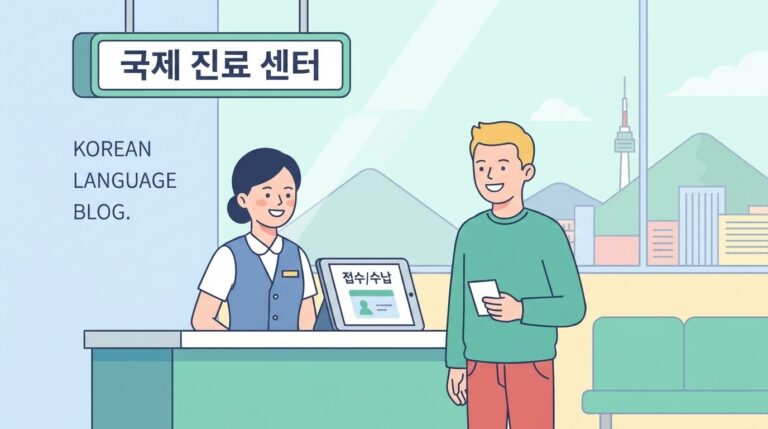
Phase 1: 공감 (Story-Driven Opening)
안녕하세요! 매일한글 에디터입니다. (Hello! This is your Daily Hangul editor!)
Imagine this scenario straight out of a heartfelt K-drama like Hospital Playlist: You are living your dream life in Korea, enjoying spicy tteokbokki and strolls along the Han River, when suddenly, an acute appendicitis or unexpected fracture lands you in a clean, high-tech Korean university hospital. The surgery goes smoothly, thanks to Korea’s phenomenal medical staff. But as discharge day approaches, a heavy knot tightens in your chest: “How on earth am I going to pay for this? Is my entire savings gone?”
When the hospital staff hands you the initial estimated invoice, the total number looks staggering. If you’ve ever felt that cold sweat at a Korean hospital window (원무과 – won-mu-gwa), take a deep breath. Korea’s National Health Insurance (NHIS) features one of the most compassionate safety nets in the world: the Out-of-Pocket Maximum System (본인부담상한제 – Bon-in-bu-dam-sang-han-je).
Many foreign residents overpay or suffer silently simply because they do not know the exact vocabulary to inquire about their income tier and refund eligibility. This guide is built directly on real administrative counseling cases from expats who navigated unexpected hospital stays in Seoul. By learning just a few key phrases, you will gain peace of mind and protect your hard-earned finances during medical emergencies.
Phase 2: 핵심 표현 3선 심층 분석 (Core 3 Expressions)
1. 본인부담상한제 적용되나요? (Bon-in-bu-dam sang-han-je jeok-yong-doe-na-yo?)
- Pronunciation: [Bon-in-boo-dam sang-han-jeh jeok-yong-dweh-na-yo?] (Think: “Bone-in” like chicken wings + “boo-dahm” + “sang-hahn-jeh”)
- Meaning: Literal: “Is the self-burden ceiling system applied?” / Nuance: “Does the out-of-pocket maximum apply to my bill?”
- K-Culture Moment: You hear this phrase in medical dramas whenever an ordinary family sits in front of the hospital social worker’s desk, asking if their catastrophic medical bill can be mitigated by state policy.
- Editor’s Insight: 본인부담 means the portion of medical expenses you pay yourself, and 상한제 means an upper limit or ceiling. When you add 적용되나요? (“Does it apply?”), you instantly signal to the administration staff that you understand the Korean health insurance framework.
- Situation Spectrum: Casual 🚫 | Semi-formal ⚠️ | Formal ✅
- 🤔 Think About It: In many countries, insurance caps are determined by private companies. In Korea, the government fixes this cap based on income deciles (분위 – bun-wi). How does your home country manage medical cost spikes?
2. 환급금 신청하고 싶어요 (Hwan-geup-geum sin-cheong-ha-go si-peo-yo)
- Pronunciation: [Hwan-geup-geum shin-cheong-hah-goh she-poh-yoh] (Sounds like “Hwan” + “soup” with a hard g + “gum”)
- Meaning: Literal: “I want to apply for a refund money.” / Nuance: “I would like to apply for the reimbursement / excess payment refund.”
- K-Culture Moment: Seen at local National Health Insurance branch offices (국민건강보험공단 지사) where seniors bring official notices to claim back the surplus hospital fees paid during the previous year.
- Editor’s Insight: If your medical expenses exceed your designated ceiling during an emergency, the NHIS calculates the excess and refunds (환급) it to your designated bank account. Using ~하고 싶어요 keeps your request polite yet proactive.
- Situation Spectrum: Casual 🚫 | Semi-formal ✅ | Formal ✅
- 🤔 Think About It: Why does Korean use the Chinese character-based term 환급 (repayment/refund) in official administrative tasks instead of the daily word 환불 (store refund)?
3. 서류는 어떤 게 필요한가요? (Seo-ryu-neun eo-tteon ge pil-yo-han-ga-yo?)
- Pronunciation: [Seo-ryoo-noon uh-tteon geh peel-yoh-hahn-gah-yoh?]
- Meaning: Literal: “As for documents, which ones are necessary?” / Nuance: “What documents do I need to prepare?”
- K-Culture Moment: The staple sentence used by anyone visiting a Korean community center (주민센터) or hospital administrative counter when wrapping up their business.
- Editor’s Insight: Rather than the rigid 무슨 서류를 가져와야 합니까?, using 어떤 게 필요한가요? sounds softer, natural, and remarkably native at an intermediate (B1) level.
- Situation Spectrum: Casual 🚫 | Semi-formal ✅ | Formal ✅
- 🤔 Think About It: Korean administrative inquiries often avoid direct “you/I” pronouns and instead put the topic (서류는) at the front of the sentence to show polite deference.
Phase 3: 교과서 한국어 vs 진짜 한국어 (Textbook vs. Real Korean)
Situation 1: Asking if high bills can be reduced at the hospital counter
- 📖 교과서 한국어: 제 병원비가 너무 많이 나왔으니 감면해 주십시오. (Je byeong-won-bi-ga neo-mu man-i na-wat-seu-ni gam-myeon-hae ju-sip-si-o. / “My bill came out too high, so please reduce it.”)
- 🗣️ 진짜 한국어: 혹시 본인부담상한제 사후정산 대상인지 확인할 수 있을까요? (Hok-si bon-in-bu-dam sang-han-je sa-hu-jeong-san dae-sang-in-ji hwag-in-hal su iss-eul-kka-yo? / “Could I check if this qualifies for the out-of-pocket maximum post-settlement?”)
- 💡 왜 다를까? Asking directly to “reduce my bill” sounds demanding and unaware of systemic processes. Using 혹시 (by any chance) and inquiring about the specific policy name (사후정산 – post-settlement) earns immediate respect from the hospital administrator.
Situation 2: Asking when the refund will arrive
- 📖 교과서 한국어: 돈이 언제 들어옵니까? (Don-i eon-je deul-eo-om-ni-kka? / “When does the money enter?”)
- 🗣️ 진짜 한국어: 환급금은 보통 언제쯤 입금되나요? (Hwan-geup-geum-eun bo-tong eon-je-jjeum ip-geum-doe-na-yo? / “Around when is the refund usually deposited?”)
- 💡 왜 다를까? Using 입금되다 (to be deposited) instead of the informal 돈이 들어오다 elevates your tone to a sophisticated B1 business/administrative register.
Phase 4: K-Culture 딥다이브 & 비언어적 매너 (Culture & Manners)
4-1. 눈치 (Nunchi) & Administrative Manners
When approaching the hospital discharge counter (퇴원/수납 창구):
* The Two-Hand Rule: Hand over your Alien Registration Card (ARC / 외국인등록증) and payment card using both hands or with your right hand supported lightly by your left forearm. It conveys sincere gratitude and humility.
* Tone of Voice: Administrative counters in Korea are busy. Start your sentence with a gentle “저기요…” or “실례지만…” followed by a slight head bow (about 15 degrees). Maintain soft eye contact without staring directly into their eyes continuously.
4-2. Cultural Insight: The Spirit of Sangjo (상부상조)
Korea’s National Health Insurance operates on 상부상조 (Sang-bu-sang-jo)—mutual assistance. The 본인부담상한제 isn’t welfare for the destitute; it is a universal safety net ensuring that no working individual or family collapses into poverty due to critical illness. Expats paying health insurance premiums are equal beneficiaries of this social contract!
Phase 5: 실전 롤플레이 시나리오 (Roleplay Dialogue)
Setting: Min-jun (a foreign resident recovering from sudden knee surgery) is standing at the billing desk (원무과 수납 창구) speaking with Officer Ji-won.
- Turn 1 (Officer Ji-won):
안녕하세요. 오늘 퇴원 수속 도와드릴게요. 신분증 부탁드립니다.
(An-nyeong-ha-se-yo. O-neul toe-won su-sok do-wa-deu-ril-ge-yo. Sin-bun-jeung bu-tak-deu-rim-ni-da.)
“Hello. I will help you with your discharge procedures today. ID card, please.”
🎭 Hands back the receipt after scanning. -
Turn 2 (Min-jun):
네, 여기 있습니다. 혹시 이번 수술비에 본인부담상한제가 적용되나요?
(Ne, yeo-gi iss-seum-ni-da. Hok-si i-beon su-sul-bi-e bon-in-bu-dam sang-han-je-ga jeok-yong-doe-na-yo?)
“Yes, here it is. By any chance, does the out-of-pocket maximum apply to this surgery bill?”
🎭 Hands the card with both hands and tilts head slightly. -
Turn 3 (Officer Ji-won):
네, 환자분. 급여 항목 중 최고 상한액을 초과한 금액은 병원에서 바로 공제해 드렸어요.
(Ne, hwan-ja-bun. Geup-yeo hang-mok jung choe-go sang-han-ae-geul cho-gwa-han geum-ae-geun byeong-won-e-seo ba-ro gong-je-hae deu-ryeoss-eo-yo.)
“Yes. For covered items, the amount exceeding the maximum ceiling was deducted right here at the hospital.”
🎭 Points to the itemized receipt. -
Turn 4 (Min-jun):
아, 그렇군요! 그럼 나머지 차액은 나중에 환급받을 수 있나요?
(A, geu-reoh-gun-yo! Geu-reom na-meo-ji cha-ae-geun na-jung-e hwan-geup-ba-deul su iss-na-yo?)
“Ah, I see! Then can I receive a refund for the remaining difference later?”
🎭 Smiles with visible relief. -
Turn 5 (Officer Ji-won):
네, 소득 분위에 따른 추가 환급금은 공단에서 8월경에 안내문을 보낼 거예요.
(Ne, so-deuk bun-wi-e tta-reun chu-ga hwan-geup-geum-eun gong-dan-e-seo pal-wol-gyeong-e an-nae-mun-eul bo-nael geo-ye-yo.)
“Yes, for additional refunds based on your income decile, the NHIS Corporation will send an official notice around August.”
🎭 Hands over an informational brochure. -
Turn 6 (Min-jun):
다행이네요. 환급 신청할 때 서류는 어떤 게 필요한가요?
(Da-haeng-i-ne-yo. Hwan-geup sin-cheong-hal ttae seo-ryu-neun eo-tteon ge pil-yo-han-ga-yo?)
“What a relief. When applying for the refund, what documents do I need?”
🎭 Listens attentively while holding the brochure. -
Turn 7 (Officer Ji-won):
건강보험공단 앱이나 전화로 본인 계좌만 등록하시면 돼요. 아주 간단합니다.
(Geon-gang-bo-heom-gong-dan aep-i-na jeon-hwa-ro bon-in gye-jwa-man deung-nok-ha-si-myeon dwae-yo. A-ju gan-dan-ham-ni-da.)
“You just need to register your personal bank account via the NHIS app or phone. It is very simple.”
🎭 Warmly nods. -
Turn 8 (Min-jun):
자세히 설명해 주셔서 정말 감사합니다!
(Ja-se-hi seol-myeong-hae ju-syeo-seo jeong-mal gam-sa-ham-ni-da!)
“Thank you so much for explaining in such detail!”
🎭 Gives a deep 30-degree respectful bow.
🔀 인터랙티브 분기점 (Interactive Choice)
Suppose the billing clerk says your bill has high “비급여 (non-covered)” items. What should you say?
- Option A: “왜 이렇게 비싸요? 깎아주세요!” (Why is it so expensive? Give me a discount!)
- Result: 🚫 Bad: Rude and counter-productive. Medical staff cannot negotiate fixed charges.
- Option B: “비급여 항목도 본인부담상한제에 포함되나요?” (Are non-covered items also included in the out-of-pocket cap?)
- Result: ⚠️ Risk: Clear question, but legally, non-covered items (비급여) are never included in the statutory cap. The clerk will say no.
- Option C: “비급여 항목 세부 내역서를 발급받을 수 있을까요? 실비보험 청구하려고요.” (Could I receive an itemized breakdown of non-covered items? I want to claim private medical insurance.)
- Result: ✅ Best! Native-level pragmatism. You obtain the 진료비 세부내역서 to claim your secondary private expat health insurance!
Phase 6: 10초 감정 섀도잉 드릴 (Shadowing Drill)
Practice matching your rhythm and emotion to these real-life sentences:
[😊 차분하고 정중하게 / Calm and respectful]
혹시 / 이번 수술비에 / 본인부담상한제가 / 적용되나요?
(Hok-si / i-beon su-sul-bi-e / bon-in-bu-dam-sang-han-je-ga / jeok-yong-doe-na-yo?)-
[💡 궁금하고 기대하며 / Inquiring with relief]
환급금은 / 보통 / 언제쯤 / 계좌로 입금되나요?
(Hwan-geup-geum-eun / bo-tong / eon-je-jjeum / gye-jwa-ro ip-geum-doe-na-yo?) -
[🙏 진심 어린 감사를 담아 / Sincere gratitude]
자세히 / 안내해 주셔서 / 정말 큰 힘이 되었습니다.
(Ja-se-hi / an-nae-hae ju-syeo-seo / jeong-mal keun him-i doe-eoss-seum-ni-da.)
Phase 7: K-Culture 미니 사전 (Mini Dictionary)
- 본인부담상한제 (Bon-in-bu-dam-sang-han-je) | Out-of-pocket maximum system. A state mechanism where annual patient payments for covered treatments are capped based on your income tier.
- 원무과 (Won-mu-gwa) | Patient Affairs / Hospital Administration Office. The department in Korean clinics and hospitals handling registration, billing, and document issuance.
- 급여 vs 비급여 (Geup-yeo vs Bi-geup-yeo) | Covered vs Non-Covered items. 급여 is co-paid by National Insurance; 비급여 (e.g., special MRI scans, private room fees) is paid 100% by the patient.
- 환급금 (Hwan-geup-geum) | Refund/Reimbursement. Official monies returned to the taxpayer/policyholder after statutory overpayments.
Phase 8: 여행자를 위한 생존 키트 (Survival Kit)
Top 3 Survival Expressions
- 진료비 영수증 주세요. (Jin-ryo-bi yeong-su-jeung ju-se-yo. / “Please give me the medical treatment receipt.”)
- Pro Tip: Keep this for tax deductions (연말정산) and personal insurance claims.
- 세부 내역서도 필요해요. (Se-bu nae-yeok-seo-do pil-yo-hae-yo. / “I also need an itemized breakdown.”)
- Pro Tip: Essential if you submit Korean hospital bills to overseas travel insurers.
- 공단에 직접 문의할게요. (Gong-dan-e jik-jeop mun-ui-hal-ge-yo. / “I will inquire directly with the National Health Insurance Service.”)
- Pro Tip: Useful when you want to clarify your income decile directly with the government.
Editor’s Expat Note
Download the official The건강보험 앱 (The NHIS Mobile App) on your smartphone. By logging in with your foreign resident certificate (Simple Authentication / 간편인증), you can check your deductible ceiling and register your refund account directly without waiting in line!
Phase 9: “한 발 더 깊이” (Food For Thought)
In many individualistic healthcare systems, unexpected illness is treated as personal misfortune and financial ruin. However, Korean health policy is grounded in the deep cultural philosophy of 정 (Jeong) and shared civic obligation. When you pay your monthly health insurance premium, you aren’t just buying a personal service—you are stocking the granary for your neighbors in case they fall ill, just as they do for you. When you ask for 본인부담상한제, you are exercising a rightful social contract established by collective community solidarity.
💬 Your Turn: Have you ever experienced paying hospital bills in Korea? What surprised you most compared to your home country? Share your stories below!
Phase 10: FAQ & 오해 방지 (FAQ & Common Mistakes)
Q: Does the out-of-pocket cap apply to foreign nationals living in Korea?
A: Yes! As long as you are enrolled in Korea’s National Health Insurance (either as an employee 직장가입자 or local subscriber 지역가입자), you are entitled to the exact same statutory limits as Korean citizens.
Q: Are cosmetic procedures or private hospital rooms covered under this cap?
A: No. The system strictly applies to 급여 (covered/benefit) treatments. Non-covered items (비급여) such as private VIP hospital rooms, certain robotic surgeries, and non-essential injections must be paid entirely out-of-pocket.
Q: How do I get my refund money if I paid in advance?
A: The NHIS calculates your total annual spending by August of the following year. They send an official letter to your registered address. You can simply submit your Korean bank account number via their phone hotline (033-811-2000 for foreign language support) or through the mobile app.
🚨 Common Mistakes Top 3
- Mistake: Throwing away mail from 국민건강보험공단 thinking it is junk mail.
Correct Action: Open all mail from the NHIS! It often contains refund application forms (본인부담상한제 환급금 지급신청서). - Mistake: Assuming the cap applies automatically to the entire final invoice amount.
Correct Action: Distinguish between 급여 (covered) and 비급여 (non-covered) costs on your bill. - Mistake: Forgetting to update your address with Immigration.
Correct Action: If your address is outdated, your refund notification will be returned and delayed.
Phase 11: 액션 미션 & 참여 유도 (Action Missions)
- 🥉 Bronze Mission (Solo Practice): Stand in front of the mirror and repeat the phrase “본인부담상한제 적용되나요?” three times with the shadowing intonation.
- 🥈 Silver Mission (App Exploration): Search for The건강보험 in your app store, install it, and check your current enrollment status.
- 🥇 Gold Mission (Community Contribution): Tell an expat friend who recently visited a Korean clinic about the existence of the out-of-pocket cap.
- 🎮 K-Culture Mission: Watch an episode of a Korean medical drama (such as Hospital Playlist or Dr. Romantic) and spot the scene where characters discuss treatment expenses at the administrative desk.
Phase 12: 인터랙티브 퀴즈 챌린지 (Interactive Quiz)
Q1. Situational Judgment: You had an unexpected appendectomy. Your bill is 2,000,000 KRW in covered items (급여) and 500,000 KRW in private room charges (비급여). Which amount is eligible for the out-of-pocket cap (본인부담상한제)?
👉 Click to reveal Answer & Explanation
Answer: Only the 2,000,000 KRW under covered items (급여)!
Explanation: The out-of-pocket maximum system strictly applies to national health insurance covered treatments. Non-covered charges (비급여) are exempt from the cap calculation.
Q2. Fill in the Blank:
“환급금 신청할 때 ( )는 어떤 게 필요한가요?”
(What documents are needed when applying for a refund?)
👉 Click to reveal Answer & Explanation
Answer: 서류 (Seo-ryu / Documents)
Sentence: 환급금 신청할 때 서류는 어떤 게 필요한가요?
Q3. True or False: Foreigners enrolled in National Health Insurance in Korea must pay higher out-of-pocket maximum limits than Korean citizens.
👉 Click to reveal Answer & Explanation
Answer: False (X)
Explanation: Korea’s NHIS does not discriminate based on nationality. Foreign subscribers have the identical income brackets and statutory ceiling benefits as Korean nationals.







