

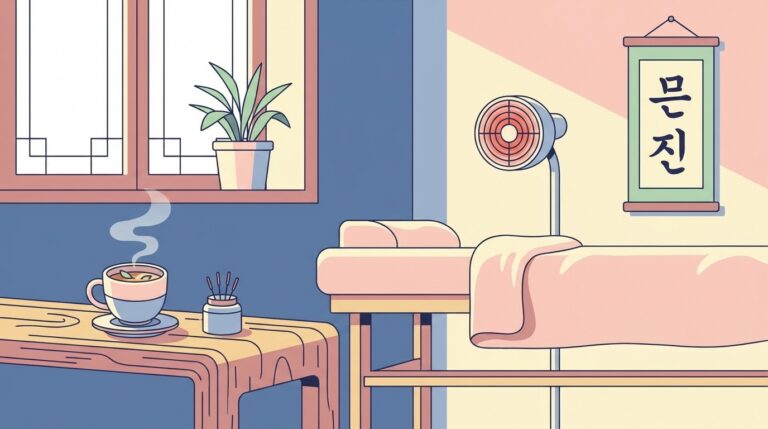
Navigating a Korean Medicine Clinic: From Needles to Insurance Claims
Phase 1: Empathy (Story-Driven Opening)
안녕하세요! 매일한글 에디터입니다.
Have you ever woken up in Seoul after trekking up the steep alleys of Bukchon Hanok Village or carrying a 25-kilogram suitcase up a metro flight of stairs, only to realize your back is frozen solid? Or maybe you spent eight hours straight hunching over a laptop at an aesthetic Seongsu cafe, and now your shoulder blades feel like they have turned into solid concrete? In K-dramas, this is the exact moment an elder sighs, clutches their lower back, and mutters that their dam (stiffness) has struck again before shuffling into a neighborhood Haniwon (한의원 – traditional Korean medicine clinic).
Stepping into a Korean medicine clinic for the first time as an expat or traveler can be downright intimidating. The ambient scent of simmering roots and mugwort (ssuk) hits your nostrils, soft ambient gayageum music plays in the background, and you hear the rhythmic click-clack of cupping suction pumps behind curtained treatment booths. You know you need relief, but how do you describe that your muscles are tightly knotted without sounding like a textbook? What does it feel like when the doctor prescribes yakchim (herbal pharmacopuncture) or infrared heat therapy? And most importantly, can you actually claim this on your private health insurance (silbi / 실손의료보험)?
Don’t worry! Based on years of feedback from international residents and real clinical visits across Seoul, this guide will equip you with B2-level natural phrases, non-verbal hospital etiquette, and insurance reimbursement tips so you can walk out pain-free with zero administrative stress.
Phase 2: Core Expressions Deep Dive
1. 뭉친 근육과 인대의 염증을 풀어 주러 왔어요 (Mungchin geunyuk-gwa indae-ui yeomjeung-eul pureo jureo wasseoyo)
- Pronunciation: [Mung-chin geun-yuk-gwa in-dae-ui yeom-jeung-eul poo-reo joo-reo wah-sseo-yo] (Think of ‘mung’ like ‘mongrel’ and ‘chin’ like your jawbone)
- Meaning: Literal: “I came to release knotted muscles and inflammation of the ligaments.” / Real Nuance: “My neck and back are severely locked up and swollen, and I need targeted clinical relief.”
- K-Culture Moment: You will hear this frequently on variety shows like I Live Alone (나 혼자 산다), where celebrities visit a clinic after an intense workout or action shoot, groaning onto the treatment table.
- Editor’s Insight: The verb mungchida (뭉치다) literally means to clump together like snowballs. Koreans personify muscle knots as clumps of stagnant energy and physical tension. Using pureojuda (풀어 주다 – to untie/unravel) shows you understand how Korean medicine approaches bodywork.
- Situation Spectrum: Casual 🚫 | Semi-formal ✅ | Formal ✅
- 🤔 Think About It: In English, we say “my back hurts,” focusing on pain. Why do Koreans conceptualize muscular pain as something “knotted” (뭉치다) that must be “unraveled” (풀다)?
2. 침이랑 부항, 그리고 약침도 같이 맞을 수 있나요? (Chim-irang buhang, geurigo yakchim-do gachi majeul su innayo?)
- Pronunciation: [Cheem-ee-rang boo-hang, geu-ree-go yahk-cheem-doh gah-chee mah-jeul soo een-nah-yo?]
- Meaning: Literal: “Can I receive acupuncture, cupping, and also pharmacopuncture together?” / Real Nuance: “Could we do a full combination treatment including herbal injections for faster recovery?”
- K-Culture Moment: In medical dramas or family sitcoms, tired parents ask the clinic director for the “full package” of needles and cupping marks on their shoulders before a busy holiday season.
- Editor’s Insight: Yakchim (약침) is an advanced Korean medicine technique combining acupuncture with purified herbal extracts injected directly into acupoints. Asking for this directly shows the doctor you have an intermediate understanding of Korean medical therapies.
- Situation Spectrum: Casual 🚫 | Semi-formal ✅ | Formal ✅
- 🤔 Think About It: Notice the verb matda (맞다 – to receive/get hit by a needle). Why is the verb for getting an injection or needle identical to receiving a raindrop (bi-reul matda) or an impact?
3. 실손보험 청구하게 진료비 영수증이랑 세부내역서 챙겨 주세요 (Silson-boheom cheong-guhage jinryobi yeongsujeung-irang sebu-naeyeokseo chaenggyeo juseyo)
- Pronunciation: [Sheel-sohn-boh-heom cheong-goo-hah-geh jeen-ryoh-bee young-soo-jeung-ee-rang seh-boo-nah-yeok-seoh chaeng-gyeo joo-seh-yo]
- Meaning: Literal: “Please prepare the medical bill receipt and itemized breakdown statement so I can file a private insurance claim.” / Real Nuance: “I need the standard claim documents for my private insurance reimbursement before I leave.”
- K-Culture Moment: At the front desk of any Korean medical facility, you will hear local office workers repeating this line almost like a reflex right after tapping their credit card.
- Editor’s Insight: Silson boheom (실손보험, often abbreviated to silbi 실비) covers standard National Health Insurance copays for acupuncture, cupping, and Chuna therapy, but usually excludes non-covered (bibeup-yeo) herbal medicine or certain cosmetic injections. Requesting the sebu-naeyeokseo (세부내역서 – itemized breakdown) is essential because insurance companies require it to verify eligible items.
- Situation Spectrum: Casual 🚫 | Semi-formal ✅ | Formal ✅
- 🤔 Think About It: Chaenggida (챙기다) is a versatile Korean cultural verb meaning to bundle, pack, care for, or ensure nothing is missed. Using it here sounds far more natural than just saying juseyo (give me).
Phase 3: Textbook Korean vs Real Korean
Situation 1: Explaining sudden stiff neck or back spasms
- 📖 교과서 한국어: 목과 허리에 통증이 매우 심합니다. (Mok-gwa heori-e tongjeung-i maeu simhamnida.) – “The pain in my neck and lower back is very severe.”
- 🗣️ 진짜 한국어: 자고 일어났는데 목에 담이 심하게 결려서 고개가 안 돌아가요. (Jago ireonanneunde mog-e dam-i simhage gyeollyeoseo gogaega an doragayo.) – “I woke up and my neck caught such a bad spasm that I can’t even turn my head.”
- 💡 왜 다를까?: Native speakers rarely say “I have severe pain” (tongjeung-i simhada). Instead, they use traditional concepts like dam-i gyeollida (담이 결리다 – trapped metabolic waste/spasm in the fascia) and describe the functional limitation (gogaega an doragayo).
Situation 2: Inquiring about insurance claim paperwork at the reception desk
- 📖 교과서 한국어: 보험 회사에 제출할 서류를 주십시오. (Boheom hoesa-e jechulhal seoryu-reul jusipsio.) – “Please give me the documents to submit to the insurance company.”
- 🗣️ 진짜 한국어: 실비 청구하려고 하는데, 진단명이랑 질병분류코드 들어간 서류로 끊어 주실 수 있나요? (Silbi cheong-guharyeogo haneunde, jindanmyeong-irang jilbyeong-bullyu-kodeu deureogan seoryuro kkeuneo jusil su innayo?) – “I am filing a private claim; could you issue documents that include the diagnosis name and disease classification code?”
- 💡 왜 다를까?: Korean insurance adjusters will automatically reject claims lacking the official KCD (Korean Classification of Diseases) code (jilbyeong-bullyu-kodeu). Asking specifically for this saves you a second trip to the clinic.
Phase 4: K-Culture Deep Dive & Non-verbal Manners
4-1. Nunchi & Clinic Body Language
When you are escorted to the treatment booth and change into patient garments (chiryobok), proper nunchi (situational etiquette) makes your session smooth:
1. The Acupuncture Breath: When the doctor warns you, “Tteuk-hamnida” (따끔합니다 – small pinch), exhale slowly through your mouth rather than tensing up. Tensing traps the needle, causing bruises (meong). If the sensation pulses deeply, that is called deukgi (득기 – arrival of Qi). Don’t jump; simply say: “Jom ppeogeunhaeyo” (좀 뻐근해요 – It feels a bit dull and heavy).
2. Infrared Lamp Positioning: The warm red lamp (jeok-oeseon onyeol-gi) placed above your back feels divine, but if it begins to burn your skin, never move the stand yourself! Moving abruptly with acupuncture needles or cupping suction cups on your body is dangerous. Call out politely: “Wonjangnim, bul-i jom tteugeowoyo!” (원장님, 불이 좀 뜨거워요! – Doctor, the heat is a bit too hot!).
4-2. Cultural Code Analysis: The Modern Haniwon as a Wellness Sanctuary
In classic historical K-dramas (Sageuk), Korean medicine is portrayed through rustic earthenware boiling bitter roots. Today, however, young Koreans view neighborhood Haniwon as an affordable, high-tech wellness retreat. Many clinics feature private acoustic booths, air-compression leg massagers, heated ceramic stone beds, and gentle Chuna therapy (chuna yobeop – joint realignment) covered by national insurance. Going to get cupping (buhang) after stressful corporate project deadlines is considered standard self-care among Korean 20s and 30s.
Phase 5: Real-Life Roleplay Scenario
Setting: A peaceful clinic in Mapo-gu, Seoul. Dr. Park (박 원장님), a warm physician with 15 years of clinical practice, checks your pulse while taking notes.
- Turn 1 (Dr. Park): 어디가 제일 불편해서 오셨어요? 진맥 먼저 짚어 볼게요. 손목 좀 편하게 올려 주세요.
(Eodiga jeil bulpyeonhaeseo osyeosseoyo? Jinmaek meonjeo jipeo bolgeyo. Sonmok jom pyeonhage ollyeo juseyo.)
“What brings you in today? Let me check your pulse first. Please rest your wrist comfortably here.”
🎭 Taking your radial pulse gently with three fingertips, nodding slightly. -
Turn 2 (You): 며칠 전부터 무거운 짐을 들다가 허리를 삐끗했는데요, 뭉친 근육이랑 인대가 뻐근해서 굽히질 못하겠어요.
(Myeochil jeonbuteo mugeoun jim-eul deuldaga heori-reul ppikkeut-haenneundeyo, mungchin geunyuk-irang indaega ppeogeunhaeseo gup-hijil mothagesseoyo.)
“A few days ago, I sprained my lower back while lifting heavy luggage; my knotted muscles and ligaments feel so stiff that I can’t bend forward.”
🎭 Gently resting your hand on your lumbar region to indicate the pain zone. -
Turn 3 (Dr. Park): 보니까 허리 주변 기립근이 많이 굳어 있고 염증 반응이 있네요. 오늘 온열 치료랑 침, 그리고 부항으로 어혈을 좀 빼 드릴게요.
(Bonikka heori jubyeon giripgeun-i mani gudeo itgo yeomjeung baneung-i inneyo. Oneul onyeol chiryo-rang chim, geurigo buhang-euro eohyeol-eul jom ppae deurilgeyo.)
“I see your spinal erector muscles are very stiff and there is inflammation. Today I will provide heat therapy, acupuncture, and cupping to release stagnant blood.”
🎭 Gently palpating the lower back to locate the trigger points. -
Turn 4 (You): 네, 원장님. 혹시 빠른 회복을 위해 약침 치료나 추나요법도 같이 받을 수 있을까요?
(Ne, wonjangnim. Hoksi ppareun hoebok-eul wihae yakchim chiryo-na chuna-yobeop-do gachi badeul su isseulkkayo?)
“Yes, Doctor. Could I possibly receive herbal pharmacopuncture or Chuna manual therapy together for faster recovery?”
🎭 Speaking with a respectful, eager tone. -
Turn 5 (Dr. Park): 네, 봉약침 성분으로 인대 염증을 가라앉히고 틀어진 골반은 추나로 바로잡아 드릴게요. 시술 후 약간 뻐근할 수 있습니다.
(Ne, bong-yakchim seongbun-euro indae yeomjeung-eul gara-anjhigo teureojin golban-eun chuna-ro barojaba deurilgeyo. Sisul hu yakgan ppeogeunhal su itseumnida.)
“Yes, we can soothe the ligament inflammation with bee-venom pharmacopuncture and realign your pelvis with Chuna. It might feel slightly sore afterward.”
🎭 Smiling reassuringly while preparing the sterilized needle set. -
Turn 6 (You): 네, 괜찮습니다! 잘 부탁드립니다.
(Ne, gwaenchanseumnida! Jal butakdeurimnida.)
“Understood, that is completely fine! I place myself in your hands.”
🎭 Lying face down on the sanitized treatment bed. -
Turn 7 (You – at reception): 치료 정말 시원하네요! 저 실손보험 청구해야 하는데, 진단서랑 진료비 세부내역서 발급 부탁드려요.
(Chiryo jeongmal siwonhaneyo! Jeo silson-boheom cheong-guhayeoya haneunde, jindanseo-rang jinryobi sebu-naeyeokseo balgeup butakdeuryeoyo.)
“The treatment was so refreshing! I need to claim private insurance, so could you please issue a medical certificate and itemized bill?”
🎭 Handing over your identification card at the front desk. -
Turn 8 (Desk Staff): 네, 환자분. 오늘 급여 항목인 침과 추나는 실비 청구 가능하시고요, 서류 바로 출력해 드릴게요!
(Ne, hwanjabun. Oneul geubyeo hangmok-in chim-gwa chuna-neun silbi cheong-gu ganeunghasigoyo, seoryu baro chulryeok-hae deurilgeyo!)
“Certainly! Today’s covered items like acupuncture and Chuna can be claimed on insurance; I will print the documents right away!”
🎭 Handing you the stamped clinical folder with two hands.
🔀 Interactive Decision Point
After the doctor applies the acupuncture needles, your back feels heavily numb and the red infrared lamp starts feeling quite hot. What do you do?
- Option A: Silently endure the burning heat because moving might dishonor the doctor.
Feedback: Bad! You risk superficial skin burns (hwasang). Medical staff want you to speak up immediately if heat therapy becomes uncomfortable. - Option B: Abruptly sit up and try to slide the lamp stand away with your hand.
Feedback: Risk! Moving while needles are inserted in your back can bend the needles or tear muscle fibers. Never sit up unassisted with needles inserted! - Option C: Keep your torso still and call gently: “저기요, 온열기 불이 좀 뜨거운데 조금만 낮춰 주시겠어요?” (Jeogiyo, onyeolgi bul-i jom tteugeowonde jogeumman natchwo jusigesseoyo?)
Feedback: Best! Perfect clinic communication. The assistant will immediately adjust the dimmer switch without disturbing your needle alignment.
Phase 6: 10-Second Emotion Shadowing Drill
Practice these natural clinic phrases aloud with the indicated pause markers (/) and emotional cues:
- [😣 뻐근함을 호소하며 – Painful & Seeking Relief]
어제부터 / 허리가 삐끗해서 / 굽히거나 펴질 못하겠어요.
(Eojebuteo / heoriga ppikkeuthaeseo / gup-higeona pyeojil mothagesseoyo.)
“Since yesterday / my back caught a spasm / and I can’t bend down or straighten up.” -
[💆 시원하고 나른하게 – Relieved & Pleasantly Relaxed]
따뜻한 찜질하고 / 침 맞고 나니까 / 뭉친 근육이 싹 풀렸어요.
(Ttatteut-han jjimjilhago / chim matgo nanikka / mungchin geunyuk-i ssak pullyeosseoyo.)
“After the warm compress / and acupuncture / all my muscle knots dissolved completely.” -
[💼 정중하고 명확하게 – Professional & Direct at Reception]
실손보험 접수용으로 / 질병코드가 들어간 / 진료비 영수증 부탁드립니다.
(Silson-boheom jeopsu-yong-euro / jilbyeong-kodeuga deureogan / jinryobi yeongsujeung butakdeurimnida.)
“For my private insurance claim / with the disease classification code included / please issue my treatment receipt.”
Phase 7: K-Culture Mini Dictionary
-
약침 (Yakchim – Herbal Pharmacopuncture):
A distinctive Korean medical practice where concentrated herbal solutions (such as wild ginseng or purified bee venom) are micro-injected into acupoints. Excellent for acute tendonitis and chronic joint inflammation. -
추나요법 (Chuna Yobeop – Chuna Manual Therapy):
A hands-on manual manipulation therapy performed personally by the licensed Korean medicine doctor to realign joints, discs, and spine segments. Since 2019, up to 20 sessions per year are partially covered by National Health Insurance! -
어혈 (Eohyeol – Stagnant Blood / Blood Stasis):
In Eastern medicine pathology, blood that fails to circulate properly due to trauma or cold stagnation. Wet cupping (su-sik buhang) extracts tiny drops of this stagnant blood to reboot local microcirculation. -
실손의료보험 / 실비 (Silson Uiryo Boheom / Silbi – Actual Loss Private Insurance):
The standard supplemental private insurance policy held by over 70% of residents in Korea. It reimburses 70% to 90% of eligible out-of-pocket medical expenses.
Phase 8: Traveler’s Survival Kit
Survival Expressions TOP 3
- “부항 자국 며칠이나 가나요?” (Buhang jaguk myeochirina ganayo?)
Meaning: How many days do these cupping marks last?
Pro Tip: Cupping marks typically fade within 3 to 7 days. If you are planning to visit a Korean bathhouse (jjimjilbang) or beach, be prepared for purple circles on your back! - “침 맞고 오늘 샤워해도 되나요?” (Chim matgo oneul syawohaedo doenayo?)
Meaning: Can I take a shower today after acupuncture?
Pro Tip: Doctors generally recommend waiting at least 2 hours before showering to avoid minor skin infection at the micro-puncture sites. - “보험 청구용 서류 일체 발급해 주세요.” (Boheom cheong-guyong seoryu ilche balgeup-hae juseyo.)
Meaning: Please issue the complete set of documents for insurance claims.
Editor’s Travel Note
- Finding English-friendly Clinics: Look up clinics on your smartphone via 네이버 지도 앱 다운로드 and search for “외국인 진료 한의원” (Foreigner-friendly Korean medicine clinic). Many clinics in Gwanghwamun, Gangnam, and Myeongdong offer multi-lingual intake sheets.
- Digital ID Requirement: Since May 2024, everyone (including foreign residents) must present official ID (Alien Registration Card or passport) to access National Health Insurance co-pays. Download the 모바일 건강보험증 앱 설치하기 on your phone to register your national insurance status digitally.
Phase 9: “One Step Deeper” (Reflective Question)
In Western medicine, an inflamed shoulder is often treated as an isolated biomechanical issue using anti-inflammatory chemicals. Korean medicine, however, views muscular knots (dam) as the outer symptom of an internal systemic imbalance between Eum (Yin) and Yang (Cold and Heat, Stagnation and Flow). When the doctor needles your leg to treat your stiff neck, they are treating the body as an interconnected web rather than disconnected spare parts. This holistic view reflects the broader Korean societal principle of gongdongche (공동체 – interconnected community), where no single element exists in complete isolation.
💬 Your Turn: Have you ever experienced Eastern bodywork like cupping or herbal acupuncture? How does the concept of “releasing knots” (pureojuda) compare to medical treatments in your home country? Share your stories in the comments below!
Phase 10: FAQ & Common Mistakes
Q: Can foreigners claim Korean medicine clinic visits on private insurance (silbi)?
A: Yes! If you hold a valid Korean private loss insurance policy (silson boheom), statutory covered items (geubyeo)—such as standard acupuncture, moxibustion, cupping, and Chuna therapy—are reimbursable after your deductible. However, non-covered items (bibeup-yeo) like restorative herbal decoctions (bo-yak) and certain pharmacopunctures are usually excluded unless specifically endorsed in your rider.
Q: Does acupuncture hurt as much as a regular injection needle?
A: Not at all! Western hypodermic needles are thick and hollow to inject or extract liquid. Korean acupuncture needles (hochim) are ultra-fine, flexible filaments about as thin as a strand of hair. Most patients only feel a mild initial pinch followed by a pleasant, heavy tingling sensation.
Q: What should I wear when visiting a Haniwon?
A: Wear comfortable, loose clothing. Even if you arrive in business attire, nearly all clinics provide sanitized two-piece treatment garments (chiryobok) with Velcro fastenings along the spine and shoulders for easy medical access.
🚨 Common Mistakes (흔한 실수 TOP 3)
- Mistake: Jumping or rolling over while needles or hot packs are active.
Correct Action: Keep still. If you experience cramps or excessive heat, gently press the bedside call bell (hochul-bel) or speak aloud. - Mistake: Drinking heavy alcohol immediately after receiving wet cupping or acupuncture.
Correct Action: Korean doctors advise avoiding alcohol (geumju) for 24 hours because vasodilation can cause dizziness or renewed inflammation. - Mistake: Forgetting to ask for the diagnosis code (jilbyeong kodeu) before leaving the counter.
Correct Action: Always ensure the receipt specifies your diagnosis code (e.g., M54 for back pain) to prevent insurance rejection.
Phase 11: Action Missions
- 🥉 Bronze Mission (Solo Practice): Stand in front of a mirror and practice asking the doctor to relieve your neck stiffness: “목에 담이 결려서 고개가 안 돌아가요. 침 치료 부탁드립니다.”
- 🥈 Silver Mission (Social Share): Post a photo of your favorite Korean herbal tea (like ssanghwa-tang or saenggang-cha) on Instagram Stories with the caption: “오늘 한의원에서 뭉친 근육 다 풀고 왔어요! #DailyHangul”
- 🥇 Gold Mission (Real-world Challenge): Next time you feel body aches in Korea, visit a neighborhood Haniwon, get a full consultation, and request your itemized receipt using: “실비 청구하게 세부내역서 챙겨 주세요.”
- 🎮 K-Culture Mission: Watch an episode of the variety show I Live Alone (나 혼자 산다) and spot a celebrity showing their round purple cupping marks (buhang jaguk) after physical therapy!
Phase 12: Interactive Quiz Challenge
Test your knowledge with these three clinic challenges!
Quiz 1: Situational Vocabulary
Which Korean expression best describes waking up with an acute muscular neck spasm that prevents head movement?
* A) 머리가 지끈거려요 (Meoriga jikkeungeoryeoyo)
* B) 목에 담이 결렸어요 (Mog-e dam-i gyeollyeosseoyo)
* C) 발목을 삐끗했어요 (Balmok-eul ppikkeut-haesseoyo)
Quiz 2: Fill in the Blank
When requesting insurance documents at the front desk, complete the sentence:
“실손보험 청구하려고 하는데 진단명이랑 질병분류____ 들어간 서류 끊어 주세요.”
* A) 코드 (Code)
* B) 카드 (Card)
* C) 쿠폰 (Coupon)
Quiz 3: True or False Cultural Manners
In modern Korean medicine clinics, Chuna manual therapy (추나요법) is completely excluded from National Health Insurance and can never be claimed. (True / False)
👉 Click to reveal Answers & Explanations!
- Quiz 1 Answer: B) 목에 담이 결렸어요. (Explanation: Dam-i gyeollida specifically refers to a muscular knot or spasm in the neck, shoulders, or back. A is for throbbing headaches, and C is for spraining an ankle.)
- Quiz 2 Answer: A) 코드. (Explanation: You need the jilbyeong-bullyu-kodeu [disease classification code] on your medical statement to file your private insurance claim smoothly.)
- Quiz 3 Answer: False. (Explanation: Since April 2019, Chuna manual therapy has been officially covered under Korea’s National Health Insurance for up to 20 sessions per year, making it eligible for private insurance copay claims!)







