

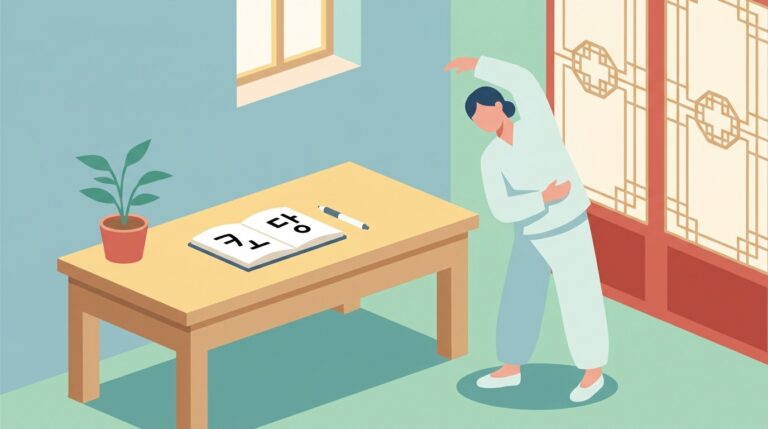
Stiff Back in Korea? Say This at the Clinic to Get Instant Relief
Phase 1: Empathy (Story Immersion Opening)
안녕하세요! (Annyeonghaseyo!) I’m your Daily Hangul editor and your personal Korean cultural navigator. Have you ever spent an entire rainy afternoon tucked inside a cozy café in Seongsu-dong, binge-watching your favorite K-Drama, only to stand up and feel an agonizing crack in your lower back? Or maybe after navigating the steep staircases of Seoul’s subway stations, you twisted your ankle slightly, and the combination of walking and sitting at your laptop left you completely stiff?
In Korea, you don’t have to suffer in silence. Visiting a 정형외과 (jeonghyeong-oegwa – orthopedic clinic) is as casual, accessible, and fast as picking up a morning iced Americano. But when you lie on that physical therapy bed and the friendly therapist tells you something fast in Korean, panic sets in. You want to nod, but your back is stiff, your ankle aches, and you aren’t sure what they asked you to do!
One of our lovely beginner learners, Sarah, told us she once spent an entire 40-minute therapy session freezing like a statue because she misunderstood the therapist’s advice to adjust her sitting posture frequently. Mastering this unit’s key phrase—“중간에 앉은 자세를 자주 바꾸고 한 시간마다 스트레칭을 해 주세요” (Change your sitting posture often and stretch every hour)—will not only save your spine in Korea’s workaholic café culture, but it will also give you immediate confidence to understand real medical and wellness advice anywhere in the country.
Phase 2: Core Expressions Deep Dive
Let’s break down the essential expressions used by Korean orthopedic doctors and physical therapists into three bite-sized, practical gems:
1. 앉은 자세를 자주 바꿔 주세요 (Anjeun jasereul jaju bakkwo juseyo)
- Pronunciation: [An-jeun ja-se-reul ja-ju bak-kwo ju-se-yo] (Intuitive sound tip: “Jaju” rhymes with the sneeze sound “Ha-tchoo!” and means frequently/often!)
- Meaning: “Please change your sitting posture frequently.”
- K-Culture Moment: You will hear this in office K-Dramas like Misaeng or King the Land whenever a hard-working manager sighs, rubs their neck, and reminds their rookie team member not to stay frozen at their desk.
- Editor’s Insight: The base form is
바꾸다(to change/switch). Adding-어/아 주세요makes it a gentle, caring instruction rather than a rigid military order. Doctors in Korea use this polite request form constantly.- Situation Spectrum:
- Casual (반말): 앉은 자세 자주 바꿔 (⚠️ – only to close friends)
- Semi-formal (해요체): 앉은 자세를 자주 바꿔 주세요 (✅ – perfect for clinic & everyday life)
- Formal (하십시오체): 앉은 자세를 자주 바꾸십시오 (✅ – formal announcements/posters)
- 🤔 Think About It: In English, we often say “don’t sit still.” Korean phrasing focuses on the affirmative action: “actively change your posture” (
자세를 바꾸다). How does your native language frame wellness advice?
2. 한 시간마다 스트레칭을 해 주세요 (Han sigan-mada seuteureching-eul hae juseyo)
- Pronunciation: [Han shi-gan-ma-da seu-teu-reh-ching-eul hae ju-se-yo] (Intuitive sound tip: “-mada” sounds like “mother” without the ‘r’—think of your mother reminding you *every single hour!)*
- Meaning: “Please stretch every hour.”
- K-Culture Moment: During intense Korean high school study sessions or idol dance practices, you’ll hear the leader clap their hands and shout, “스트레칭 타임!” (Stretching time!).
- Editor’s Insight: The particle
-마다(mada) attaches directly to time nouns to mean “every” or “each” (e.g.,한 시간마다= every hour,날마다= every day). Notice how the English word “stretching” is adopted into Korean phonetics as스트레칭(seuteureching).- Situation Spectrum:
- Casual: 한 시간마다 스트레칭해 (⚠️)
- Semi-formal: 한 시간마다 스트레칭을 해 주세요 (✅ – clear, warm, natural)
- Formal: 매시간 스트레칭을 하시기 바랍니다 (✅ – clinic guideline sheet)
- 🤔 Think About It: Korean borrows many English health terms like “stretching” and “massage.” Why do you think modern healthcare combines traditional Korean particles with borrowed English lifestyle words?
3. 허리를 곧게 펴세요 (Heorireul gotge pyeoseyo)
- Pronunciation: [Heo-ri-reul got-ge pyeo-se-yo] (Intuitive sound tip: “Heori” sounds a bit like “hurry”—hurry and straighten your lower back!)
- Meaning: “Straighten your back / Sit up straight.”
- K-Culture Moment: An elderly grandmother (할머니) gently tapping your back while you eat at a traditional floor-seating restaurant, urging you not to slouch over your soup bowl.
- Editor’s Insight:
허리technically refers to the waist and lumbar area, while등refers to the upper back. When Koreans talk about desk posture, they almost always mention허리.곧게means “straight” or “upright.”- Situation Spectrum:
- Casual: 허리 좀 펴 (⚠️ – to younger siblings or close friends)
- Semi-formal: 허리를 곧게 펴세요 (✅ – polite medical or gym instruction)
- Formal: 허리를 곧게 펴 주십시오 (✅ – formal rehab training)
- 🤔 Think About It: Why does Korean have distinct everyday body focus points like
허리compared to English just saying “sit up straight”?
Phase 3: Textbook Korean vs. Real Korean
Situation 1: Expressing that your back or joints feel stiff
- 📖 교과서 한국어 (Textbook): 제 척추에 통증이 있습니다. (Je cheokchue tongjeung-i itseumnida. – I have pain in my spine.)
- 🗣️ 진짜 한국어 (Real-life): 허리가 너무 뻐근해요. (Heoriga neomu bbeogeunhaeyo. – My back feels so stiff and sore.)
- 💡 왜 다를까? (Why the difference?): Real Koreans rarely use formal medical jargon like
척추(spine) or통증(pain) in casual clinic checkups. Instead, they use vivid physical sensation adjectives like뻐근하다(stiff/heavy muscle feeling).
Situation 2: Asking someone to fix their slouching posture
- 📖 교과서 한국어 (Textbook): 바른 자세로 의자에 착석하십시오. (Bareun jasero uijae chakseokhasippsio. – Please seat yourself on the chair in a correct posture.)
- 🗣️ 진짜 한국어 (Real-life): 허리 펴고 바르게 앉으세요. (Heori pyeogo bareuge anjeuseyo. – Straighten your back and sit upright.)
- 💡 왜 다를까? (Why the difference?):
착석하다is a robotic Sino-Korean term seen on flight announcements. Physical therapists and trainers talk to you like a caring coach: action verbs like펴다(straighten) and앉다(sit).
Phase 4: K-Culture Deep Dive & Nonverbal Manners
4-1. 눈치 (Nunchi) & Clinic Etiquette
When you enter a Korean physical therapy room (물리치료실 - mullichiryosil), you will notice a soothing, almost spa-like atmosphere partitioned by pastel curtains.
* Shoe Etiquette: Look at the floor immediately! If you see slippers lined up beside the bed, take off your sneakers and put your shoes into the small shelf beneath the bed.
* Small Bows While Lying Down: When the therapist adjusts your heat pack or electrical stimulation pads (전기치료), you don’t need to stand up to bow. A gentle 15-degree head nod while lying down with a soft “감사합니다” (Gamsahamnida) displays immaculate nunchi.
* Expressing Pain Politely: Korean therapists will frequently ask, “아프세요?” (Apuseyo? – Does it hurt?) or “참을 만하세요?” (Chameul manhaseyo? – Is it bearable?). If it hurts too much, don’t scream; raise your hand slightly and say: “조금 아파요, 살살해 주세요” (Jogeum apayo, salsalhae juseyo – It hurts a bit, please be gentle).
4-2. Cultural Code: The “Palli-Palli” Desk Syndrome
South Korea boasts incredible digital infrastructure, which also means long hours in front of screens. Office workers are nicknamed “거북목족” (geobukmok-jok – the turtle-neck tribe) due to forward head posture. Because of this, modern Korean orthopedic clinics treat physical therapy not just as injury recovery, but as essential maintenance for desk workers and students alike. Posture correction posters are ubiquitous on buses and office bulletin boards!
Phase 5: Real-Life Roleplay Scenario
Setting: You are inside the physical therapy room at a modern Orthopedic Clinic (정형외과) near Gangnam Station. The physical therapist, Minsu (민수), is wrapping up an ultrasound treatment on your stiff lumbar back.
- Turn 1 (민수): 치료 다 끝났습니다. 천천히 일어나 보세요.
(Chiryo da kkeutnatseumnida. Cheoncheonhi ireona boseyo.)
“The treatment is finished. Please try sitting up slowly.”
🎭 Helping you sit up gently by supporting your shoulder -
Turn 2 (You): 네, 감사합니다. 아까보다 훨씬 가벼워요.
(Ne, gamsahamnida. Akkaboda hwolssin gabyeowoyo.)
“Yes, thank you. It feels much lighter than before.”
🎭 Gently rotating your shoulders to test your back -
Turn 3 (민수): 다행이네요. 그런데 평소에 컴퓨터 오래 하세요?
(Dahaeng-ineyo. Geureonde pyeongsoe keompyuteo orae haseyo?)
“Glad to hear that. By the way, do you use the computer for long hours normally?”
🎭 Inspecting your posture with a warm, caring look -
Turn 4 (You): 네, 카페에서 대여섯 시간씩 앉아서 작업해요.
(Ne, kape-eseo daeyeoseot siganssik anjaseo jageophaeyo.)
“Yes, I sit at cafés and work for five or six hours at a time.”
🎭 Laughing with a shy, apologetic face -
Turn 5 (민수): 아이고, 그러면 근육이 금방 굳어요. 중간에 앉은 자세를 자주 바꿔 주세요.
(Aigo, geureomyeon geunyug-i geumbang gudeoyo. Junggan-e anjeun jasereul jaju bakkwo juseyo.)
“Oh dear, your muscles will stiffen up in no time then. Please change your sitting posture frequently in between.”
🎭 Demonstrating by shifting posture left and right -
Turn 6 (You): 그렇군요. 얼마나 자주 움직여야 할까요?
(Geureokunyo. Eolmana jaju umjig-yeoya halkkayo?)
“I see. How often should I move around?”
🎭 Listening intently with eyes wide -
Turn 7 (민수): 한 시간마다 스트레칭을 꼭 해 주세요. 알람을 맞춰 두시면 좋아요.
(Han sigan-mada seuteureching-eul kkok hae juseyo. Allam-eul matchwo dusimyeon joayo.)
“Please make sure to stretch every hour. It’s great if you set a phone alarm.”
🎭 Mimicking rolling shoulders backward -
Turn 8 (You): 네! 오늘부터 잊지 않고 꼭 해 볼게요.
(Ne! Oneulbuteo itji anko kkok hae bolgeyo.)
“Got it! Starting today, I will make sure not to forget and do it.”
🎭 Giving a respectful nod and a bright smile
🔀 Interactive Branching Moment!
After Minsu gives you the stretching tip, you want to ask if doing intense gym squats is okay today. What do you reply?
- Option A: “오늘 헬스장 가서 무거운 거 들어도 돼요?” (Oneul helseujang gaseo mugeoun geo deureodo dwaeyo? – Can I go to the gym and lift heavy things today?)
- 👉 Feedback (Risk): Grammatically correct, but lifting heavy weights right after muscle treatment will shock your spine! Minsu will frown and say “안 돼요! 오늘은 푹 쉬세요!” (No! Rest up today!).
- Option B: “가벼운 스트레칭 말고는 오늘은 푹 쉴게요.” (Gabyeoun seuteureching malgoneun oneureun puk swilgeyo. – Aside from light stretching, I’ll take a deep rest today.)
- 👉 Feedback (Best! ⭐): Exemplary patient! Minsu will praise you for your intuition and recommend a warm bath.
- Option C: “운동 안 해요.” (Undong an haeyo. – I don’t exercise.)
- 👉 Feedback (Bad): A bit too blunt and slightly awkward in tone. It ends the rapport abruptly.
Phase 6: 10-Second Emotion Shadowing Drill
Practice these lines out loud. Pay attention to the pause slashes (/) and embody the emotion!
[😣 Stiff and slightly sore]
허리가 / 너무 뻐근해서 / 오래 앉아 있기 힘들어요.
(Heoriga / neomu bbeogeunhaeseo / orae anja itgi himdeureoyo.)
My back / is so stiff / that it’s tough to stay seated for long.-
[👨⚕️ Warm and reassuring advice]
중간에 / 앉은 자세를 자주 바꾸고 / 한 시간마다 / 스트레칭을 해 주세요.
(Junggan-e / anjeun jasereul jaju bakkugo / han sigan-mada / seuteureching-eul hae juseyo.)
In between / change your sitting posture frequently / and every hour / please stretch. -
[😊 Energetic and determined]
네 선생님! / 틈틈이 / 허리를 곧게 펴 볼게요!
(Ne seonsaengnim! / teumteumi / heorireul gotge pyeo bolgeyo!)
Yes, doctor! / In my spare moments / I’ll try to straighten my back!
Phase 7: K-Culture Mini Dictionary
- 물리치료 (Mullichiryo) | Physical therapy
Everyday context: In Korea, you can walk into almost any neighborhood 정형외과 without months of waiting and get comprehensive heat, electro, and manual therapy (도수치료) under $10–$25 with standard coverage or basic visit rates. - 담 (Dam) | Acute muscle spasm / Knot
Everyday context: If you wake up and can’t turn your neck, Koreans say: “목에 담 걸렸어” (A knot got caught in my neck). Doctors will instantly recognize this phrase. - 뻐근하다 (Bbeogeunhada) | To feel stiff / heavy in the joints or muscles
Everyday context: The ultimate expression after sitting on a KTX bullet train or an airplane seat for 4 hours. - 파스 (Paseu) | Medicated pain relief patch
Everyday context: Sold at every Korean pharmacy (약국) and convenience store. It comes in cooling (쿨파스) and heating (핫파스) variations!
Phase 8: Traveler’s Survival Kit
Top 3 Clinic Survival Phrases
- 발목을 삐었어요. (Balmogeul bbieosseoyo.)
- I sprained my ankle.
- Pro Tip: Useful if you step into an uneven curb in hilly neighborhoods like Itaewon or Bukchon.
- 여기가 찌릿찌릿해요. (Yeogiga jjirit-jjirithaeyo.)
- It feels tingling / sharp electric pain right here.
- Pro Tip:
찌릿찌릿is an onomatopoeia for nerve tingles!
- 물리치료 받을 수 있나요? (Mullichiryo badeul su innayo?)
- Can I receive physical therapy?
- Pro Tip: Say this at the reception desk upon check-in.
Editor’s Travel Note: Finding Clinics Like a Local
Don’t rely on generic search engines in Korea; download and search via Naver Map App. Simply type “정형외과” into the search bar. Look for clinics marked with high reviews and keywords like “친절한 물리치료” (friendly physical therapy). No appointments are needed for first-time general clinic visits—just walk in with your passport, take a number, and state your symptoms!
Phase 9: “One Step Deeper” (Cultural Reflection)
In Korean healthcare culture, doctors and therapists speak with an intimacy that bridges professional distance and familial care. When a therapist says, “스트레칭을 해 주세요”, notice that they attach -주세요 (“do it for me / please do”). Rather than an authoritarian directive, it implies: “I care for your body, so please do me the favor of taking care of yourself.” Health is viewed as an interactive, communal responsibility. You are not just a patient on a conveyor belt; you are someone’s wellness partner.
💬 Your Turn: Do you tend to freeze up when working, or are you good at setting stretching reminders? What’s your favorite posture habit? Share in the comments below!
Phase 10: FAQ & Avoiding Misunderstandings
Q: Do I need a doctor’s referral letter to get physical therapy at a Korean orthopedic clinic?
A: No! Unlike many Western healthcare systems where you need a GP’s referral to see a physiotherapist, in South Korea, you simply walk directly into any local 정형외과 (Orthopedic clinic). The on-site doctor will consult you, take quick X-rays if needed, and send you straight to their internal physical therapy room on the same day.
Q: Can I buy medicated patches (파스) at a convenience store if the clinic is closed?
A: Yes! Korean convenience stores (GS25, CU, 7-Eleven) stock basic over-the-counter pain patches (파스) and pain relievers like Tylenol in their safety medicine shelf (안전상비의약품). However, specialized patches (like extra-large sizes or strong NSAID formulas) are found at pharmacies (약국).
Q: What is the difference between 한의원 (Oriental clinic) and 정형외과 (Orthopedics)?
A: If you sprain an ankle or have back stiffness, both are widespread in Korea! 정형외과 uses modern Western medicine (X-ray, ultrasound, physical therapy machines, anti-inflammatory meds), while 한의원 focuses on acupuncture (침), cupping (부항), and herbal medicine. For acute structural pain, foreigners usually start with 정형외과.
🚨 Common Mistakes Warning Board
- Mistake: Confusing
허리(waist/lower back) with등(upper/mid back).- Correct Action: If you point to your belt line, say
허리(heori). If you touch your shoulder blade area, say등(deung).
- Correct Action: If you point to your belt line, say
- Mistake: Telling the doctor “저 아파요” without specifying where.
- Correct Action: Always attach the body part before
아파요: “[Body Part]이/가 아파요” (e.g., 발목이 아파요 – My ankle hurts).
- Correct Action: Always attach the body part before
- Mistake: Saying “스트레칭 하세요” to the therapist.
- Correct Action:
-세요is an imperative. Saying that tells the therapist to stretch! Instead say, “스트레칭 자주 할게요” (I will stretch frequently).
- Correct Action:
Phase 11: Action Missions
- 🥉 Bronze Mission (Solo Shadowing): Stand up right now, roll your shoulders backward 5 times, and say out loud with enthusiasm: “허리를 곧게 펴고 스트레칭을 해요!” (Heorireul gotge pyeogo seuteureching-eul haeyo!)
- 🥈 Silver Mission (Phone Setting): Set a timer on your phone labeled: “한 시간마다 스트레칭!” and post a screenshot on your Instagram Stories tagging
@DailyHangul! - 🥇 Gold Mission (Real-Life Clinic Challenge): The next time you feel stiff at work or visit a clinic/massage shop, tell someone: “허리가 뻐근해서 스트레칭이 필요해요” (Heoriga bbeogeunhaeseo seuteureching-i piryohaeyo).
- 🎮 K-Culture Mission: Watch an episode of a workplace K-Drama (like Misaeng). Spot any scene where an employee stretches at their cubicle, and identify if they shake their wrists or twist their waist!
Phase 12: Interactive Quiz Challenge
1. Situational Judgment
You are sitting in a Korean café working for 3 hours. Your neck feels completely stiff. Which phrase should you say to yourself or your study buddy?
* A) 발목이 삐었어요.
* B) 목이 너무 뻐근해요. 한 시간마다 스트레칭해야겠어요.
* C) 물리치료를 받으십시오.
🔍 Click to Reveal Answer & Explanation
Correct Answer: B
Explanation: 목이 너무 뻐근해요 means “My neck feels so stiff,” and 한 시간마다 스트레칭해야겠어요 means “I should stretch every hour.” (A refers to a sprained ankle, and C is a formal command telling someone else to receive physical therapy!)
2. Fill-in-the-Blank
Complete the doctor’s advice using the particle meaning “every”:
* “두 시간_________ 일어나서 걸으세요.” (Please stand up and walk every two hours.)
🔍 Click to Reveal Answer & Explanation
Correct Answer: 마다 (mada)
Full Sentence: 두 시간마다 일어나서 걸으세요. (Du sigan-mada ireonaseo georeuseyo.)
Explanation: The particle -마다 attaches to time units to express recurring intervals.
3. True or False Cultural Quiz
True or False: In Korea, you must always schedule an appointment weeks in advance to see a physical therapist at an orthopedic clinic.
🔍 Click to Reveal Answer & Explanation
Correct Answer: False!
Explanation: Korean primary orthopedic clinics (정형외과 의원) accommodate walk-in patients easily. You can usually see a doctor and complete a full physical therapy cycle in under an hour without prior reservation!







