

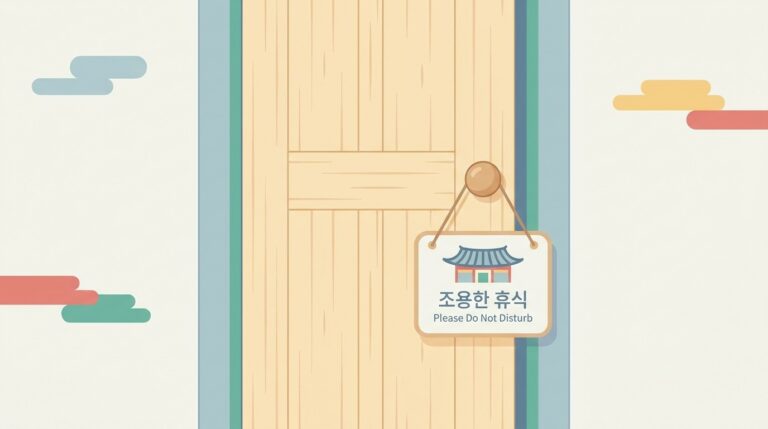
Master Hotel Korean: How to Politely Say ‘No Need to Clean My Room’
Phase 1: Empathy (Story Opening)
안녕하세요! 매일한글 에디터입니다. (Hello! I’m your Daily Hangul editor!)
Imagine this: You spent yesterday exploring the bustling alleys of Ikseon-dong, shopped until your feet hurt in Myeongdong, and capped off midnight with crispy Korean fried chicken while binge-watching your favorite K-drama. Naturally, your hotel room looks like a hurricane made of K-beauty face masks, snack wrappers, and unzipped suitcases. It’s 10:30 AM. You are still tucked under the warm duvet when suddenly—knock, knock, knock! A cheerful voice outside calls out: “고객님, 방 청소해 드릴까요? (Gogaeknim, bang cheongso-hae deurilkkayo? / Guest, shall we clean the room?)”
Panic sets in. You want to shout, “No thanks! Please don’t come in!” but your brain freezes. You don’t want to sound rude or like an angry guest, but you also definitely don’t want anyone seeing your Olive Young shopping explosion across the floor!
Every traveler in Korea hits this exact wall. In Korean culture, service workers are exceptionally attentive and eager to tidy up, meaning daily housekeeping knocks are standard unless you say something. Today, we’re going to master the single most polite, natural, and stress-free phrase to declutter your morning: “객실 청소는 안 해 주셔도 돼요 (You don’t need to clean the room).” Based on real feedback from hundreds of beginner students at Daily Hangul, this one survival phrase will instantly give you back your peaceful mornings and privacy.
Phase 2: Core Expressions Deep Dive
Here are the top three golden expressions you need for a frictionless hotel stay.
1. 청소 안 해 주셔도 돼요 (Cheongso an hae jusyeodo dwaeyo)
- Pronunciation: Cheong-so ahn hae joo-syeo-doh dwae-yo (Think: Cheong sounds like “Chung”, dwae-yo sounds like “Dway-yo”)
- Meaning: Literal: “Even if you do not do cleaning, it is okay.” ➔ Actual Nuance: “You don’t have to clean the room / No need to clean, thank you!”
- K-Culture Moment: You often hear this polite declining pattern in slice-of-life K-dramas when a warm landlady or mother figure offers to wash dishes, and the younger lead gently declines to avoid burdening them.
- Editor’s Insight: In Korean, saying a blunt “청소 하지 마세요! (Do not clean!)” sounds like an angry military command. Adding “-안 해 주셔도 돼요” shifts the focus from an order to a thoughtful courtesy: “I don’t want to trouble you with cleaning.”
- Situation Spectrum: Casual 🚫 | Semi-formal ✅ | Formal ✅
- 🤔 Think About It: In English, we say “Don’t worry about it.” Why do you think Korean expresses refusal as “It is okay if you don’t do it for me”? How does that protect both people’s feelings?
2. 수건만 더 주세요 (Su-geon-man deo ju-se-yo)
- Pronunciation: Soo-geon-mahn duh joo-seh-yo (Like “Sue-gun-mahn duh joo-say-yo”)
- Meaning: Literal: “Only towels more please give.” ➔ Actual Nuance: “Just some extra towels, please.”
- K-Culture Moment: The magic particle 만 (man) means “only.” When you skip the full room service but just want clean towels or bottled water, this is the exact phrase used by hotel regulars in Korean reality travel shows!
- Editor’s Insight: You can swap 수건 (su-geon / towel) with 물 (mul / water) or 휴지 (hyu-ji / toilet paper): “물만 더 주세요 (Just extra water, please).”
- Situation Spectrum: Casual ⚠️ | Semi-formal ✅ | Formal ✅
- 🤔 Think About It: Why does adding the word “only” (만) make a request sound much smaller and less demanding in customer service interactions?
3. 와이파이 비밀번호가 뭐예요? (Wa-i-pa-i bi-mil-beon-ho-ga mwo-ye-yo?)
- Pronunciation: Wah-ee-pah-ee bee-meel-bun-ho-gah mwo-yeh-yo?
- Meaning: Literal: “Wi-Fi secret number what is it?” ➔ Actual Nuance: “What is the Wi-Fi password?”
- K-Culture Moment: In Korea—the capital of lightning-fast 5G—stepping into any café, guest house, or hotel lobby starts with scanning the walls for the Wi-Fi code. If you can’t spot the sign, asking the front desk with this phrase gets you connected in seconds.
- Editor’s Insight: Locals almost always shorten 비밀번호 (bi-mil-beon-ho) to 비번 (bi-beon)! So “와이파이 비번이 뭐예요?” will make you sound like an absolute Seoul local.
- Situation Spectrum: Casual ⚠️ | Semi-formal ✅ | Formal ✅
- 🤔 Think About It: How does the compound word “secret number” (비밀 + 번호) compare to the Western concept of a “pass-word”?
Phase 3: Textbook Korean vs. Real-World Korean
Situation 1: Declining Housekeeping at the Door
- 📖 Textbook Korean: 방 청소를 원하지 않습니다. (Bang cheong-so-reul won-ha-ji an-seum-ni-da.) — “I do not desire room cleaning.”
- 🗣️ Real-World Korean: 청소는 괜찮아요! 안 해 주셔도 돼요. (Cheong-so-neun gwaen-chan-a-yo! An hae ju-syeo-doh dwae-yo.) — “Cleaning is fine! You don’t need to do it.”
- 💡 Why is it different? Textbook phrases can sound like a formal legal disclaimer written on a contract. Real Koreans soften refusals with 괜찮아요 (It’s okay / I’m good) to sound friendly and considerate.
Situation 2: Asking for the Wi-Fi Code
- 📖 Textbook Korean: 무선 인터넷 접속 비밀번호를 알려 주십시오. (Mu-seon in-teo-net jeop-sok bi-mil-beon-ho-reul al-lyeo ju-sip-si-o.) — “Please inform me of the wireless internet access password.”
- 🗣️ Real-World Korean: 와이파이 비번 뭐예요? (Wa-i-pa-i bi-beon mwo-ye-yo?) — “What’s the Wi-Fi password?”
- 💡 Why is it different? Nobody says “wireless internet” (무선 인터넷) in modern conversation. Everyone just says “Wi-Fi” and shortens password to “비번 (bi-beon)”.
Phase 4: K-Culture Deep Dive & Non-Verbal Manners
4-1. Nunchi (눈치) & Body Language: The Gentle Refusal
When you open the hotel room door slightly to talk to housekeeping, non-verbal cues carry 50% of the message:
* The Two-Hand Soft Wave: Raise one or both hands slightly in front of your chest and make a gentle, slow waving motion from side to side. In Korean body language, this instantly signals: “No need, you’re fine!” without being confrontational.
* The Soft Head Bow: Accompany your “괜찮아요 (Gwaen-chan-a-yo)” with a slight 15-degree head bow. It signals deep respect and gratitude for their willingness to clean.
* Keep the Door Modest: Housekeepers in Korea respect guest privacy strictly. You don’t need to swing the door wide open; cracking it open just enough to smile and exchange words is completely customary and polite.
4-2. Cultural Insight: Eco-Friendly “Green Stay” in Korea
Did you know? Under recent Korean environmental regulations, most Korean hotels and business lodgings no longer provide disposable toothbrushes, razors, or single-use toiletries for free. Furthermore, many Korean boutique hotels and boutique stays now actively encourage 연박 (yeon-bak / consecutive multi-night stay) guests to skip daily linen changes to save water and energy. Declining daily cleaning is not considered strange at all—it’s viewed as eco-friendly and thoughtful!
Phase 5: Real-Life Roleplay Scenario
Setting: 11:00 AM at a trendy boutique hotel in Yeonnam-dong, Seoul. You’ve had a late night and are lounging in your room. Housekeeping staff member 민우 (Min-woo) taps lightly on the door.
- Min-woo (Staff): (Knocks politely twice) 실례합니다! 객실 청소 지금 해 드릴까요?
(Sil-lye-ham-ni-da! Gaek-sil cheong-so ji-geum hae deu-ril-kkayo?)
“Excuse me! Shall I clean the room for you now?” - You (Guest): (Cracking door open, smiling with a gentle hand wave) 🎭 안녕하세요! 청소는 안 해 주셔도 돼요.
(An-nyeong-ha-se-yo! Cheong-so-neun an hae ju-syeo-doh dwae-yo.)
“Hello! You don’t need to clean the room.” - Min-woo (Staff): (Nods understandingly) 아, 네! 알겠습니다. 필요한 건 없으세요?
(A, ne! Al-get-seum-ni-da. Pil-yo-han geon eop-seu-se-yo?)
“Ah, yes! Understood. Is there anything you need?” - You (Guest): 🎭 수건만 두 장 더 주실 수 있어요?
(Su-geon-man du jang deo ju-sil su it-seo-yo?)
“Could you please give me just two more towels?” - Min-woo (Staff): (Takes fresh towels from cart) 네, 여기 새 수건 두 장 있습니다.
(Ne, yeo-gi sae su-geon du jang it-seum-ni-da.)
“Yes, here are two fresh towels for you.” - You (Guest): (Receiving towels with both hands) 🎭 감사합니다! 쓰레기는 문 앞에 둘게요.
(Gam-sa-ham-ni-da! Sseu-re-gi-neun mun a-pe dul-ge-yo.)
“Thank you! I will leave the trash bag in front of the door.” - Min-woo (Staff): (Bows slightly) 네, 문 앞에 두시면 치워 드릴게요. 편히 쉬세요!
(Ne, mun a-pe du-si-myeon chi-wo deu-ril-kkayo. Pyeon-hi swi-se-yo!)
“Yes, if you put it outside the door, I will clear it. Rest comfortably!” - You (Guest): 🎭 네, 감사합니다. 수고하세요!
(Ne, gam-sa-ham-ni-da. Su-go-ha-se-yo!)
“Yes, thank you. Keep up the good work!”
🔀 Interactive Decision Point
If the housekeeper asks: “어메니티나 생수는 더 필요하세요? (Do you need more amenities or bottled water?)” What do you say?
- Choice A: “안 필요해요. 가세요! (An pil-yo-hae-yo. Ga-se-yo!)”
❌ Bad Feedback: Ouch! “가세요” translates to “Go away!” This sounds extremely harsh and abrupt in Korean. - Choice B: “물 두 병만 더 주세요. 감사합니다! (Mul du byeong-man deo ju-se-yo. Gam-sa-ham-ni-da!)”
🏆 Best Feedback: Perfect natural score! You used the polite counter “병 (bottles)”, added “만 (only)”, and finished with gratitude. - Choice C: “청소 싫어요! (Cheong-so sirh-eo-yo!)”
⚠️ Risk Feedback: “싫어요” means “I hate/dislike it!” While they will understand you don’t want cleaning, it sounds childish or upset.
Phase 6: 10-Second Emotion Shadowing Drill
Practice these aloud! Pay attention to the slash marks (/) for natural breath pauses and adopt the emotional mindset in the brackets.
- [😊 Friendly & Reassuring]
청소는 / 괜찮아요! / 안 해 주셔도 돼요.
(Cheong-so-neun / gwaen-chan-a-yo! / An hae ju-syeo-doh dwae-yo.)
Cleaning is / totally fine! / You really don’t have to clean. -
[🙏 Polite & Modest Request]
수건 두 장만 / 더 / 부탁드려요.
(Su-geon du jang-man / deo / bu-tak-deu-ryeo-yo.)
Just two towels / more / please, if possible. -
[🙋 Curious & Casual]
저기요, / 와이파이 비번 / 뭐예요?
(Jeo-gi-yo, / wa-i-pa-i bi-beon / mwo-ye-yo?)
Excuse me, / Wi-Fi password / what is it?
Phase 7: K-Culture Mini Dictionary
-
비번 (Bi-beon) | Noun (Slang/Abbreviation)
Short for 비밀번호 (secret password). Used everywhere in daily life in Korea—from asking for front door keypad codes to unlocking Wi-Fi at cafés. -
어메니티 (Eo-me-ni-ti) | Noun (Loanword)
Directly borrowed from “Amenities.” Refers specifically to hotel toiletries (shampoo, body wash, lotion, comb). -
연박 (Yeon-bak) | Noun (Travel Term)
Staying consecutive nights at the same lodging (연속 숙박). When booking or checking in, staff will often ask: “연박이신가요? (Are you staying consecutive nights?)” -
비품 (Bi-pum) | Noun (Formal Term)
Room fixtures, supplies, and amenities provided for guest convenience (e.g., hair dryer, electric kettle, towels, slippers).
Phase 8: Traveler’s Survival Kit
Survival Expressions TOP 3
- 와이파이가 안 돼요 (Wa-i-pa-i-ga an dwae-yo)
Meaning: The Wi-Fi isn’t working.
Pro Tip: Use this at the front desk if the network suddenly drops. - 새 수건으로 바꿔 주세요 (Sae su-geon-eu-ro ba-kkwo ju-se-yo)
Meaning: Please exchange these for fresh towels.
Pro Tip: Hand your used towels to housekeeping with this phrase to get clean ones instantly without needing room cleaning. - 문 앞에 둘게요 (Mun a-pe dul-ge-yo)
Meaning: I will leave it in front of the door.
Pro Tip: Perfect when you want trash taken away without letting anyone inside your room.
Editor’s Travel Note
- Essential Navigation: Never rely on Google Maps for walking directions or finding hotel telephone numbers in South Korea. Instead, make sure to check the Naver Map app navigation guide to search your hotel name in Korean, locate local convenience stores, and find trash drop points.
- The DND Button: In modern Korean hotels, look by the entrance wall switch for two buttons: 방해금지 (Do Not Disturb / Red Light) and 청소요청 (Please Clean / Green Light). Pressing the “방해금지” button turns on an indicator outside your door so housekeepers won’t even knock!
Phase 9: One Step Deeper (Cultural Reflection)
In Korean communication, there is a deep linguistic concept known as 돌려 말하기 (dol-lyeo mal-ha-gi)—indirect speech. Western languages often prioritize clarity and efficiency: “Do not clean today.” But in Korean society, direct commands to service providers can come across as cold or reprimanding.
When you say “안 해 주셔도 돼요” (It’s okay even if you don’t do it), you are using the grammar pattern -아/어도 되다 (permission/allowance) in the negative. You are effectively granting the staff permission to take a break from serving you! It frames your request not as a rejection of their service, but as an act of consideration for their workload. That is the true heart of Korean politeness.
💬 Your Turn: Have you ever experienced an awkward encounter with hotel staff abroad because of language barriers? How does Korean indirect politeness compare to how you say “no thanks” in your country? Drop your story in the comments below!
Phase 10: FAQ & Avoiding Misunderstandings
Q: Can I just say “청소하지 마세요” to make sure they understand?
A: While grammatically correct, “청소하지 마세요 (Do not clean)” can sound quite harsh, almost like you are scolding the staff. Sticking to “청소 안 해 주셔도 돼요 (You don’t need to clean)” or simply “청소는 괜찮아요 (Cleaning is okay/fine)” is much warmer and equally effective.
Q: What should I do with my trash if I don’t want cleaning?
A: Tie up the small trash can liners from your room and set them neatly just outside your room door in the hallway. When you see housekeeping or call the front desk, say: “쓰레기는 문 앞에 뒀어요 (I left the trash in front of the door).” They will clear it away promptly.
Q: How do I ask for bottled water without paying extra?
A: Most Korean hotels offer 2 complimentary bottles of water per day (무료 생수). You can politely ask: “생수 두 병만 더 주실 수 있나요? (Could you give me just two more bottles of water?)” If there is an extra fee, they will kindly inform you beforehand.
🚨 Common Mistakes Warning Board
- Mistake: Shouting “No cleaning!” in English through the closed door.
Correct Action: Open the door slightly, give a gentle head bow, and say: “청소는 괜찮아요! (Cheong-so-neun gwaen-chan-a-yo!)” - Mistake: Saying “청소 싫어요 (Cheongso sireoyo)” which literally translates to “I hate cleaning!”
Correct Action: Use “청소 안 해 주셔도 돼요” to politely relieve them of the duty. - Mistake: Forgetting to ask for fresh towels while declining room cleaning.
Correct Action: Combine them: “청소는 괜찮고, 수건만 더 주세요! (Cleaning is fine, just more towels, please!)”
Phase 11: Action Missions
- 🥉 Bronze Mission (Solo Practice): Stand in front of your bedroom door. Practice saying “청소는 안 해 주셔도 돼요! (Cheong-so-neun an hae ju-syeo-doh dwae-yo!)” three times out loud with a soft two-handed wave.
- 🥈 Silver Mission (Social Share): Leave a comment below using the word 비번 (bi-beon) in a complete beginner sentence.
- 🥇 Gold Mission (Real Life): On your next stay at a hotel or Airbnb in Korea, request fresh towels at the desk or decline cleaning using today’s exact phrase!
- 🎮 K-Culture Mission: Watch an episode of a Korean variety show set in a hotel or guesthouse (like Hyori’s Homestay or Youn’s Stay) and spot how Koreans ask for everyday items using the word “더 주세요 (deo ju-se-yo)”!
Phase 12: Interactive Quiz Challenge
1. Situation Judgment Quiz
Housekeeping knocks at 10 AM. You are half-asleep and your luggage is messy everywhere. You don’t want them to come in, but you need one fresh towel. What is the most polite combination?
* A) 청소 하지 마! 수건 줘!
* B) 청소 안 해 주셔도 돼요. 수건만 한 장 더 주세요!
* C) 싫어요! 나가세요!
👉 Click to reveal Answer & Explanation
Correct Answer: B)
Explanation: B is both polite and natural! Option A uses banmal (informal/rude speech), and Option C means “I hate it! Get out!” which would shock the staff.
2. Fill-in-the-Blank Quiz
Complete the sentence to ask for the Wi-Fi password casually like a local:
“저기요, 와이파이 _____ 뭐예요?”
👉 Click to reveal Answer & Explanation
Correct Answer: 비번 (or 비밀번호)
Explanation: While “비밀번호” is the full word, “비번 (bi-beon)” is the beloved slang abbreviation used everywhere in Korea!
3. True or False Cultural Quiz
In South Korea, it is considered very rude to tell hotel staff that you do not need room cleaning.
* [ ] True
* [ ] False
👉 Click to reveal Answer & Explanation
Correct Answer: False!
Explanation: Declining cleaning is completely normal and even seen as eco-friendly in Korea! Just remember to use the polite phrase “안 해 주셔도 돼요” rather than a harsh direct refusal.







