

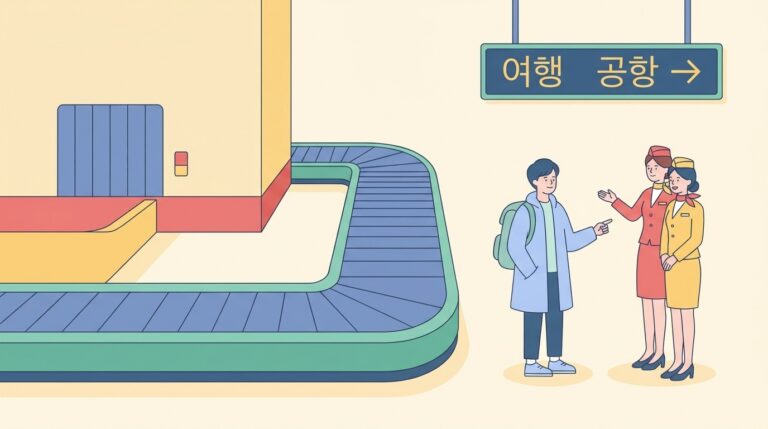
Phase 1: Empathy & Storytelling
안녕하세요! 매일한글 에디터입니다.
You’ve just landed at Incheon International Airport after a long flight. You grab a quick banana milk, head to baggage carousel number 8, and wait. At first, bags tumble out one by one—hard-shell suitcases, golf bags, and taped-up cardboard boxes. Travelers grab their items with a relieved smile and head straight for the AREX train toward Seoul.
Twenty minutes pass. Then thirty. The carousel belt squeaks to a crawl, and suddenly… the light turns red and the rubber flaps stop moving entirely. You’re left standing alone by an empty conveyor belt. That gut-drop feeling hits: My suitcase isn’t here.
Every traveler dreads this moment, but facing it in another country can feel doubly overwhelming. In high-stress travel moments, textbooks often teach stiff phrases like “제 수하물이 분실되었습니다” (My baggage is lost), which sounds like an official police statement rather than how real people communicate with ground crew. Based on real feedback from hundreds of travelers, knowing how to explain your situation politely, calmly, and naturally will get the airport staff on your side instantly. Let’s make sure you never feel stranded at a Korean airport baggage claim!
Phase 2: Top 3 Core Expressions Deep Dive
1. 제 짐이 아직 안 나왔어요 (Je jimi ajik an nawasseoyo)
- Pronunciation: [Je jimi ajik an nawasseoyo] (Sound analogy: Think of “Je” like the start of ‘general’, “jimi” like the name ‘Jimmy’, “ajik” like ‘ah-jick’, and “nawasseoyo” like ‘now-wah-saw-yo’)
- Meaning: Literal: “My luggage still hasn’t come out.” / Real Nuance: “I’ve been waiting, but my bag hasn’t arrived on the belt yet.”
- K-Culture Moment: In travel vlogs or K-dramas where a character arrives overseas, you’ll hear travelers using this exact sentence when looking around the belt with a puzzled expression.
- Editor’s Insight: Koreans frequently refer to all personal luggage and baggage as 짐 (jim). While 수하물 (suhamul) is the formal airport term, 짐 is warm, natural, and immediately understood.
- Situation Spectrum:
- Casual: 짐이 아직 안 나왔어 (Jim-i ajik an nawasseo) ⚠️ (Only with close friends)
- Semi-formal (Polite): 제 짐이 아직 안 나왔어요 (Je jimi ajik an nawasseoyo) ✅ (Perfect for ground staff)
- Formal: 제 짐이 아직 나오지 않았습니다 (Je jimi ajik naoji anatseumnida) ⚠️ (A bit too stiff for a customer desk)
- 🤔 Think About It: Why does Korean focus on the bag “coming out” (나오다) rather than “I cannot find my bag”? It reflects Korean’s situational perspective—describing what is visibly happening in the shared space!
2. 수하물 분실 신고는 어디서 하나요? (Suhamul bunsil singoneun eodiseo hanayo?)
- Pronunciation: [Su-ha-mul bun-sil sin-go-neun eo-di-seo ha-na-yo?] (Sound analogy: ‘Soo-hah-mool boon-sheel sheen-go-noon uh-dee-saw ha-nah-yo’)
- Meaning: Literal: “Where do I make a baggage loss report?” / Real Nuance: “Could you direct me to the desk where I can file a missing baggage claim?”
- K-Culture Moment: Heard often at international terminals when connecting flights go awry, spoken to the roaming customer service staff holding tablets.
- Editor’s Insight: Adding ~는 어디서 하나요? (~neun eodiseo hanayo?, Where do I do…?) is a versatile B1 pattern you can reuse everywhere, from tax refunds (택스 리펀은 어디서 하나요?) to SIM cards.
- Situation Spectrum:
- Casual: 분실 신고 어디서 해? (Bunsil singo eodiseo hae?) 🚫 (Rude to staff)
- Semi-formal: 수하물 분실 신고는 어디서 하나요? (Suhamul bunsil singoneun eodiseo hanayo?) ✅ (Ideal balance of clarity and courtesy)
- Formal: 분실물 접수처가 어디입니까? (Bunsilmul jeopsucheoga eodiimnikka?) ✅ (Acceptable, but feels like an exam paper)
- 🤔 Think About It: In English, we often say “I need to report…” putting “I” front and center. Korean drops “I” and asks about the place or procedure itself. How does this reduce confrontation?
3. 찾으면 숙소로 보내주실 수 있나요? (Chajeumyeon suksoro bonaejusil su innayo?)
- Pronunciation: [Cha-jeu-myeon suk-so-ro bo-nae-ju-sil su in-na-yo?] (Sound analogy: ‘Chah-jeum-yun sook-so-ro bo-nay-joo-sheel soo een-nah-yo’)
- Meaning: Literal: “If you find it, can you send it to my accommodation?” / Real Nuance: “Once it turns up, could you arrange delivery directly to my hotel?”
- K-Culture Moment: Used by experienced travelers who don’t want to waste a day waiting at the airport terminal for the next incoming flight.
- Editor’s Insight: 숙소 (sukso) is a comprehensive word that covers hotels, guesthouses, and Airbnbs. The pattern ~아/어 주실 수 있나요? is the gold standard for polite requests at the B1 level.
- Situation Spectrum:
- Casual: 찾으면 숙소로 보내줘 (Chajeumyeon suksoro bonaejwo) 🚫 (Never use with service workers)
- Semi-formal: 찾으면 숙소로 보내주실 수 있나요? (Chajeumyeon suksoro bonaejusil su innayo?) ✅ (Standard polite request)
- Formal: 발견 즉시 숙소로 배송해 주시겠습니까? (Balgyeon jeuksi suksoro baesonghae jusigetseumnikka?) ⚠️ (Overly bureaucratic)
- 🤔 Think About It: Notice how the word 주시다 (an honorific form of giving) shows gratitude before the favor has even been fulfilled.
Phase 3: Textbook Korean vs. Real Korean
Situation 1: Explaining that your suitcase didn’t arrive
- 📖 교과서 한국어 (Textbook): 제 여행용 가방이 도착하지 않았습니다. (Je yeohaeng-yong gabangi dochakhaji anatseumnida. – “My travel bag has not arrived.”)
- 🗣️ 진짜 한국어 (Real Korean): 마지막까지 기다렸는데 가방이 안 나와서요. (Majimakkkaji gidaryeonneunde gabangi an nawaseoyo. – “I waited until the very end, but my bag didn’t come out…”)
- 💡 왜 다를까?: Textbook phrasing sounds like an automated legal memo. Real Koreans share the context leading up to the issue using ~는데 (~neunde) and end softly with ~어서요 (~eoseoyo), which naturally invites the other person to assist.
Situation 2: Inquiring about baggage tracking
- 📖 교과서 한국어 (Textbook): 화물의 위치를 추적해 주십시오. (Hwamurui wichireul chujeokhae jusipsio. – “Please track the location of the cargo.”)
- 🗣️ 진짜 한국어 (Real Korean): 짐표 여기 있는데, 확인 한번 부탁드려요. (Jimpyo yeogi inneunde, hwagin hanbeon butakdeuryeoyo. – “Here is my baggage tag, could you please take a quick look?”)
- 💡 왜 다를까?: 화물 (hwamul) is used for commercial industrial freight. Handing over your baggage tag (짐표) while gently asking for a quick check (확인 한번 부탁드려요) is 100 times more natural and effective.
Phase 4: K-Culture Deep Dive & Non-Verbal Manners
4-1. Nunchi (눈치) & Body Language at Korean Service Counters
When things go wrong at an airport, tension runs high. In Korean customer service culture, showing excessive anger, raising your voice, or finger-pointing can get you labeled as 진상 (jinsang, an unreasonable or entitled customer). Service staff are trained to be extremely helpful, but escalating aggressively often triggers defensive protocol rather than speedier help.
* Two-Handed Courtesy: When passing your passport, boarding pass, and luggage receipt sticker (짐표), always hold them with both hands or with your left hand lightly supporting your right forearm.
* A Gentle Eye Contact & Head Nod: Start with a small 15-degree bow and a warm “저기요, 죄송한데요…” (Excuse me, I’m sorry to bother you, but…). In Korea, acknowledging that you’re interrupting someone’s work with “죄송한데요” immediately sets a cooperative tone.
4-2. Incheon Airport Culture & The “Palli-Palli” System
Incheon International Airport regularly ranks among the top airports worldwide for baggage handling efficiency. Because the system is notoriously fast (often getting bags onto belts within 15 to 20 minutes), if a bag is missing, it almost always means it missed a tight transfer at a transit hub overseas. Ground staff in Korea operate on “빨리빨리” (palli-palli, fast-fast) culture—once you provide your claim tag, they will immediately scan the international database to trace which flight your bag ended up on.
Phase 5: Real-World Roleplay Scenario
- Setting: Incheon Airport Terminal 1, Baggage Claim Area near Belt 14. All other passengers have left. Airline Ground Crew Min-ji (민지) is checking a clipboard.
Turn 1
Traveler: 저기요, 죄송한데요. 제 짐이 아직 안 나와서요.
(Jeogiyo, joesonghandeyo. Je jimi ajik an nawaseoyo.)
“Excuse me, sorry to bother you. My luggage hasn’t come out yet.”
🎭 Approaching the counter politely with hands clasped in front.
Turn 2
Min-ji: 아, 그러세요? 벨트에 짐이 다 내려졌나요?
(A, geureoseyo? Belteue jimi da naeryeojyeonnayo?)
“Oh, really? Has all the luggage cleared from the carousel?”
🎭 Looking toward the stationary conveyor belt with a concerned expression.
Turn 3
Traveler: 네, 마지막까지 기다렸는데 제 캐리어만 없어요.
(Ne, majimakkkaji gidaryeonneunde je kaerieoman eopseoyo.)
“Yes, I waited until the very end, but only my suitcase is missing.”
🎭 Shrugging slightly and speaking with a calm, disappointed tone.
Turn 4
Min-ji: 탑승권이랑 수하물 태그 스티커 좀 보여주시겠어요?
(Tapseunggwon-irang suhamul taegeu seutikeo jom boyeojusigetseoyo?)
“Could you show me your boarding pass and luggage tag sticker?”
🎭 Holding out two hands to receive the documents.
Turn 5
Traveler: 여기요. 혹시 경유지에서 안 실린 걸까요?
(Yeogiyo. Hoksi gyeong-yujieseo an sillin geolkkayo?)
“Here they are. Could it not have been loaded at my layover?”
🎭 Handing over the boarding pass using both hands.
Turn 6
Min-ji: 조회해 보니 환승편에 연결이 안 되었네요. 오늘 저녁 비행기로 도착할 예정입니다.
(Joehae boni hwanseungpyeone yeon-gyeori an doeeonneyo. Oneul jeonyeok bihaenggiro dochakhal yejeong-imnida.)
“Checking the system, it looks like it missed the connecting flight. It is scheduled to arrive on tonight’s flight.”
🎭 Typing quickly into the terminal computer, then speaking apologetically.
Turn 7
Traveler: 다행이네요. 그러면 찾으면 숙소로 보내주실 수 있나요?
(Dahaeng-ineyyo. Geureomyeon chajeumyeon suksoro bonaejusil su innayo?)
“What a relief. In that case, can you have it delivered to my accommodation once it arrives?”
🎭 Sighing in relief and asking with an expectant smile.
Turn 8
Min-ji: 네, 물론입니다. 여기 분실 신고서에 호텔 주소와 연락처를 적어주세요.
(Ne, mollonimnida. Yeogi bunsil singoseoe hotel jusowa yeollakcheoreul jeogeojuseyo.)
“Yes, of course. Please fill out your hotel address and phone number on this claim form.”
🎭 Handing a clipboard and pen politely.
🔀 Interactive Decision Point
How would you respond if the staff said the delivery might take up to 24 hours?
* Choice A: “지금 당장 제 캐리어 찾아내세요!” (Find my suitcase right this instant!)
* 🚫 Feedback (Bad): Calling demands aggressively will not make the plane arrive faster and triggers awkward friction.
* Choice B: “어쩔 수 없네요. 필요한 세면도구 살 수 있게 보상 지원이 되나요?” (I understand. Is there compensation support so I can buy basic toiletries?)
* ✅ Feedback (Best): Perfect! Calmly acknowledging the situation while inquiring about the airline’s emergency overnight kit or voucher (비상 필수품 지원).
* Choice C: “그냥 내일 제가 공항으로 다시 올게요.” (I’ll just come back to the airport myself tomorrow.)
* ⚠️ Feedback (Risk): While okay, Incheon Airport is an hour away from central Seoul. Delivery to your hotel is free for delayed baggage—save your travel time!
Phase 6: 10-Second Emotional Shadowing Drill
Practice matching the cadence, pauses (/), and emotional nuance:
[🥺 걱정스럽고 조심스럽게 / Worried and hesitant]
저기요, / 마지막까지 기다렸는데 / 제 짐이 안 나와서요.
(Jeogiyo, / majimakkkaji gidaryeonneunde / je jimi an nawaseoyo.)-
[🙏 차분하고 정중하게 / Calm and polite]
짐표 여기 있어요. / 확인 한번 부탁드려요.
(Jimpyo yeogi isseoyo. / Hwagin hanbeon butakdeuryeoyo.) -
[😊 안도하며 부탁하는 어조 / Relieved yet requesting]
다행이네요! / 찾으면 호텔로 배송해 주실 수 있나요?
(Dahaeng-ineyyo! / Chajeumyeon hotello baesonghae jusil su innayo?)
Phase 7: K-Culture Mini Dictionary
-
수하물 수취대 (Suhamul suchwidae) | Baggage Claim / Carousel
Everyday Usage: Often labeled simply as 수취대 or with numbers like 10번 수취대. You’ll see this sign overhead right after customs. -
짐표 / 수하물 태그 (Jimpyo / Suhamul taegeu) | Baggage Claim Tag / Sticker
Everyday Usage: The small barcode sticker usually stuck onto the back of your passport or boarding pass sleeve during check-in. -
분실물 센터 / 유실물 보관소 (Bunsilmul senteo / Yusilmul bogwanso) | Lost & Found Office
Everyday Usage: Where items left behind inside the terminal cabin or transit areas are stored. -
지상직 승무원 (Jisangjik seungmuwon) | Ground Airline Staff
Everyday Usage: Airline team members working at gates, check-in desks, and baggage claim areas who wear airline uniforms.
Phase 8: Traveler’s Survival Kit
Survival Phrases Top 3
- 짐표 잃어버렸는데 어떡하죠? (Jimpyo ireobeoryeonneunde eotteokhajyo?)
“I lost my baggage receipt sticker, what should I do?”
Pro Tip: Keep your digital airline app or e-ticket ready. They can match your name and passport number in the system. - 제 캐리어가 파손되었어요. (Je kaerieoga pasondwoeeosseoyo.)
“My suitcase was damaged / broken.”
Pro Tip: Always report physical cracks or broken wheels before leaving the customs exit gate; otherwise, liability claims become difficult. - 가방이 언제쯤 도착할까요? (Gabangi eonjejjeum dochakhalkkayo?)
“Around what time will the bag arrive?”
Pro Tip: Ask for an estimated delivery window so your hotel concierge can accept it on your behalf.
Editor’s Travel Note
- Airport Navigation: If you’re stuck at Incheon, open the official Incheon International Airport Guide Application on your phone to find the exact location of your airline’s baggage assistance counter (수하물 안내 데스크).
- Hotel Concierge Tip: When arranging hotel delivery, ask the airport staff for the 분실 접수증 (Property Irregularity Report / PIR receipt). Hand a photo of this to your hotel front desk so they receive the suitcase while you are out exploring Myeongdong or Hongdae!
Phase 9: One Step Deeper (Culture & Insight)
In many Western airport cultures, consumers are taught that being firm, loud, and uncompromising is the only way to get compensation. In South Korea, however, customer interactions are guided by 상호 존중 (sangho jonjung, mutual respect) and 배려 (baeryeo, consideration). When you demonstrate calm empathy toward an airline worker who has likely had a chaotic day, they will often go out of their way to expedite courier delivery, offer emergency amenity kits, or track down odd-sized baggage.
Language isn’t merely a tool for transferring data; it reflects how we position ourselves in another society. Approaching a stressful mishap with graceful Korean phrases turns a travel disaster into a heartwarming cultural connection.
💬 Your Turn: Have you ever had a piece of luggage vanish during a flight? How did you handle it, and what phrase would have helped you the most in that moment? Drop your stories in the comments below!
Phase 10: FAQ & Common Pitfalls
Q: What if my Korean isn’t good enough to explain what my suitcase looks like?
A: Don’t panic! Airline staff carry an illustrated “Baggage Identification Chart” showing suitcase shapes, colors (검정색, 은색, 빨간색), materials (hard-shell vs. fabric), and brands. Simply point and provide any smartphone photos you took of your suitcase before departing.
Q: Will the airline deliver the missing luggage directly to my Airbnb?
A: Yes, but keep in mind that Korean couriers (택배) need a functional local phone number and the exact passcode to an apartment building’s front door (공동현관 비밀번호). If your Airbnb doesn’t have a front desk, give your host’s contact information.
Q: Can I claim immediate compensation for daily necessities?
A: Major airlines provide emergency basic amenity kits (일회용 세면도구 세트) or an interim expense stipend (일일 비상 경비 지원) if your baggage is delayed overnight away from home. Ask: “지연 보상이나 비상 키트 지원이 가능한가요?” (Jiyeon bosang-ina bisang kiteu jiwoni ganeunghangayo?).
🚨 Common Mistakes Alert
- Leaving the Baggage Area without a Property Irregularity Report (PIR)
Wrong: Leaving through Customs (세관) thinking you can just email customer service tomorrow.
Correct Action: Once you exit the customs doors, you cannot re-enter the baggage carousel area. Always locate the airline counter inside the baggage hall before stepping outside. - Confusing ‘수하물’ (Luggage) with ‘화물’ (Freight)
Wrong: “화물이 분실되었어요” (My cargo shipment is lost).
Correct Action: Use “제 짐” (je jim) or “수하물” (suhamul). - Discarding the Barcode Claim Tag
Wrong: Tossing your boarding pass into the trash upon landing.
Correct Action: Keep that luggage barcode safe until you have your bag firmly in your hands!
Phase 11: Action Missions
- 🥉 Bronze Mission (Solo Practice): Record yourself on your phone saying: “마지막까지 기다렸는데 제 짐이 안 나왔어요” smoothly in under 4 seconds.
- 🥈 Silver Mission (Social Share): Snap a photo of your suitcase next time you travel, tag a fellow K-travel buddy, and teach them the word “짐표 (jimpyo)”!
- 🥇 Gold Mission (Real World Ready): Next time you arrive at a Korean airport or station, locate the “분실물 보관소” (Lost & Found) on the terminal map and read the signs without using a translation app.
- 🎮 K-Culture Mission: Watch an episode of a Korean airport drama (like Where Stars Land / 여우각시별) and spot the airport badges and radios ground crew use during baggage emergencies!
Phase 12: Interactive Quiz Challenge
1. Situational Judgment Quiz
You have waited 40 minutes at Carousel 5. The belt stops. Which of the following is the most natural and polite way to speak to the nearby ground staff?
a) 야, 내 가방 어디 갔어? (Ya, nae gabang eodi gasseo?)
b) 저기요, 마지막까지 기다렸는데 짐이 안 나와서요. (Jeogiyo, majimakkkaji gidaryeonneunde jimi an nawaseoyo.)
c) 항공사가 제 가방을 훔쳐갔습니다. (Hangongsaga je gabang-eul humchyeogatseumnida.)
2. Fill-in-the-Blank Quiz
Complete the sentence to politely ask for hotel delivery:
“가방을 찾으면 숙소로 ( ________ ) 주실 수 있나요?”
Options: [보내 / 먹어 / 닫아]
3. True or False Cultural Quiz
Statement: In Korea, it is okay to leave the baggage claim area and go to your hotel first, then come back later that night to look for your airline desk. (True / False)
👉 Click to view answers and explanations!
- Answer: b
Explanation: Option (b) uses gentle context-building and polite speech. Option (a) is disrespectful banmal (informal slang), and (c) accuses the airline of stealing! - Answer: 보내 (bonae)
Explanation: 보내다 means “to send/deliver.” “보내 주실 수 있나요?” means “Could you please send it?” - Answer: False
Explanation: Once you cross the customs threshold (세관 구역) into the public arrival hall, security regulations prohibit passengers from re-entering the baggage claim carousel zone without special airport police clearance. Always report your missing bag before exiting!







