

Phase 1: Empathy (Story-Immersive Opening)
안녕하세요! (Annyeonghaseyo!) It is your Daily Hangul editor here, your personal Korean cultural navigator!
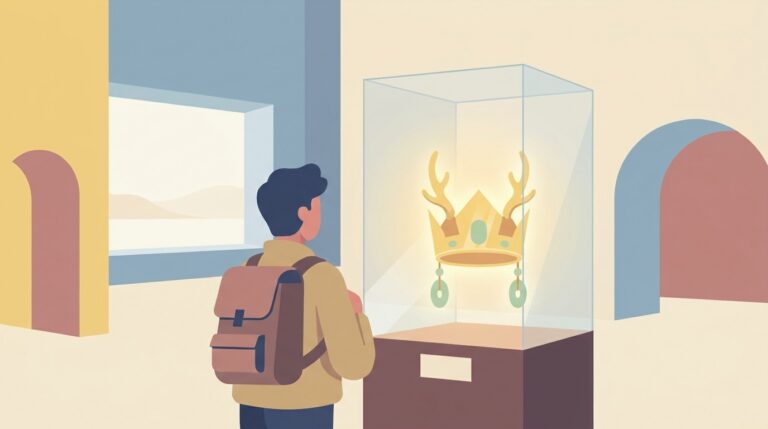
Picture this: You are standing in the softly lit, serene gallery of the National Museum of Korea in Seoul. In front of you sits the magnificent Pensive Bodhisattva (Banga Sayusang), an artifact dating back over 1,400 years with an enigmatic, tranquil smile. You have seen this exact relic on Instagram travel pages, K-drama historical backdrops, and Korean history textbooks for months. Now, your heart skips a beat because it is right there in real life—so close you can see the subtle texture of the bronze.
Your Korean friend turns to you with glowing eyes and asks, “어때요? (Eottaeyo? – How is it?)”
You freeze. You want to express how surreal and thrilling it feels to see a textbook masterpiece right in front of your eyes. But the only word your brain supplies is: “좋아요… (Joh-ayo… It’s good…)” You feel a bit frustrated! You wanted to share that electric spark of wonder, not sound like you are rating a convenience store sandwich.
Many of our learners share this exact pain point: “I know simple adjectives, but how do I express genuine cultural awe without sounding like a robotic textbook?” In this guide, tailored specifically to A2 learners, you will master the exact phrases native Koreans use to marvel at museum treasures, navigate audio guide rentals with ease, and soak in Korea’s rich artistic heritage like a true local.
Phase 2: Deep Dive into 3 Core Expressions
1. 책에서만 보다가 실제로 보니까 진짜 신기해요! (Chaeg-eseoman bodaga siljelo bonikka jinjja singihaeyo!)
- Pronunciation: [Chaek-eh-seo-man bo-da-ga shil-je-ro bo-ni-kka jin-jja shin-gi-hae-yo] (Sounds roughly like: Check-eh-suh-man bo-da-ga seal-jeh-ro bo-nee-kka jean-jja sheen-gee-heh-yo)
- Meaning: Literal: “Only looking in books, then actually seeing, it is really fascinating!” | Actual Nuance: “Seeing it in person after only knowing it from books is such an incredible, surreal feeling!”
- K-Culture Moment: Frequently heard on variety shows like 2 Days & 1 Night or travel vlogs when cast members finally visit UNESCO world heritage sites in Gyeongju.
- Editor’s Insight: The magical grammar pattern here is
-다가(-daga), which marks a switch or contrast between past ongoing action (looking at pictures) and current reality (standing before it). Meanwhile, “신기하다” (singihada) captures a mix of awe, curiosity, and pleasant surprise. - Situation Spectrum: Casual: ⚠️ (drop ‘-yo’) | Semi-formal: ✅ | Formal: ✅
- 🤔 Think About It: In English, we often say “It feels surreal.” Notice how Korean focuses on the journey of perception: from book to eye.
2. 오디오 가이드 대여하고 싶어요. (Odio gaideu daeyeohago sipeoyo.)
- Pronunciation: [Oh-dee-oh gah-ee-deu dae-yeo-ha-go shi-peo-yo] (Sounds like: Oh-dee-oh guide day-yuh-ha-go she-poh-yo)
- Meaning: Literal: “Audio guide I want to rent.” | Actual Nuance: “I would like to rent an audio guide, please.”
- K-Culture Moment: At major Korean museums, special audio guides are often narrated by top actors or K-pop idols (such as BTS’s RM lending his soothing voice to contemporary art tours).
- Editor’s Insight: Everyday Korean uses “빌리다” (billida) to borrow small things from friends. But at museums, car rentals, or official venues, the formal Sino-Korean verb “대여하다” (daeyeohada – to lease/rent) signals polished, respectful etiquette.
- Situation Spectrum: Casual: 🚫 | Semi-formal: ✅ | Formal: ✅
- 🤔 Think About It: Why do institutions favor Sino-Korean roots (Dae-yeo) over pure Korean verbs (Bil-li-gi)? How does formality shape credibility in public spaces?
3. 사진 촬영이 가능한가요? (Sajin chwaryeong-i ganeunghangayo?)
- Pronunciation: [Sah-jin chwa-ryeong-ee gah-neung-han-gah-yo?]
- Meaning: Literal: “Is photography shooting possible?” | Actual Nuance: “Excuse me, is photography allowed here?”
- K-Culture Moment: Seen before entering sacred spaces, historic royal artifact chambers, or quiet art retrospectives in Insa-dong or Samcheong-dong.
- Editor’s Insight: Notice the ending
-ㄴ가요?(-n-ga-yo?). Instead of asking bluntly “사진 찍어도 돼요?” (Can I take photos?), this ending cushions your voice with a gentle, humble tone. - Situation Spectrum: Casual: 🚫 | Semi-formal: ✅ | Formal: ✅
- 🤔 Think About It: Notice the soft indirect inquiry. Korean manners emphasize minimizing pressure on the person answering.
Phase 3: Textbook Korean vs. Real Korean
Scenario 1: Expressing awe at an artifact
- 📖 Textbook Korean: 이것은 매우 아름답습니다. (Igeoseun maeu areumdapseumnida. – “This is very beautiful.”)
- 🗣️ Real Korean: 와, 실물로 보니까 느낌이 완전 달라요! (Wa, silmullo bonikka neukkimi wanjeon dallayo! – “Wow, seeing it in real life feels completely different!”)
- 💡 Why the difference? While “아름답습니다” sounds like an official speech, native speakers love the word “실물” (silmul – real object / in real life). It vividly highlights the contrast between glossy magazine pages and the breathtaking physical object.
Scenario 2: Asking if English is supported on the audio guide
- 📖 Textbook Korean: 영어 오디오 가이드가 있습니까? (Yeongeo odio gaideuga itsseumnikka? – “Is there an English audio guide?”)
- 🗣️ Real Korean: 혹시 영어 오디오 가이드도 지원되나요? (Hoksi yeongeo odio gaidedo jiwondoenayo? – “By any chance, is English audio guide supported as well?”)
- 💡 Why the difference? Starting with “혹시” (hoksi – by any chance) instantly raises your politeness index by 200%. The word “지원되다” (jiwondoeda – to be supported/provided) sounds modern and professional.
Phase 4: K-Culture Deep Dive & Non-Verbal Etiquette
4-1. Nunchi (눈치) & Museum Manners
- The Two-Handed Handover: When handing over your passport, payment card, or taking your rented audio guide device, always support your right forearm or wrist with your left hand, or hold the item with both hands. This shows tremendous respect toward museum staff.
- The Subdued Whisper (속닥속닥 – Sokdak-sokdak): Korean gallery culture values tranquility. Even when overcome with excitement, keep your excitement within a gentle whisper. If you spot a famous masterpiece, lean in slightly to your companion rather than pointing excitedly with an outstretched finger.
- Camera Flash Etiquette: Always verify that your smartphone camera flash is deactivated before stepping into historic relic halls. Many ancient celadon and silk paintings degrade under strong bursts of light.
4-2. The Cultural Trend: “Museum Healing” & Art Culture
Visiting exhibitions has evolved into a premier lifestyle trend in Korea, widely referred to as “문화생활” (munhwasaenghwal – cultural life). Young Koreans love “Art Dates” in historic neighborhoods like Samcheong-dong, Bukchon, and Yongsan. Iconic cultural ambassadors like BTS’s RM have inspired tens of thousands of young travelers to slow down, explore historical retrospectives, and meditate alongside traditional treasures like Joseon Moon Jars (Dalhang-ari).
Phase 5: Real-Life Roleplay Scenario
Setting: The information desk inside the Grand Lobby of the National Museum of Korea.
Characters: You (an excited culture enthusiast) & Minji (민지, friendly museum docent staff).
- Turn 1 (You): 🎭 [Approaching the counter politely with a slight 15-degree bow]
안녕하세요! 오디오 가이드 대여하고 싶어요. (Annyeonghaseyo! Odio gaideu daeyeohago sipeoyo. – “Hello! I would like to rent an audio guide.”) - Turn 2 (Minji): 🎭 [Smiling warmly, pointing toward the digital rental display]
네, 환영합니다! 혹시 어떤 언어로 필요하신가요? (Ne, hwanyeonghamnida! Hoksi eotteon eoneoro piryohasingayo? – “Yes, welcome! Which language do you need, by any chance?”) - Turn 3 (You): 🎭 [Answering with a clear, friendly smile]
영어 버전으로 부탁드려요! (Yeongeo beojeoneuro butakdeuryeoyo! – “English version, please!”) - Turn 4 (Minji): 🎭 [Receiving payment card with both hands]
신분증이나 카드를 잠깐 확인하겠습니다. 대여 완료되었습니다! (Sinbunjeung-ina kadeureul jamkkan hwaginhagessseumnida. Daeyeo wanryeodoeeossseumnida! – “I will briefly check your ID or card. Your rental is complete!”) - Turn 5 (You): 🎭 [Putting on the headset, pointing towards the special exhibit entrance]
감사합니다! 저기 전시실 안에서 사진 촬영이 가능한가요? (Gamsahamnida! Jeogi jeonsisil aneseo sajin chwaryeong-i ganeunghangayo? – “Thank you! Is photo shooting allowed inside that exhibition room over there?”) - Turn 6 (Minji): 🎭 [Gentle hand gesture indicating safety guidelines]
플래시 없이 일반 사진 촬영은 가능합니다. (Peullaesi eopsi ilban sajin chwaryeong-eun ganeunghamnida. – “Standard photography without flash is permitted.”) - Turn 7 (You): 🎭 [Looking into the main hall and marveling at the giant Goryeo pagoda]
우와, 책에서만 보다가 실제로 보니까 진짜 신기해요! (Uwa, chaeg-eseoman bodaga siljelo bonikka jinjja singihaeyo! – “Wow, seeing it in person after only reading about it in books is truly fascinating!”) - Turn 8 (Minji): 🎭 [Nodding with proud appreciation]
실물이 훨씬 멋지죠? 즐거운 관람 되세요! (Silmuri hwolssin meotjijyo? Jeulgeoun gwallam doeseyo! – “The real object is much cooler, right? Have a wonderful visit!”)
🔀 Interactive Decision Point
After viewing the masterpiece, you want to ask Minji where the museum gift shop is located to buy a souvenir replica.
- Choice A: “야, 기념품점 어디야?” (Ya, ginyeompumjeom eodiya?)
- Choice B: “저기요, 혹시 기념품점은 어디에 있나요?” (Jeogiyo, hoksi ginyeompumjeomeun eodie itnayo?)
- Choice C: “기념품점을 내놔라.” (Ginyeompumjeomeul naenwara.)
Feedback:
* Choice A (Risk!): Extremely rude. “야” (Hey!) is banmal and treats the staff like a childhood friend or subordinate. Avoid!
* Choice B (Best!): Perfect! “저기요” grabs polite attention, “혹시” softens the inquiry, and “어디에 있나요?” is natural A2 polite honorific speech.
* Choice C (Bad!): Sounds like a movie villain demanding ransom (“Hand over the souvenir shop!”). Definitely not recommended!
Phase 6: 10-Second Emotion Shadowing Drill
Practice breathing life into your Korean sentences! Match the emotional tone and pause precisely at the slashes (/).
[😊 Delighted & Awe-inspired]
책에서만 보다가 / 실제로 보니까 / 진짜 신기해요!
(Chaeg-eseoman bodaga / siljelo bonikka / jinjja singihaeyo!)-
[🤝 Polite & Inquiring]
혹시 / 영어 오디오 가이드도 / 지원되나요?
(Hoksi / yeongeo odio gaidedo / jiwondoenayo?) -
[🤫 Respectful & Careful]
실례지만, / 플래시 끄고 / 사진 찍어도 되나요?
(Sillyejiman, / peullaesi kkeugo / sajin jjigeodo doenayo?)
Phase 7: K-Culture Mini Dictionary
- 유물 (Yumul) | Historic Relic / Artifact
- Usage: Used for ancient historical treasures such as Silla crowns, earthenware, or Goryeo weapons.
- 명화 (Myeonghwa) | Famous Painting / Masterpiece
- Usage: Refers to classic works of fine art, such as Shin Yun-bok’s folk paintings or world-renowned oil masterpieces.
- 실물 (Silmul) | Real Life / Physical Object in Person
- Usage: Used constantly in K-pop and art circles when someone or something looks breathtaking in person: “실물 대박!” (Even better in real life!).
- 도슨트 (Doseunteu) | Museum Docent / Exhibition Guide
- Usage: Borrowed into Korean to describe specialized volunteers or art educators conducting scheduled tour walk-throughs.
Phase 8: Traveler’s Survival Kit
Survival Phrases TOP 3
- 플래시 꺼야 하나요? (Peullaesi kkeoya hanayo?)
- Meaning: “Do I need to turn off the flash?”
- Pro Tip: Keep this handy whenever you approach glass display cases.
- 여기서부터 어떻게 가요? (Yeogiseobuteo eotteoke gayo?)
- Meaning: “How do I get there from here?”
- Pro Tip: Useful when navigating labyrinthine multi-floor complexes like the National Folk Museum.
- 한국어 팜플렛 말고 영어 있나요? (Hangugeo pampeullet malgo yeongeo itnayo?)
- Meaning: “Do you have an English brochure instead of the Korean one?”
- Pro Tip: Usually found right next to the central ticketing turnstiles.
Editor’s Travel Note
Before stepping onto the subway line 4 toward Ichon Station, save yourself 20 minutes in line by completing your [National Museum of Korea official app download] or checking floor maps on the [Naver Map navigation application]. Most national galleries offer free admission to permanent collections, but special blockbuster exhibitions require reserved time slots on weekends!
Phase 9: Think Deeper (한 발 더 깊이)
In Korean culture, admiring historical artifacts is rarely just an academic exercise. For many Koreans, ancient relics like the simple, organic Joseon Moon Jar (Dalhang-ari) represent resilience, understated elegance (Geombulhwi – frugal yet not shabby), and surviving centuries of turbulent history. When you tell a Korean curator or companion “실물로 보니까 감동적이에요” (Seeing it in person is genuinely moving), you aren’t just complimenting an object—you are connecting with Korea’s living cultural soul.
💬 Your Turn: What is one world-famous artifact, artwork, or landmark you have seen in books that blew you away when you saw it in person? Share your memory in the comments below!
Phase 10: FAQ & Common Mistakes
Q: Can I use “빌리다” instead of “대여하다” for the audio guide?
A: Yes! You can say “오디오 가이드 빌리고 싶어요” (Odio gaideu billigo sipeoyo). It is completely understandable and polite. However, “대여하다” is the more professional service term typically found on signs and used by museum staff.
Q: What is the difference between “신기해요” and “놀라워요”?
A: “신기하다” (singihada) highlights curiosity, fascinating novelty, and wonder (like seeing a magical floating display or a centuries-old crown). “놀랍다” (nollapda) emphasizes pure shock or sheer astonishment (like hearing unexpected news).
Q: Is admission to Korean national museums expensive?
A: Surprisingly, permanent exhibition galleries at most state-run institutions like the National Museum of Korea and the National Folk Museum of Korea are completely free! You only pay nominal fees (around 1,000–3,000 KRW) for audio guide devices.
🚨 Common Mistakes Alert!
- Mistake 1: Calling an artifact “예쁜 물건” (pretty item).
- Fix: Use the respectful word “유물” (yumul – artifact) or “작품” (jakpum – artwork).
- Mistake 2: Using informal “진짜 신기해” directly to museum security or docents.
- Fix: Always preserve the polite ending: “진짜 신기해요!”
- Mistake 3: Forgetting to turn off camera sound shutters in serene halls.
- Fix: Download silent camera apps or switch phones to vibrate/silent mode before entering.
Phase 11: Action Mission & Engagement
- 🥉 Bronze Level: Practice saying “책에서만 보다가 실제로 보니까 진짜 신기해요!” out loud three times using our Phase 6 emotion tags.
- 🥈 Silver Level: Leave a comment below introducing your favorite historic Korean relic using the keyword 유물 (yumul).
- 🥇 Gold Level: On your next museum or gallery trip, approach the desk and rent an audio guide completely in Korean using: “오디오 가이드 대여하고 싶어요!”
🎮 K-Culture Mission: Watch a travel episode of your favorite K-pop group or a K-drama museum scene (like Her Private Life) and spot whether the characters use “실물” or “작품” when admiring art!
Phase 12: Interactive Quiz Challenge
Test your knowledge with these three quick questions!
- Situational Judgment: You want to ask the staff if you are allowed to take photos of a 1,000-year-old Buddhist bell. Which is the most natural and polite phrase?
- a) 사진 찍어.
- b) 사진 촬영이 가능한가요?
- c) 사진을 왜 찍어요?
- Fill in the Blanks: Complete the sentence meaning: “Seeing it in person after seeing it in books is so fascinating!”
- 책에서만 ( ) 실제로 보니까 진짜 신기해요!
- True or False: In Korean public galleries, it is customary to borrow audio guide equipment using the casual word “뺏다” (ppaetda).
- [ True / False ]
👉 Click here to reveal answers & explanations!
- Answer: b) 사진 촬영이 가능한가요?
- Explanation: Choice (a) is disrespectful banmal, and Choice (c) means “Why are you taking photos?”. Choice (b) is the gentle, polite standard.
- Answer: 보다가 (bodaga)
- Explanation: The grammar pattern
-다가marks a change or transition from the action of looking in books to viewing in person.
- Explanation: The grammar pattern
- Answer: False
- Explanation: “뺏다” means to snatch or extort! You should use “대여하다” (to rent) or “빌리다” (to borrow).
- Explanation: “뺏다” means to snatch or extort! You should use “대여하다” (to rent) or “빌리다” (to borrow).







