

안녕하세요! 매일한글 에디터입니다.
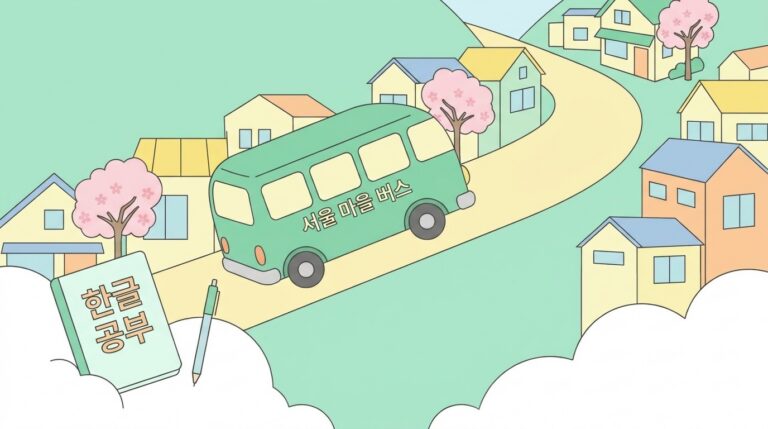
Have you ever stood at the foot of a winding, scenic hill in Seoul—maybe after hunting down that dreamy rooftop café in Huam-dong or tracking down a filming spot from your favorite K-drama—only to realize your legs feel like jelly, and the nearest subway station is a 25-minute uphill-and-downhill trek away? Suddenly, a cute, bright green mini-bus zooms around the corner like a magical green fairy. That is Korea’s famous 마을버스 (Maeul-beoseu), or neighborhood village bus!
For many of our beginner learners, stepping onto these little green buses feels twice as intimidating as riding the grand blue or green city buses. The alleys are narrow, the turns are thrillingly sharp, and the driver seems ready to launch the moment the doors slide shut. “What if it takes me somewhere totally unfamiliar?” “How do I ask if it actually goes to the subway station?” Don’t panic! Today, we are going to master the exact phrases, cultural habits, and insider survival tips you need to hop on that village bus and glide right to your subway train like a seasoned local.
Phase 2: 핵심 표현 3선 심층 분석 (Top 3 Core Expressions)
1. 지하철역 가요? (Jihacheol-yeok gayo?)
- Pronunciation: [Ji-ha-cheol-yeok gah-yoh?] (Think of jee-ha like “gee-ha!”, cheol rhyming with “hull”, and gayo like “guy-yo”)
- Meaning: “Does this go to the subway station?” (Literal: “Subway station goes?”)
- K-Culture Moment: You will see characters in heartwarming K-dramas (like My Liberation Notes) running breathlessly up to an idling green bus at dusk, poking their head in through the front folding doors, and breathlessly asking the driver this exact question before swiping their transit card.
- Editor’s Insight: Notice that in Korean, you don’t even need to say “Does this bus go…” In Korean conversational culture, context is king! Naming your destination plus 가요? (Gayo? / Does it go?) is all you need.
- Situation Spectrum:
- Casual (to close friends): 🚫 (Too polite or awkward to use with buddies)
- Semi-formal (to bus drivers/passengers): ✅ (Perfect and natural!)
- Formal (announcements/interviews): ⚠️ (Use 지하철역에 갑니까? instead)
- 🤔 Think About It: Notice how English requires subjects and prepositions (“Does this bus go to the subway?”), while Korean comfortably cuts straight to the destination and action. Why do you think Korean values brevity and shared situational context so much?
2. 이번에 내려요 (Ibeone naeryeoyo)
- Pronunciation: [Ee-beon-eh neh-ryeo-yoh] (Sounds like ee-bun-air + nay-ryuh-yo)
- Meaning: “I am getting off at this stop.” (Literal: “This time I get off.”)
- K-Culture Moment: During the morning rush hour on a packed village bus, passengers often gently say this as they squeeze their way toward the back door while holding tightly onto the overhead yellow straps.
- Editor’s Insight: Village buses stop quickly and move quickly! Saying this alert gives the driver a heads-up through their rearview mirror that someone in the back needs that rear door opened right away.
- Situation Spectrum:
- Casual: 🚫
- Semi-formal (Everyday polite): ✅
- Formal: ⚠️
- 🤔 Think About It: In English, we often say “Excuse me, getting through!” but Koreans announce the action itself: “Getting off this stop!” How does stating your intent help prevent misunderstandings in tight spaces?
3. 잠시만요! (Jamsimanyo!)
- Pronunciation: [Jahm-she-mahn-yoh] (Think Jahm like strawberry jam, see-mahn-yo)
- Meaning: “Just a moment, please!” / “Excuse me!”
- K-Culture Moment: The bus is turning, you are struggling to reach the card scanner before the door closes, or someone is blocking the exit—this is Korea’s ultimate magic phrase spoken in every crowded train, bus, or alleyway.
- Editor’s Insight: While textbook Korean teaches 실례합니다 (Sillyehamnida) for “excuse me”, real Koreans on public transit almost exclusively use 잠시만요! (Jamsimanyo!) or 죄송합니다 (Joesonghamnida) to gently part the sea of people.
- Situation Spectrum:
- Casual: 🚫
- Semi-formal: ✅
- Formal: ✅
- 🤔 Think About It: Jamsi literally means “a brief moment of time.” Isn’t it poetic that polite Korean behavior asks fellow citizens for a sliver of their time rather than calling attention to oneself?
Phase 3: 교과서 한국어 vs 진짜 한국어 (Textbook vs. Real Korean)
Situation 1: Asking if the bus stops at the station
- 📖 교과서 한국어 (Textbook Korean): 이 버스는 지하철역으로 운행합니까? (I beoseuneun jihacheol-yeogeuro unhaenghamnigga?) — Does this bus operate toward the subway station?
- 🗣️ 진짜 한국어 (Real Korean): 기사님, 역 가요? (Gisanim, yeok gayo?) — Driver, does this go to the station?
- 💡 왜 다를까? (Why the difference?): In daily life, “기사님” (respected driver) + destination + “가요?” is standard, warm, and natural. Village bus drivers prefer quick, crystal-clear questions since traffic moves fast!
Situation 2: Asking someone to step aside so you can exit
- 📖 교과서 한국어 (Textbook Korean): 저를 지나가게 해 주시겠습니까? (Jeoreul jinagage hae jusigesseumnikka?) — Would you please allow me to pass through?
- 🗣️ 진짜 한국어 (Real Korean): 저 내릴게요! / 잠시만요! (Jeo naerilgeyo! / Jamsimanyo!) — I’m getting off! / Just a moment!
- 💡 왜 다를까? (Why the difference?): Korean transit etiquette relies on swift, active cues. Announcing “저 내릴게요!” (I will get off!) instantly cues nearby passengers to shift shoulders and make a path.
Phase 4: K-Culture 딥다이브 & 비언어적 매너 (Culture Deep Dive & Non-verbal Manners)
4-1. 눈치 (Nunchi) & Vital Bus Gestures
- Hold on with both hands! Village buses tackle hills that rival rollercoaster inclines. As soon as you step on, find a pole or handle. Korean locals tap their transit card with one hand while anchoring their feet wide.
- The Pre-Exit Tap: By law and custom, Koreans tap their card on the exit terminal just before the bus comes to a complete halt at the stop. While drivers prefer safety first, having your card in hand before arriving at your stop ensures the driver doesn’t think the exit is empty and shut the doors.
- Head Nod to the Driver: When boarding a small village bus, giving the driver a brisk 15-degree head nod as you tap your card builds instant warmth.
4-2. The Romance and Reality of the 마을버스 (Maeul-bus)
In major cities like Seoul and Busan, large blue (간선) and green (지선) buses travel across wide boulevards. But Korea’s geographical charm lies in its steep hillside neighborhoods—known historically as daldongne (moon villages)—and tucked-away residential enclaves. Regular full-size buses physically cannot fit through these narrow streets. Enter the 마을버스, the vital capillaries of Korean transit! They connect modest apartment gates, traditional markets, and university backdoors straight to the nearest subway line. Riding one isn’t just transit; it’s a window into authentic neighborhood living.
Phase 5: 실전 롤플레이 시나리오 (Real-Life Roleplay Scenario)
Setting: A chilly evening at a small neighborhood bus stop in Mapo-gu. The small green bus #07 pulls up with an inviting hum. You are eager to reach Hongik University Station.
Characters: You (유나 – Yuna) and a warm, grandfatherly Bus Driver (기사님 – Gisanim).
- 기사님 (Driver): (문이 열리며 친절하게 바라본다) 어서 오세요!
(Muni yeollimyeo chinjeolhage barabonda) Eoseo oseyo!
🎭 The front door opens with a hiss. The driver glances toward you with a welcoming smile.
“Welcome!” -
유나 (Yuna): (앞문으로 조심스럽게 타며) 기사님, 홍대입구역 가요?
(Ammuneuro josimseureopge tamyeo) Gisanim, Hongdae-ipgu-yeok gayo?
🎭 Stepping onto the first step, peeking inside with polite eyes.
“Driver, does this go to Hongik University Station?” -
기사님 (Driver): (고개를 끄덕이며) 네, 가요! 카드 찍고 타세요.
(Gogaereul kkeudeogimyeo) Ne, gayo! Kadeu jjikgo taseyo.
🎭 Nods reassuringly and points to the green card scanner.
“Yes, it does! Tap your card and come on in.” -
유나 (Yuna): (카드를 단말기에 대며) 감사합니다!
(Kadeureul danmalgie daemyeo) Gamsahamnida!
🎭 Taps card against the sensor. BEEP!
“Thank you!” -
기사님 (Driver): (룸미러로 승객을 확인하며) 버스 흔들리니까 손잡이 꼭 잡아요!
(Rum-mireoro seunggaegeul hwaginnamyeo) Beoseu heundeullinikka sonjabi kkok jabayo!
🎭 Checks the rearview mirror and warns warmly as the bus begins to turn.
“The bus shakes a lot, so make sure to hold tight to the handrail!” -
유나 (Yuna): (노란 손잡이를 꼭 잡으며) 네, 알겠습니다!
(Noran sonjabireul kkok jabyeomyeo) Ne, algesseumnida!
🎭 Grabs the yellow strap firmly with both feet grounded.
“Yes, understood!” -
[안내방송 (Announcement)]: 이번 정류장은 홍대입구역입니다. 다음은 동교동삼거리입니다.
Ibeon jeongnyujangeun Hongdae-ipgu-yeogimnida. Daeumeun Donggyo-dong samgeori-imnida.
🎭 A chime rings through the speakers as the red stop button illuminates.
“This stop is Hongik University Station. Next is Donggyo-dong Intersection.” -
유나 (Yuna): (뒷문으로 향하며) 기사님, 이번에 내려요!
(Dwinmuneuro hyanghamyeo) Gisanim, ibeone naeryeoyo!
🎭 Steps toward the rear door and taps the card smoothly on the exit reader.
“Driver, getting off at this stop!”
🔀 Interactive Choice Point
You are standing in the middle of the bus, and your subway stop is announced. Two passengers are blocking the aisle toward the exit door. What do you do?
- Option A: Push past them silently while sighing loudly.
- Option B: Say gently with a small bow: “저 내릴게요. 잠시만요!” (Jeo naerilgeyo. Jamsimanyo!)
- Option C: Stay in your seat because you are too shy, and hope the driver waits forever.
Feedback:
* Option A (Bad): Risk of bumping into people on a rocking bus and creating uncomfortable vibes. Public transit values quiet mutual courtesy.
* Option B (Best!): Spot on! Saying “I’m getting off, just a moment!” prompts people to immediately compress against the seats to clear your path.
* Option C (Risk): You will miss your subway stop, end up at the top of a mountain terminal, and have to take the bus all the way back!
Phase 6: 10초 감정 섀도잉 드릴 (10-Second Emotion Shadowing Drill)
Practice reading these out loud with rhythm! The / represents a natural breath pause.
- [🙋♀️ Curious & Polite]
기사님, / 지하철역 / 가요?
(Gisanim, / jihacheol-yeok / gayo?) -
[🚨 Urgent & Clear]
저 / 이번에 / 내려요!
(Jeo / ibeone / naeryeoyo!) -
[🙏 Courteous & Gentle]
잠시만요, / 지나갈게요!
(Jamsimanyo, / jinagalgeyo!)
Phase 7: K-Culture 미니 사전 (Mini Dictionary)
-
마을버스 (Maeul-beoseu) | Neighborhood / Village Bus
The mini green buses with two digits (e.g., 마포07, 종로09) connecting neighborhood nooks to arterial transit stations. -
환승 (Hwan-seung) | Transfer (Transit Discount System)
Korea’s incredible integrated transit system where tapping your card when getting off a bus lets you board the subway within 30 minutes for free or a minimal surcharge. -
하차벨 (Hacha-bel) | Stop Bell
The round red buttons on bus walls and ceilings. You must press this before your stop to signal the driver to halt! -
정류장 (Jeongnyujang) | Bus Stop
The designated waiting post or shelter with arrival screens (BIT – Bus Information Terminal) showing real-time bus locations.
Phase 8: 여행자를 위한 생존 키트 (Traveler’s Survival Kit)
TOP 3 Survival Phrases
- 카드 찍어 주세요 (Kadeu jjigeo juseyo) — Please tap your card / please scan. (Useful if the driver prompts you).
- 벨 눌렀어요! (Bel nulleosseoyo!) — I pressed the bell! (If the driver starts to pull past your stop by mistake).
- 다음 역이 어디예요? (Daeum yeogi eodiyeyo?) — Where is the next stop/station?
Editor’s Travel Note
- Essential Navigation: Do not rely on basic international map apps in Korea; walking paths and neighborhood bus lines are often inaccurate. Instead, search your route using the 네이버 지도 앱 다운로드 (Naver Map App Download) or 카카오맵 앱 다운로드 (KakaoMap App Download) for live GPS bus tracking.
- Always Tap Out: Always tap your transit card (T-Money, EZL, or Climate Card) on the terminal by the rear exit doors when disembarking to secure your transfer discount and avoid penalty fares!
Phase 9: “한 발 더 깊이” (Deep Cultural Thought)
Korea is internationally celebrated for its speed and sleek hyper-modernity, yet the humble 마을버스 preserves a warm, nostalgic slice of communal life. Unlike the anonymous rush of huge 10-car subway trains, neighborhood bus drivers often know their regular passengers—greeting elderly aunties carrying fresh vegetables from the market or university students returning from late-night study sessions. Riding this bus teaches us that language isn’t just about transferring data; it is about anchoring yourself within a living community.
💬 Your Turn: Have you ever ridden a small public bus in another country? How did it feel compared to taking a subway train? Let us know in the comments below!
Phase 10: FAQ & 오해 방지 (FAQ & Common Mistakes)
Q: Can I pay with cash on the neighborhood bus?
A: Most buses in Seoul and major metropolitan areas are now entirely cashless! You must use a rechargeable transportation card like T-Money, an international visitor transit card (such as WOWPASS/Namane), or an unlimited pass like the Climate Card.
Q: Do all green buses go to subway stations?
A: While almost all 마을버스 routes connect to at least one major subway stop, they run on loop routes! Asking “지하철역 가요?” (Jihacheol-yeok gayo?) when boarding ensures you aren’t heading in the opposite direction toward the hilly terminus.
Q: What if I forget to press the stop bell?
A: If nobody presses the bell and no one is waiting at the roadside stop, the driver will safely pass the stop without stopping. Always look for the red buzzer as soon as you hear your station announced!
🚨 흔한 실수 (Common Mistakes TOP 3)
- Mistake: Standing up while the bus is speeding through tight corners.
Correct Action: Keep a tight grip on the handrails until the bus slows down for the stop. - Mistake: Forgetting to tap the card when getting off.
Correct Action: Tap out at the exit reader every time to lock in transit transfer discounts. - Mistake: Calling the driver “아저씨 (Ajeossi)”.
Correct Action: Address transit drivers respectfully as 기사님 (Gisanim) instead.
Phase 11: 액션 미션 & 참여 유도 (Action Missions)
- 🥉 Bronze Mission (Solo): Stand in front of your mirror and practice saying: “기사님, 지하철역 가요?” three times with a confident, bright smile.
- 🥈 Silver Mission (Social): Share this phrase on your Instagram or TikTok story, tag @DailyHangul, and show us how you practice your bus driver greetings.
- 🥇 Gold Mission (Real Life): When you next visit Seoul or Busan, skip the taxi! Find a green neighborhood bus, ask the driver if it goes to the station, and enjoy the authentic scenic ride.
- 🎮 K-Culture Mission: Watch an episode of a slice-of-life K-drama (like Hospital Playlist or Extraordinary Attorney Woo) and spot how passengers exit buses and tap their cards!
Phase 12: 인터랙티브 퀴즈 챌린지 (Interactive Quiz Challenge)
Quiz 1. Situational Judgment
You are on the bus and need to get off at the upcoming station. What is the most natural thing to say as you move toward the exit?
* A) 기사님, 멈추세요! (Gisanim, meomchuseyo!)
* B) 저 이번에 내려요. (Jeo ibeone naeryeoyo.)
* C) 안녕히 계세요. (Annyeonghi gyeseyo.)
👉 Click to see the answer and explanation!
Correct Answer: B) 저 이번에 내려요.
Explanation: Saying “저 이번에 내려요” (I am getting off this time) politely alerts the driver and surrounding passengers so doors open and people make room. Option A is an unnatural command, and Option C is only used as a general farewell.
Quiz 2. Fill in the Blank
Complete the question you ask the driver to see if the bus goes to the subway:
“기사님, ______ 가요?”
* Hint: It means ‘subway station’!
👉 Click to see the answer and explanation!
Correct Answer: 지하철역 (Jihacheol-yeok)
Full sentence: 기사님, 지하철역 가요? (Driver, does this go to the subway station?)
Quiz 3. Culture True or False
True or False: In Korea, you do not need to tap your transit card when getting off the bus if you don’t feel like it.
👉 Click to see the answer and explanation!
Correct Answer: FALSE!
Explanation: Failing to tap out results in losing your transfer discount and incurring a maximum distance penalty fare on your next ride. Always tap out!







