

Phase 1: 공감 (Story-Driven Opening)
안녕하세요! 매일한글 에디터입니다.
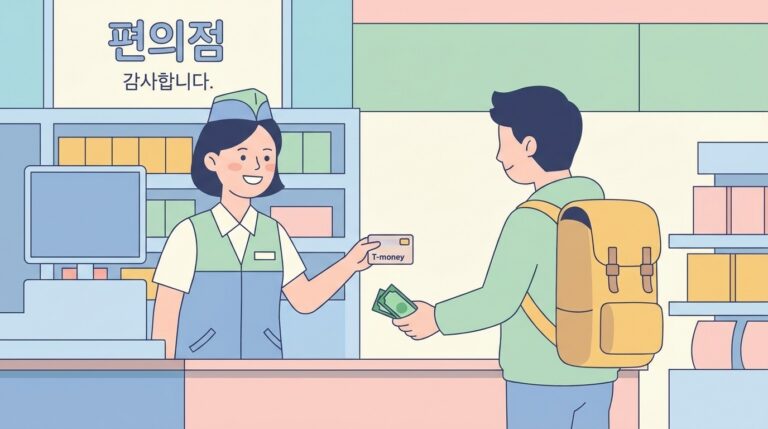
Imagine this classic Seoul arrival scene: You just touched down at Incheon, grabbed your stylish BTS-branded T-Money card, and excitedly wandered into a bright, welcoming GS25 convenience store. The air smells like sweet banana milk and warm roasted sweet potatoes. You pick out a delicious triangle kimbap on a 1+1 promotion, slide your transit card across the counter, and casually tap your foreign credit card on the reader to add 20,000 won for the subway. Suddenly, the friendly clerk pauses, crosses their arms into a gentle ‘X’ shape, and politely says, “현금만 돼요 (Hyeon-geum-man dwae-yo).”
Panic kicks in! You don’t have enough cash in hand, a queue of bustling commuters is forming behind you, and you suddenly realize South Korea—one of the most cashless, hyper-digital societies on Earth—has one giant, quirky exception: transit card reloading requires physical cash! This exact situation happens to over 90% of our first-time students. But do not worry, dear friend. With just three simple phrases and a pinch of local nunchi (quick social intuition), you will glide through every convenience store transaction like a seasoned Seoulite.
Phase 2: 핵심 표현 3선 심층 분석 (Top 3 Essential Expressions)
1. 교통카드 충전해 주세요 (Gyotongkadeu chungjeonhae juseyo)
- Pronunciation: Gyo-tong-ka-deu chung-jeon-hae ju-se-yo (Sounds like: Gyo-tong-card-uh Choong-jeon-hey Joo-say-yo)
- Meaning: Literal: “Transit card, please recharge.” | Real Nuance: “Could you please reload my transit card?”
- K-Culture Moment: Seen in almost every coming-of-age K-Drama (like Twenty-Five Twenty-One or Weightlifting Fairy Kim Bok-joo) where high school characters dash into a local shop to tap up their cards before chasing the green neighborhood bus.
- Editor’s Insight: Chungjeon (충전) comes from Chinese characters meaning “to replenish/fill up.” You use the exact same word when asking a café barista to recharge your dying smartphone battery!
- Situation Spectrum: Casual: ⚠️ (Only with close peers: 충전해 줘) | Semi-formal: ✅ (충전해 주세요 – Perfect for retail!) | Formal: ✅ (충전해 주시겠습니까)
- 🤔 Think About It: In English, we simply say “Ten dollars on this card, please.” Notice how Korean explicitly adds the polite verb form ~해 주세요 (please do for me) to show gratitude before the service is even performed.
2. 현금만 돼요? (Hyeon-geum-man dwae-yo?)
- Pronunciation: Hyeon-geum-man dwae-yo? (Sounds like: Hyun-gum-mahn dway-yo?)
- Meaning: Literal: “Is only cash possible?” | Real Nuance: “Is it cash only?”
- K-Culture Moment: You’ll hear this uttered by hungry tourists and locals alike at traditional street food stalls in Myeongdong or Gwangjang Market when buying hotteok (sweet pancakes).
- Editor’s Insight: The particle ~만 (~man) translates to “only.” If you ever need to confirm payment boundaries quickly, attach ~만 돼요? to any payment method.
- Situation Spectrum: Casual: ⚠️ | Semi-formal: ✅ (Safe, polite, and universally understood) | Formal: ✅ (현금만 가능합니까?)
- 🤔 Think About It: Why does Korea enforce cash for transit cards? It is tied to national anti-money laundering regulations and preventing credit card point fraud on liquid transit funds!
3. 만 원 충전해 주세요 (Man won chungjeonhae juseyo)
- Pronunciation: Man won chung-jeon-hae ju-se-yo (Sounds like: Mahn-won choong-jeon-hey joo-say-yo)
- Meaning: Literal: “10,000 won recharge please.” | Real Nuance: “Please top up 10,000 won.”
- K-Culture Moment: The iconic green 10,000 KRW bill (featuring King Sejong the Great) changing hands at subway convenience stores early in the morning.
- Editor’s Insight: In Korean counting, numbers shift into ten-thousands (man / 만). Ten thousand won is roughly $7.50 USD—the ideal baseline amount for 2–3 days of city travel.
- Situation Spectrum: Casual: ⚠️ | Semi-formal: ✅ | Formal: ✅
- 🤔 Think About It: English groups large numbers by thousands (10,000 = ten thousands), whereas Korean operates in units of four zeros (1,0000 = 일만). This subtle linguistic shift is the biggest brain hurdle for A1 learners!
Phase 3: 교과서 한국어 vs 진짜 한국어 (Textbook vs. Real Korean)
Situation 1: Specifying the reload amount at the counter
- 📖 교과서 한국어 (Textbook Korean):
교통카드에 만 원을 충전하고 싶습니다. (Gyotongkadeue man woneul chungjeonhago sipseumnida.)
“I desire to reload 10,000 won onto the transit card.” - 🗣️ 진짜 한국어 (Real-World Korean):
교통카드 만 원 충전해 주세요. (Gyotongkadeu man won chungjeonhae juseyo.)
“Transit card, 10,000 won recharge please.” - 💡 왜 다를까? (Why the difference?):
In everyday Korean life, particles like ~에 (onto) and rigid grammar endings like ~고 싶습니다 are naturally dropped to maintain swift customer speed in busy convenience stores.
Situation 2: Asking if card payment is accepted
- 📖 교과서 한국어 (Textbook Korean):
신용카드로 결제할 수 있습니까? (Sinyongkadeuro gyeoljehal su itseumnikka?)
“Is it feasible to execute a transaction via credit card?” - 🗣️ 진짜 한국어 (Real-World Korean):
카드는 안 돼요? (Kadeuneun an dwaeyo?)
“Card doesn’t work?” - 💡 왜 다를까? (Why the difference?):
Real spoken Korean favors short, punchy questions with rising intonation over stiff textbook vocabulary like 결제 (payment execution).
Phase 4: K-Culture 딥다이브 & 비언어적 매너 (Culture Deep Dive & Etiquette)
4-1. 눈치 (Nunchi) & Gestures
When interacting at a Korean convenience store counter:
1. The Two-Handed Handover (두 손): Always hand your transit card and physical cash using both hands (or support your right forearm with your left hand). Handing money with one hand flippantly is seen as dismissive.
2. The Polite Card Tap: Place your transit card directly on the small sensor pad next to the cash register screen. You don’t need to hand it to the clerk’s fingers directly unless they reach for it.
3. Deciphering the ‘X’ Sign: If a clerk crosses their forearms or index fingers in an ‘X’ before you speak, they aren’t being rude! It’s the universal Korean silent shorthand for “Unavailable / No / Cash only.”
4-2. Cultural Code Analysis: The Paradox of K-Convenience Stores
South Korea boasts the highest credit card usage rate in the world; you can buy a 500-won piece of chewing gum with Apple Pay or an international visa card without anyone blinking. However, transit cards (T-Money, Cashbee) function as anonymous digital cash. Because reloading a transit card is technically converting credit into liquid cash value, the Korean Financial Services Commission restricts credit card charging to prevent unauthorized cash advances. Remembering this will save you endless confusion at convenience stores!
Phase 5: 실전 롤플레이 시나리오 (Real-Life Roleplay)
Setting: A lively CU store outside Hongik University Station on a rainy Friday night.
Characters: You (nervous traveler) and Min-su (friendly part-time clerk with a bright blue uniform vest).
- Turn 1 (You): 🎭 Sliding a T-money card onto the counter reader with both hands
안녕하세요! 교통카드 충전해 주세요. (Annyeonghaseyo! Gyotongkadeu chungjeonhae juseyo.)
“Hello! Please recharge my transit card.” - Turn 2 (Min-su): 🎭 Nods pleasantly and taps the POS terminal screen
네! 얼마 충전해 드릴까요? (Ne! Eolma chungjeonhae deurilkkayo?)
“Sure! How much would you like me to recharge for you?” - Turn 3 (You): 🎭 Pointing to the screen while holding your credit card
만 원이요. 카드로 할게요! (Man won-iyo. Kadeuro halgeyo!)
“10,000 won, please. I’ll pay by card!” - Turn 4 (Min-su): 🎭 Makes a polite mini ‘X’ gesture with hands, shaking head gently
아, 죄송해요. 충전은 현금으로만 돼요. (A, joesonghaeyo. Chungjeoneun hyeongeumeuroman dwaeyo.)
“Ah, I’m sorry. Reloading is cash only.” - Turn 5 (You): 🎭 Realizing quickly, checking your wallet with a small smile
아, 현금만 돼요? 잠깐만요! (A, hyeon-geum-man dwae-yo? Jamkkanmanyo!)
“Ah, cash only? One moment please!” - Turn 6 (You): 🎭 Handing over a crisp green 10,000 won bill with two hands
여기 만 원 있어요. (Yeogi man won isseoyo.)
“Here is 10,000 won.” - Turn 7 (Min-su): 🎭 Inserts the cash into the register; a cheerful beep sounds
네, 충전 완료되었습니다! 영수증 필요하세요? (Ne, chungjeon wanryo-doe-eotseumnida! Yeongsujeung piryohaseyo?)
“Yes, reload complete! Do you need a receipt?” - Turn 8 (You): 🎭 Taking your card back with a slight bow
아니요, 괜찮아요. 감사합니다! (Aniyo, gwaenchanayo. Gamsahamnida!)
“No, that’s alright. Thank you!”
🔀 Interactive Branching Moment
What do you do if you open your wallet and find zero Korean cash bills?
* Option A: Say “ATM 어디에 있어요?” (ATM eodie isseoyo? / Where is the ATM?) and look inside the store.
* Option B: Insist louder in English: “Just try my Visa card once!”
* Option C: Leave the card on the counter and run out the door silently.
- Option A Feedback [BEST]: 🌟 Brilliant! Almost every Korean convenience store has an ATM machine right next to the entrance door. Min-su will gladly point to it.
- Option B Feedback [BAD]: ❌ The store POS system is hard-coded by bank network regulations to decline card transactions for transit balance. You will only cause awkwardness!
- Option C Feedback [RISK]: ⚠️ Abandoning your card will leave you stranded before the metro gates, and the clerk will feel bad chasing after you.
Phase 6: 10초 감정 섀도잉 드릴 (10-Second Shadowing Drill)
Practice out loud with real emotion! Pay attention to the pause slashes (/).
[😊 Confident & Friendly]
안녕하세요! / 교통카드 / 충전해 주세요.
(Annyeonghaseyo! / Gyotongkadeu / chungjeonhae juseyo.)-
[😳 Slightly surprised & Curious]
어? / 카드는 안 돼요? / 현금만 돼요?
(Eo? / Kadeuneun an dwaeyo? / Hyeongeumman dwaeyo?) -
[🤝 Polite & Relieved]
네! / 여기 만 원 / 있어요. / 감사합니다!
(Ne! / Yeogi man won / isseoyo. / Gamsahamnida!)
Phase 7: K-Culture 미니 사전 (Key Vocabulary Dictionary)
- 교통카드 (Gyotong-kadeu): Noun. Public transit card. Refers to all branded contactless cards like T-Money or Cashbee used on subways, buses, and city taxis.
- 충전 (Chungjeon): Noun. Recharging / Reloading. Used for smart cards, electric vehicles, and smartphone power.
- 현금 (Hyeon-geum): Noun. Physical cash (coins and paper currency).
- 원플러스원 (Won-peul-leo-seu-won): Slang / Retail Term. Korea’s beloved ‘1+1’ (Buy One Get One Free) promotional sale seen on snack shelves across all convenience stores.
Phase 8: 여행자를 위한 생존 키트 (Traveler’s Survival Kit)
Survival Phrases TOP 3
- 만 원만 충전해 주세요. (Man won-man chungjeonhae juseyo.)
- Pro Tip: Use this to ask for exactly 10,000 won if the clerk is waiting for your amount.
- 영수증 버려주세요. (Yeongsujeung beoryeojuseyo.)
- Pro Tip: Means “Please discard the receipt.” Most eco-conscious Seoul locals say this automatically after charging.
- 티머니 카드 있어요? (T-meoni kadeu isseoyo?)
- Pro Tip: Ask this when you first land to purchase the physical blank card itself at the counter!
Editor’s Travel Note
- App Tip: Always have your navigation ready. Avoid Google Maps for walking in Korea; instead, make sure to read our full Naver Map app setup and navigation guide before riding transit.
- Cash Advice: Keep at least two 10,000 won banknotes tucked behind your phone case strictly reserved for transit top-ups. Subway ticket machines take 1,000, 5,000, and 10,000 won bills (rarely 50,000 won bills).
Phase 9: “한 발 더 깊이” (Cultural Reflection)
Korea is internationally celebrated as a hyper-modern techno-wonderland where people pay for taxis with smartwatches and order dinner through mobile apps without uttering a single syllable. Yet, the transit reload policy remains rooted in tangible paper bills. This intentional friction represents a collective social boundary: public transit is treated as a secure public utility, protected from speculative credit debt. What feels like an inconvenience at first is actually a fascinating window into how modern Korea balances cutting-edge tech with strict social safety nets.
💬 Your Turn: Does your home country allow you to reload public transportation cards using credit cards or smartphones? Drop a comment below and share your transit system experiences!
Phase 10: FAQ & 흔한 실수 방지 (FAQ & Common Mistakes)
Q: Can I use foreign Visa or Mastercard at the subway station vending machines to reload my T-money card?
A: No. Neither convenience stores nor automated subway station kiosk machines accept foreign credit cards for T-Money reloads. Both require physical Korean Won cash bills.
Q: Can I reload my card using Korean mobile pay like KakaoPay or Samsung Pay?
A: Only if you hold a domestic Korean bank account linked with a resident registration number (ARC). Temporary travelers with foreign credit cards cannot use digital payment for reloads.
Q: What is the maximum amount I can load onto a Korean transit card?
A: You can load up to 500,000 KRW onto a standard T-Money card, but we strongly advise loading 10,000 to 20,000 KRW at a time for loss security.
🚨 흔한 실수 (Common Mistakes) Warning Board
- Mistake 1: Handing over a 50,000 won bill at a subway station kiosk.
- Correct Action: Convenience store clerks can break large bills or reload 50,000 KRW, but station machines often reject 50k bills. Break them at the convenience store register first!
- Mistake 2: Tapping your transit card at the convenience store register before telling the clerk your desired amount.
- Correct Action: State the amount first (“만 원 충전해 주세요”), wait for the clerk to punch the number into the POS, and place the card down when the pad flashes.
- Mistake 3: Assuming transit card funds can pay for normal convenience store groceries.
- Correct Action: You CAN pay for drinks, snacks, and 1+1 promotions with your T-Money balance! Just ensure you have separate funds for your train ride home.
Phase 11: 액션 미션 & 참여 유도 (Action Missions)
- 🥉 Bronze Mission (Solo Practice): Stand before your mirror with an old card and practice saying “교통카드 만 원 충전해 주세요” three times with crisp pronunciation.
- 🥈 Silver Mission (Social Share): Snap a photo of your cute Korean transit card or a 1+1 snack you bought at CU/GS25, and share it on Instagram with the hashtag
#DailyHangulChallenge. - 🥇 Gold Mission (Real Life Execution): Walk into a convenience store in Korea, hand the clerk cash with two hands, and successfully complete a transit reload without resorting to English!
- 🎮 K-Culture Mission: Watch episode 1 of any slice-of-life K-drama and spot the distinctive beep sound of a transit card tap at a turnstile or convenience store register.
Phase 12: 인터랙티브 퀴즈 챌린지 (Interactive Quiz)
1. Situational Judgment: You are at a 7-Eleven counter in Seoul. You want to reload 10,000 won onto your T-Money card. What should you say?
* (A) 카드로 결제해 주세요. (Kadeuro gyeoljehae juseyo.)
* (B) 만 원 충전해 주세요. (Man won chungjeonhae juseyo.)
* (C) 만 원 환불해 주세요. (Man won hwanbulhae juseyo.)
2. Fill-in-the-Blank: Complete the question to ask if cash is the only option:
* “_______만 돼요?” (Hint: Cash)
3. True or False: In Korea, you can reload your T-Money card at convenience stores using an international Apple Pay account.
* (True / False)
👉 Click here to reveal the answers and explanations!
- Answer: (B) 만 원 충전해 주세요.
- Explanation: Choice (A) means “Please pay by card,” which will not work for transit reloads. Choice (C) asks for a refund (환불).
- Answer: 현금 (Hyeon-geum)
- Explanation: 현금만 돼요? translates directly to “Is it cash only?”
- Answer: False
- Explanation: Transit card reloads are strictly cash-only for foreign tourists due to anti-speculation and currency convertibility laws.
- Explanation: Transit card reloads are strictly cash-only for foreign tourists due to anti-speculation and currency convertibility laws.







