

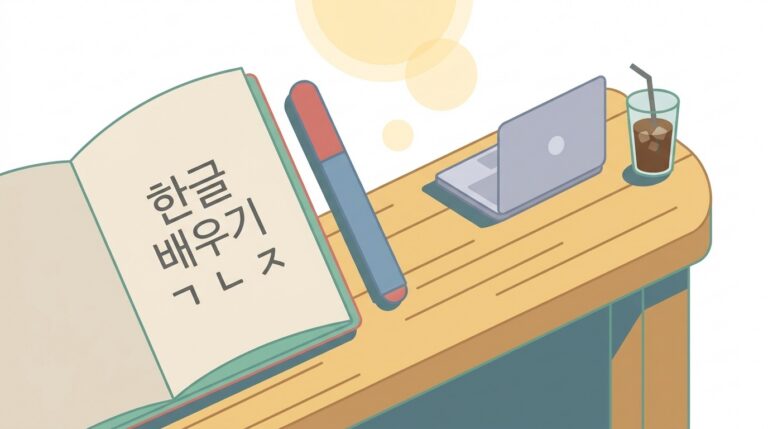
When You Can’t Focus: Switching to the Cafe Zone & Conquering Korean Study Cafes
Phase 1: Empathy & Storytelling Opening
안녕하세요! 매일한글 에디터입니다.
Picture this: You step into a modern, aesthetic study cafe (스터디카페) in Sinchon, Seoul. You successfully book a seat at the automated kiosk and enter the Focus Zone (포커스존). The air is so quiet that even breathing feels like a criminal offense. You sit down, pull out your laptop, and click your mouse—CLICK! Instantly, you feel three pairs of sharp eyes turn toward you in synchronized slow motion. Your heart skips a beat. You freeze. Suddenly, your brain turns into pure mush, your eyelids grow heavy, and studying feels impossible.
You desperately want to move to the cozy Cafe Zone (카페존), where gentle keyboard chatter, quiet murmurs, and soothing white noise (백색소음) will rescue your drowning focus. But wait… how do you change seats on that intimidating touch-screen machine? What if you need to ask the desk staff without breaking the sacred silence?
Don’t worry! Visiting a “Seuka” (스카) is an authentic rite of passage for students, digital nomads, and travelers in Korea. Based on real questions from hundreds of our beginner learners, this practical A2-level guide gives you the exact phrases, cultural manners, and kiosk hacks to gracefully move your seat and unlock your ultimate productivity.
Phase 2: 3 Core Expressions In-Depth
1. 자리를 옮기고 싶어요. (Jari-reul olgigo sipeoyo.)
- Pronunciation: Jah-ree-reul ohl-gee-goh she-poh-yoh (Think of jari like “jar-y”, olgi like “all-gear” without the ‘r’, and sipeoyo like “she-poh-yo”).
- Meaning: Literal: “I want to move (my) seat.” | Nuance: A polite, direct way to express your wish to switch desks.
- K-Culture Moment: In popular youth K-Dramas like Crash Course in Romance or True Beauty, students whisper this to friends or librarians when their current desk has terrible lighting or annoying drafts.
- Editor’s Insight: Using the beginner grammar pattern -고 싶어요 (-go sipeoyo / I want to) makes your statement sound modest and friendly rather than demanding. Notice that you don’t even need to say “I” (저는); Korean naturally understands who is speaking from context!
- Situation Spectrum: Casual: ⚠️ (Use 자리 옮길래 with close friends) | Semi-formal: ✅ (Perfect for study cafe staff) | Formal: ✅ (Polite in any library front desk).
- 🤔 Think About It: In English, we often say “Can I change my seat?” Why do you think Korean drops personal pronouns like “I” and “my” so effortlessly in shared public situations?
2. 집중이 잘 안 돼요. (Jipjung-i jal an dwaeyo.)
- Pronunciation: Jeep-joong-ee jahl ahn dway-yoh (Jipjung sounds like “jeep” + “jung”, jal like the start of “jalapeño”, and an dwaeyo like “ahn-dway-yo”).
- Meaning: Literal: “Focus is not happening well.” | Nuance: “I’m having trouble focusing” or “I can’t seem to concentrate.”
- K-Culture Moment: Seen in behind-the-scenes K-Pop training clips when trainees rub their temples late at night and sigh while trying to memorize lyrics.
- Editor’s Insight: Instead of complaining that a room is “too loud” or “too quiet,” Koreans often frame the issue around their internal condition: “Focus isn’t forming well.” It is humble, soft, and avoids blaming anyone else in the room.
- Situation Spectrum: Casual: ⚠️ (Say 집중 안 돼 to peers) | Semi-formal: ✅ | Formal: ⚠️ (Slightly too personal for high-level business settings).
- 🤔 Think About It: How does phrasing an issue as “focus isn’t working” feel different from complaining “this room is making me distracted”?
3. 카페존으로 바꿀 수 있나요? (Kapejon-euro bakkul su innayo?)
- Pronunciation: Kah-peh-john-eu-roh bahk-kool soo een-nah-yoh (Kapejon is Konglish for “Cafe Zone”, -euro sounds like “oo-roh”, and bakkul su innayo like “bah-kool soo in-nah-yo”).
- Meaning: Literal: “Is it possible to exchange toward the cafe zone?” | Nuance: “May I switch my seat to the cafe zone?”
- K-Culture Moment: Walking up to a 24-hour study cafe counter when you realize you need to type an urgent essay and cannot stay in the silent zone.
- Editor’s Insight: The pattern -(으)로 바꿀 수 있나요? (Can I switch to…?) is a total life-saver. You can replace “카페존” with “스터디룸” (study room), “창가 자리” (window seat), or “1인석” (single private booth) anytime!
- Situation Spectrum: Casual: 🚫 | Semi-formal: ✅ | Formal: ✅.
- 🤔 Think About It: The directional particle ‘-(으)로’ indicates movement toward a new state or place. It feels active and purposeful!
Phase 3: Textbook Korean vs. Real Korean
Situation 1: Changing your seat with the manager
- 📖 교과서 한국어: 제 좌석을 다른 구역으로 변경하고자 합니다. (Je jwaseogeul dareun guyeogeuro byeong-gyeonghagoja hamnida. / I intend to modify my seat to another section.)
- 🗣️ 진짜 한국어: 저기요, 자리 카페존으로 바꿔도 돼요? (Jeogiyo, jari kapejon-euro bakkwodo dwaeyo? / Excuse me, can I switch my seat to the cafe zone?)
- 💡 왜 다를까? Textbook Korean leans heavily on formal Sino-Korean nouns (좌석, 변경, 구역) that sound like a legal government contract! Real Koreans use the conversational verb 바꾸다 (to change) combined with the approachable question ending -도 돼요? (may I…?).
Situation 2: Telling a friend you are moving desks
- 📖 교과서 한국어: 주의가 산만하여 집중력이 저하되었습니다. (Juuiga sanmanhayeo jipjungnyeogi jeohadwaetseumnida. / My attention is scattered and my concentration has deteriorated.)
- 🗣️ 진짜 한국어: 멍 때리게 돼서 백색소음 있는 데로 갈래. (Meong ttaerige dwaeseo baeksaeksoeum inneun dero gallae. / I keep spacing out, so I’m heading over to where the white noise is.)
- 💡 왜 다를까? Native speakers frequently use colorful colloquial phrases like 멍 때리다 (to zone out / space out) rather than clinical terms to express mental fatigue.
Phase 4: K-Culture Deep Dive & Non-verbal Manners
4-1. 눈치 (Nunchi) & Non-verbal Manners
When you decide to relocate seats in a Korean study cafe, physical nunchi (social radar) is just as vital as your Korean vocabulary:
* Walk on the balls of your feet: Floors are often wooden. Avoid hard heel-strikes that echo across the silent chamber.
* Hug your gear: Don’t drag your tote bag or let loose cables swing against desks. Clasp your laptop, notebook, and water tumbler close to your chest with both hands.
* The 15-degree whisper bow: If you speak to a desk clerk or companion, lean forward slightly with a subtle nod, whispering in a low chest voice rather than a high-pitched hiss.
4-2. Culture Code: The “White Noise” Phenomenon
Why are Korean study cafes partitioned into “Focus Zones” and “Cafe Zones”? In Korea’s hyper-competitive test culture (열공 문화), students spend 10 to 14 hours a day prepping for exams like the CSAT (수능) or civil service exams. Cognitive researchers in Korea revealed that dead silence often spikes cortisol and magnifies minuscule noises.
To solve this, modern study cafes installed specialized acoustic systems broadcasting 백색소음 (white noise)—gentle ambient rainfall frequencies or simulated cafe murmurings. It masks sudden pencil drops and typing clicks, creating a comforting acoustic cocoon. The Cafe Zone gives you that chic Starbucks energy without loud gossip or sticky tables!
Phase 5: Real-life Roleplay Scenario
Setting: A modern study cafe near Sinchon station. Alex (an international student) approaches Min-ji (the kind evening desk assistant) after struggling to concentrate in the pitch-silent room.
- Alex: 저기요, 실례지만 질문 하나 해도 될까요? (Jeogiyo, sillyejiman jilmun hana haedo doelkkayo? / Excuse me, may I ask a quick question?)
🎭 Whispers gently while stepping towards the reception counter. - Min-ji: 네, 말씀하세요! 어떤 것 도와드릴까요? (Ne, malsseumhaseyo! Eotteon geot dowadeurilkkayo? / Yes, please go ahead! How can I help you?)
🎭 Leans forward with a reassuring, quiet smile. - Alex: 포커스존에 있는데, 집중이 잘 안 돼요. (Pokeseujone inneunde, jipjung-i jal an dwaeyo. / I’m currently in the Focus Zone, but I can’t focus well.)
🎭 Apologetically scratches the back of his neck. - Min-ji: 아, 거기가 너무 조용해서 답답하셨군요? (A, geogiga neomu joyonghaeseo dapdaphasyeotgunnyo? / Ah, was it stuffy because it’s too quiet in there?)
🎭 Nods with genuine sympathy. - Alex: 네, 백색소음 나오는 카페존으로 자리를 옮기고 싶어요. (Ne, baeksaeksoeum naoneun kapejon-euro jari-reul olgigo sipeoyo. / Yes, I’d like to move my seat to the cafe zone with white noise.)
🎭 Gestures softly toward the frosted glass door marked 'Cafe Zone'. - Min-ji: 키오스크에서 ‘좌석 이동’ 누르고 새 번호 선택하시면 돼요! (Kioseukeueseo ‘jwaseok idong’ nureugo sae beonho seontaekhasimyeon dwaeyo! / Just tap ‘Seat Transfer’ on the kiosk and pick a new number!)
🎭 Points toward the automated touch-screen near the front door. - Alex: 그렇군요! 혹시 지금 빈자리 많나요? (Geureokunnyo! Hoksi jigeum binjari mannayo? / Got it! Are there many empty seats right now?)
🎭 Tilts head curiously checking the screen from afar. - Min-ji: 네, 14번이랑 18번 창가 자리 비어있어요. 편하게 이용하세요! (Ne, sipsabon-irang sip-palbeon changga jari bieoitseoyo. Pyeonhage iyonghaseyo! / Yes, seat 14 and window seat 18 are open. Enjoy your study time!)
🎭 Hands Alex a complimentary wrapped peppermint candy.
🔀 Interactive Branching Point
You step up to the kiosk, but the interface seems tricky. What do you do?
* Choice A: “저기요, 키오스크 좌석 이동 좀 도와주실 수 있나요?” (Jeogiyo, kioseukeu jwaseok idong jom dowajusil su innayo? / Excuse me, could you please help me with the seat transfer on the kiosk?)
* Feedback: [Best] Super polite, natural use of the softener word 좀 (a little/please). The staff will gladly guide your fingers across the buttons.
* Choice B: “야, 이거 왜 안 돼? 자리 바꿔줘!” (Ya, igeo wae an dwae? Jari bakkwojwo! / Hey, why isn’t this working? Change my seat!)
* Feedback: [Bad] Highly offensive informal speech (반말). Saying 야 (Hey) to staff will shock everyone in the lobby!
* Choice C: Simply pick up your laptop and sit in the Cafe Zone without updating the kiosk.
* Feedback: [Risk] High risk! Korean study cafes track seats in real time. Within 15 minutes, another guest who officially booked that seat will tap your shoulder, causing supreme embarrassment.
Phase 6: 10-Second Emotion Shadowing Drill
Practice these natural rhythm pauses marked with / and embrace the emotional cues:
[🥺 조심스럽고 공손하게 - Hesitant and ultra-polite]
저기요… / 자리를 / 옮기고 싶어요.
(Jeogiyo… / jari-reul / olgigo sipeoyo.)-
[😮💨 답답하고 솔직하게 - Frustrated and honest]
여기서 / 집중이 / 잘 안 돼요.
(Yeogiseo / jipjung-i / jal an dwaeyo.) -
[✨ 밝고 희망차게 - Cheerful and curious]
카페존으로 / 바꿀 수 있나요?
(Kapejon-euro / bakkul su innayo?) -
[💡 안도하며 만족스럽게 - Relieved and satisfied]
백색소음 덕분에 / 집중이 / 진짜 잘 돼요!
(Baeksaeksoeum deokbune / jipjung-i / jinjja jal dwaeyo!)
Phase 7: K-Culture Mini Dictionary
- 스카 (Seuka) | Study Cafe | The universal Korean abbreviation combining Study (스터디) and Cafe (카페). E.g., “오늘 스카 갈래?” (Do you want to hit the study cafe today?).
- 백색소음 (Baeksaeksoeum) | White Noise | Ambient broadband acoustic sound played via ceiling speakers to mask distracting noises.
- 좌석 이동 (Jwaseok Idong) | Seat Transfer / Move Seat | The exact Korean label found on 99% of study cafe and public library touchscreen kiosks.
- 카페존 (Kapejon) | Cafe Zone | A designated wing in study cafes where light mouse clicking, keyboard typing, and quiet sipping are permissible.
Phase 8: Survival Kit for Travelers
TOP 3 Survival Phrases
- 자리 이동 어떻게 해요? (Jari idong eotteoke haeyo?)
- Meaning: How do I do a seat change?
- Pro Tip: Use this at the front desk if the kiosk menu looks confusing.
- 여기 빈자리인가요? (Yeogi binjari-ingayo?)
- Meaning: Is this an empty seat?
- Pro Tip: Handy when someone left a notebook on a table and you aren’t sure if it’s occupied.
- 스터디룸 예약 확인해 주세요. (Seuteodirum yeyak hwaginhae juseyo.)
- Meaning: Please check my study room reservation.
- Pro Tip: Essential when renting a group room for Zoom calls or language exchanges.
Editor’s Travel Note
Looking for an aesthetic place to catch up on work or Korean homework? Type “스터디카페” on the Naver Map Navigation App to uncover dozens of modern 24-hour spots near every subway station. Most automated kiosks only accept credit cards or prepaid travel cards like WOWPASS and Namane cards. Keep an eye out for kiosks with a globe icon for English language mode!
Phase 9: One Step Deeper
Korean study cafes reflect an ingenious cultural compromise. In Korean society, extreme collective order coexists with intense personal ambition. Instead of forcing everyone into monastic silence or noisy coffee shop chaos, the Korean concept of “Zone Segmentation” acknowledges that every human brain works differently. By creating dedicated spaces for absolute silence, white-noise flow, and group discussion, Korean society nurtures productivity without confrontation.
💬 Your Turn: What works best for your brain when studying: complete, pin-drop silence, or the rhythmic hum of white noise in a cafe? Share your study style in the comments below!
Phase 10: FAQ & Avoiding Misunderstandings
Q: Can I bring outside food or drinks into the Cafe Zone?
A: Almost all Korean study cafes offer complimentary espresso bars, herbal teas, and mini snacks in the lounge (휴게실). However, bringing in outside hot, aromatic foods (like burgers, gimbap, or fried chicken) is strictly forbidden. Drinks with tight spill-proof lids are almost always welcome!
Q: What should I do if I step out for lunch?
A: Look for the 외출 (Oechul / Going Out) button on the kiosk and scan your QR code or enter your phone number. Never just walk out! If you are gone for more than the permitted outing time (usually 60 to 90 minutes), the system will automatically cancel your seat to free it up for others.
Q: Can I do speaking practice or make phone calls in the Cafe Zone?
A: No. Even though keyboard typing is allowed in the Cafe Zone, vocal talking is not. If you need to take a phone call, step into the soundproof phone booth or lounge. For conversational language practice, book a private 스터디룸 (Study Room).
🚨 Common Mistakes Alert
- Moving your body without moving your ticket: Moving your physical seat without selecting “좌석 이동” on the kiosk leads to double-booking disputes. Always transfer your seat on the screen first!
- Loud mechanical keyboards: Even in the Cafe Zone, loud gaming mechanical keyboards with blue switches will attract cold glares (눈총). Use a soft silicone keyboard cover (키보드 스킨) or silent mouse, usually borrowed for free from the cafe amenity cart.
- Leaving trash on the desk: Unlike traditional coffee shops where baristas bus your table, Korean study cafes are strictly self-service (셀프 정리). Wipe down your desk with the disinfectant wipes provided at the door.
Phase 11: Action Missions
- Bronze Mission (Solo Practice): Stand in front of your mirror and repeat 3 times with polite whispering tone: “카페존으로 자리를 옮기고 싶어요.”
- Silver Mission (Social Share): Snap a photo of your current desk or study mug, upload it to your Instagram stories, and write: “오늘은 백색소음 들으면서 열공! (Studying hard with white noise today!)” and tag @DailyHangul.
- Gold Mission (Real-world Challenge): Next time you visit a cafe, library, or study space, use the kiosk or politely ask the counter in Korean to switch to a window seat or quieter zone!
- 🎮 K-Culture Mission: Search “스카 브이로그” (Study Cafe Vlog) on YouTube. Watch 5 minutes of a Korean student’s day and spot the moment they tap the kiosk screen for 좌석 이동 (Seat transfer)!
Phase 12: Interactive Quiz Challenge
Test your real-world skills with these three quick questions!
1. Situation Decision:
You are studying in the silent zone, but you feel sleepy and your attention is slipping. You want to ask the attendant to move you to the cafe zone. Which phrase is best?
* A) 여기서 잘래요. (I want to sleep here.)
* B) 카페존으로 바꿀 수 있나요? (Can I switch to the cafe zone?)
* C) 노래 좀 크게 틀어주세요. (Please play songs loudly.)
2. Fill in the Blank:
“여기서 공부하는데 집중이 잘 ___ 돼요.” (I’m studying here, but I can’t focus well.)
* [Hint: A 2-letter Korean negative adverb meaning ‘not’]
3. True or False:
In a Korean study cafe’s Cafe Zone (카페존), you can freely talk on your phone on speaker mode because white noise cancels the sound. (True / False)
👉 Click to reveal answers & explanations!
- 1. Answer: B) 카페존으로 바꿀 수 있나요?
- Explanation: Option B is polite and natural. Option A means you want to sleep at the desk, and Option C asks the library to blast music!
- 2. Answer: 안 (An)
- Explanation: The phrase is 집중이 잘 안 돼요 (Focus is not happening well). 안 is the essential negative marker placed right before 돼요.
- 3. Answer: False!
- Explanation: The Cafe Zone permits subtle background keyboard and mouse sounds under white noise, but speaking on the phone is strictly forbidden inside all study rooms. Phone calls belong in the hallway or lounge!
- Explanation: The Cafe Zone permits subtle background keyboard and mouse sounds under white noise, but speaking on the phone is strictly forbidden inside all study rooms. Phone calls belong in the hallway or lounge!






