

Writing a Heartfelt Korean Thank-You Letter to Your Mentor or Teacher
Phase 1: 공감 (Story-Driven Opening)
안녕하세요! 매일한글 에디터입니다.
Remember that breathtaking moment in the K-drama Crash Course in Romance (일타 스캔들) or the intense corporate battles in Misaeng (미생) when a student or rookie employee finally achieves their ultimate dream? Their eyes tear up, hands tremble holding the acceptance certificate, and the very first person they want to call isn’t just family—it’s the mentor who believed in them when nobody else did.
Now, imagine that’s you. You opened your portal, and the screen flashed: “합격을 축하합니다” (Congratulations on your acceptance!) Whether it’s your dream master’s program at Seoul National University or that coveted offer at a Seoul tech startup, your heart races. You sit down to write a thank-you letter or KakaoTalk message to your Korean professor, supervisor, or language mentor. But suddenly, your fingers freeze over the keyboard.
“Is ‘감사합니다’ (Gamsahamnida) too plain? If I use ‘-아/어/여요’ (-a/eo/yeoyo), does it sound too casual? But if I use ‘-하십시오’ (-hasipsio), will I sound like an ancient Joseon scholar? How do I say ‘I passed thanks to you’ without sounding boastful?”
If you’re feeling this exact friction, take a deep breath. At Level B1, you’re stepping beyond simple greetings into the nuanced realm of Korean relational etiquette. Writing a letter of gratitude for an acceptance news (합격 소식) is considered an art form in Korea—a balance of humble deference, deep warmth, and genuine excitement. Over the past ten years coaching hundreds of international students, I’ve seen learners make their Korean mentors tear up with pride simply by choosing the right three sentences. Let’s turn your happy news into an unforgettable tribute to your mentor.
Phase 2: 핵심 표현 3선 심층 분석 (3 Core Expressions In-Depth)
1. 선생님의 가르침 덕분에 합격할 수 있었습니다 (Seonsaengnim-ui gareuchim deokbune hapgyeokal su isseotseumnida)
- Pronunciation: [Seon-saeng-nim-ui ga-reu-chim deok-bu-ne hap-gyeo-kal su is-seot-seum-ni-da] (Think: Sun-saeng-neem-wee gah-roo-cheem dock-boo-neh hahp-gyuh-kahl soo ee-ssut-seum-nee-dah)
- Meaning: Literally: “Thanks to your teaching, I was able to pass.” / Nuance: “Your guidance made my dream possible; I couldn’t have done this on my own.”
- K-Culture Moment: The iconic climax of any graduation or entrance exam film where the student bows deeply to their instructor outside the academy (hagwon).
- Editor’s Insight: The phrase “덕분에” (deokbune – thanks to you) is the ultimate magic key in Korean relationship building. Koreans have an aversion to claiming solitary credit for their success. Saying 내가 잘해서 합격했다 (I passed because I’m great) is a cultural taboo; attributing your victory to another’s mentorship showcases personal maturity and high emotional intelligence (눈치, nunchi).
- Situation Spectrum:
- Casual: 🚫 (너 덕분에 붙었어 – only for close friends)
- Semi-formal: ⚠️ (선생님 덕분에 합격했어요 – acceptable for friendly tutors)
- Formal: ✅ (선생님의 가르침 덕분에 합격할 수 있었습니다 – perfect for professors/mentors)
- 🤔 Think About It: In English, we often say, “I finally got in! Thank you for the letter of recommendation.” In Korean, the syntax literally places the mentor’s guidance (가르침 덕분에) before your accomplishment. How does placing someone else’s effort at the front of your sentence change how you view your own achievements?
2. 베풀어 주신 은혜에 진심으로 감사드립니다 (Bephureo jusin eunhye-e jinsimeuro gamsadeurimnida)
- Pronunciation: [Be-pu-reo ju-sin eun-hye-e jin-sim-eu-ro gam-sa-deu-rim-ni-da] (Think: Beh-poo-ruh joo-sheen oon-hyeh-eh jeen-sheem-oo-roh gahm-sah-doo-reem-nee-dah)
- Meaning: Literally: “I sincerely thank you for the grace/kindness you have bestowed upon me.” / Nuance: “I hold the deepest reverence for your unwavering support and benevolent guidance.”
- K-Culture Moment: The touching letter exchanged between Master Kim Sabu and his pupils in Dr. Romantic (낭만닥터 김사부).
- Editor’s Insight: “은혜” (eunhye) translates poorly as just “kindness”—it originates from the classical concept of profound, life-altering grace received from parents, teachers, or masters. You cannot give 은혜 to a friend; it flows from a respected figure of authority who nurtured you selflessly. Pairing it with “베풀어 주신” (bestowed upon) elevates your Korean into poetic, deeply respectful writing.
- Situation Spectrum:
- Casual: 🚫 (Sounds awkward or sarcastic among peers)
- Semi-formal: ⚠️ (Slightly heavy for casual mentors)
- Formal: ✅ (The gold standard for written cards to professors or senior directors)
- 🤔 Think About It: Western cultures often celebrate individual autonomy and transactional support (“You did your job well as my advisor”). Does having a word like 은혜 deepen a teacher’s lifelong stake in their student’s future?
3. 항상 건강하시고 행복하시기를 기원합니다 (Hangsang geonganghasigo haengbokhasigireul giwonhamnida)
- Pronunciation: [Hang-sang geon-gang-ha-si-go haeng-bok-ha-si-gi-reul gi-won-ham-ni-da] (Think: Hahng-sahng gun-gahng-hah-she-goh haeng-bok-hah-she-gee-rool gee-won-hahm-nee-dah)
- Meaning: Literally: “I pray that you will always remain healthy and happy.” / Nuance: “Wishing you enduring health and joy; you will always be in my thoughts.”
- K-Culture Moment: Every year on May 15th (Korean Teachers’ Day / 스승의 날), this phrase is inscribed on millions of hand-folded red carnation greeting cards across Korea.
- Editor’s Insight: In Korean epistolary tradition, an email or card should never abruptly end after the main announcement. A Korean letter is considered unfinished and cold without a closing wish for the recipient’s health (건강) and peace (평안). Adding the honorific marker -시- (-si-) shows that your respect extends to their personal well-being.
- Situation Spectrum:
- Casual: 🚫 (건강하고 행복해 is far too blunt for elders)
- Semi-formal: ⚠️ (늘 건강하시고 행복하세요 – fine for familiar mentors)
- Formal: ✅ (항상 건강하시고 행복하시기를 기원합니다 – impeccable finish)
- 🤔 Think About It: Why is wishing for someone’s physical health considered the ultimate sign of respect across East Asian correspondence?
Phase 3: 교과서 한국어 vs 진짜 한국어 (Textbook vs. Real Korean)
Situation 1: Sharing that you got accepted
- 📖 교과서 한국어 (Textbook): 저는 이번 시험에 합격했습니다. (Jeoneun ibeon siheome hapgyeokaesseumnida. – “I passed this exam.”)
- 🗣️ 진짜 한국어 (Real-Life Pro): 교수님, 저 이번에 원하던 대학교에 합격했어요! (Gyosunim, jeo ibeone wonhadeon daehakgyoe hapgyeokaesseoyo! – “Professor, I was accepted into my dream university this time!”) or in a letter: “선생님 덕분에 이번에 꿈꾸던 회사에 최종 합격하게 되었습니다!” (Seonsaengnim deokbune ibeone kkumkkudeon hoesae choejong hapgyeokhage doe-eosseumnida!)
- 💡 왜 다를까? (Why the difference?): Standard textbooks teach plain declarative sentences (-했습니다), which can sound dry and robotic. Real native communication highlights the emotional dream aspect (꿈꾸던, 원하던) combined with passive agency (-게 되었습니다 – “it came to pass”), showing modesty rather than blunt triumph.
Situation 2: Repaying their kindness
- 📖 교과서 한국어 (Textbook): 나중에 돈을 많이 벌어서 갚겠습니다. (Najunge doneul mani beoreoseo gapgetseumnida. – “I will make a lot of money later and pay you back.”)
- 🗣️ 진짜 한국어 (Real-Life Pro): 보내주신 응원에 부끄럽지 않은 제자가 되겠습니다. (Bonaejusin eungwone bukkeureopji aneun jejaga doegetseumnida. – “I will become a disciple/student worthy of your support.”)
- 💡 왜 다를까? (Why the difference?): Paying a teacher back monetarily is considered inappropriate and transactional in Korean culture. The highest form of repayment is your personal integrity and becoming a proud representation of your mentor’s guidance (부끄럽지 않은 사람/제자).
Phase 4: K-Culture 딥다이브 & 비언어적 매너 (Deep Dive & Non-Verbal Manners)
4-1. 눈치 (Nunchi) & Gestures: Delivering Good News with Humility
When you visit your teacher or mentor to deliver this letter or share the news in person, body language speaks before your words do:
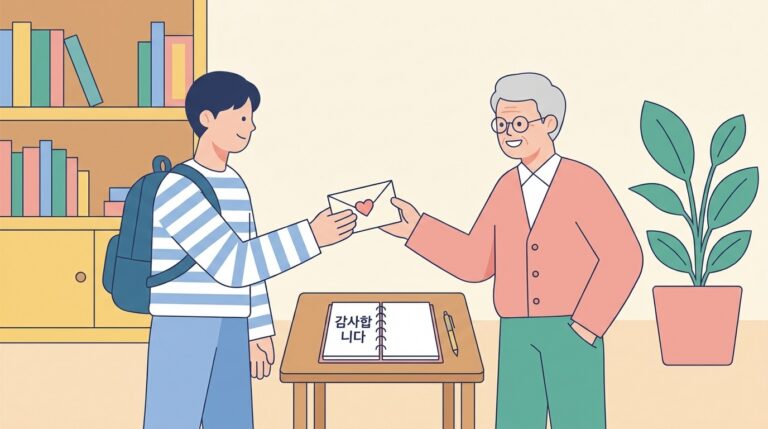
1. The Two-Handed Handover (두 손 전달): Never slide an envelope across a desk with one hand. Hold the letter or envelope with both hands, thumbs securing the top edge, slightly lowering your head as you present it.
2. The 30-Degree Modest Bow (목례/정중한 인사): Do not puff your chest out with victory arms. When sharing that you passed, maintain eye contact briefly, smile warmly, and bow your upper torso roughly 30 degrees while saying: “다 선생님 덕분입니다” (It is all thanks to you, Teacher).
3. Seating Nunchi (자리 눈치): If they offer you tea or coffee in their office, wait until they take their first sip before you drink yours. Turn your head slightly to the side if taking a sip in front of a very senior professor.
4-2. Cultural Code Analysis: 스승의 은혜 (The Grace of the Teacher)
In Korea, there is a famous proverb: “스승의 그림자는 밟지도 않는다” (One does not even step on the shadow of one’s teacher). While contemporary Korea has softened this strict Confucian hierarchy, the mentor-mentee relationship remains deeply familial and sacred. When an applicant passes a university interview or a major corporation’s hiring round (공채, gongchae), it is an accomplishment that belongs to the mentor’s legacy as much as the student’s. Writing this letter isn’t just polite—it seals a lifelong alliance. Even after you graduate or change jobs, a mentor who receives this heartfelt note will continue to champion you throughout your career.
Phase 5: 실전 롤플레이 시나리오 (Real-Life Roleplay Scenario)
Setting: Professor Min-woo Kim’s sunlit office at Korea University. Professor Kim, wearing round-frame tortoiseshell glasses, is reviewing research papers when Alex, a foreign exchange student who just passed the Graduate School Admission, knocks on the door.
- Alex: 실례합니다, 교수님. 잠시 들어가도 될까요? (Sillyehamnida, gyosunim. Jamsi deureogado doelkkayo?)
- “Excuse me, Professor. May I come in for a moment?”
- 🎭 Knocks softly twice, opening the door slightly with a polite smile.
- Professor Kim: 어, 알렉스 씨! 어서 와요. 발표 났지요? 어떻게 됐어요? (Eo, Al-lek-seu ssi! Eoseo wayo. Balpyo natjiyo? Eotteoke dwaesseoyo?)
- “Oh, Alex! Welcome, come on in. The announcement came out, right? How did it go?”
- 🎭 Sets his glasses down and looks up with curious, encouraging eyes.
- Alex: 네, 교수님! 교수님의 따뜻한 가르침 덕분에 이번에 대학원에 최종 합격했습니다! (Ne, gyosunim! Gyosunim-ui ttatteutan gareuchim deokbune ibeone daehagwone choejong hapgyeokaesseumnida!)
- “Yes, Professor! Thanks to your warm guidance, I was finally accepted into the graduate program!”
- 🎭 Bows at 45 degrees, beaming with excitement while holding a handwritten letter in both hands.
- Professor Kim: 아이고, 축하해요! 알렉스 씨가 그동안 고생 많았는데 정말 잘됐네요! (Aigo, chukhahaeyo! Al-lek-seu ssiga geudongan gosaeng maneanneunde jeongmal jaldwaenneyo!)
- “Oh wow, congratulations! You went through so much hard work all this time, I am so thrilled for you!”
- 🎭 Stands up and pats Alex warmly on the shoulder.
- Alex: 교수님께서 추천서도 써 주시고 연구 계획서도 봐 주셔서 큰 용기를 얻었습니다. (Gyosunimkkeseo chucheonseodo sseo jusigo yeon-gu gyehoekseodo bwa jusyeoseo keun yong-gireul eodeotseumnida.)
- “Because you wrote my recommendation letter and reviewed my research proposal, I gained so much courage.”
- 🎭 Places hand near the heart humbly, nodding respectfully.
- Professor Kim: 알렉스 씨의 열정 덕분이지요. 내가 한 건 별로 없어요. (Al-lek-seu ssi-ui yeoljeong deokbunijiyo. Naega han geon byeollo eopseoyo.)
- “It was all thanks to your passion, Alex. I barely did anything.”
- 🎭 Waves hand modestly in typical Korean fashion.
- Alex: 아닙니다. 작은 감사의 마음을 담아 편지를 써 왔습니다. 받아 주세요. (Animnida. Jageun gamsaui maeumeul dama pyeonjireul sseo watseumnida. Bada juseyo.)
- “Not at all, sir. I wrote a small letter containing my gratitude. Please accept it.”
- 🎭 Presents the envelope with both hands, slightly bowing his head.
- Professor Kim: 고마워요, 알렉스 씨. 앞으로 연구실에서도 멋진 활약 기대할게요! (Gomawoyo, Al-lek-seu ssi. Apu-ro yeon-gusireseodo meotjin hwalyak gidaehalgeyo!)
- “Thank you, Alex. I will look forward to great achievements from you in our research lab!”
- 🎭 Receives the letter with both hands and offers a seat on the sofa.
🔀 인터랙티브 분기점 (Interactive Decision Point)
How should you reply to Professor Kim’s final encouragement: “앞으로 연구실에서도 멋진 활약 기대할게요!”?
- Choice A: “네! 교수님 실망시켜 드리지 않도록 최선을 다하겠습니다!” (Ne! Gyosunim silmangsikyeo deuriji antorok choeseoneul dahagetseumnida!)
- Feedback: 🌟 BEST CHOICE! Striking the quintessential Korean note of determination: promising to work hard so as never to disappoint their trust. Perfect B1 formal phrasing.
- Choice B: “당연하죠! 저 진짜 똑똑하니까 걱정 마세요.” (Dang-yeonhajyo! Jeo jinjja ttokttokanikka geokjeong maseyo! – “Of course! I’m really smart, so don’t worry.”)
- Feedback: ❌ BAD CHOICE. Coming off as arrogant and completely ignores the virtue of humility. Korean mentors value modest determination (겸손과 끈기) far more than self-praise.
- Choice C: “응, 고마워 김 교수!” (Eung, gomawo Kim gyosu! – “Yeah, thanks Kim professor!”)
- Feedback: 🚨 CRITICAL RISK! Using Banmal (casual speech) and addressing a professor without the honorific title 님 will instantly damage the relationship. Never omit -님!
Phase 6: 10초 감정 섀도잉 드릴 (10-Second Emotion Shadowing Drill)
Read these lines aloud, mimicking native pitch contours marked by / and guided by the emotional tags!
[😊 벅차고 감격스럽게 - Overjoyed & Emotional]
선생님! / 저 이번에 / 꿈꾸던 대학교에 / 최종 합격했습니다!
(Seonsaengnim! / Jeo ibeone / kkumkkudeon daehakgyoe / choejong hapgyeokaesseumnida!)-
[🥺 겸손하고 진심 어린 목소리로 - Humble & Heartfelt]
모두 / 선생님께서 / 믿고 이끌어 주신 / 덕분입니다.
(Modu / seonsaengnimkkeseo / mitgo ikkeureo jusin / deokbunimnida.) -
[🙇♂️ 정중하고 단호한 다짐으로 - Respectful & Determined]
가르쳐 주신 은혜를 잊지 않고, / 늘 자랑스러운 제자가 / 되겠습니다.
(Gareuchyeo jusin eunhye-reul itji anko, / neul jarangseureoun jejaga / doegetseumnida.)
Phase 7: K-Culture 미니 사전 (Mini Dictionary)
- 은사님 (Eun-sa-nim) | Beloved teacher / Revered mentor
- Unlike the generic 선생님 (teacher), 은사님 refers specifically to a teacher who fundamentally shaped your character, life direction, or career path. Used when talking about them with profound honor.
- 합격 (Hap-gyeok) | Passing / Acceptance / Qualification
- The magic two syllables every Korean strives for. Combined with 소식 (news), 합격 소식 means “the announcement that you passed.” The colloquial opposite is 불합격 (failure) or slangily 미역국을 먹다 (to slip/fail).
- 덕분에 (Deok-bu-ne) | Thanks to / Owing to (positive causes)
- Essential grammar: Noun + 덕분에. Only used for good results! If you want to blame someone for a bad outcome, Koreans switch to 탓에 (tase – due to the fault of).
- 보답하다 (Bo-dap-ha-da) | To repay / To reciprocate a kindness
- Frequently combined as 은혜에 보답하다 (to repay someone’s grace). It symbolizes reciprocating long-term emotional support through dedication and success.
Phase 8: 여행자 & 체류자를 위한 생존 키트 (Survival Kit for Expats)
Top 3 Survival Phrases for Congratulatory Moments:
- 기쁜 소식 전해 드립니다! (Gippeun sosik jeonhae deurimnida!)
- Meaning: “I am reaching out to share some wonderful news!” (Ideal opening sentence for emails or formal Kakao messages).
- 항상 응원해 주셔서 감사합니다. (Hangsang eung-wonhae jusyeoseo gamsahamnida.)
- Meaning: “Thank you for always rooting for me.”
- 조만간 직접 찾아뵙고 인사드리겠습니다. (Joman-gan jikjeop chajabwoepgo insadeurigetseumnida.)
- Meaning: “I will visit you in person soon to pay my respects properly.”
Editor’s Travel & Expat Note:
If you want to send a handwritten card along with a small token of appreciation, visit 교보 핫트랙스 (Kyobo Hottracks Stationery Store) or an Artbox store found in almost every university district. Look for elegant Korean traditional handmade paper envelopes (한지 편지봉투).
* Local Gifting Tip: In Korea, public school teachers and university professors are subject to the Kim Young-ran Act (Anti-Graft Law), which strictly limits personal gifts from active students. Expensive presents can cause legal headaches! Instead, stick to a thoughtful handwritten letter, a simple coffee gift card via KakaoTalk Gift (카카오톡 선물하기), or a box of traditional walnut cakes (호두과자) under 20,000 KRW to share with colleagues.
Phase 9: “한 발 더 깊이” (Cultural Essay: The Philosophy of Deokbun)
When a Korean athlete wins an Olympic medal or an idol tops the Billboard charts, their immediate phrase is inevitably: “팬 여러분 덕분입니다” (It’s all thanks to the fans) or “감독님 덕분입니다” (It’s thanks to the coach). In Western discourse, we champion self-made individualism; self-confidence is expressed by owning one’s brilliance.
However, Korean social psychology is rooted in 우리의식 (collective identity). By declaring 덕분에, you do not diminish your hard work; rather, you weave your success into a tapestry of mutual support. Acknowledging that someone else lit the candle in your darkest hours creates a bond that outlasts individual milestones.
💬 Your Turn: Who is the mentor who unlocked a door for your Korean studies or your career? What is the one thing they told you that you will never forget? Share in the comments below!
Phase 10: FAQ & 오해 방지 (FAQ & Common Mistakes)
Q: Can I use “고마워요” (Gomawoyo) if I feel really close to my mentor?
A: Unless the mentor explicitly invited you to drop formalities (e.g., saying 말 편하게 해), never use 고마워요 with someone superior in age or rank. Even though it ends with -요, 고맙다 has a softer, horizontal texture compared to the reverent Sino-Korean 감사합니다 (Gamsahamnida). Stick with 감사드립니다 or 감사합니다 for teachers.
Q: Is sending a KakaoTalk message considered rude compared to a paper letter?
A: In modern Korea, a polished, well-formatted KakaoTalk message sent during standard business hours (between 10 AM and 5 PM) is completely acceptable and widely practiced! Just avoid sending it late at night or during the weekend. Adding a photo of a handwritten card inside your Kakao message is the ultimate thoughtful touch.
Q: How do I address a professor in an email header?
A: Always use: “OOO 교수님께” (To Professor [Full Name]). Do not use “존경하는” (Respected) alone without the name and title, and never write just “선생님 알렉스” (putting your name before the teacher). Keep it dignified: 김민우 교수님께, 안녕하세요. 알렉스입니다.
🚨 흔한 실수 (Common Mistakes) 경고판:
- ❌ Mistake 1: Writing “선생님 덕에” instead of “선생님 덕분에”.
- Correction: Dropping the -부- makes 덕에 sound overly casual or dismissive. Always use 덕분에 for elders.
- ❌ Mistake 2: Saying “축하해 주세요!” (Please congratulate me!).
- Correction: In Korean etiquette, directly commanding or asking someone to congratulate you can sound slightly entitled. Instead, state your gratitude (좋은 소식을 전해 드릴 수 있어 기쁩니다 – I am delighted to be able to share good news) and let them offer congratulations organically.
- ❌ Mistake 3: Ending with “수고하세요” (Keep working hard).
- Correction: 수고하세요 implies the other person has tedious work ahead and should only be spoken by a senior to a junior. End with “건강 조심하세요” (Please take care of your health) or “행복한 하루 보내세요” (Have a happy day).
Phase 11: 액션 미션 & 참여 유도 (Action Missions)
- 🥉 Bronze Mission (Solo Shadowing): Read the 3 sentences in Phase 6 out loud three times while looking in the mirror. Focus on smiling warmly during the word 덕분에.
- 🥈 Silver Mission (Drafting Your Letter): Fill in the blanks of this essential template in your Korean notebook:
[멘토 이름] 선생님/교수님께, 안녕하세요. [본인 이름]입니다. 선생님의 가르침 덕분에 이번에 [학교/회사 이름]에 합격하게 되었습니다! 항상 진심으로 감사드리며, 늘 건강하시길 바랍니다.
- 🥇 Gold Mission (Real Connection): Send this message or a handwritten note to an actual Korean teacher, language exchange partner, or mentor who helped your Korean journey!
- 🎮 K-Culture Mission: Watch an episode of a Korean drama depicting university or hospital life (like Hospital Playlist or Twenty-Five Twenty-One). Spot when a junior uses the phrase “선생님 덕분입니다” and notice the exact bow they use!
Phase 12: 인터랙티브 퀴즈 챌린지 (Interactive Quiz Challenge)
1. 상황 판단 (Situational Judgment)
You just received an offer letter from a Korean company. You want to thank your Korean language tutor on KakaoTalk. Which sentence is the most natural, respectful, and culturally appropriate?
* ① 야! 나 드디어 합격했다! 한턱 쏠게!
* ② 선생님, 그동안 가르쳐 주신 덕분에 원하던 회사에 합격했습니다. 진심으로 감사드립니다!
* ③ 선생님이 숙제를 많이 주신 탓에 제가 합격했습니다.
* ④ 저 합격했으니까 빨리 축하해 주세요.
2. 빈칸 채우기 (Fill-in-the-Blank)
Complete the sentence using the honorific phrase meaning “Thanks to [your] guidance/teaching”:
* “선생님의 _________ 덕분에 꿈을 이룰 수 있었습니다.”
* (A) 잔소리 (Jansori)
* (B) 가르침 (Gareuchim)
* (C) 구경 (Gugyeong)
3. True / False 문화 퀴즈
- Q: In Korea, it is considered polite to end an email to an elderly professor by writing “수고하세요!” because it shows you appreciate their labor. (True / False)
👉 Click to reveal answers & explanations!
- Answer: ②
- Explanation: Option ② perfectly balances the polite 가르쳐 주신 덕분에 with a sincere expression of gratitude (진심으로 감사드립니다). Option ① is too informal (banmal), Option ③ mistakenly uses 탓에 (which is for negative blame), and Option ④ rudely commands them to congratulate you.
- Answer: (B) 가르침
- Explanation: 가르침 is the dignified noun form of 가르치다 (to teach), meaning “teaching/guidance.” 잔소리 means nagging, and 구경 means sightseeing.
- Answer: False
- Explanation: 수고하세요 is never spoken upward to a superior or senior figure. It should be replaced with wishes for good health (건강하세요) or general peace (평안한 하루 보내세요).
- Explanation: 수고하세요 is never spoken upward to a superior or senior figure. It should be replaced with wishes for good health (건강하세요) or general peace (평안한 하루 보내세요).







