

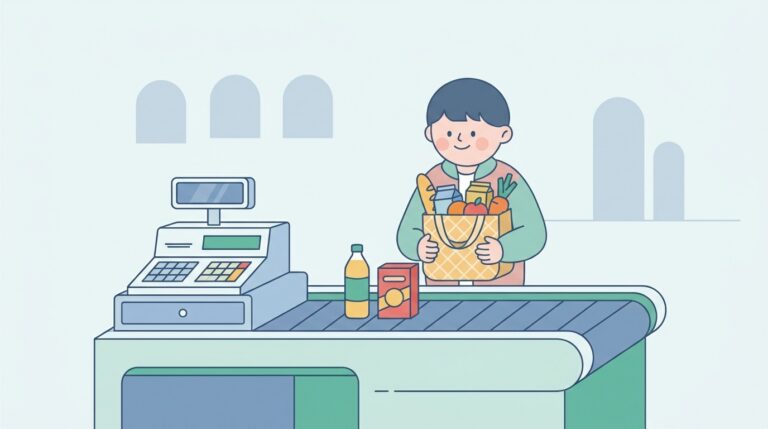
Master Korean Supermarket Checkouts: How to Say “I Brought My Own Bag”
Phase 1: Empathy (Real-Life Daiso & Supermarket Dilemma)
안녕하세요! 매일한글 에디터입니다. (Hello! I’m your editor from Daily Hangul.)
Picture this: You are standing inside a bustling 8-story Daiso in Myeongdong or a massive E-Mart in Seoul on a lively Friday night. Your arms are overflowing with cute Korean stationery, sheet masks, and viral K-drama snacks. The cashier scans your items at lightning speed—beep, beep, beep! Then, without looking up, they ask the inevitable question:
“봉투 필요하세요?” (Bongtu piryohaseyo? – Do you need a bag?)
Your heart skips a beat. You brought your favorite canvas tote bag folded neatly in your coat pocket. But under the pressure of the beeping register and the impatient line behind you, your mind goes completely blank. You end up either nodding nervously and paying extra for a trash bag you can’t use, or waving your hands in panicked silence like you’re fighting an invisible bee.
Don’t worry—you are not alone! Over 80% of beginner Korean learners tell us that grocery checkout counters are their number one source of everyday conversational anxiety. In this practical guide, we will equip you with the single most empowering phrase for Korean shopping: “장바구니 가져왔어요” (I brought my own shopping bag). By mastering this simple, friendly sentence, you’ll save money, protect the planet, and instantly earn warm smiles from local cashiers who appreciate your eco-conscious manners.
Phase 2: Top 3 Core Expressions for Supermarkets & Daiso
1. 장바구니 가져왔어요 (Jang-ba-gu-ni ga-jyeo-wa-sseo-yo)
- Pronunciation: Jang-ba-gu-ni ga-jyeo-wa-sseo-yo (Think of: Jahng-bah-goo-nee gah-juh-wah-ssuh-yo)
- Meaning: Literal: “Market-basket brought” | Real Nuance: “I brought my own reusable eco-bag, so I don’t need to buy one.”
- K-Culture Moment: You’ll see characters in modern slice-of-life K-dramas (like in Weightlifting Fairy Kim Bok-joo or Our Blues) whipping out patterned foldable totes at local grocery stores.
- Editor’s Insight: “장” (Jang) comes from the traditional market (Sijang), and “바구니” (Baguni) means basket. In modern Korea, this compound noun refers to any cloth tote, mesh bag, or eco-bag you bring to carry purchases.
- Situation Spectrum: Casual (⚠️ With close friends only) | Semi-formal 존댓말 (✅ Perfect for cashiers) | Formal (✅)
- 🤔 Think About It: In English, we say “I have a bag” (state of possession), but Korean highlights the dynamic action: “가져왔어요” (I brought it here). Notice how Korean often highlights the action leading up to the present moment!
2. 봉투는 괜찮아요 (Bong-tu-neun gwaen-cha-na-yo)
- Pronunciation: Bong-tu-neun gwaen-cha-na-yo (Think of: Bong-too-neun gwen-chah-nah-yo)
- Meaning: Literal: “As for the bag, it is okay” | Real Nuance: “No bag needed, thank you!”
- K-Culture Moment: Whenever a friendly convenience store clerk reaches for a disposable plastic pouch, a quick smile and this phrase politely stops them before they charge you.
- Editor’s Insight: The word “괜찮아요” (Gwaenchanayo) is the ultimate Swiss Army knife in Korean politeness. Instead of saying a blunt “No” (아니요), Koreans express refusal through soft contentment: “I’m already all good!”
- Situation Spectrum: Casual (⚠️) | Semi-formal (✅ Daily retail default) | Formal (✅)
- 🤔 Think About It: Why do Koreans avoid saying “아니요” (No) in retail? Because smooth harmony and avoiding direct negation keeps interpersonal interactions warm and comfortable.
3. 여기에 담아주세요 (Yeo-gi-e da-ma-ju-se-yo)
- Pronunciation: Yeo-gi-e da-ma-ju-se-yo (Think of: Yuh-ghee-eh dah-mah-joo-seh-yo)
- Meaning: Literal: “Please pack it into here” | Real Nuance: “Could you put the items inside this bag for me, please?”
- K-Culture Moment: Handing your open tote to a sweet Imo-nim (auntie) at a neighborhood mart who packs your groceries with speed and care.
- Editor’s Insight: “담다” means to contain or place inside. Pairing it with “-주세요” (please do for me) transforms it into an affectionate, respectful request.
- Situation Spectrum: Casual (🚫 Too blunt) | Semi-formal (✅ Friendly & clear) | Formal (✅)
- 🤔 Think About It: Adding “-주세요” turns any daily verb into a respectful bridge between strangers.
Phase 3: Textbook Korean vs. Real Korean
Situation A: Declining a plastic bag
- 📖 Textbook Korean: 저는 비닐봉지를 원하지 않습니다. (Jeoneun binilbongjireul wonhaji anseumnida – “I do not desire a vinyl plastic bag.”)
- 🗣️ Real Korean: 봉투 안 주셔도 돼요! (Bongtu an jusyeodo dwaeyo! – “You don’t need to give me a bag!”) or simply 봉투는 괜찮아요! (Bongtuneun gwaenchanayo!)
- 💡 Why the difference? Textbook phrasing sounds like an official legal disclaimer or robot declaration. Real native speakers use soft modal endings like “~안 주셔도 돼요” (you don’t have to give) to keep the rhythm natural.
Situation B: Letting the clerk know you brought a bag
- 📖 Textbook Korean: 저에게는 쇼핑백이 소유되어 있습니다. (Jeoegeneun syopingbaegi soyudoeeo itseumnida – “A shopping bag is possessed by me.”)
- 🗣️ Real Korean: 장바구니 있어요! (Jangbaguni isseoyo! – “I have a shopping bag!”) or 가방에 넣을게요! (Gabange neoheulgeyo! – “I will put it in my bag!”)
- 💡 Why the difference? Native Koreans avoid heavy Sino-Korean possession verbs in everyday errands. Short, active sentences win every time!
Phase 4: K-Culture Deep Dive & Non-Verbal Manners
4-1. 눈치 (Nunchi) & Polite Checkout Gestures
- The Gentle Two-Hand Bag Lift: When saying “장바구니 가져왔어요”, hold your eco-bag with both hands at chest level, showing it gently to the cashier. This non-verbal visual cue saves the cashier from having to repeat their question.
- The Soft Head Tilt: Rather than shaking your head vigorously side-to-side (which can look dismissive in Korean body language), offer a subtle 10-degree head nod while holding up your hand with palm open at waist level.
4-2. Cultural Code: Why Bags Cost Money in Korea
In 2019, South Korea enacted strict nationwide eco-laws banning free single-use plastic bags in large supermarkets and Daiso stores. If you need a bag at a Korean supermarket, you will often be offered a 종량제 봉투 (Jong-ryang-je bong-tu)—a government-standard trash bag that costs around 200 to 500 KRW, designed to be filled with household trash later. Because Koreans are deeply mindful of trash sorting and plastic waste, carrying an eco-friendly tote bag (장바구니) is seen as responsible, stylish, and highly respected.
Phase 5: Real-Life Roleplay Scenario
Setting: Daiso Myeongdong Station Branch checkout counter, 7:30 PM.
Character: Cashier Minji (민지), scanning stationery and snacks with lightning efficiency.
- Turn 1 (Minji): 어서오세요! 바코드 스캔할게요. (Eoseo-oseyo! Bakodeu seukaenhalgeyo. – Welcome! I’ll scan your items.)
🎭 Scanning items briskly, rhythmic beeps filling the air - Turn 2 (You): 안녕하세요! (Annyeonghaseyo! – Hello!)
🎭 Smiling gently and placing items neatly onto the belt - Turn 3 (Minji): 봉투 필요하세요? 백 원이에요. (Bongtu piryohaseyo? Baek-won-ie-yo. – Do you need a bag? It’s 100 won.)
🎭 Pausing hand over the bag dispenser, making quick eye contact - Turn 4 (You): 아, 장바구니 가져왔어요! (A, jangbaguni gajyeowasseoyo! – Ah, I brought my shopping bag!)
🎭 Pulling your canvas tote out with both hands - Turn 5 (Minji): 아, 네! 여기에 담으시면 돼요. (A, ne! Yeogie dameusimyeon dwaeyo. – Ah, great! You can pack them right here.)
🎭 Sliding the scanned items toward your side of the counter - Turn 6 (You): 네, 감사합니다. 영수증은 버려주세요. (Ne, gamsahamnida. Yeongsujeungeun beoryeojuseyo. – Yes, thank you. Please discard the receipt.)
🎭 Packing goods into the bag and handing over your payment card - Turn 7 (Minji): 네, 결제 완료되었습니다. 안녕히 가세요! (Ne, gyeolje wanryo-doeeotseumnida. Annyeonghi gaseyo! – Yes, payment is complete. Have a wonderful day!)
🎭 Handing back the card with two hands and a warm nod - Turn 8 (You): 감사합니다! 수고하세요. (Gamsahamnida! Sugohaseyo. – Thank you! Keep up the good work.)
🎭 Giving a polite 15-degree bow as you pick up your tote
🔀 Interactive Choice Point
The cashier asks: “봉투 필요하세요?” (Do you need a bag?) How do you respond?
* Choice A: “장바구니 가져왔어요!” (Jangbaguni gajyeowasseoyo!)
* 👉 Feedback: [BEST] 100% natural, polite, and clarifies that you don’t need to purchase any bag.
* Choice B: “아니요, 싫어요!” (Aniyo, sireoyo!)
* 👉 Feedback: [BAD] “싫어요” means “I hate it!” or “I dislike it!” This sounds overly aggressive and rude to retail staff.
* Choice C: “가방… 가방…” while fumbling silently in your coat pocket.
* 👉 Feedback: [RISK] The cashier might assume you don’t understand and immediately scan a paid bag to keep the fast-moving line moving.
Phase 6: 10-Second Emotion Shadowing Drill
Practice these aloud! Notice the slash marks (/) for natural rhythm pauses:
[😊 Cheerful & Proactive]
장바구니 / 가져왔어요!
(Jang-ba-gu-ni / ga-jyeo-wa-sseo-yo!)
Pitch rises gently on “장바구니”, then settles comfortably on “가져왔어요”.-
[😌 Calm & Courteous]
봉투는 / 괜찮아요.
(Bong-tu-neun / gwaen-cha-na-yo.)
Smooth, relaxed intonation that signals polite gratitude. -
[✨ Bright & Friendly]
여기에 / 담아주세요!
(Yeo-gi-e / da-ma-ju-se-yo!)
Crisp and upbeat, inviting friendly teamwork with the store clerk.
Phase 7: K-Culture Mini Dictionary
- 장바구니 (Jang-ba-gu-ni) | Reusable shopping tote / grocery bag | The essential term for sustainable shopping in Korea. Used everywhere from corner marts to mega malls.
- 종량제 봉투 (Jong-ryang-je bong-tu) | Standard government waste disposal plastic bag | The official prepaid trash bags sold at grocery checkout counters that double as shopping bags.
- 비닐봉투 (Bi-nil-bong-tu) | Disposable vinyl plastic bag | The conventional thin plastic bag. Mostly phased out or charged at 50–100 KRW.
- 영수증 (Yeong-su-jeung) | Receipt | Often asked as “영수증 드릴까요?” (Shall I give you the receipt?). You can reply with “버려주세요” (Please throw it away).
Phase 8: Traveler’s Survival Kit
Top 3 Survival Expressions for Quick Errands
- “봉투 필요 없어요.” (Bongtu piryo eopseoyo.)
Translation: I don’t need a bag.
Pro Tip: Use this at convenience stores when grabbing a single bottle of iced tea or milk. - “그냥 가져갈게요.” (Geunyang gajyeogalgeyo.)
Translation: I will just carry it as is.
Pro Tip: Great when your hands or pockets are already big enough to hold the item. - “테이프 붙여주세요.” (Te-i-peu bu-chyeo-ju-se-yo.)
Translation: Please put tape on it.
Pro Tip: If you carry an unbagged item out of a Korean mart, the cashier will place a small colored tape over the barcode to prove you have paid for it!
Editor’s Travel Note
- Navigation Guide: When exploring Korea’s iconic discount shopping spots, use the Naver Map app download for iOS and Android to search for multi-story flagship branches, such as Daiso Myeongdong Station (12 floors!).
- Checkout Tip: Most modern Daiso branches feature self-checkout kiosks (셀프 계산대) with English language support. When the screen prompts “봉투를 구매하시겠습니까?” (Would you like to purchase a bag?), simply press “구매 안 함” (No Purchase) on screen!
Phase 9: One Step Deeper (Reflective Thought)
In Korean culture, the phrase 장바구니 가져왔어요 carries more than just words—it reflects a collective commitment to civic mindfulness. Following Korea’s rapid economic modernization, the country transformed into one of the world’s most disciplined recycling societies through the Jongnyangje system. When you tell a cashier that you brought your own bag, you aren’t merely saving a 100-won coin; you are stepping into the rhythm of local daily consideration, showing respect for neighborhood cleanliness and shared public space.
💬 Your Turn: In your home country, do supermarkets charge fees for plastic bags, or is bringing your own eco-bag second nature? Share your local shopping habits or funniest Korean checkout memory in the comments below!
Phase 10: FAQ & Avoiding Misunderstandings
Q: Can I say “장바구니 가져왔어요” if I’m just holding a regular backpack or purse?
A: Yes, absolutely! While “장바구니” specifically denotes a grocery tote, cashiers immediately understand that you intend to put your purchased items into whatever bag you are carrying.
Q: What if the cashier already charged me 100 KRW for a bag before I could speak?
A: No stress at all! Just gently present your tote and say: “봉투 취소해 주세요” (Bongtu chwisohae juseyo – Please cancel the bag). Cashiers can void the bag with one quick tap on their screen.
Q: Why did the mart cashier give me a thick white or blue bag printed with local ward names?
A: You received a 종량제 봉투 (pay-as-you-throw government garbage bag)! Korean marts sell these as shopping carriers so you can reuse them at your Airbnb or hotel for general household trash.
🚨 Common Mistakes Warning Board
- ❌ Mistake 1: Shouting “싫어요!” (Sireoyo! – I hate it!) when offered a bag.
👉 Correct Action: Say “괜찮아요” (Gwaenchanayo) with a light head nod. - ❌ Mistake 2: Pronouncing “Shopping Bag” with a heavy English accent (쇼핑백).
👉 Correct Action: Say “가방 있어요” (Gabang isseoyo – I have a bag) or “장바구니 가져왔어요”. - ❌ Mistake 3: Putting your hands deep inside your shopping tote while blocking the scanner.
👉 Correct Action: Set the bag flat on the packing ledge next to the register so the cashier can slide items toward you safely.
Phase 11: Action Missions & Community Challenge
- 🥉 Bronze Mission (Solo Practice): Stand before a mirror with your favorite backpack or canvas bag and say “장바구니 가져왔어요!” three times with a bright, confident smile.
- 🥈 Silver Mission (Social Sharing): Snap a quick photo of your everyday carry bag and share it on Instagram or X with the caption: “오늘 장바구니 가져왔어요! Ready to explore Korean marts with #DailyHangul”.
- 🥇 Gold Mission (Real-World Triumph): Visit a local Korean mart, Daiso, or convenience store. Confidently decline the plastic bag using today’s target phrases and pack your goods like a true local!
- 🎮 K-Culture Bonus Mission: In your next K-drama or Korean vlog binge, spot any scene where characters return home from the grocery store. Notice what kind of bags they are carrying!
Phase 12: Interactive Quiz Challenge
Question 1: Situation Judgment
You are standing at an E-Mart checkout. The clerk finishes scanning your snacks and asks: “봉투 담아드릴까요?” You already have your canvas bag ready. What is the best phrase to say?
* A) 비닐봉지 싫습니다!
* B) 장바구니 가져왔어요!
* C) 영수증 주세요!
Question 2: Fill-in-the-Blank
When declining a bag politely without saying “No”, fill in the blank:
* “봉투는 ______________.”
Question 3: True or False (Culture Check)
True or False: In major Korean hypermarkets and Daiso branches, disposable plastic bags are provided for free as long as you spend more than 30,000 KRW.
👉 Click here to reveal Answers & Explanations!
- Q1 Answer: B) 장바구니 가져왔어요!
Explanation: Option A is overly aggressive and awkward. Option C asks for the receipt. Option B is polite, natural, and directly communicates that you have your own bag. - Q2 Answer: 괜찮아요 (gwaen-cha-na-yo)
Explanation: “봉투는 괜찮아요” translates naturally to “No bag needed, I’m okay!” - Q3 Answer: False
Explanation: Under South Korean environmental regulations, large supermarkets and discount stores are strictly prohibited from distributing free single-use plastic bags regardless of purchase amount!







