

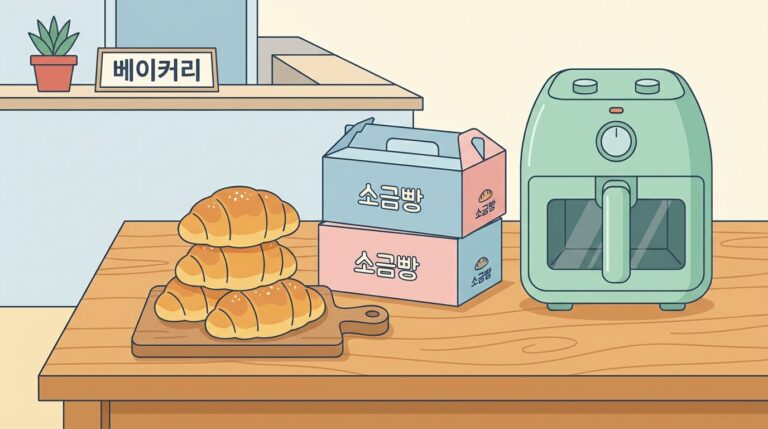
Mastering Korean Bakery Leftovers: How to Toast Like a Seoul Local
Phase 1: Empathy (Story Opening)
안녕하세요! 매일한글 에디터입니다. (Hello! I am your Daily Hangul editor.)
Picture this: You are walking down the cobblestone alleys of Yeonnam-dong in Seoul. The sweet, buttery aroma of roasted yeast pulls you inside an aesthetic neighborhood bakery. The display counter looks like a set piece from a cozy K-drama—golden salt bread (소금빵), towering garlic cream cheese buns, and delicate pastries dusted with sugar. Intoxicated by the scent, you load up your wicker tray with four different baked treats, forgetting that you are just one person on an afternoon coffee run.
At the register, the barista rings up your order, carefully boxing your uneaten treats. As they hand over the cute paper bag with two hands, they smile warmly and say something ending in: “…남은 빵은 집에서 에어프라이어에 살짝 구워 드세요!”
You catch the loanword “air fryer,” but the rest flies right past you. You nod, bow awkwardly, and wonder: Did they give me baking instructions, an expiration warning, or a secret recipe?
Many of our beginner learners tell us that bakery interactions in Korea feel intimidating once the conversation moves past “아메리카노 한 잔이요” (One Americano, please). Getting authentic tips on enjoying your food at home is one of the most rewarding milestones in everyday Korean. In this guide, you will master the exact vocabulary and cultural etiquette needed to handle leftover pastries like a seasoned Seoulite—ensuring your treats stay wonderfully crispy, never soggy!
Phase 2: Top 3 Core Expressions (Deep Dive)
1. 남은 빵은 집에서 에어프라이어에 살짝 구워 드세요. (Nameun ppang-eun jib-eseo eeo-peura-ieo-e saljjak guwo deuseyo.)
- Pronunciation: [Nameun ppang-eun jib-eseo eeo-peura-ieo-e saljjak guwo deuseyo] (Say it like: Nah-meun ppahng-eun jeeb-eh-saw air-fryer-eh sahl-jjak goo-waw deu-seh-yo. Notice how saljjak sounds snappy, like a gentle tap on a counter!)
- Meaning: Literal: “As for leftover bread, at home in an air fryer slightly roast and eat.” / Natural: “Please lightly toast any leftover bread in your air fryer at home.”
- K-Culture Moment: In slice-of-life K-dramas, neighborhood bakers often slip this parting advice to customers as a sign of warm hospitality.
- Editor’s Insight: The star of this phrase is the adverb 살짝 (saljjak), which means “lightly,” “just a little,” or “briefly.” It prevents you from burning the butter-rich bread! Meanwhile, -세요 (-seyo) softens the instruction into a gentle, polite recommendation.
- Situation Spectrum: Casual ⚠️ | Semi-formal ✅ | Formal ✅
- 🤔 Think About It: In English, we might just say “Reheat before eating.” Why do Korean bakery staff frequently name the specific kitchen appliance (air fryer) instead of a general microwave?
2. 남은 거 포장해 주세요. (Nameun geo pojanghae juseyo.)
- Pronunciation: [Nameun geo pojanghae juseyo] (Say it like: Nah-meun gaw poh-jahng-hae joo-seh-yo.)
- Meaning: Literal: “Leftover thing, please pack.” / Natural: “Could you please pack up what is left?”
- K-Culture Moment: After chatting for hours over desserts at a trendy Seongsu cafe, characters gather their half-eaten pastries to take home in a cute branded paper box.
- Editor’s Insight: 포장 (pojang) means packaging, wrapping, or bagging for takeout. Combining it with -해 주세요 (-hae juseyo) creates an effortless, polite request suitable for all cafes and restaurants.
- Situation Spectrum: Casual ⚠️ | Semi-formal ✅ | Formal ✅
- 🤔 Think About It: Western cafes often hand you an empty carton so you can pack your own leftovers at the table. In Korea, staff almost always take your plate and package it neatly behind the counter. What does this reveal about customer care in Korea?
3. 겉은 바삭하고 속은 촉촉해요. (Geot-eun basakhago sok-eun chokchokhaeyo.)
- Pronunciation: [Geoteun basak-hago sogeun chokchok-haeyo] (Say it like: Gawt-eun bah-sahk-hah-goh sok-eun chohk-chohk-hae-yo.)
- Meaning: Literal: “The outside is crunchy and the inside is moist.” / Natural: “It’s crispy on the outside and moist on the inside!”
- K-Culture Moment: Every Korean variety show host and YouTube foodie exclaims this phrase whenever they take a bite of fresh pastry or fried chicken.
- Editor’s Insight: This sentence is the parent of Korea’s most iconic food slang: 겉바속촉 (Geot-ba-sok-chok). Use this when the staff asks how your pastry tastes, and you will instantly earn genuine smiles!
- Situation Spectrum: Casual ✅ | Semi-formal ✅ | Formal ✅
- 🤔 Think About It: Korean cuisine relies heavily on mimetic words describing delicate textures. How does your native language express the balance between crunchy and soft?
Phase 3: Textbook Korean vs. Real-Life Korean
Situation 1: Asking if you can reheat the pastry tomorrow
- 📖 Textbook Korean: 이 빵을 내일 다시 데워도 됩니까? (I ppang-eul naeil dasi dewodo doebnikka? – May I reheat this bread again tomorrow?)
- 🗣️ Real-Life Korean: 이거 내일 에어프라이어에 돌려도 돼요? (Igeo naeil eeo-peura-ieo-e dollyeodo dwaeyo? – Can I just pop this in the air fryer tomorrow?)
- 💡 Why is it different? The verb 돌리다 (dollyeoda) literally means “to spin” or “to run a machine.” In spoken Korean, locals almost never use the rigid book verb “데우다” for electric appliances; they say “에어프라이어에 돌리다” (spin it in the air fryer) or “전자레인지에 돌리다” (microwave it).
Situation 2: Asking the cashier to pack your uneaten cake
- 📖 Textbook Korean: 남은 케이크를 담아갈 상자를 주십시오. (Nameun keikeureul damagal sangjareul jusipsio. – Please grant me a box to carry away the remaining cake.)
- 🗣️ Real-Life Korean: 이거 남은 것 좀 포장해 주실 수 있으세요? (Igeo nameun geot jom pojanghae jusil su isseuseyo? – Could you wrap up these leftovers for me, please?)
- 💡 Why is it different? Directly asking for an empty box sounds transactional and blunt. Adding 좀 (jom – a little) and using the soft inquiry -주실 수 있으세요? matches the polite social flow of modern Korean service culture.
Phase 4: K-Culture Deep Dive & Non-Verbal Manners
4-1. Nunchi (눈치) & Body Language at the Bakery Counter
When handing over your pastry tray to the cashier, always support the rim with both hands or hold your right wrist with your left hand—a subtle gesture of respect.
If the clerk begins explaining how to store or reheat your bread (“에어프라이어에…”), maintain gentle eye contact and give a slight vertical nod (끄덕임). Saying a small “아, 네~!” (Ah, yes!) shows active listening. When they pass you your boxed pastry, take the bag with two hands, give a 15-degree bow, and say: “감사합니다, 맛있게 먹을게요!” (Gamsahamnida, mas-itge meogeulgeyo! – Thank you, I will enjoy eating this!).
4-2. The Korean “Air Fryer Revolution” & Bakery Pilgrimages
In Korea, going on a 빵지순례 (Ppang-ji-sun-rye – Bakery Pilgrimage) is a massive weekend lifestyle trend. Foodies travel across provinces just to buy sourdough, salted rolls, and cream pastries.
Because Korean apartments are notoriously compact, traditional ovens are rare. Instead, virtually every Korean household owns a high-tech air fryer. To Koreans, soggy leftover bread heated in a microwave is a culinary sin! Bakers actively instruct buyers to use air fryers at 160°C to 180°C for 3 minutes to revive the original crispy crust. When a Korean bakery owner gives you this advice, they are welcoming you into an unspoken culinary ritual.
Phase 5: Real-World Roleplay Scenario
- Setting: “Bake & Butter (베이크앤버터)”, a minimalist bakery cafe in Yeonnam-dong filled with the scent of butter.
- Characters: You (Min-woo, a hungry customer) and Yujin (the warm store manager).
— Dialogue Start —
Turn 1: Min-woo
저기요, 빵이 좀 남았는데 남은 거 포장해 주세요.
(Jeogiyo, ppang-i jom nam-anneunde nameun geo pojanghae juseyo.)
Excuse me, we have some bread left; could you please pack it up for us?
🎭 Holding up the tray gently with both hands at the counter.
Turn 2: Yujin
네, 손님! 예쁘게 담아 드릴게요. 잠시만 기다려 주세요.
(Ne, sonnim! Yeppeuge dama deurilgeyo. Jamsiman gidaryeo juseyo.)
Of course! I will pack it up nicely for you. Please wait just a moment.
🎭 Taking the tray with a courteous two-handed grip.
Turn 3: Min-woo
감사합니다! 혹시 이 소금빵은 내일 먹어도 괜찮아요?
(Gamsahamnida! Hoksi i sogeumppang-eun naeil meogeodo gwaenchannayo?)
Thank you! By any chance, is it okay to eat this salt bread tomorrow?
🎭 Tilting head slightly with an inquisitive, friendly smile.
Turn 4: Yujin
그럼요! 오늘 다 못 드시면 밀봉해서 실온에 두시고요.
(Geureomyo! Oneul da mot deusimyeon milbonghaeseo sil-on-e dusigoyo.)
Certainly! If you can’t finish it today, seal it and keep it at room temperature.
🎭 Tying the pastry bag with a branded sticker.
Turn 5: Yujin
남은 빵은 집에서 에어프라이어에 살짝 구워 드세요. 겉바속촉으로 진짜 맛있어져요!
(Nameun ppang-eun jib-eseo eeo-peura-ieo-e saljjak guwo deuseyo. Geot-ba-sok-chok-euro jinjja mas-isseojyeoyo!)
Lightly toast the leftover bread in an air fryer at home. It becomes truly delicious and crispy on the outside, moist on the inside!
🎭 Leaning forward slightly, sharing a genuine insider tip.
Turn 6: Min-woo
우와, 에어프라이어에 몇 분 정도 돌리면 돼요?
(Uwa, eeo-peura-ieo-e myeot bun jeongdo dollyeomyeon dwaeyo?)
Wow, about how many minutes should I run it in the air fryer?
🎭 Widening eyes with interest and appreciation.
Turn 7: Yujin
백팔십 도에서 삼 분 정도만 살짝 돌리시면 딱 좋아요!
(Baek-pal-sip do-eseo sam bun jeongdoman saljjak dollisimyeon ttak joayo!)
At 180 degrees, just run it for about 3 minutes and it’s perfect!
🎭 Handing over the handle of the take-away paper bag with both hands.
Turn 8: Min-woo
꿀팁 감사합니다! 내일 아침에 그렇게 구워 먹을게요.
(Kkool-tip gamsahamnida! Naeil achim-e geureohge guwo meogeulgeyo.)
Thank you for the pro-tip! I will toast it like that tomorrow morning.
🎭 Receiving the bag with both hands while bowing slightly.
— Dialogue End —
🔀 Interactive Decision Point!
Yujin just handed you the packaged bread and shared her reheating tip. How do you respond?
- Option A: “전자레인지에 오래 돌려도 되죠?” (Can I just microwave it for a long time instead?)
- Feedback: [Risk! ⚠️] While understandable, telling a passionate Korean baker you plan to blast delicate salt bread in a microwave will break their heart! Microwaves make crispy bread rubbery. Stick to the air fryer tip.
- Option B: “알려주셔서 감사해요! 집에서 살짝 구워 먹어 볼게요.” (Thank you for letting me know! I will try lightly toasting it at home.)
- Feedback: [Best! 🌟] Outstanding response! You used the key grammar vocabulary correctly, showed appreciation for her advice, and proved your A2 fluency.
- Option C: “그냥 버려 주세요.” (Please just throw it away.)
- Feedback: [Bad! ❌] Asking to package leftovers and then abruptly telling them to toss it is socially awkward and contradicts what you requested in Turn 1!
Phase 6: 10-Second Emotional Shadowing Drill
Read these aloud while matching the emotional cue and natural pauses marked by /:
[😊 감사의 마음을 담아 - Bright and Grateful]
저기요, / 빵이 좀 남았는데 / 포장해 주실 수 있나요?
(Jeogiyo, / ppang-i jom nam-anneunde / pojanghae jusil su 있nayo?)-
[💡 꿀팁을 전수하듯 - Confident Pro-Tip Sharing]
남은 빵은 / 집에서 / 에어프라이어에 / 살짝 구워 드세요!
(Nameun ppang-eun / jib-eseo / eeo-peura-ieo-e / saljjak guwo deuseyo!) -
[😋 기대감 가득 찬 목소리로 - Anticipating Great Food]
우와, / 겉은 바삭하고 / 속은 진짜 촉촉해요!
(Uwa, / geot-eun basakhago / sok-eun jinjja chokchokhaeyo!)
Phase 7: K-Culture Mini Dictionary
-
겉바속촉 (Geot-ba-sok-chok)
Meaning: Crispy on the outside, soft and chewy on the inside.
Usage: The ultimate food compliment in Korea. Works for roasted bread, Korean fried chicken, and grilled pork belly. -
빵지순례 (Ppang-ji-sun-rye)
Meaning: Bread Pilgrimage (A compound of 빵 [bread] + 성지순례 [religious pilgrimage]).
Usage: Used by food lovers who plan travel itineraries centered around touring famous artisanal bakeries throughout Korea. -
포장 (Pojang)
Meaning: Packaging / Takeout / Doggy-bagging.
Usage: Essential in any food service interaction. Say “포장해 주세요” for take-out boxes, or “포장 되나요?” to ask if takeout is supported. -
살짝 (Saljjak)
Meaning: Lightly, gently, just for a moment.
Usage: Very versatile! In cooking, it means “sear lightly” or “blanch briefly.” In daily conversation, it can mean doing something casually without making a big deal.
Phase 8: Survival Kit for Travelers
Top 3 Survival Phrases
- 남은 거 싸 주실 수 있나요? (Nameun geo ssa jusil su 있nayo?)
Can you wrap up what’s left?
Pro Tip: “싸다 (ssada)” is an informal synonym for “포장하다 (pojanghada)”. Very natural! - 에어프라이어에 몇 도에 돌려요? (Eeo-peura-ieo-e myeot do-e dollyeoyo?)
At what temperature should I run it in the air fryer? - 포장비 따로 있나요? (Pojangbi ttaro 있nayo?)
Is there an extra charge for takeout packaging?
Pro Tip: Some dessert spots charge ₩300 to ₩1,000 for intricate cake gift boxes.
Editor’s Travel Note
When hunting down famous bakeries in neighborhoods like Mangwon, Seongsu, or Euljiro, Google Maps often lacks real-time updates. Check out our essential Naver Map navigation guide to search “베이커리 카페” (bakery cafe) and verify opening times and restock hours. Also keep in mind that most cafes in Seoul are strictly card-only (or Apple Pay/T-Money card supported).
Phase 9: A Step Deeper (Reflective Essay)
In many fast-paced urban cultures, customer service ends the second payment clears. But in Korea, the cultural concept of 정 (Jeong – deep social affection and care) frequently extends past the counter. When a bakery employee tells you to toast the bread lightly in an air fryer, they aren’t reading a corporate script; they genuinely care that the food they baked maintains its peak flavor when you eat it alone in your apartment the next morning. Food in Korea is not just fuel—it is a communal expression of care.
💬 Your Turn: Have you ever received thoughtful food storage advice from a local store owner while traveling? How does your home culture handle leftover restaurant food? Share your stories in the comments below!
Phase 10: FAQ & Common Mistakes
Q: Can I use this phrase for cake or cream buns as well?
A: No! The phrase “에어프라이어에 살짝 구워 드세요” is specifically intended for crusty, buttery breads (such as salt bread, croissants, baguettes, or scones). Cream-filled buns (크림빵) and fresh cakes should be refrigerated (“냉장 보관해 주세요” – Please keep refrigerated) and eaten cold!
Q: What is the difference between “구워 드세요” and “드세요”?
A: “드세요” simply means “please eat” (honorific form of 먹다). “구워 드세요” combines the verb 굽다 (to toast/bake/grill) with 드세요, meaning “toast it and then eat it.” It specifies the method of preparation prior to consumption.
Q: Can I say “전자레인지” (jeon-ja-rein-ji) instead of “에어프라이어”?
A: Absolutely! If you do not own an air fryer, you can ask: “전자레인지에 돌려도 돼요?” (Can I run this in the microwave?) The staff will gladly advise you on the timing (usually 15-20 seconds max).
🚨 Common Mistakes Alert
- Mistake: Saying “남은 빵 요리해 주세요” (Please cook the leftover bread).
- Correct Action: Say “포장해 주세요” (Please pack it). Bakeries do not recook leftovers for you on site.
- Mistake: Confusing 살짝 (saljjak – lightly) with 빨리 (ppalli – quickly).
- Correct Action: Use “살짝” to describe gentle heat or subtle actions. “빨리 구워 드세요” sounds like an urgent command to rush your meal!
- Mistake: Asking for a “도기 백” (doggy bag).
- Correct Action: Most Korean staff will not understand “doggy bag.” Always use the standard word 포장 (pojang).
Phase 11: Action Mission & Engagement
- 🥉 Bronze Mission (Solo Practice): Stand in front of your mirror and practice repeating: “남은 빵은 에어프라이어에 살짝 구워 드세요” 3 times with a friendly shopkeeper smile.
- 🥈 Silver Mission (Social Share): The next time you reheat a pastry, snap a photo and post it on your Instagram Story with the caption: “오늘 아침은 겉바속촉! 🥐✨” and tag @DailyHangul.
- 🥇 Gold Mission (Real Life Application): Visit any Korean bakery or local cafe. If you cannot finish your treat, confidently walk up to the counter and say: “저기요, 남은 거 포장해 주세요!”
🎮 K-Culture Mission: Watch an episode of a food-centric K-drama or a bakery tour vlog on YouTube. Listen closely for the word 겉바속촉 or 돌리다 when food is being reheated!
Phase 12: Interactive Quiz Challenge
Test what you learned today! Click to reveal the answers.
Question 1 (Situational Judgement)
You bought two salt rolls (소금빵) at a bakery in Ikseon-dong. You want to ask the clerk if you can warm it up tomorrow using your home air fryer. Which sentence is the most natural?
* (A) 내일 에어프라이어에 돌려도 돼요?
* (B) 내일 빵을 불태워 주세요.
* (C) 빵을 에어프라이어에 먹으세요.
🔍 Click to reveal the answer for Question 1
Correct Answer: (A)
Explanation: (A) uses the natural conversational verb “돌리다” (to run/spin an appliance) with the polite permission ending “-도 돼요?”. Option (B) means “Please burn the bread tomorrow,” and (C) is grammatically incorrect nonsense.
Question 2 (Fill in the Blank)
Complete the phrase meaning “Crispy on the outside, moist on the inside”:
겉은 ________하고 속은 촉촉해요.
🔍 Click to reveal the answer for Question 2
Correct Answer: 바삭 (basak)
Explanation: “바삭하다” means to be crunchy or crispy. Combined with “속은 촉촉해요” (the inside is moist), it creates the beloved expression “겉바속촉”!
Question 3 (True or False Cultural Quiz)
In Korea, it is considered rude to ask cafe staff to package uneaten pastries to take home.
* [True / False]
🔍 Click to reveal the answer for Question 3
Correct Answer: False!
Explanation: It is completely normal and welcomed! Korean bakeries and dessert cafes take pride in their custom packaging. Simply bring your tray to the counter and say, “남은 거 포장해 주세요.”







