

Phase 1: Empathy (Story-Immersive Opening)
안녕하세요! 매일한글 에디터입니다. (Hello! I’m your Daily Hangul editor.)
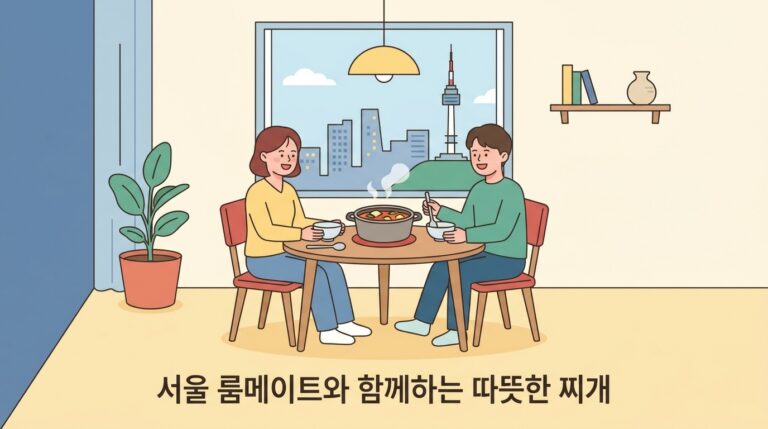
Imagine this: It is 10:30 PM in Seoul. You return to your shared flat after a grueling day of Korean language classes or university lectures. Your shoes slip off at the front door, and your shoulders drop with fatigue. If you lived alone in a tiny, claustrophobic studio (oneroom), the silence greeting you could feel deafening. But here, the aroma of bubbling kimchi-jjigae drifts from the kitchen. Your housemate looks up, flashes a tired yet warm smile, and says, “밥 먹었어요? (Bap meogeosseoyo? / Have you eaten?)”
Finding a compatible housemate in Korea—and navigating shared living expenses—can feel intimidating. Many of our international learners share their initial anxieties: What if our lifestyle rhythms clash? How do I split utility bills without awkwardness? Will I just feel like an intruder in someone else’s space?
Yet, when you find that person whose energy aligns with yours, the entire experience of living in Korea transforms. The cold, anonymous city suddenly feels like home. This guide is crafted directly from real-life experiences and student feedback to help you articulate gratitude, connect authentically, and establish transparent financial harmony with your Korean housemate at a solid B1 level.
Phase 2: 3 Core Expressions Deep-Dive
1. 마음이 잘 맞아요 (Maeumi jal majayo)
- Pronunciation: [Mae-um-i jal ma-ja-yo] (Sounds like: May-oom-ee jahl mah-jah-yo)
- Meaning: Literally “Our minds/hearts fit well.” In natural English: “We click so well” or “We’re on the same wavelength.”
- K-Culture Moment: Seen frequently in slice-of-life K-dramas like Hello, My Twenties! (청춘시대) when housemates suddenly realize their quiet habits and values align harmoniously.
- Editor’s Insight: While 성격이 맞다 (seong-gyeogi matda) refers to matching personality traits logically, 마음이 맞다 touches on emotional resonance, mutual consideration, and shared intuition.
- Situation Spectrum: Casual: ✅ | Semi-formal: ✅ | Formal: ⚠️
- 🤔 Think About It: In English, we say we “click” (a mechanical metaphor). Korean uses 마음 (heart/mind fitting). What does that reveal about relational harmony in Korean culture?
2. 든든해요 (Deundeunhaeyo)
- Pronunciation: [Deun-deun-hae-yo] (Sounds like: Duhn-duhn-hay-yo)
- Meaning: Literally “Feeling stout/solid/full.” In natural English: “I feel safe and supported” or “It gives me great reassurance.”
- K-Culture Moment: When a housemate leaves cold medicine and a warm sports drink on your desk when you catch a winter flu.
- Editor’s Insight: This word captures a unique emotional belly-warmth. It means you don’t feel vulnerable in a foreign country because someone has your back.
- Situation Spectrum: Casual: ✅ | Semi-formal: ✅ | Formal: ✅
- 🤔 Think About It: Is there a single word in your native language that blends physical security, emotional comfort, and quiet companionship as deundeunhada does?
3. 덕분에 (Deok-bun-e)
- Pronunciation: [Deok-bun-e] (Sounds like: Duhk-boon-ay)
- Meaning: Literally “Thanks to [someone/something].”
- K-Culture Moment: Saying this when settling monthly expenses without any friction: “룸메 덕분에 이번 달도 알뜰하게 살았네! (Rumme deokbune ibeon daldo alteulhage saratne! / Thanks to my roomie, we lived frugally this month too!)”
- Editor’s Insight: Korean has two causal connectors for “because of”: 덕분에 (positive credit) and 탓에 (tase, negative blame). Using 덕분에 instantly elevates interpersonal rapport and acknowledges the other person’s positive influence.
- Situation Spectrum: Casual: ✅ | Semi-formal: ✅ | Formal: ✅
- 🤔 Think About It: How often do we consciously credit our flatmates for small daily peace, and how does phrasing impact long-term co-living relationships?
Phase 3: Textbook Korean vs. Real Korean
Situation 1: Proposing to split shared bills
- 📖 교과서 한국어 (Textbook): “우리 생활비를 똑같이 나눕시다.” (Uri saenghwalbireul ttokgachi nanupsida. / Let us divide the living expenses equally.)
- 🗣️ 진짜 한국어 (Real-Life): “이번 달 공과금 엔분의 일(1/N)로 정산할까요?” (Ibeon dal gonggwageum en-bun-ui il-ro jeongsan-halkkayo? / Shall we split this month’s utilities 1/N?)
- 💡 왜 다를까? (Why the difference?): Native speakers rarely say “똑같이 나눕시다” in modern daily life. Instead, they use the colloquial mathematical term “엔분의 일 (1/N)” alongside “정산하다 (to settle/tally up expenses).”
Situation 2: Expressing comfort and lack of homesickness
- 📖 교과서 한국어 (Textbook): “당신과 함께 있어서 외로움을 느끼지 않습니다.” (Dangsingwa hamkke isseoseo oeroumeul neukkiji anseumnida. / Because I am with you, I do not experience loneliness.)
- 🗣️ 진짜 한국어 (Real-Life): “하메를 잘 만나서 타지 생활이 진짜 든든해요.” (Hamereul jal mannaseo taji saenghwari jinjja deundeunhaeyo. / Thanks to meeting such a great housemate, living away from home feels so reassuring.)
- 💡 왜 다를까? (Why the difference?): Natural Korean avoids the pronoun “당신 (you)” in daily conversation, as it sounds bookish or overly dramatic. Using clipped terms like 하메 (hame, short for housemate) and conversational conjunctions creates immediate warmth.
Phase 4: K-Culture Deep Dive & Non-Verbal Manners
4-1. Nunchi (눈치) & Flat-Sharing Gestures
Living harmoniously under one roof in Korea hinges on unspoken spatial awareness.
* Slippers Culture (실내화 매너): Footsteps carry easily through traditional Korean ondol floor-heating structures. Wearing indoor padded slippers shows instant nunchi for your housemate’s peace.
* Fridge Partitioning: Use colorful post-it notes with polite phrasing rather than blunt name tags. Instead of “Don’t touch,” write: “함께 먹어요! (Hamkke meogeoyo! / Let’s share this!)” or “제 우유예요~ (Je uyuyeyo~ / This is my milk~)” with a small smiley face.
* Digital Transfer Manners: When sending your share of rent or utilities via KakaoPay or Toss, always accompany the payment with a supportive sticker or a brief note like “항상 고마워요 (Hangsang gomawoyo / Thank you always).”
4-2. Culture Code: “야식 (Late-Night Snack) Diplomacy”
In Korea, true housemate bonding rarely happens through formal house meetings. It happens organically around 11 PM over delivery chimaek (chicken and beer) or a pot of ramyeon on the living room low table. When your housemate asks, “라면 하나 끓여 먹을 건데, 한 젓가락 할래? (Ramyeon hana kkeullyeo meogeul geonde, han jeotgarak hallae? / I’m making ramyeon, want a bite?)”, this isn’t just about carbs—it’s an invitation to decompress and bridge cultural gaps.
Phase 5: Real-Life Roleplay Scenario
Setting: A cozy two-room flat near Hongdae. Yujin (a 24-year-old Korean graphic designer) and Alex (an exchange student) are sitting cross-legged by a low wooden coffee table on a Sunday evening, checking their utility bills on their smartphones.
- Turn 1 (Yujin):
🎭 Checking her gas app screen with a relieved smile
“알렉스! 이번 달 도시가스 요금 나왔는데, 생각보다 적게 나왔어요.”
(Alex! Ibeon dal dosigaseu yogeum nawanneunde, saenggakboda jeokge nawasseoyo. / Alex! This month’s gas bill arrived, and it’s much lower than expected.) -
Turn 2 (Alex):
🎭 Looking over curiously while sipping barley tea
“진짜요? 날씨가 추워서 난방 많이 튼 줄 알았는데 다행이네요.”
(Jinjja-yo? Nalssiga chuwoseo nanbang mani teun jul aranneunde dahaeng-ineyo. / Really? The weather was freezing so I thought we ran the heating a lot, what a relief.) -
Turn 3 (Yujin):
🎭 Tapping on KakaoPay
“우리 둘 다 전기 절약 잘해서 그런가 봐요. 총 4만 원 나왔으니까 2만 원씩 엔분의 일 하면 될 것 같아요!”
(Uri dul da jeonggi jeoryak jalhaeseo geureonga bwayo. Chong saman won nawasseunikka iman wonssik en-bun-ui il hamyeon doel geot gatayo! / Probably because we both conserved energy well. It’s 40,000 KRW total, so splitting 1/N makes it 20,000 KRW each!) -
Turn 4 (Alex):
🎭 Sending money on phone with a bright smile
“지금 바로 카카오페이로 보냈어요! 유진 씨 덕분에 항상 정산이 깔끔해서 좋아요.”
(Jigeum baro kakaope-iro bonaesseoyo! Yujin ssi deokbune hangsang jeongsani kkalkkeumhaeseo joayo. / I just sent it via KakaoPay! Thanks to you, settling our expenses is always so smooth.) -
Turn 5 (Yujin):
🎭 Pocketing her phone, looking touched
“에이, 알렉스가 칼송금 해주는 덕분이죠. 솔직히 처음에 하우스메이트 구할 때는 걱정 많았거든요.”
(Ei, Alex-ga kalsonggeum haejuneun deokbunijyo. Soljiki cheoeume hauseumeiteu guhal ttaeneun geokjeong manatgeodeunyo. / Oh, it’s thanks to your lightning-fast transfers. Honestly, I worried a lot when first looking for a housemate.) -
Turn 6 (Alex):
🎭 Nodding empathetically, leaning forward
“저도요. 그런데 유진 씨랑 생활 패턴도 비슷하고 마음이 잘 맞아서 타지 생활이 전혀 안 외로워요.”
(Jeodoyo. Geureonde Yujin ssirang saenghwal paeteondo biseuthago maeumi jal majaseo taji saenghwari jeonhyeo an oerowoyo. / Me too. But our daily routines match well and we click so nicely, so living far from home doesn’t feel lonely at all.) -
Turn 7 (Yujin):
🎭 Beaming warmly
“저도 알렉스가 룸메라 진짜 든든해요. 우리 하메 기념으로 떡볶이 시켜 먹을까요? 제가 쏠게요!”
(Jeodo Alex-ga rumme-ra jinjja deundeunhaeyo. Uri hame ginyeomeuro tteokbokki sikyeo meogeulkkayo? Jega ssolgeyo! / I also feel so secure having you as a roomie. Shall we order tteokbokki to celebrate our flatmate bond? My treat!) -
Turn 8 (Alex):
🎭 Clapping hands cheerfully
“우와, 좋아요! 그럼 튀김이랑 순대는 제가 살게요!”
(Uwa, joayo! Geureom twigimirang sundaeneun jega salgeyo! / Wow, awesome! Then I will cover the fried sides and sundae!)
🔀 Interactive Branching Point
You notice that common household items like garbage bags and dish soap are running out. How do you propose buying shared supplies?
- Option A: “생필품 떨어졌으니까 제가 먼저 사고 영수증 청구할게요! 편하게 확인해주세요.” (Best: Practical, considerate, and takes proactive initiative without pressuring.)
- Option B: “왜 아무도 종량제 봉투를 안 사요? 빨리 사다 놓으세요.” (Bad: Accusatory and disrupts mutual respect instantly.)
- Option C: “필요한 것 같은데 그냥 각자 알아서 쓸 것만 사요.” (Risk: Impractical for shared spaces and leads to silent passive-aggression.)
Phase 6: 10-Second Emotion Shadowing Drill
Practice reading these aloud, pausing at the / markers with the emotional attitude indicated:
[😊 Warm, expressive gratitude]
“마음이 잘 맞는 하메 덕분에 / 타지 생활이 전혀 외롭지 않아요.”
(Maeumi jal manneun hame deokbune / taji saenghwari jeonhyeo oeropji anayo. / Thanks to a compatible housemate, living away from home isn’t lonely at all.)-
[🤝 Reliable, friendly confidence]
“이번 달 관리비 나왔는데 / 지금 바로 엔분의 일로 정산할까요?”
(Ibeon dal gwallibi nawanneunde / jigeum baro en-bun-ui il-ro jeongsan-halkkayo? / This month’s maintenance fee is here; shall we split it 1/N right now?) -
[🥺 Sincere and touching appreciation]
“혼자 살았으면 무서웠을 텐데 / 같이 있어서 진짜 든든해요.”
(Honja sarasseumyeon museowosseul tende / gachi isseoseo jinjja deundeunhaeyo. / If I lived alone I’d be scared, but being together makes me feel so safe.)
Phase 7: K-Culture Mini Dictionary
- 공과금 (Gong-gwa-geum)
- Meaning: Utility bills (electricity, water, city gas).
- Usage: Essential for shared housing. Keep track of seasonal spikes like winter gas (도시가스) and summer air conditioning (전기세).
- 룸메 / 하메 (Rum-me / Ha-me)
- Meaning: Slang contractions for Roommate (룸메이트) and Housemate (하우스메이트).
- Usage: Used ubiquitously in text messaging and friendly talk among young adults.
- 칼송금 (Kal-song-geum)
- Meaning: “Knife-fast wire transfer” (sending owed money instantly upon receiving the total).
- Usage: The highest compliment in shared living etiquette in Korea.
- 생활 패턴 (Saeng-hwal pae-teon)
- Meaning: Daily routine or lifestyle patterns (wake-up times, sleeping schedules, shower hours).
- Usage: The #1 factor Koreans ask about before signing a shared apartment contract.
Phase 8: Traveler and Expat Survival Kit
Top 3 Survival Phrases
- “우리 공용 물품 살 때 공동 통장 만들까요?”
(Uri gong-yong mulpum sal ttae gongdong tongjang mandeulkkayo? / Shall we create a shared account when buying common goods?)- Pro Tip: Look into dedicated shared banking or Dutch Pay apps.
- “혹시 샤워 먼저 하실래요?”
(Hoksi syawo meonjeo hasillaeyo? / By any chance, would you like to shower first?)- Pro Tip: Demonstrates thoughtful daily consideration during busy morning schedules.
- “제가 주말에 대청소 한번 할게요!”
(Jega jumare daecheongso hanbeon halkkeyo! / I’ll do a deep cleaning this weekend!)- Pro Tip: Offering deep cleaning shows you value the shared space as a true partner.
Editor’s Travel & Living Note
Managing shared finances in Korea is virtually frictionless if you use local digital finance tools. Instead of counting out paper cash coins, master the KakaoPay Money transfer tutorial and utilize the built-in Dutch-pay (1/N) button. Also, ensure you download the Naver Map navigation application to easily coordinate bulk household shopping trips to nearby discount supermarkets like E-Mart Traders or Costco.
Phase 9: “One Step Deeper” (Cultural Reflection)
In Western individualist traditions, roommate agreements often look like corporate contracts: exact refrigerator shelves, precisely metered noise hours, and individual rolls of bathroom tissue. However, in Korea, shared housing operates on the cultural foundation of “우리 (Uri – Our/We)” and “정 (Jeong – affectionate bond)”. While clear accounting rules are respected, rigidly dividing every single grain of rice often erodes domestic warmth. True harmony in a Korean housemate relationship is found in the fluid space between exact financial fairness and generous emotional care.
💬 Your Turn: Have you ever experienced a flatmate situation where simple acts of kindness made a foreign city feel like home? What is the most important quality for you in a housemate?
Phase 10: FAQ & Common Mistakes
Q: What is the best way to ask my Korean housemate to quiet down at night?
A: Instead of a direct command like “조용히 해 (Be quiet),” use a soft indirect question highlighting the early morning: “내일 아침 일찍 수업이 있어서 그런데, 조금만 조용히 해줄 수 있어요? (I have an early class tomorrow, so could you please keep it down just a bit?)”
Q: How do Koreans split the internet bill when one person leaves for a month on vacation?
A: Fixed monthly recurring charges like Wi-Fi (인터넷 요금) and building maintenance fees (관리비) are usually split 50/50 regardless of temporary travel, while variable usage utilities (water, gas) can be adjusted flexibly by prior agreement.
Q: Can I use “반말 (informal speech)” with my housemate if we are the same age?
A: Even if you are the same age (동갑), always maintain polite존댓말 (jondaetmal) for the first few weeks until one person comfortably suggests: “우리 말 편하게 할까요? (Shall we speak comfortably?)”
🚨 Common Mistakes Alert
- Mistake 1: Delaying bill transfers without communication.
- Correct Action: If money is tight, communicate the exact date you can transfer before the bill deadline arrives.
- Mistake 2: Leaving personal trash bags inside the room until they overflow.
- Correct Action: Korea strictly regulates designated food waste (음식물 쓰레기) and standard garbage bags (종량제 봉투). Dispose of them promptly in designated outdoor bins.
- Mistake 3: Bringing friends home without prior notice.
- Correct Action: Always send a polite KakaoTalk message at least a few hours in advance: “오늘 친구가 잠깐 들러도 괜찮아요? (Is it okay if a friend stops by briefly today?)”
Phase 11: Action Missions
- 🥉 Bronze Mission (Solo Practice): Stand before a mirror and repeat the phrase “마음이 잘 맞아서 정말 든든해요” three times with authentic gratitude in your facial expression.
- 🥈 Silver Mission (SNS & Note): Write a brief KakaoTalk message or sticky note to a friend or housemate using “~덕분에 편해요 (Thanks to ~, it’s comfortable)” and share your favorite Korean roommate memory.
- 🥇 Gold Mission (Real-Life Application): Next time you split a bill or shared item, use “엔분의 일(1/N)로 정산해요!” and follow up with a warm snack exchange.
- 🎮 K-Culture Mission: Watch an episode of a Korean share-house drama or reality variety show and spot when housemates eat midnight food together.
Phase 12: Interactive Quiz Challenge
1. Situational Judgment: Your housemate paid the whole 60,000 KRW heating bill upfront. How should you naturally message them after sending your 30,000 KRW share?
* A) 돈 보냈어요. (Don bonaesseoyo.)
* B) 3만 원 입금 완료! 정산해줘서 고마워요~ (Saman won ipgeum wallyo! Jeongsanhaejwoseo gomawoyo~)
* C) 다음엔 제가 낼게요, 그냥 두세요. (Daeumen jega naelkkeyo, geunyang duseyo.)
2. Fill-in-the-Blank:
“룸메이트가 성격도 좋고 나랑 ( ) 잘 맞아서 같이 사는 게 즐거워요.”
* A) 머리가
* B) 손이
* C) 마음이
3. Cultural True or False:
* In Korea, it is considered polite to split restaurant takeout packaging and shared trash without separating recyclables to save time. (True / False)
👉 Click to reveal Quiz Answers & Explanations
- Answer: B
- Explanation: Option B combines prompt confirmation with warm, respectful gratitude (고마워요), enhancing interpersonal connection.
- Answer: C (마음이)
- Explanation: The idiom for clicking emotionally with someone is “마음이 맞다”.
- Answer: False
- Explanation: Korea enforces rigorous waste separation (분리수거). Failing to clean and sort delivery food containers can lead to heavy municipal fines and housemate disputes.
- Explanation: Korea enforces rigorous waste separation (분리수거). Failing to clean and sort delivery food containers can lead to heavy municipal fines and housemate disputes.







