

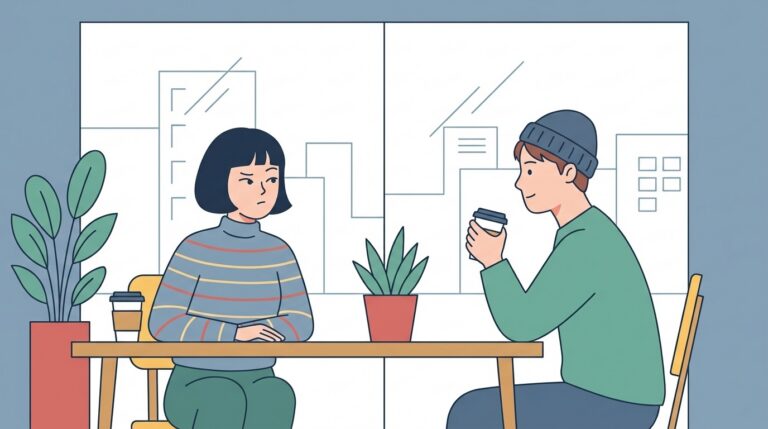
The Korean Art of Calling Out Fair-Weather Friends and Flatterers
Phase 1: Empathy (Immersive Storytelling Opening)
안녕하세요! (Annyeonghaseyo!) I’m your Daily Hangul editor and longtime Korean culture navigator. Have you ever experienced that sudden, suspicious buzz from your phone on a quiet Sunday afternoon? It’s an old acquaintance who hasn’t answered your messages for six months. Suddenly, their text begins with: “Hey bestie! Miss you so much! By the way, do you still have that contact at the design agency?”
If you’ve watched hit workplace K-Dramas like Misaeng or Queen of Tears, you know this exact character archetype. They ghost you when things are calm, but the millisecond they need a favor or sense where the power lies, they roll out the red carpet of compliments. In Korean, we have an outrageously vivid idiom to describe this chameleon-like opportunism: “간에 붙었다 쓸개에 붙었다 한다” (Gan-e but-eotta sseul-gae-e but-eotta handa)—literally, “sticking to the liver one minute and to the gallbladder the next.”
Intermediate learners often struggle to express these subtle, sharp social critiques because literal dictionary translations make you sound like an academic paper. Today, we’re taking you beyond textbook politeness. By the end of this guide, you will master the exact idioms, gestures, and nunchi required to call out opportunists, flatterers, and innocent-acting culprits like a native speaker.
Phase 2: Core Expressions In-Depth
1. 간에 붙었다 쓸개에 붙었다 한다 (Gan-e but-eotta sseul-gae-e but-eotta handa)
- Pronunciation: [Gan-eh boo-teot-da sseul-gae-eh boo-teot-da han-da] (Sounds like “Gahn-eh boot-ut-dah sseul-geh-eh boot-ut-dah hahn-dah”)
- Meaning: Literal: “Attaches to the liver, then attaches to the gallbladder.” / Real Nuance: Flip-flopping loyalty purely for self-interest; being an unprincipled opportunist.
- K-Culture Moment: Seen in historical and office dramas whenever a junior manager shamelessly switches alliances between rival directors during a corporate takeover.
- Editor’s Insight: Anatomically, the liver and gallbladder sit right next to each other in the human body. This phrase paints a comical image of a parasite darting back and forth between adjacent organs depending on which one has more food at that second.
- Situation Spectrum: Casual: ✅ | Semi-formal: ⚠️ | Formal: 🚫 (Use behind someone’s back among trusted friends or as a sarcastic jab)
- 🤔 Think About It: Does your native language compare human loyalty to internal digestive organs, or does it focus on external elements like weather (e.g., “fair-weather friend”)?
2. 비위를 맞추다 (Bi-wi-reul mat-chu-da)
- Pronunciation: [Bi-wi-reul mat-chu-da] (Sounds like “Bee-wee-reul maht-choo-dah”)
- Meaning: Literal: “To tune or match someone’s stomach and spleen.” / Real Nuance: To cater excessively to someone’s whims, pander, or suck up to appease their mood.
- K-Culture Moment: Junior employees frantically refilling the boss’s glass and laughing at terrible jokes during mandatory after-work dinners (hoesik).
- Editor’s Insight: In traditional Korean medicine, biwi (spleen/stomach) dictates a person’s temperament and appetite. “Matching” someone’s stomach means bending your entire personality so they don’t get disgusted or annoyed.
- Situation Spectrum: Casual: ✅ | Semi-formal: ✅ | Formal: ⚠️
- 🤔 Think About It: Why does Korean corporate culture link digestion to interpersonal harmony?
3. 시치미를 떼다 (Si-chi-mi-reul tte-da)
- Pronunciation: [Si-chi-mi-reul tte-da] (Sounds like “See-chee-mee-reul tteh-dah”)
- Meaning: Literal: “To pull off the owner’s tag.” / Real Nuance: Feigning innocence, pretending you know nothing, or playing dumb after doing something cheeky.
- K-Culture Moment: In variety shows like Running Man, when a cast member steals an item, hides it behind their back, and blinks with wide, innocent eyes.
- Editor’s Insight: This idiom dates back to the Goryeo dynasty falconry era! Falcons wore an identification tag called a sichimi. If a falcon flew into someone else’s yard, a thief would swiftly rip off the tag (tte-da) and claim the bird was always theirs.
- Situation Spectrum: Casual: ✅ | Semi-formal: ✅ | Formal: 🚫
- 🤔 Think About It: How does your culture historically describe catching someone red-handed or playing innocent?
Phase 3: Textbook Korean vs. Real Korean
Situation 1: Calling out a coworker switching sides
- 📖 교과서 한국어 (Textbook): 그 사람은 자신의 이익에 따라 쉽게 입장을 바꿉니다. (Geu sarameun jasin-ui i-ig-e ttara swipge ipjang-eul bakkumnida. / “That person easily changes stances according to their personal gain.”)
- 🗣️ 진짜 한국어 (Real-World): 저 사람 또 시작이네. 완전 간에 붙었다 쓸개에 붙었다 해. (Jeo saram tto sijag-ine. Wanjeon gan-e but-eotta sseul-gae-e but-eotta hae. / “Here they go again. They totally stick to the liver and then to the gallbladder.”)
- 💡 왜 다를까? (Why the difference?): Koreans rarely describe opportunism with clinical abstract nouns like “benefit” (i-ik). Instead, visceral bodily idioms deliver immediate comedic punch and social clarity.
Situation 2: Replying to someone who only texts when they need a favor
- 📖 교과서 한국어 (Textbook): 필요할 때만 저에게 연락하는 것은 부적절합니다. (Pilyohal ttaeman jeo-ege yeollakhaneun geoseun bujeokjeolhamnida. / “Contacting me only when you need something is inappropriate.”)
- 🗣️ 진짜 한국어 (Real-World): 너 평소엔 답장도 없더니, 아쉬울 때만 바로 연락 오더라? (Neo pyeongso-en dapjangdo eopdeoni, aswiul ttaeman baro yeollak odeora? / “You never reply on normal days, yet you message instantly only when you’re in a pinch, huh?”)
- 💡 왜 다를까? (Why the difference?): Using aswipda (feeling needy or desperate for a favor) highlights the emotional unfairness without sounding like a legal contract.
Phase 4: K-Culture Deep Dive & Non-Verbal Manners
4-1. 눈치 (Nunchi) & Micro-Gestures
When calling out an opportunist, Koreans rarely yell. It’s all about calculated nunchi (social sensing) and facial micro-expressions:
* The Side-Eye Glance (흘겨보기 – Heulgyeo-bogi): If someone walks over acting sweet because they need a favor, keep your posture relaxed, tilt your head down 5 degrees, and look at them with slightly narrowed eyes.
* The Sarcastic Nod (고개 끄덕이기): Slowly nodding while someone is flattering you signals: “I know exactly what game you’re playing, and it won’t work.”
* Boundary Defense: Keep your hands clasped together or around your coffee cup. Do not lean forward—giving physical space subtly invalidates their sweet talk.
4-2. Cultural Code Analysis: The Workplace “Bat” (박쥐)
In Korean office and social circles, people who display this flip-flopping behavior are often metaphorically labeled “박쥐” (bak-jwi – bats), referencing Aesop’s fable where the bat sided with beasts during mammal victories and birds during avian victories. Korean group culture (jeong and collective loyalty) highly values standing by your team even during rough patches. Shifting allegiance just for convenience violates the unspoken contract of mutual trust.
Phase 5: Real-World Roleplay Scenario
Setting: A 14th-floor break room at a digital agency in Teheran-ro, Gangnam. Steam rises from two paper cups of Americano.
Characters:
* You (민호 – Min-ho): An intermediate designer who was left on read by Jun-woo for two weeks.
* 준우 (Jun-woo): An opportunistic colleague who needs your presentation templates ahead of a big executive meeting.
[Dialogue]
1. 준우: 민호 씨! 오늘 헤어스타일 진짜 멋진데요? 역시 센스쟁이라니까! (Jun-woo: Min-ho ssi! Oneul he-eo-seuta-il jinjja meotjinde-yo? Yeogsi senseu-jaeng-irannikka!)
🎭 Hands you an iced tea with a wide, exaggerated grin.
“Min-ho! Your hair looks incredible today! You really are full of style!”
- 나 (Min-ho): 하하, 고마워요. 근데 준우 씨가 웬일로 먼저 음료수를 다 주시네요? (Ha-ha, gomawoyo. Geunde Jun-woo ssi-ga wen-illo meonjeo eumryosu-reul da jusineyo?)
🎭 Raises an eyebrow playfully without taking the cup immediately.
“Haha, thanks. But what brings you over offering drinks first, Jun-woo?” -
준우: 에이, 우리가 사이가 얼마나 좋은데요! 실은 내일 본부장님 보고 자료 템플릿 좀 빌릴 수 있을까 해서요. (E-i, uri-ga sa-i-ga eolmana joeun-deyo! Sil-eun naeil bonbujang-nim bogo jaryo tempeullit jom billil su isseulkka haeseoyo.)
🎭 Rubs hands together, leaning in close.
“Aw, come on, we’re best buds! Actually, could I borrow your report template for tomorrow’s executive brief?” -
나 (Min-ho): 저번 주에 제가 협조 요청 메일 보냈을 땐 일주일 내내 읽씹하셨잖아요. (Jeobeon ju-e jega hyeopjo yocheong me-il bonaesseul ttaen ilju-il naenae ilksシップhasyeotjanhayo.)
🎭 Smiles calmly while gently calling out the ghosting.
“When I emailed requesting cooperation last week, you left me on ‘read’ for a whole week, didn’t you?” -
준우: 아이고, 그때는 프로젝트 마감이라 너무 바빠서 정신이 없었어요! 절대 일부러 그런 거 아니에요! (A-i-go, geuttaeneun peurojekteu magam-ira neomu bappaseo jeongsin-i eopseosseoyo! Jeoldae ilbureo geureon geo anieyo!)
🎭 Waves hands frantically in defense.
“Oh my gosh, I was completely overwhelmed by project deadlines back then! I never meant to do that on purpose!” -
나 (Min-ho): 꼭 이렇게 아쉬울 때만 저한테 다정하게 다가오시더라고요. (Kkok ireoke aswiul ttaeman jeohante dajeonghage dagaosideoragoyo.)
🎭 Softly delivers the reality check with a half-smile.
“You always approach me so warmly only when you’re in a pinch.” -
준우: 민호 씨, 이번 한 번만 살려주세요! 제가 이번 주 금요일에 맛있는 점심 살게요, 네? (Min-ho ssi, ibeon han beonman sallyeojuseyo! Jega ibeon ju geum-yo-il-e masinneun jeomsim salgeyo, ne?)
🎭 Clasps palms together in a praying gesture.
“Min-ho, save me just this once! I’ll buy you an amazing lunch this Friday, deal?” -
나 (Min-ho): 완전 간에 붙었다 쓸개에 붙었다 하시네요. 좋아요, 점심 메뉴는 제가 정합니다! (Wanjeon gan-e but-eotta sseul-gae-e but-eotta hasineyo. Jo-ayo, jeomsim menyuneun jega jeonghamnida!)
🎭 Laughs out loud, cutting tension while locking in the free lunch.
“You truly stick to the liver and then the gallbladder! Fine, but I pick the restaurant!”
🔀 Interactive Choice Point
How would you handle Jun-woo’s sudden favor request?
* Choice A: “준우 씨는 진짜 간에 붙었다 쓸개에 붙었다 하는 사람 같아서 정떨어져요. 다신 말 걸지 마세요.” (Directly insulting him in a cold tone)
* Choice B: “완전 간에 붙었다 쓸개에 붙었다 하시네요! 이번만 도와줄 테니 다음엔 제 메일도 칼답 해줘요.” (Playful, calling out the behavior while maintaining rapport)
* Choice C: “네! 여기 바로 파일 드릴게요! 다음에도 언제든 말씀하세요!” (Unconditionally giving the file right away)
Feedback:
* Choice A (Bad 🚫): Far too blunt. You’ll create an instant workplace enemy in a Korean collective environment.
* Choice B (Best ✅): Perfect B2-level natural diplomacy! You show you aren’t naive, tease him with the idiom, and establish clear boundaries.
* Choice C (Risk ⚠️): You become an easy target (hogu) who will be taken advantage of again next month.
Phase 6: 10-Second Emotional Shadowing Drill
Read these aloud while mimicking the rhythmic cadence marked by slashes /:
[😒 살짝 얄밉다는 듯이 / Mildly sassy and sarcastic]
평소엔 / 연락도 없더니 / 아쉬울 때만 / 오빠 찾더라?
(Pyeongso-en / yeollakdo eoptdeoni / aswiul ttaeman / oppa chatdeora?)
“You never texted before / yet only when you’re desperate / you come looking for me?”-
[😏 뼈 있는 장난을 치며 / Teasing with sharp truth]
너 지금 / 시치미 떼는 거야? / 증거가 / 다 남아 있는데?
(Neo jigeum / sichimi tteneun geoya? / Jeung-geoga / da nama inneunde?)
“Are you playing dumb right now? / When all the evidence / is right here?” -
[🤣 호탕하게 웃으며 일침 / Hearty laugh followed by a sharp punchline]
어휴, / 완전 / 간에 붙었다 / 쓸개에 붙었다 하네!
(Eohyu, / wanjeon / gan-e but-eotta / sseul-gae-e but-eotta hane!)
“Phew, / you seriously / stick to the liver / and then flip to the gallbladder!”
Phase 7: K-Culture Mini Dictionary
- 얌체 (Yam-che) | The Selfish Opportunist
Describes someone who subtly ducks duties, dodges paying the bill, or snatches easy benefits while leaving the heavy lifting to others. - 눈치코치 (Nun-chi-ko-chi) | Supercharged Social Radar
An intensified colloquial form of nunchi. Someone with nunchikochi senses an opportunistic person entering the room before they even speak. - 아쉬울 때만 (A-swi-ul ttae-man) | Only When in Need
The universal qualifier for fair-weather contacts: “너는 꼭 아쉬울 때만 전화하더라” (You exclusively call when you need something). - 박쥐 (Bak-jwi) | The Turncoat / Fence-Sitter
Used in politics, student clubs, and offices to describe individuals who bounce back and forth between opposing teams depending on who is winning.
Phase 8: Traveler’s Survival Kit
Top 3 Boundary-Setting Phrases
- 괜찮아요, 제가 알아서 할게요. (Gwaenchanayo, jega araseo halgeyo.)
Pronunciation: [Gwen-chan-ah-yo, jeh-gah ah-rah-seo hal-geh-yo.]
Pro Tip: Perfect for warding off overly aggressive salespeople in tourist shopping districts like Myeongdong. - 방금 말씀하신 거랑 조금 다른데요? (Bang-geum malsseumhasin georang jogeum dareundeyo?)
Pronunciation: [Bahng-geum mal-sseum-hah-shin geo-rahng jo-geum dah-reun-deh-yo?]
Pro Tip: Use this politely if a merchant or taxi driver changes terms on the fly. - 다음에 기회 되면 연락드릴게요. (Daeume gihoe doemyeon yeollakdeurilgeyo.)
Pronunciation: [Dah-eum-eh gee-hweh dweh-myeon yeol-lahk-deu-ril-geh-yo.]
Pro Tip: The classic polite Korean brush-off when someone tries to latch onto you for future favors.
Editor’s Travel Note: Staying Smart on the Ground
When navigating Seoul or Busan, smooth logistics reduce awkward social encounters. Always navigate using the Naver Map app on your phone instead of Google Maps, which lacks transit walk-routing in Korea. If an acquaintance suddenly invites you out claiming “it’s on me” and then disappears when the bill arrives, simply show your physical transit card or bank app and say: “각자 계산해요!” (Gakja gyesanhaeyo! / Let’s pay separately!).
Phase 9: “한 발 더 깊이” (Deep Cultural Reflection)
In traditional Korean culture, organs are viewed as the emotional control centers of the body. You experience intense envy when your “stomach hurts” (bae-ga apeuda), you lose your nerve when your “liver shrinks” (gan-i jageojida), and an unprincipled turncoat jumps between the liver and gallbladder (gan-e but-eotta sseul-gae-e but-eotta handa). This reveals how deeply Koreans value genuine, consistent emotional connections (jeong). Flattery and opportunism aren’t merely treated as bad etiquette—they are felt as bodily deceit.
💬 Your Turn: Have you ever encountered someone in your life who fits this “liver and gallbladder” description? How did you respond, and what equivalent phrase exists in your native culture? Share your story in the comments below!
Phase 10: FAQ & Avoiding Misunderstandings
Q: Can I say “간에 붙었다 쓸개에 붙었다 한다” directly to my boss?
A: Absolutely not! Even in a joking tone, calling someone an opportunist implies they lack loyalty and integrity. Only use this expression behind someone’s back among close colleagues, or playfully toward an intimate friend of equal or younger status.
Q: What is the difference between “비위를 맞추다” and simple compliments?
A: Compliments (chingchan) are sincere expressions of praise. “비위를 맞추다” carries a distinct undertone of subservience—swallowing your true opinions to ensure the other person’s fickle temper remains calm.
Q: When is “시치미를 떼다” inappropriate?
A: Never use it in serious legal, contractual, or formal disciplinary contexts. Saying “시치미 떼지 마세요” in a formal dispute can sound dismissive or confrontational. Reserve it for social interactions, playful accusations, or casual storytelling.
🚨 Common Mistakes
- Mistake: Using “간에 붙었다 쓸개에 붙었다” to describe someone changing their food order.
Correct Action: That’s just being indecisive (우유부단하다 – u-yu-bu-dan-hada). Reserve the organ idiom for changes in social loyalty for personal gain! - Mistake: Confusing “배가 아프다” (jealousy) with a literal stomach bug.
Correct Action: If a friend buys a house and you say “배 아파 죽겠다”, you are playfully admitting envy, not food poisoning. - Mistake: Smiling broadly while saying “시치미 떼지 마” to someone genuinely hurt.
Correct Action: Ensure the tone matches the context. If an actual mistake happened, address it directly rather than accusing them of acting innocent.
Phase 11: Action Missions
- 🥉 Bronze Mission (Solo Shadowing): Practice saying “완전 간에 붙었다 쓸개에 붙었다 하네!” 5 times in front of the mirror, matching the sassy side-glance from Phase 4.
- 🥈 Silver Mission (Social Share): Find a K-Drama scene where an opportunistic character shows up with fake smiles. Post a 10-second clip on Instagram Stories with the caption: “간에 붙었다 쓸개에 붙었다 하는 중 ㅋㅋㅋ @dailyhangul”.
- 🥇 Gold Mission (Real-Life Deployment): The next time a close friend ignores your texts all week and then casually asks to borrow notes or clothes, text them back: “너 또 아쉬울 때만 연락했지? ㅋㅋㅋ”.
- 🎮 K-Culture Mission: Watch Episode 1–3 of any historical drama (Sageuk). Spot the treacherous court official switching sides between ministers and identify the non-verbal signs of biwi-reul matchuda!
Phase 12: Interactive Quiz Challenge
Click to reveal answers & explanations!
Q1. Situation Judgment
Your coworker Min-ji refused to help you finish inventory last month. Today, hearing you have spare VIP tickets to a concert, she brings your favorite coffee and says she’s always supported you. Which phrase fits best behind her back?
* A) 비위를 아주 잘 맞추네요.
* B) 완전 간에 붙었다 쓸개에 붙었다 하네.
* C) 시치미를 이미 뗐네요.
Answer: B.
Explanation: Switching loyalties and acting warm only when you possess something they want is the textbook definition of “간에 붙었다 쓸개에 붙었다 한다”.
Q2. Fill-in-the-Blank
“너 내가 아까 서류 가져가는 거 다 봤는데, 지금 왜 모르는 척 (__________) 떼고 있어?”
Answer: 시치미 (sichimi)
Explanation: Feigning ignorance when caught red-handed uses the phrase 시치미(를) 떼다.
Q3. True or False Cultural Quiz
True or False: Calling someone a “박쥐” (bat) in a business meeting is a polite way to praise their flexibility and adaptability.
Answer: False!
Explanation: Calling someone a bat (bak-jwi) is a strong criticism meaning they are an unprincipled turncoat who flips sides without loyalty.







