

Master the Korean New Year Bow: How to Do Sebae and Receive Sebaetdon Like a Native
Phase 1: Empathy (Story-Immersed Opening)
안녕하세요! 매일한글 에디터입니다. (Hello! I’m your Daily Hangul editor.)
Picture this: It’s a crisp, bright winter morning in Seoul during Seollal (설날 – Lunar New Year). You’re invited to your Korean friend’s grandparents’ house. The aroma of simmering beef bone broth and sliced rice cakes fills the home. Family members are gathered on the living room floor, wearing vibrant silk Hanbok (한복). Suddenly, everyone stands up, lines up by generation, and drops to the floor in a synchronized, ceremonial deep bow. Then, the grandfather smiles and pulls out crisp white paper envelopes filled with fresh banknotes.
Suddenly, your heart starts racing. Wait, which hand goes on top? Do I bow once or twice? What do I say while bowing? And when Grandpa hands me that envelope of cash, do I take it with one hand? Do I refuse it first? Can I open it?
If you have ever felt nervous about making a cultural faux pas in front of Korean elders, you are definitely not alone! This exact moment is one of the most common anxiety triggers our A1 beginner students share with us. But here is the good news: Korean elders do not expect perfection from international guests. When you take the initiative to perform the traditional bow—called 세배 (Sebae)—and say the right greeting with polite two-handed etiquette, you won’t just look respectful—you will melt their hearts and earn massive love (and maybe a little extra pocket money!).
Let’s break down the exact words, movements, and cultural secrets so you can walk into any Seollal gathering with 100% confidence!
Phase 2: Core Expressions Breakdown
Here are the top 3 essential expressions you need for Seollal morning:
1. 새해 복 많이 받으세요 (Saehae bok mani badeuseyo)
- Pronunciation: [Saehae bok mani badeuseyo] (Sounds like: “Say-hay boke mah-nee bah-duh-seh-yo”)
- Meaning: Literal: “Please receive a lot of New Year’s fortune/blessings” | Real Nuance: “Happy New Year!”
- K-Culture Moment: On every Lunar New Year TV special, K-Pop idols and variety show casts (like Running Man) dress in pastel Hanbok, bow deeply toward the camera, and shout this phrase in unison!
- Editor’s Insight: The word 복 (bok) represents good fortune, luck, and cosmic blessing. Unlike the English “Happy New Year,” which focuses on emotional happiness, the Korean greeting actively wishes tangible prosperity and blessings upon the listener.
- Situation Spectrum: Casual (새해 복 많이 받아): 🚫 (Never to elders!) | Semi-formal (새해 복 많이 받아요): ⚠️ | Formal (새해 복 많이 받으세요): ✅
- 🤔 Think About It: In English, we wish people a “Happy” time, whereas Korean culture wishes for the “receiving of fortune” (복). Why do you think sharing blessings is such a communal concept in Korea?
2. 건강하세요 (Geonganghaseyo)
- Pronunciation: [Geonganghaseyo] (Sounds like: “Gun-gahng-hah-seh-yo”)
- Meaning: Literal: “Please be healthy” | Real Nuance: “Wishing you good health and long life!”
- K-Culture Moment: In K-Dramas, whenever adult children or grandchildren visit their grandparents in the countryside, they bow and clasp their hands while wishing them good health above all else.
- Editor’s Insight: For Korean elders, wishing them health (건강) is the highest compliment and most thoughtful wish you can offer. It shows you care about their longevity.
- Situation Spectrum: Casual (건강해): 🚫 | Semi-formal (건강해요): ⚠️ | Formal (건강하세요 / 항상 건강하세요): ✅
- 🤔 Think About It: Why does wishing health carry more emotional weight than wishing wealth when speaking to seniors?
3. 감사합니다 (Gamsahamnida)
- Pronunciation: [Gamsahamnida] (Sounds like: “Gahm-sah-hahm-nee-dah”)
- Meaning: Literal: “I do thankfulness” | Real Nuance: “Thank you very much!”
- K-Culture Moment: The moment Grandpa or Grandma pulls out the crisp white envelope containing 세뱃돈 (Sebaetdon – New Year’s pocket money) and places it into your waiting two hands!
- Editor’s Insight: While it’s the standard “thank you,” the delivery matters. Pair it with a polite head nod and receiving the gift with both hands.
- Situation Spectrum: Casual (고마워): 🚫 | Semi-formal (고마워요): ⚠️ | Formal (감사합니다): ✅
- 🤔 Think About It: Notice how polite expressions in Korean shift dramatically depending on social hierarchy and age. How does physical body language reinforce verbal respect?
Phase 3: Textbook Korean vs. Real Korean
Let’s see how textbook Korean compares to how native speakers actually talk during Seollal:
Situation 1: Greeting elders on New Year’s morning
- 📖 교과서 한국어 (Textbook): 안녕하십니까? 새해를 축하합니다. (Annyeonghasimnikka? Saehaereul chukahamnida. – “How do you do? I congratulate the New Year.”)
- 🗣️ 진짜 한국어 (Real Life): 할머니, 할아버지, 새해 복 많이 받으세요! (Halmeoni, harabeoji, saehae bok mani badeuseyo! – “Grandma, Grandpa, please receive lots of New Year blessings!”)
- 💡 왜 다를까? (Why the difference?): “새해를 축하합니다” sounds like a cold, formal printed greeting card or a government broadcast. In real Korean families, warm familial titles followed by “새해 복 많이 받으세요” are standard.
Situation 2: When receiving New Year pocket money (세뱃돈)
- 📖 교과서 한국어 (Textbook): 돈을 주셔서 고맙습니다. (Doneul jusyeoseo gomapseumnida. – “Thank you for giving money.”)
- 🗣️ 진짜 한국어 (Real Life): 우와, 감사합니다! 새해에도 건강하세요! (Uwa, gamsahamnida! Saehaeedo geonganghaseyo! – “Wow, thank you so much! Please stay healthy this year too!”)
- 💡 왜 다를까? (Why the difference?): Explicitly mentioning the word “money” (돈) sounds awkward and overly transactional. Native Koreans focus their thanks on the kindness and immediately return a blessing of health and happiness.
Phase 4: K-Culture Deep Dive & Non-Verbal Manners
4-1. 눈치 (Nunchi) & Gestures: The Art of the Sebae Bow
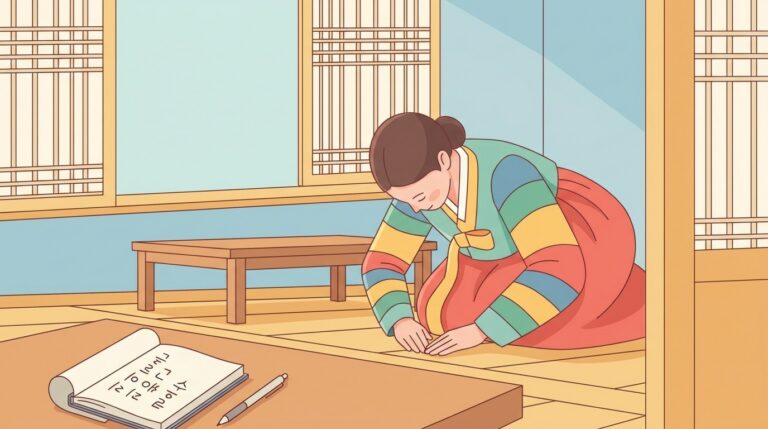
Sebae is not just a regular standing bow; it is a full, floor-level kneeling bow. Here is your step-by-step master checklist:
1. Hand Placement (공수법 – Gongsubeop):
– For Men (남좌 – Men Left): Place your left hand on top of your right hand.
– For Women (여우 – Women Right): Place your right hand on top of your left hand.
2. The Bow:
– Bring your clasped hands up to chest or eye level.
– Kneel down slowly (left knee down first, then right knee).
– Bend forward at the waist until your forehead approaches the back of your hands resting on the floor.
– Hold the position for 1 to 2 seconds.
– Rise back up smoothly (right knee up first, then left), bring hands back to waist level, and bow your head slightly.
3. After the Bow: Sit comfortably on your knees and say: “새해 복 많이 받으세요!”
4. Receiving Sebaetdon: Never hold out one single hand! Extend both hands with palms up or hold your right wrist with your left hand. Bow your head gently and say “감사합니다!”
4-2. Cultural Code: The Meaning of Tteokguk and White Envelopes
On Seollal morning, families eat 떡국 (Tteokguk – sliced rice cake soup). The white oval rice cakes resemble old dynasty coin currency (엽전 – Yeopjeon), symbolizing purity and wealth. In Korean tradition, finishing your bowl of Tteokguk marks the moment you officially become one year older!
After Sebae, elders provide 덕담 (Deokdam)—warm words of wisdom, career encouragement, and marriage or study wishes—accompanied by 세뱃돈 (Sebaetdon) tucked into clean white envelopes. Never open the envelope in front of the elder; slip it respectfully into your pocket or bag.
Phase 5: Real-Life Roleplay Scenario
Setting: A sunlit living room in Seoul with polished wood floors. The scent of savory beef broth and sesame oil fills the air. Grandfather (Min-jun) sits comfortably on a cushion. Sarah, an international guest, enters in a lovely pastel Hanbok.
Characters:
* Min-jun (Grandfather / 할아버지): Warm, smiling elder.
* Sarah (사라): Eager beginner Korean learner.
Turn 1
Sarah: 🎭 (Standing politely with hands folded in front)
할아버지, 새해 복 많이 받으세요!
(Harabeoji, saehae bok mani badeuseyo!)
Grandpa, please receive lots of New Year blessings!
Turn 2
Min-jun: 🎭 (Smiles broadly and pats the floor in front of him)
오, 사라 왔구나! 어서 와서 세배하렴.
(O, Sarah watguna! Eoseo waseo sebaeharyeom.)
Oh, Sarah has arrived! Come on over and do your New Year bow.
Turn 3
Sarah: 🎭 (Places right hand over left hand, kneels down smoothly to bow)
새해 복 많이 받으시고 건강하세요!
(Saehae bok mani badesigo geonganghaseyo!)
Please receive many New Year blessings and stay healthy!
Turn 4
Min-jun: 🎭 (Nods happily, placing his hands on his knees)
아이고, 세배도 참 예쁘게 잘하네! 올해 한국어 공부도 열심히 하고 건강하렴.
(Aigo, sebaedo cham yeppeuge jalhane! Olhae hangugeo gongbudo yeolsimhi hago geongangharyeom.)
Oh my, you bow so beautifully! Study Korean hard this year and stay healthy.
Turn 5
Min-jun: 🎭 (Reaches into his Hanbok pocket and pulls out a crisp white envelope)
자, 이건 우리 사라 세뱃돈이다!
(Ja, igeon uri Sarah sebaetdonida!)
Here, this is our Sarah’s New Year money!
Turn 6
Sarah: 🎭 (Reaches out with both hands and bows head gratefully)
우와, 할아버지! 감사합니다!
(Uwa, harabeoji! Gamsahamnida!)
Wow, Grandpa! Thank you so much!
Turn 7
Min-jun: 🎭 (Chuckles warmly and stands up)
맛있는 것도 많이 사 먹고! 자, 이제 다 같이 떡국 먹자.
(Masinneun geotdo mani sa meokgo! Ja, ije da gachi tteokguk meokja.)
Buy yourself something delicious to eat! Now, let’s all eat rice cake soup together.
Turn 8
Sarah: 🎭 (Smiling brightly, holding the envelope carefully with two hands)
네! 떡국 맛있게 먹겠습니다!
(Ne! Tteokguk masitge meokgesseumnida!)
Yes! I will enjoy the rice cake soup!
🔀 Interactive Choice Point
When Min-jun holds out the white envelope of Sebaetdon in Turn 5, what should Sarah do?
- Option A: Reach out with one hand, immediately pull the bills out, and count them with excitement.
- Option B: Receive the envelope with both hands, bow her head respectfully, say “감사합니다,” and place it safely in her pocket without opening.
- Option C: Wave both hands in distress, shout “No, no, I cannot take your money!” and push his hand away.
Feedback:
* Option A: ❌ Bad! Opening the envelope and counting money in front of elders looks greedy and disrespectful.
* Option B: ✅ Best! Accepting with two hands, bowing, and keeping the envelope unopened shows perfect Korean etiquette (100점 만점에 100점!).
* Option C: ⚠️ Risk! While modesty is valued, flat-out refusing a holiday blessing and gift from an elder makes the room awkward. Accept it with humble gratitude!
Phase 6: 10-Second Emotional Shadowing Drill
Practice these lines out loud! Pay attention to the pauses (/) and adopt the indicated emotions:
[😊 Respectful and Bright]
할아버지, / 새해 복 / 많이 받으세요!
(Harabeoji, / saehae bok / mani badeuseyo!)
Grandpa, / New Year blessings / please receive a lot!-
[💖 Sincere and Caring]
항상 / 건강하세요!
(Hangsang / geonganghaseyo!)
Always / please stay healthy! -
[✨ Delighted and Humble]
세뱃돈 / 정말 / 감사합니다!
(Sebaetdon / jeongmal / gamsahamnida!)
New Year money / truly / thank you so much!
Phase 7: K-Culture Mini Dictionary
-
세배 (Sebae)
Literal: New Year Bow
Usage: The traditional floor-level deep bow performed on Seollal to show reverence to living elders and wish them health. -
세뱃돈 (Sebaetdon)
Literal: New Year Bow Money
Usage: Gift money presented in envelopes to younger generations after they perform the Sebae bow. -
덕담 (Deokdam)
Literal: Virtuous Words
Usage: Heartfelt blessings and advice shared by elders following the bow, wishing happiness, employment, or academic success. -
떡국 (Tteokguk)
Literal: Rice Cake Soup
Usage: The staple dish of Seollal morning. Eating a bowl symbolically adds one year to your age and welcomes a clean, prosperous year.
Phase 8: Traveler’s Survival Kit
Survival Phrases TOP 3
- 새해 복 많이 받으세요! (Saehae bok mani badeuseyo!)
Pro Tip: Use this greeting when entering convenience stores, taxis, or cafes during the 3-day Seollal holiday. Koreans love hearing it! - 떡국 있어요? (Tteokguk isseoyo?)
Pro Tip: Many traditional restaurants offer special holiday Tteokguk around Seollal. Ask this to taste an authentic bowl. - 연휴에 문 열어요? (Yeonhyue mun yeoreoyo?)
Meaning: Are you open during the holiday?
Pro Tip: Independent shops often shut down for 2–3 days during Seollal. Always ask ahead!
Editor’s Travel Note
- Check Store Openings: Download the Naver Map app navigation tool to check live holiday operating hours for restaurants and attractions.
- Transport Alert: Major train lines (KTX) sell out months in advance due to the nationwide family migration (귀성길 – Gwiseong-gil). If traveling inside Korea during Seollal, book tickets early through the official Korail train ticket booking platform.
Phase 9: “One Step Deeper” (Reflective Thought)
In many Western cultures, giving money directly inside a family setting can sometimes feel cold or transactional. But in Korea, 세뱃돈 (Sebaetdon) combined with 세배 (Sebae) represents a sacred cycle of mutual care: the younger generation offers physical reverence and wishes of longevity, while the elder generation responds with tangible life support and encouragement (덕담). It is an expression of 정 (Jeong)—the warm, unspoken emotional bond that holds Korean community life together.
💬 Your Turn: Does your home culture have a custom where elders hand out money, sweets, or specific blessings to children during the New Year? Share your experience in the comments below!
Phase 10: FAQ & Avoiding Misunderstandings
Q: Should I do the Sebae bow to my Korean friends who are the same age?
A: No! Sebae is strictly meant for seniors and elders (grandparents, parents, aunts, uncles, or respected senior mentors). Among peers or friends your age, simply smile, wave, and say “새해 복 많이 받아!” (Saehae bok mani bada!).
Q: How many times do I bow during Sebae?
A: Exactly once! Bowing twice (or three times) is strictly reserved for funeral ceremonies (절 – Jeol at memorial services). Doing two full floor bows to a living person is considered very bad luck, so remember: One bow for living elders!
Q: What if I’m not wearing a Hanbok? Can I still do Sebae?
A: Yes! While traditional Hanbok is wonderful, wearing neat, modest everyday clothing (like slacks, a clean sweater, or a long skirt) is completely acceptable in modern Korean households.
🚨 흔한 실수 (Common Mistakes) Warning Board
- Mistake: Bowing with hands unclasped and resting flat far apart on the floor.
Correct Action: Keep your hands clasped together (left over right for men; right over left for women) and lower your forehead close to your hands. - Mistake: Grabbing the Sebaetdon envelope with one hand like grabbing a receipt.
Correct Action: Always extend both hands with palms facing upward to receive gifts from elders. - Mistake: Saying “생일 축하해요” (Happy Birthday) or “새해 축하해요” by mistake.
Correct Action: Stick to the classic golden phrase: “새해 복 많이 받으세요!”
Phase 11: Action Missions & Engagement
- 🥉 Bronze Mission (Solo): Stand in front of your mirror and practice the hand placement: Men = Left hand over right; Women = Right hand over left. Practice bowing smoothly without losing your balance!
- 🥈 Silver Mission (Social): Share a photo of your Korean study notes or a bowl of Tteokguk on Instagram or X, tagging it with
#DailyHanguland writing 새해 복 많이 받으세요! - 🥇 Gold Mission (Real Life): Send a text message to a Korean friend, tutor, or language partner saying: “새해 복 많이 받으시고 항상 건강하세요!”
- 🎮 K-Culture Mission: Search YouTube for your favorite K-Pop group’s annual “Hanbok Seollal Greeting” video. Notice their hand placement and count how many times they say 복 (Bok)!
Phase 12: Interactive Quiz Challenge
Test what you’ve learned before you face the elders!
1. Scenario Judgment: You just completed your Sebae bow to your friend’s grandfather. He smiles and extends a white envelope to you. What should you do?
(A) Wave it off and refuse it three times loudly.
(B) Take it with both hands, bow your head, say “감사합니다,” and place it in your pocket.
(C) Open it immediately to see how much money is inside.
2. Fill-in-the-Blank: Complete the traditional New Year greeting:
“새해 _____ 많이 받으세요!”
3. True or False: For a male bowing during Seollal, the left hand should be placed over the right hand. (True / False)
👉 Click here to reveal the answers and explanations!
1. Answer: (B)
Explanation: Receiving the envelope with both hands while bowing slightly and keeping it closed shows perfect Korean manners and gratitude.
2. Answer: 복 (Bok)
Explanation: “복” means blessing/fortune. The phrase means “Please receive lots of New Year blessings!”
3. Answer: True
Explanation: Under traditional Korean rules (남좌여우 – Men left, Women right), men place their left hand on top, while women place their right hand on top.






