

Master Seoul Meetups: How to Set Time, Pick Subway Exits, and Plan Like a Local
Phase 1: Empathy (Story-Driven Opening)
안녕하세요! 매일한글 에디터입니다. (Hello! I’m your Daily Hangul editor.)
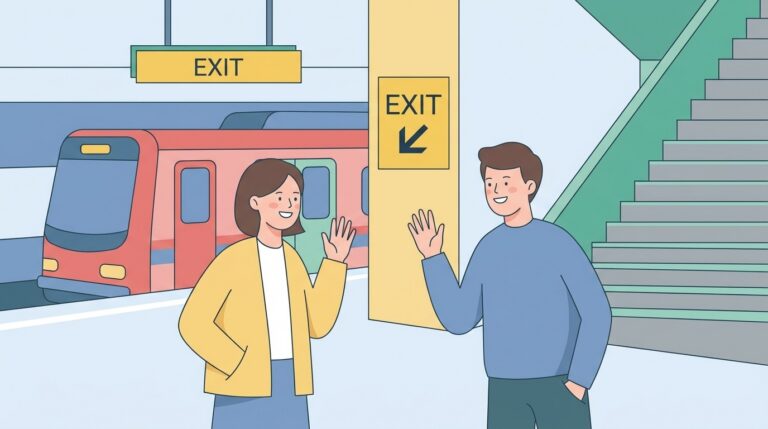
Picture this classic Seoul moment: You are planning an exciting weekend catch-up with your Korean friend, Minji. After browsing trendy cafes on Instagram, she texts you: “그럼 일요일 오후 1시에 합정역 5번 출구 안에서 만나는 걸로 하자!”
You stare at the screen. You understand 일요일 (Sunday) and 오후 1시 (1 PM), but your head starts spinning at the rest. What exactly is ~는 걸로 하자? And more crucially: does 합정역 5번 출구 안에서 (inside Exit 5 of Hapjeong Station) mean inside the ticket gates, halfway down the stairs, or shivering right under the exit sign outside?
If you have ever felt nervous about making plans in Korea or ended up pacing around the wrong subway exit while your phone battery drained to 3%, you are certainly not alone. Setting up appointments is one of the biggest real-life hurdles for A2 learners because textbooks teach stiff phrases like “몇 시에 만날까요?”, whereas real Koreans communicate with casual, collaborative nuances and hyper-specific spatial cues.
This guide is built on real classroom feedback from hundreds of elementary learners living in and visiting Korea. By the end of this post, you will effortlessly lock in meeting times, suggest natural hangout spots, and decode Seoul’s famous subway exit meetup culture just like a local friend.
Phase 2: Core Expressions Deep Dive
Let’s unpack three essential building blocks that will instantly elevate your daily Korean planning skills.
1. ~는 걸로 하자 (Hangul: ~는 걸로 하자)
- Pronunciation: [~neun geol-ro ha-ja] (Sound analogy: Think of “nun” like a sister in a convent + “girl-low” + “ha-ja” like “ha-ha” with a soft ‘j’ sound).
- Meaning: Literal: “Let’s do it as the thing of…” | Real Nuance: “Let’s settle on doing…” or “Let’s make it a deal to…”
- K-Culture Moment: You will hear this constantly in slice-of-life K-dramas (like Hospital Playlist) whenever characters finally wrap up a chaotic group chat debate about where to eat dinner.
- Editor’s Insight: Rather than a blunt command, ~는 걸로 하자 softens the final decision. It implies: “We considered options, and this seems like the best mutual agreement.”
- Situation Spectrum: Casual ✅ | Semi-formal ⚠️ (Use ~는 걸로 해요) | Formal 🚫
- 🤔 Think About It: Why do you think Korean uses noun phrases (“the thing of doing”) to finalize decisions instead of direct active verbs? How does indirect phrasing help maintain harmony among friends?
2. [장소] [번호]번 출구 안에서 (Hangul: [장소] [번호]번 출구 안에서)
- Pronunciation: [[Jang-so] [Beon-ho]-beon chul-gu an-e-seo] (Sound analogy: “chul-gu” sounds like “chull-goo”, rhymes with “cool blue”).
- Meaning: Literal: “Inside Exit [Number] of [Place]” | Real Nuance: “Inside the station shelter at Exit [Number], before walking out to the street.”
- K-Culture Moment: Seen in romantic webtoons where characters wait safely away from rainy or freezing weather right by the stairs of a designated exit.
- Editor’s Insight: In Korea, subway stations are massive underground cities. 안에서 (inside) almost always means inside the underground station area near that exit stairwell, keeping you protected from summer humidity or sub-zero winter winds, but outside the fare gates!
- Situation Spectrum: Casual ✅ | Semi-formal ✅ | Formal ✅
- 🤔 Think About It: In your home country, do people meet at specific station exit numbers, or at nearby landmarks like statues or cafes? Why are numbered exits so vital in Korean city planning?
3. 이번 주말에 시간 괜찮아? (Hangul: 이번 주말에 시간 괜찮아?)
- Pronunciation: [I-beon ju-mal-e si-gan gwaen-chan-a?] (Sound analogy: “gwaen-chan-a” sounds like “gwen-chahn-ah”).
- Meaning: Literal: “Is time okay this weekend?” | Real Nuance: “Are you free this weekend? / Does your schedule allow us to hang out?”
- K-Culture Moment: The quintessential opening line whenever a crush texts you in a youth romance drama.
- Editor’s Insight: Asking “시간 있어요?” (Do you have time?) can sometimes sound a bit formal or abrupt. 시간 괜찮아? sounds warmer because you are gently inquiring whether hanging out would be comfortable for them.
- Situation Spectrum: Casual ✅ | Semi-formal ⚠️ (Use 시간 괜찮으세요?) | Formal 🚫
- 🤔 Think About It: Notice how Korean focuses on whether the time feels comfortable (괜찮다), rather than directly checking your personal ownership of time.
Phase 3: Textbook Korean vs. Real Korean
Situation 1: Finalizing a meeting plan
- 📖 교과서 한국어 (Textbook):
우리 일요일에 만납시다. (Uri iryoil-e mannapsida. / Let us meet on Sunday.) - 🗣️ 진짜 한국어 (Real Korean):
그럼 일요일에 보는 걸로 하자! (Geureom iryoil-e boneun geollo haja! / Then let’s plan on seeing each other Sunday!) - 💡 왜 다를까? (Why is it different?):
The ending -ㅂ시다 sounds like an announcement made by a committee director. Real peers use the friendly collaborative ending ~는 걸로 하자 or simply verb stem + ~자 (일요일에 보자!).
Situation 2: Asking if a suggested time works
- 📖 교과서 한국어 (Textbook):
오후 1시가 당신에게 적당합니까? (Ohu hansi-ga dangsin-ege jeokdanghamnikka? / Is 1 PM suitable for you?) - 🗣️ 진짜 한국어 (Real Korean):
1시 어때? 괜찮아? (Hansi eottae? Gwaenchana? / How is 1 o’clock? Does that work?) - 💡 왜 다를까? (Why is it different?):
Never say 당신 (dangsin) to your friends—it sounds unnatural or confrontational! Native speakers drop pronouns completely and use the breezy pattern [Time] 어때?.
Phase 4: K-Culture Deep Dive & Non-Verbal Manners
4-1. 눈치 (Nunchi) & Meeting Manners
When meeting a Korean friend at a designated station exit:
* The Fare Gate Dilemma: If someone says 5번 출구 안에서 (inside Exit 5), do not tap out through the card turnstiles if you are early and unsure! Instead, send a quick text: “나 개찰구 앞이야” (I’m in front of the card turnstiles). Once you tap out, going back in costs money.
* The Phone Wave: Station concourses are bustling. Stand slightly off to the side so you don’t block commuters walking up the stairs. Keep your phone in hand at chest height. When you spot your friend, a high, two-handed subtle wave with a slight bow of the head is the universal friendly Korean greeting.
4-2. The Anatomy of Seoul’s Subway Culture
Why are subway exits such an institution in Korea? In popular hubs like Hapjeong (합정), Hongdae (홍대), or Gangnam (강남), sprawling underground malls connect directly to subway lines. Meeting “near Exit 5” isn’t just a coordinate—it is an entire micro-neighborhood! Exit 5 in Hapjeong, for instance, leads directly toward the trendy, cafe-filled alleys of Mangwon and Sangsu. Naming the exit sets the immediate vibe for your day.
Phase 5: Real-Life Roleplay Scenario
Setting: You and your Korean classmate Minji (민지) are messaging back and forth on KakaoTalk on a Thursday afternoon, planning your weekend cafe crawl.
- 민지: 이번 주말에 시간 괜찮아? 같이 카페 갈래?
(Ibeon jumal-e sigan gwaenchana? Gachi kape gallae?)
“Are you free this weekend? Want to go to a cafe together?”
🎭 [KakaoTalk notification rings, sending a dancing peach sticker] -
나 (You): 좋아! 일요일 어때?
(Joa! Iryoil eottae?)
“Sounds great! How about Sunday?”
🎭 [Typing eagerly] -
민지: 일요일 좋아. 몇 시에 볼까?
(Iryoil joa. Myeot si-e bolkka?)
“Sunday works. What time should we meet?”
🎭 [Quick reply with a thumbs-up] -
나 (You): 점심 먹고 오후 1시쯤 어때?
(Jeomsim meokgo ohu hansi-jjeum eottae?)
“How about around 1 PM after lunch?”
🎭 [Checking calendar on phone] -
민지: 딱 좋아! 어디서 만날까? 합정역 갈래?
(Ttak joa! Eodiseo mannalkka? Hapjeong-yeok gallae?)
“Perfect! Where should we meet? Shall we go to Hapjeong Station?”
🎭 [Excited energy] -
나 (You): 응! 합정역에 예쁜 카페 많잖아.
(Eung! Hapjeong-yeog-e yeppeun kape manjana.)
“Yeah! There are lots of pretty cafes in Hapjeong, right?”
🎭 [Remembering photos seen on Instagram] -
민지: 맞아. 그럼 일요일 오후 1시에 합정역 5번 출구 안에서 만나는 걸로 하자!
(Maja. Geureom iryoil ohu hansi-e Hapjeong-yeok obeon chulgu an-eseo mannaneun geollo haja!)
“Right. Then let’s make it Sunday at 1 PM inside Exit 5 of Hapjeong Station!”
🎭 [Locking down the plan with a cute sticker] -
나 (You): 그래, 좋아! 그때 보자!
(Geurae, joa! Geuttae boja!)
“Sounds awesome! See you then!”
🎭 [Putting phone down with relief]
🔀 Interactive Choice Point
Minji texts you on Sunday at 12:55 PM: “나 거의 다 왔어! 너 어디야?” (I’m almost there! Where are you?)
How do you reply?
- Option A: “나 지금 5번 출구 안쪽 계단 앞이야!” (I’m currently in front of the stairs inside Exit 5!)
- Option B: “너 어디로 가?” (Where are you going?)
- Option C: “나는 5번 출구 밖 길거리에서 서 있어.” (I am standing outside on the street by Exit 5 in the freezing cold.)
Feedback:
* Option A is BEST! 🌟 Clear, exact, and follows standard Korean station etiquette by staying warm/cool inside near the specific exit stairwell.
* Option B is BAD. ❌ It ignores her question and asks an unnatural, vague question when she’s already arriving.
* Option C is a RISK. ⚠️ In summer or winter, making someone search for you on the crowded outdoor sidewalk is uncomfortable. Wait inside near the exit signage!
Phase 6: 10-Second Emotion Shadowing Drill
Practice these natural cadences out loud! Use the slashes / as brief micro-pauses.
[😊 기쁘고 신나게 / Cheerful & Excited]
그럼 / 일요일 오후 1시에 / 만나는 걸로 하자!
(Geureom / iryoil ohu hansi-e / mannaneun geollo haja!)
Pause after ‘그럼’ and ‘1시에’ to sound natural and confident!-
[🤔 고민하며 조심스럽게 / Thoughtful & Inquiring]
이번 주말에 / 혹시 / 시간 괜찮아?
(Ibeon jumal-e / hoksi / sigan gwaenchana?)
Drop your tone slightly on ‘혹시’ to show gentle politeness. -
[🤝 명확하고 깔끔하게 / Crisp & Decisive]
합정역 5번 출구 / 안에서 볼까?
(Hapjeong-yeok obeon chulgu / an-eseo bolkka?)
Keep ‘안에서’ crisp so your friend knows not to stand out in the cold rain!
Phase 7: K-Culture Mini Dictionary
- 약속 (Yaksok) | Appointment / Plans / Promise
In English, “promise” sounds solemn, but in Korea, having an appointment with a friend or a dentist is simply having a 약속. If you have weekend plans, say: “나 이번 주말에 약속 있어” (I have plans this weekend). - 중간 지점 (Junggan jijeom) | Halfway point
Seoul is huge—crossing from east to west takes over an hour! Friends commonly say “중간에서 보자” (Let’s meet in the middle) to pick a fair transit station. - 번 출구 (Beon chulgu) | Exit Number [X]
Korean subway exits are strictly numbered clockwise or sequentially. Memorizing this phrase prevents miles of unnecessary walking. - 막차 (Makcha) | The Last Train
The ultimate schedule constraint in Korea. When hanging out, friends often adjust evening plans by asking: “너 막차 몇 시야?” (What time is your last train?).
Phase 8: Traveler’s Survival Kit
TOP 3 Survival Expressions
- 몇 번 출구로 가야 해요? (Myeot beon chulgu-ro gaya haeyo?)
Which exit number should I go to?
Pro Tip: Show your map app destination to a station attendant if you get lost underground. - 카드 찍고 나가야 해요? (Kadeu jjikgo nagaya haeyo?)
Do I need to tap my transit card and exit the gates?
Pro Tip: Essential when meeting someone inside the station to clarify which side of the turnstile they mean. - 거의 다 왔어, 2분 뒤에 도착해! (Geoui da wasseo, ibun dwie dochakhae!)
I’m almost there, arriving in 2 minutes!
Pro Tip: The golden courtesy text when your subway train is rolling into the station.
Editor’s Travel Note
- Navigation Guide: Google Maps does not provide accurate walking routes in South Korea due to local mapping regulations. Be sure to complete your [Naver Map app download for English navigation] or use KakaoMap to search exit numbers easily.
- Exit Sign Hack: Inside Seoul subway stations, look up at the ceiling signs: yellow circular badges show exit numbers with arrows pointing toward the staircases.
Phase 9: A Step Deeper (Thinking Question)
Korean social interactions prioritize shared comfort and collective harmony. When proposing a plan with ~는 걸로 하자, you are gently wrapping up a mutual consensus rather than imposing an individual desire. By specifying an exact meeting coordinate down to the subway exit number and temperature zone (안에서), Koreans show deep consideration for their companion’s time, comfort, and safety.
💬 Your Turn: In your home culture, what is considered the polite way to finalize a meeting location? Do people prefer strict meeting spots down to the exact door number, or do you prefer meeting vaguely at a neighborhood? Share your thoughts below!
Phase 10: FAQ & Avoiding Misunderstandings
Q: Can I use “~는 걸로 하자” with my boss or professor?
A: Definitely not! The ending ~자 is strictly 반말 (casual speech) reserved for close peers or people younger than you. If speaking to a professor or supervisor, use formal deferential endings like “~하는 것으로 결정하겠습니다” or polite suggestions like “~하는 것으로 하시겠습니까?”.
Q: What if a subway station has multiple lines, like Hapjeong (Line 2 and Line 6)?
A: Always double-check! Hapjeong connects Line 2 and Line 6. Luckily, exit numbers are unique to the entire station (there is only one Exit 5), but walking from Line 6 to the Line 2 exit underground can take 7–10 minutes. Budget extra walking time in transfer stations!
Q: What is the difference between “5번 출구 앞” and “5번 출구 안”?
A: 5번 출구 앞 (in front of Exit 5) usually implies waiting right outside the street opening or right by the curb. 5번 출구 안 (inside Exit 5) means staying inside the roofed staircase or underground shelter area, especially crucial during rain or freezing winter.
🚨 Common Mistakes Alert
- Mistake: Saying “1시에 만납시다” to your same-age close friend.
Correct Action: Use “1시에 만나자” or “1시에 만나는 걸로 하자!” to sound naturally friendly. - Mistake: Tapping your card through the fare gate immediately without checking if your friend is waiting on the platform side.
Correct Action: Text “너 카드 찍고 나갔어?” (Did you tap out?) before passing the turnstile. - Mistake: Searching for street addresses instead of exit numbers.
Correct Action: Ask “몇 번 출구 근처야?” (Near which exit number?)—Koreans orient their entire urban navigation around station exits.
Phase 11: Action Missions
- 🥉 Bronze Mission (Solo Practice): Say the sentence “그럼 내일 오후 2시에 강남역 11번 출구 안에서 만나는 걸로 하자!” out loud 3 times using the Shadowing drill pauses.
- 🥈 Silver Mission (Social Share): Send a message to a Korean-learning buddy or on your language exchange app asking: “이번 주말에 시간 괜찮아?”.
- 🥇 Gold Mission (Real-Life Trial): The next time you meet a friend in Korea, pick an exact station exit number and specify 안에서 만나자! instead of wandering the streets.
- 🎮 K-Culture Mission: Watch any episode of a contemporary K-drama and spot a scene where characters wait at a subway exit. Notice where they stand and how they spot each other!
Phase 12: Interactive Quiz Challenge
Test your skills below! Click the toggle to reveal the answers.
1. Situational Judgment
You want to casually agree with a friend to meet at 3 PM tomorrow. What do you say?
a) 내일 3시에 만납시다.
b) 내일 3시에 만나는 걸로 하자!
c) 내일 3시에 만나는 것을 명령합니다.
2. Fill-in-the-Blank
Fill in the particle to mean “Inside Exit 5”:
합정역 5번 출구 ______에서 보자! (Inside)
3. Cultural True or False
True or False: If a Korean friend says “출구 안에서 만나자”, they expect you to wait on the outdoor sidewalk directly next to the traffic light.
👉 Click to reveal answers & explanations!
-
Answer: b) 내일 3시에 만나는 걸로 하자!
Explanation: Option (a) is too stiff and formal for friends, while (c) uses a humorous/military command word! Option (b) is the most natural casual phrasing. -
Answer: 안 (An)
Sentence: 합정역 5번 출구 안에서 보자! (안 means inside; 밖 would mean outside). -
Answer: False!
Explanation: 출구 안 specifically means waiting underground or inside the sheltered staircase area away from rain, wind, or excessive heat. Outdoor sidewalk would be 출구 밖 (outside the exit).







